Mark Pietz
Member
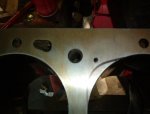
Hole in deck with felt marker showing gasket contour. Since finer measurement indicates around 0.025-0.030" to fire ring, I think I'll plug the hole with jb weld. Sole purpose is to seal coolant from fibrous portion of gasket.
Been looking hard at the turbo sizing calculations. Here are some conclusions: I have the trw/rajay b, e, and f flow maps. The original 152t "b" flow was adequately sized for that engine. Mapping the 196 flow (5 lbs boost) to the b flow map shows it would probably run great but no margin for much more boost than that as it runs close to the surge line. I have an f flow. The f flow is a great match up to 5 lbs, then efficiency drops off the map (below 60%) at 1.5 pressure ratio (7 lbs.). If I wastegated it as I should, that would work. As far as "old" turbos go, the real great match is the e flow. I can have my f flow compressor machined for an e flow wheel (I know a guy who does this). Why would I do this? Because my carb options are frankly limited to a side draft using current exhaust manifolding, and my yh will bolt to it. I can live with that. 4-5 lbs. Will give me all I really want. I am not racing, just bumping up power for hills, etc. Another option that maps great just like the e flow is a garrett t04b s-3. But mounting a sidedraft to it would be a puzzle. I was pleased to see that for all the longhand calcs I did using macginnis' formulas and tables, the computer programs brought me in to essentially the same pressure ratios and flows. But programs are quicker.
While a short term goal would be would be to go with a f or e flow (those won't blow up) for now, I can see how to weld up a short vertical flange to mount on my manifold's upturned outlet, that could have a take-off for a wastegate, and use a t04b and go blow-through. But then what down-draft carb to use. A little digging and I found a carb appropriate rising rate regulator online today (reference boost + 5 lbs), so that stuff's out there.
Been looking hard at the turbo sizing calculations. Here are some conclusions: I have the trw/rajay b, e, and f flow maps. The original 152t "b" flow was adequately sized for that engine. Mapping the 196 flow (5 lbs boost) to the b flow map shows it would probably run great but no margin for much more boost than that as it runs close to the surge line. I have an f flow. The f flow is a great match up to 5 lbs, then efficiency drops off the map (below 60%) at 1.5 pressure ratio (7 lbs.). If I wastegated it as I should, that would work. As far as "old" turbos go, the real great match is the e flow. I can have my f flow compressor machined for an e flow wheel (I know a guy who does this). Why would I do this? Because my carb options are frankly limited to a side draft using current exhaust manifolding, and my yh will bolt to it. I can live with that. 4-5 lbs. Will give me all I really want. I am not racing, just bumping up power for hills, etc. Another option that maps great just like the e flow is a garrett t04b s-3. But mounting a sidedraft to it would be a puzzle. I was pleased to see that for all the longhand calcs I did using macginnis' formulas and tables, the computer programs brought me in to essentially the same pressure ratios and flows. But programs are quicker.
While a short term goal would be would be to go with a f or e flow (those won't blow up) for now, I can see how to weld up a short vertical flange to mount on my manifold's upturned outlet, that could have a take-off for a wastegate, and use a t04b and go blow-through. But then what down-draft carb to use. A little digging and I found a carb appropriate rising rate regulator online today (reference boost + 5 lbs), so that stuff's out there.
 these calculator sites also stress the value of quench working along with this. I think I've got that base covered.
 true oem is 6.75 your rr (rod ctoc over stroke)= 1.84. For street power and torque I like 1.6. IH's are oddly large but in bus it makes sense not in a light line truck.
  I slipped a digit somewhere, that's why I ask to confirm. Anyway, a recheck and you are right of course. Plugging that 6.75" in, I get: 6.35 dynamic, 8.51 w/5 lbs. Boost, and 9.82 w/7 lbs. Boost. Using 64 degrees abdc. What is not clear to me in the data point they are asking, is "degrees @ 0.050" + 15 degrees". I pulled 64 degrees from my grind sheet, and assumed that was when the valve was closed, not almost closed.

 please let me know what you think.
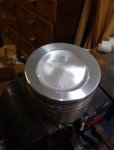
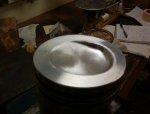
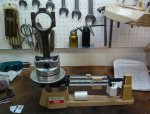
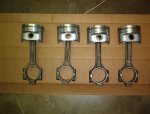
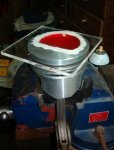
 the problem was due to my inexperience and getting the horse before the cart with respect to getting those pistons mounted and not checking volumes and such first. Hopefully won't make that Mistake again!