Limited disassembly of a 1980 IC 196

That sounds great! Is that power steering bracket set factory? Do you know where I can find one? Putting a 196 in my trail rig and the donor had no ps.
 
Robert,
now that it runs, I wish to offer you sincere thanks for your input in bringing it to this stage! But it is only the beginning of the real work, as the vehicle itself was a beater (with potential), pulled from a field. Now it's a beater with a fresh engine! I'll only begin to be happy once the I know the camshaft isn't going to have a flat lobe or two. There are little glitches to address. The t19 weeps from the pto plates, the d20 weeps from its oil pan, and the exhaust came loose last night (big surprise there). I had hoped the engine would run smoother, and I'm still dinking with the carb. Gas tank was emptied completely and now it runs on fresh gasoline. Engine needs to be broken in before any real conclusions can be drawn. I live on a 1/2 mile road that's an 8% grade, so yesterday I'd start at the bottom and accelerate to the top using the lower gears. Did that a bunch of times. That's a start in getting it broken in. Vehicle isn't roadworthy so this is the best I can do for now.

Anyway...cold starts are good. Couple of pumps to set the automatic choke, turn the key and it starts easily. I have the idle now at 600, and the meter shows it only drifts through a range of about 20 rpm, which is good. Tomorrow I'll put the gauge on it to see how much vacuum I'm pulling. And now that it runs, I'm going to finish up installing the edis/megajolt ignition. Now that it starts reliably and runs, no longer a reason to keep the distributor. My prediction is that the crank-fire system will change the nature of how it runs. That's been my experience with this system.

About the power steering. This is factory p/s on a late ic, so the brackets are oem. Because I needed to pick off the drive from a pulley more forward than was ever done stock, I had to move the pump forward the distance equal to the width of a pulley. I put a dog-leg in the adjusting bracket to account for this (you can see in the video). That bracket May be stock or maybe it came from something else, I can't remember, but otherwise there was room to space it forward without any trouble at all. You wouldn't know it wasn't designed this way.

Update: static timing set 5 degrees btdc. Vacuum advance then hooked up, idle set to 700 rpm, idle screw adjusted best idle. Pulling 16" vacuum. I suppose there's room for more static advance?
 
Last edited:
Glad to help Mark.

The hill easy hill climb and return down the hill is a good ring seating procedure. Some good highway drives intermixed are good too..

I definitely think setting the total timing at 32-34 will take 10+ degrees of initial. Will also help the vacuum... Won't hurt anything.

Keep us updated if you can. Cool to see a project comming together.
 
This is exactly what I was hoping to find sweet project I cant wait to see what that motor turns out. Hp and torq. And I bet it will sound bad ass ...keep up the good work man


post a video I gotta hear that lol.
 
The saga continues. Since my engine does run, there is no reason not to finish installing the crankfire ignition system. Just ordered my new megajolt jr. Ignition module tonight, it should arrive next week. In the meantime, I've fashioned the wiring harness needed to operate the system. A "custom" harness is made from adding sections of wires, as needed, to the salvaged ends that plug into the coil pack, driver, and trigger wheel sensor. I am taking pics of that to show how it's done, but it is hardly rocket science. The installation on a four-banger is fairly neat. I have a standard relay on the firewall that will get its signal to "close" from the ignition wire itself, then route switched power from the fuse panel to the relay, to run the coil packs. Those fuse for 10 amps. This wire will also power the mjlt, and branches off and is fused for either 1/4 or 1/2 amp, as it's really only a fancy flash drive. The leads (pip and saw) from the driver to the mjlt is shielded security wire from hd, what, 20 cents/foot? I want to do the crank-fire ignition mod as a separate thread, so watch for it. It will have step-by-step pictures, some that have been seen here before. So if all goes well, it should appear by next weekend....
 
No different than a modern 4x4 crossing a deep creek. Clearance between the rotating teeth and the pick-up sensor is about 1 mm (0.040"), so water shouldn't be a problem. I'd be worried if mud and pebbles got jammed in there, but if it did, I think you'd have had far more serious problems first.

Once I document this, those with four-bangers will immediately see how relatively easy this becomes. The only real thing to farm out would be to have teeth cut onto a pulley sheave. I would not have had to do the fancy aluminum disc piloted into the forward-most sheave and all that had I stuck with the oem single belt drive for the water pump. I'm anal and like the dual belt setup, hence the additional fabbing. But it isn't necessary. One might not even need a welder to concoct that pick-up sensor bracket. From my pictures, one can see what's necessary and adapt as needed.

What I'm really looking forward to is someone with a v-8 to do this. Those use damper hubs and I haven't thought about how to adapt a trigger wheel to the backside, like mine used (if it even could be done), or more likely, a wheel bolted to the very front of the damper. I have one of those wheels and in fact was all set to do the equivalent of this before I got turned on to the idea of the rear sheave (a sbc guy did it and showed the way....). I'll sell it for $25 if someone's interested - I'll never use it now. That I can easily imagine, although the pick-up coil would then have to be positioned somehow to avoid belts and such, but I believe it could be done.
 
For those of you following this thread, I have started a new thread for the crank-fire conversion. It's called the "megajolt/edis crank-fire conversion". I hope you continue following the progress of my conversion to a modern-ish (1990s) Ford edis crank-fire, wasted spark, system powered by a megajolt, jr. Programmable ignition module. The primary driver for going this route is that it will properly address the unique ignition needs that arise when I get to the final stage of my project - turbocharging this 196 and basically fashioning a "196t", if you will.
 
Now I get to work out the bugs. Engine running via megajolt, and I've occasionally driven it up my street and back (about 1 mile round trip). Maybe 10 miles on it. It definitely isn't roadworthy with badly worn suspension and steering parts. Yesterday I warmed it up and pulled the valve cover to verify push rod rotation. All turn well, but the same one is still very slow. At idle it just creeps around (I put black dots on the rods so you could tell), but does still turn. I'm of a mind to just forget about it for a while and fix other things. There is no valvetrain noise that I can detect, other than an occasional 'tick', but that May not be related at all.

Here's the current problem. I never let it set and just idle for more than a few minutes, but did so yesterday. Engine warmed up, and although I don't have a shroud on it, temps rose and it started running a bit rough. Removed the cap and there was no boiling coolant so it wasn't overheating. It won't idle below about 750 rpm, before it would get down to 500. Although this carb isn't "in the plan" long term, I think it's the problem. It's a 1940. As the p.o. (or p.o.s') had jacked some things around, I'm just waking up to little details about how the original installation was. The carb sits directly on the manifold with just a thin gasket. Did these things have one of those thick spacers? If it needed one, maybe too much heat is being transferred to the bowl.

Edit: I don't know how it ran as well as it did. Took the carb apart. I had put a kit in it a while back, and never thought long term I'd really need to fix it right, so never looked real close at it. The return-spring side shaft hole is really egged out, throttle cable side worn, but not as horrible. Float level was also off almost 1/4" (too high). So now I'll re-bush this thing myself to minimize air leakage past the throttle shaft. Am running a large file over the bottom of the throttle body surface, as it is also slightly warped. I also went down to napa and got a suitable insulator-type spacer for between the carb and manifold. We are now so far past carbs that counter people don't know how to deal with looking up carb parts, if they even have them in stock.
 
Last edited:
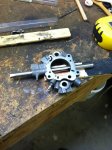
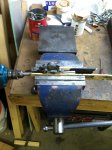
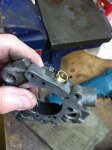
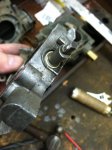
Finally got around to repairing the loose throttle shaft on the Holley 1940 carb. Bought a reamer (0.413 w/0.370 shank), used a dremel to back-cut "teeth" on the backside of the flutes, inserted the reamer and backwards-cut the hole. Shank serves as pilot. Machined a brass bushing to press fit into the hole (0.420" od into 0.417" id). Now there is, say, 0.001" play on that side. I chose to not press my luck and ream the linkage side, as it only has 0.006" play, within what is considered spec (<0.008"). Before it was over 0.020". I filed flat the slightly warped throttle plate, now will reassemble and fix the stripped screw holes. Hoping it will now maintain a stable idle.

Addendum: put all back together. Any idling below about 750 rpm is rough, no matter what I do. I can't see for the life of me how the book can say set idle to 550 rpm (not that I want to), as I don't see how that's possible. Any ideas, anyone?
 

Attachments

  • IMG_0152.jpg
    IMG_0152.jpg
    46.3 KB · Views: 404
  • IMG_0154.jpg
    IMG_0154.jpg
    40.4 KB · Views: 364
  • IMG_0157.jpg
    IMG_0157.jpg
    34.6 KB · Views: 338
  • IMG_0158.jpg
    IMG_0158.jpg
    33.5 KB · Views: 373
Last edited:
I need to put a few miles on this engine before I move on to adding the turbo. However, to date, I've put maybe three or four miles on it driving up and down my street (if illegal aliens are undocumented workers, then I have an undocumented truck). Still have the break-in oil in it, even. I need it running much better before I slap insurance on it and truck on down to dmv to get the plates. Here's my progress so far. Overall, I am unhappy with how it runs, mostly how it idles. Not real smooth. I've seen these four-bangers sit there and idle like a sewing machine. Not mine. I even had it balanced.
1) carb had real sloppy shafts. Rebushed. The Holley 1940 is a real simple carb, and I have it set up by the numbers, so there's not much else that can be done with it. Installed a 1/4" insulator gasket between it and the manifold. I can't detect any vacuum leaks around the intake manifold or any of the hoses. In rebushing, recentered butterfly so when closed has slight, but even, light coming through all around.
2) looking for the best timing at idle. Have run from 8 to 20 degrees. Right now 12 is looking best, but still not satisfied. Engine responds to the carb's idle screw. Right now somewhere around 2 turns out - more than that, slows down. Less than about 1 1/2, idle drops, so things are working like they should.
3) discovered (!) the other day that the power brake booster was leaking badly, and I think the internal leakage was erratic. Sometimes would idle better than at other times for no apparent reason, so that was throwing me off. Clamped it off - idle suddenly dropped big time. Now beginning the tuning all over again. Now using 12 degrees at idle, which helps. Best idle, still not super smooth, is around 800 rpm. Can get it to idle down to 550 rpm, but that's waaay to slow. I'd love it around 650 and smooth.
4) am going to reload the timing table and use bill's 4-cyl map, (sum avg), and go from there.
5) am thinking today of warming it up and doing a compression test just to see what's going on at this point. Lifters sound quiet, but you know, all IH engines I've ever owned have funny little sounds. This one sounds no different than the non-ic 196 I rebuilt 30 years ago. Odd little tics and such but nothing I'd call valvetrain noise out of the ordinary.
6) best vacuum is 48 kpa (close to 16" hg) @ 18 degrees initial, idling around 800-850 rpm. As this little four needs to pull power steering, a higher idle is desirable.

Edit: warmed it up and drove it a bit. Did a compression test:
#1 - 148 lbs., #2 - 148, #3 - 151, #4 - 151. All hit at least 100 lbs. By the second revolution. Final numbers by the fifth revolution. All plugs light brown color, but one had a gap of around 0.020" (how does that happen), rest around 0.030", reset all to 0.035". Programmed idle for 18 degrees, which has improved things.

 
Last edited:
Mark,
I know you had pcv concerns. That plays a big part in variable idle quality. Try blocking it off and see if it stabilizes.

Your compression numbers look good for a 9-1 engine....
 
I replaced it with the proper one. When running, I can feel slight, rapid pulses moving through it. I'm going to put the wrong one in and see what happens, as well as blocking it completely. Still have pressure coming out of the filler, not slight vacuum like you describe. But I'm not seeing if that's really a problem. ?????

I calculated 8:1 c.r., not 9:1 . I have published data here in the 1968 truck motor manual that says cranking pressure for a 196/392 should be 143 psi, +/- 10 psi, so I was quite gratified with the numbers . so it is what it is .

I'll chug on out and mess around with the pcv valves .

edit: ran it w/o pcv valve . idle dropped around 20-30 rpm . idle quality was different, I'd say better, although not a "sewing machine" . so....what does this tell me ? and still with the positive pressure . if I have compression this good, it shouldn't have much blow-by . so what's up with the positive pressure ? it did this before I rebuilt it . ??????

Other thing: you know how almost all these IH engines have the periodic "puff" sound (random misses) coming from the tail pipe? W/o pcv, I wasn't hearing them.
Now my real concern is with those positive pulses coming out of the crankcase. Will that pressure keep a turbo from draining? I don't know if I want to go back to the old road-draft tube!
 
Last edited:
With the oil fill cap installed and it running, there should be a net inflow of air into the port that would normaly hook to the middle of the air cleaner. As you increase the rpm unloaded the pcv valve should allow greater flow and suck the engine down if you block the port I mention earlier.
The cranking pressure published is greatly effected by a short duration cam like they came with. If all things remained the same a bigger cam (later intake valve closing) will reduce cranking cylinder pressures.
You are still making book or better pressures so your engine acts like it has a higher than stock compression.
 
I understand crankcase ventilation and flow, but am puzzled by the fact that I don't have excessive blow-by (assumed by my good compression numbers), but could be wrong. If not wrong, then what generates the excess positive pressure? And how do you get rid of it if not through the pcv valve, assuming an otherwise sealed system? The baffle and spark-arresting fitting on the valve cover isn't blocked.

Bottom line is where do I go from here?

Other question. Since I have such good compression, I was targeting 8:1 for boost considerations. If these numbers are showing a 9:1, am I screwed? :icon_eek: I had put a bunch of numbers into those "effective" compression calculators and came up okay. Please explain what's going on here.
 
Mark I never questioned your understanding of the pcv system but rather what you are experiencing at the oil fill tube....
Humor me and stick a vacuum gauge on the small port. Use a tiny fitting to damp out the pulsation and increase the rpm, watch the gauge.... You must see some suction. If not you have a problem...


I also don't think you have seated the rings yet.. Take a look at it some miles down the road...

After you start force inducing the pcv line will need a check valve so you don't blow air out and into the crankcase. All of the blow by will exit the engine into the air filter housing.
 
No offense taken. I don't understand what you're saying by "small port" ...there is suction through the pcv valve, but I haven't quantified it. When I clamp off the hose from the tappet cover to the pvc inlet, idle changes. Do you mean running it at fast idle and seeing what kind of pressure is in the crankcase? And (or) I have a vacuum gauge I can put on the dipstick tube. At the end of the day you're probably right - just need the rings to seat better. I do know one thing, though. The engine does seem to run strong, and easily spins up to 3,500 rpm without protest. Can wait until it breaks in a bit more to get it up to 4k or so just to see how it handles it.

About a check valve. Exactly what part # would you recommend (you must have a source). And, would I also need a check valve for the hose going into the power brake booster?

All of this must wait until I get back home. In socal this week on business. Darn, it was sure windy coming into the pomona valley via the 210.
 
Ok the pcv removes the crankcase vapor/air and you should have a fitting on the engine that acts as return air. That is the small fitting. On the early 4 bangers you have a fitting in the fill tube coming off of the front cover. On yours the pcv should plumb to the valve cover or the valley/lifter cover... Could be the other way round but either way one is an inlet/out let based on crankcase pressure and throttle position... Hook a gauge to the in feed line and see what the net pressure profile is at given rpm's. A small goose of the throttle will increase manifold pressure enough to allow the pcv to open more fully.
 
Fired it up and let it warm up. I have the spark arrestor on the valve cover, that feeds air into the crank case via the air cleaner. At idle I feel a slight vacuum, which goes away when revved. So that's the answer? Perhaps the "blow" coming from the valve cover (oil filler cap hole) is the rapid paddle motion of the boat-style rockers right below it (and fairly close to the hole - check yours out) moving the air out of the hole. Is that maybe too obvious or what? :icon_mrgreen:
 
The suction at idle is what I was wanting you to feel. Upon initial rev the suction will go away but should return after the rpm stabilizes. Your good with the idle suction. The puffing you feel is the standing waves from the piston movement. It is only the in and out with no net out flow. Good enough:winky:
 
Been super busy at work the past couple of months, but have had a few opportunities to continue getting this truck road-worthy, eventually. The suspension isn't safe, but I manage blasting up and down my street every weekend.

I've figured out something that's bugged me about these engines for over thirty years. Probably a "duh", but for me a confirmation. I've previously rebuilt a 196, and it had a 1bbl carb on it with what I now would believe had a worn throttle shaft. Even fresh, it would have that odd miss while idling. My '75 w/345 also had that odd miss while idling, but that engine had 400k. Now this fresh one, with new guides and mostly new valves all properly sized, also had that odd miss at idle. Even after rebushing the throttle shaft.

It went away when I put a fresh vacuum booster in it. Now a steady, miss-free idle. Although the first 196 I rebuilt was an early with non-power brakes, it had a worn throttle shaft. So it seems that the mysterious "lean" miss comes from slight leakage around a worn or loose throttle shaft (non-power brakes) and/or from a very slightly leaking booster, one you'd otherwise not suspect of having a problem. So now I have a fresh booster and m/c, now going to replace the leaking front hoses and rusted calipers.
 
Last edited:
Robert,
a footnote regarding the little pock-Mark in my deck near #3 cylinder. I was checking out your stickie about the differences between ic and non-ic 392 blocks. In your shot of the right bank of the ic-392, the little defect can be clearly seen in the deck for the rear-most two cylinders. You shot of the left bank is too dark but I wonder if they don't manifest there as well. I agree it is probably an artifact from the foundry process.
 
Back
Top