I-4 and SV Engine Non-Oiling Rocker Assembly

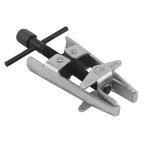
As soon as I posted that I realized it wasn't what you were asking about. That is the tool I use to pop in the push rods. I don't think I used an specific tool to remove the springs. As I recall it was a bit ugly using a few different tools for leverage. I did it with the heads still installed and using compressed air to keep the valves in place.
 
These work in a pinch and also for removing the spring with the head on the engine. Many similar looking versions out there but not all work as well as this one. It is the same one that I have in my tool cabinet.
 

Attachments

  • Spring Tool.jpg
    Spring Tool.jpg
    9.3 KB · Views: 747
Hey, I figured it out. Saw another reply where someone took a large socket and hammer and gently "smacked" the top of the springs. That loosened the "keepers". C-clamp does work. Duh!
Onward and upward!!!!
 
Ok, got the heads off, cleaned and they look very nice for sitting 30 years. Question: has anyone ported/polished the heads/intake manifold? Is this worth the time/$$$ given the restrictive flow of the 345?
 
In the simplest of terms, it's a waste of money.

The IH sv can be brought up in power, but not like you would expect (for example) from a small block Chevy.

A simple porting/polish won't not do anything.
 
I appreciate the response. Helps save $$$. Just needed to confirm before I put this thing back together. On another note: the umbrella seals vs. The standard ones? Any thoughts?
 
Is the disassembly of the rocker being advised for all engines that have been sitting for a long time or just ones that are knocking?
 
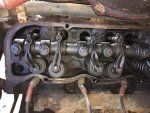
That's a tough one. If the truck has been sitting you definitely want to spin the oil pump with a drill motor. Ideally you verify that oil is flowing up to the rockers. The only way to do that is to remove the valve covers. Ideally you have a set of half covers to keep oil from running all over the place.

Rocker noise is likely to be from lifters so re assembling rocker arms wont fix them. If you remove lifters and put them back remember that everything has to go back where it was!

If you are going that route post here at IHPA and get opinions. There are plenty of people here that know more than me.

Have fun

Is the disassembly of the rocker being advised for all engines that have been sitting for a long time or just ones that are knocking?
 
Looking to see if I can get some input from the group. It's a long story and I will try to keep on point.

Like many I was bitten recently by the IH bug. Started with one, now I have 4 in all levels of condition. I really don't have much time for these with work, kids, life but these things get under your skin so I find time. I'm also not a trained mechanic I just love doing the stuff and learning as I go. I am technical and mechanical by nature but no formal training.

I bought a 70 SR-2, all original but rotten pretty good. Needs a new tub but drive train all there, engine, etc. 304, auto from factory.

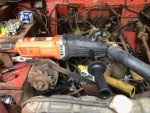
I started the process of resurrection knowing nothing about the vehicles history. I found the OP of this articles saved PDF, Old iron comes to life and have been trying to get my arms around it with my first attempt as a failure. I'm also not following it exactly, and by that I did not hook up an oil pressure gauge because I didn't have one and not sure where to get one although it might be simple. My goal was to just make sure I see the oil coming out the 3rd rocker on each side like he explains and go from there. Before I put a lot of time and money I need to fire this engine and before that I need to do this procedure.

So, here is where I am at after going through 2/3 cheap drills I bought a big $300 1750 rpm drill to use in the dizzy opening to get to the oil pump.

For the first minute or so the drill was going backwards and I hope I didn't do any damage but it's done if so. Then after that I switch the direction and let the drill run on hight for 3 minutes. Nothing coming out of the heads at all anywhere.

I regrouped and pump the drill on for another 5 minutes and same result, no oil coming out on top. At that point I quit and said OK let me ask for help. I think I need to get one of those portable oil pressure gauges but not sure where or what type of line/fittings I would need as well.

It is also very possible the engine is toast but I was able to move the crank a very little bit and it was easy to turn. I didn't do much more than make sure it wasn't seized after reading MM article to be clear.

So, any help from the resident experts?
 

Attachments

  • IMG_7578.jpg
    IMG_7578.jpg
    124.9 KB · Views: 510
you have to rotate the engine/cam. The cam bearings are what feed the rockers. So once you have good pressure. Rotate the engine clockwise until you start to see some oil at the rockers.

Get an 1/8" npt gauge that goes to say 60 psi. Put it in the drivers side oil galley next to the oem pressure sender.
 
Thanks for the response so my problem might be that I am blocking the passages because of the rotation of the CS and cam in its current spot?

Any idea where I can get said gauge? JEGS, Summit, local auto parts store?
 
I would get an external oil pressure gauge from the parts store. A cheapie with the capillary tubing. Plumb it into the oil galley just forward of the stock sender. There will be a series of plugs front to back that correspond to the main bearing oil passages. They will all have pressure (or should) when the drill is moving the pump. Now you can be sure of pump function.
As far as oil getting to the rockers, it will not flow constantly as with other engines. The cam bearing is drilled to "spit" oil thru the passage in the heads up to the rockers. If the cam isn't lined up, little (or no) oil will flow. I understand the apprehension of spinning a dead motor by hand, but at this point, (verify this with your pressure gauge test) you can be reasonably sure the main and cam bearings have been flooded with oil. It should be safe at this point to gently crank the engine by hand until you get the cam holes lined up to flood the rocker assembly. You'll need a helper for this as someone has to run the drill and someone run the wrench.
Getting lube to the cam bearings on a dead motor is the prime concern. Obviously oil at the rockers is important too, but its a much easier fix R&R'ing the rockers than the cam bearings.
Also, if the top end isn't all sludged up, the rockers should oil up as soon as they get pressure. Lack of maintenance, low oil level, over heating...they all cause sludge. If you can see it, you can be sure it'll be worse where you can't see it.
Let us know how it goes.
 
Roger that, I was kind of looking for an all in one package on the oil pressure gauge but I'll work with the local guys to make something work...I need a gauge, tube and fitting...I'll have to look at the block and follow your instructions on which is the right one to open to put this gauge in. Can I not just find the OEM one and use that hole to put my test gauge in to make it easier?

Makes sense on the two person job for sure. I did look down the openings on the heads and there seems to be oil around the lifters in each hole as well.

When i took the VC off last year when I got the truck it was a mess inside and the returns were all clogged up. I have since carefully cleaned them out and took as much of the slug off as I could. I know long term this is a rebuild but for now I'm assessing the viability of the engine before I spend to much money on the turd :)
 

Attachments

  • IMG_6248.jpg
    IMG_6248.jpg
    95.2 KB · Views: 503
Be aware, only one head will get oil at a time.

The #2 cam bearing feeds the left head and #4 cam bearing feeds the right head.
The cam bearing holes do not align to feed oil at the same time.
So rotate the crankshaft slowly by hand while pressurizing the oil system.
As you get one head to receive oil, let it run for a minute or so, then rotate the crankshaft slowly until the other head gets oil. Then lube it for a few minutes.
It should all be explained in the Old Iron write-up.

I'll attach a SV-8 oil diagram that may help you understand the oiling system.
 

Attachments

  • SV-8 Lubrication Diagram.PDF
    872 KB · Views: 557
Last edited:
This is all good stuff. I have the diagram and the old iron article but running this solo and never doing anything like this is a bit scary for me but I'm getting through it. The small tidbits are the good stuff like knowing oil will oil get the one side until I more the crankshaft to do the other. That would have mind f'd me for sure...I get all the theory, I just don't have the experience but I'm working on it...thanks again for the info...going to local auto place to pick up what I need for the gauge, tubbing and fitting...
 
hey there 428street:

I thought I would chime in re: your engine and the oil pump. Yes, you can do the drill with one hand, and with a socket/1/2 inch ratchet (long one if possible), "slowly" turn the crank, I mean real slow. If the VC's are off, you will see the rocker arm assembly start to fill with oil. Also, what I did was when I found that "sweet spot", I marked the crank balancer with white paint at the TDC mark. There will be two of these, one for each side of engine rocker arm assembly.

Enjoy!.
 
Hey Folks, 2 quick tourist questions for y'all:

1). When using your drill motor to spin the oil pump and pre-prime things, will the crank and cam shaft fill with oil no matter WHAT position the crankshaft is? Or does it need to be turned a few degrees before spinning the oil pump again?

2). I had decent oil pressure the first 600 miles I drove it last month....before I took everything off to clean, re-gasket, replace or repair (except the crank, the piston and the camshaft). Oil pump gears were in great condition and the spring measured out perfectly. While I had it apart I added an .070" washer and re-gasketed her. This one had the cover plate style pump (body, thin steel plate and then the 1/4" thick outside cover plate. My Fel-Pro gasket set didn't come with any that exactly fit my pump, so I made one very thin gasket (.006") and then another for the cover plate that was .010". Now I can't get her to pump oil from the pan no matter how long I spin the drill or at what speed. Did I screw up by doubling the 'space' inside the pump body? I can almost garantee that new O ring at the pickup tube is sealing properly and the pickup screen is spotless. Has 6.75 quarts of brand new oil in the pan and the new WIX filter was prefilled and is 75% full at the moment. I also cleaned out the mechanical o/pressure gauge and tube and fittings and is installed in the block properly. But unlike my last SV engine I did the exact same thing to, I just can't get the pump to pump. Also I noticed this time around I'm also not feeling the same 'resistance' with my drill motor as I felt four years ago on my last engine.

Ideas?.......:gringrin:
 
You should be feeling resistance against the drill motor quite soon as the lubrication system becomes pressurized, no matter where the engine is sitting in terms of rotation. Part of the ongoing pre-lube process involves engine rotation by hand in small increments for one full revolution, in conjunction with continued pump spinning to ensure that adequate lubrication has reached every portion of the top end, as well as all cam and crank shaft bearing lubrication points.
Unless your chucked drive tool just didn't engage with the oil pump drive shaft, it would appear that something within your oil pump modification and reassembly process has failed. As far as specifics there, I can't really go beyond this Captain Obvious-like response. The pump would need to come out for inspection on your bench to determine the exact cause.
 
Hey Folks, 2 quick tourist questions for y'all:

1). When using your drill motor to spin the oil pump and pre-prime things, will the crank and cam shaft fill with oil no matter WHAT position the crankshaft is? Or does it need to be turned a few degrees before spinning the oil pump again?

2). I had decent oil pressure the first 600 miles I drove it last month....before I took everything off to clean, re-gasket, replace or repair (except the crank, the piston and the camshaft). Oil pump gears were in great condition and the spring measured out perfectly. While I had it apart I added an .070" washer and re-gasketed her. This one had the cover plate style pump (body, thin steel plate and then the 1/4" thick outside cover plate. My Fel-Pro gasket set didn't come with any that exactly fit my pump, so I made one very thin gasket (.006") and then another for the cover plate that was .010". Now I can't get her to pump oil from the pan no matter how long I spin the drill or at what speed. Did I screw up by doubling the 'space' inside the pump body? I can almost garantee that new O ring at the pickup tube is sealing properly and the pickup screen is spotless. Has 6.75 quarts of brand new oil in the pan and the new WIX filter was prefilled and is 75% full at the moment. I also cleaned out the mechanical o/pressure gauge and tube and fittings and is installed in the block properly. But unlike my last SV engine I did the exact same thing to, I just can't get the pump to pump. Also I noticed this time around I'm also not feeling the same 'resistance' with my drill motor as I felt four years ago on my last engine.

Ideas?.......:gringrin:

Yes you did screw up. You should have matched the gaskets that were in there. The gears should only have .003" hosuing clearance.
 
Even .016" gap wouldn't prohibit some pressure build. Are you sure the drill was spinning clockwise? I always pack the gears with bearing grease after service to help them make a good seal and create enough vacuum to draw oil from the pan. Not sure if that's even necessary, just my thing.
Like Trever said, unless you totally goofed the spinning thingy in the pump slot, I'm at a loss to explain this situation...

Unless... The gap is too great for an un-primed pump and you're just sucking air above the oil level. Still, the only way out for the air is around the shaft which is a much tighter fit than the one created by the gaskets. All I can think of is that there is a lack of vacuum being created by the dry pump gears. Again, the grease. Not much help now, I know. Clue us in when you figure it out. I'm curious!
 
Last edited:
There are holes drilled all the way through the bearing surfaces from one side of the cam bearing to the other. The rotation of those holes only lines up with the pressurized oil gallery maybe 5% of the rotation. It is only during that alignment that you will get pressure through the cam to the upper end of the engine. You are rotating slowly so you can be sure to catch those openings. If you don't rotate (and aren't lucky enough to be lined up already) or don't rotate so that you make the holes align you won't see the pressure you are looking for.
 
Back
Top