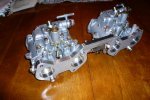
Limited disassembly of a 1980 IC 196

#1 is a no. The web and shell back should be dry to aid in staying still.

#2 use a moly assembly grease or anti seize on the threads and under the bolt head and washer.
 
Robert,
got the head back. They had to surface it but I didn't ask how much they took off to clean it up (call them later today). I plan on getting a small piece of lucite and a graduated cylinder because the only way I can know exactly the combustion chamber volume is to cc it. Looking at your previous post on this topic, my estimate is:

49.33 ci (I'm at 0.020" over or 4.145") or 808.51 cc
assume your 10 cc valve relief volume
assume your 9 cc head gasket volume
my silvolites "should" bring me to a zero deck but will confirm when I actually install a piston. So assuming all of the above (808.51 + 9 + 10 + 85) we have 912.51 divided by 104 = 8.77 cr. Of course the variable will be my true "deck" and true combustion chamber volume. But that's the ballpark. Aside from only adding 0.020" over to the cylinder's volume, I'm surprised that the ratio appears to be this high.
 
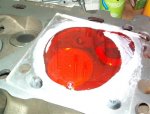
434514C2 head (Small).jpg

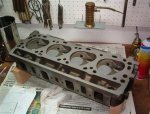
IC 196Head (Small).jpg

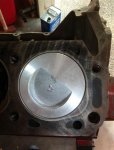
Piston mock up 2 (Small).jpgbeginning the reassembly and reassement process. Got the cylinder head back (196/392 434514c2) and cc:'d it. 91 cc, and that's after having a few thou planed off to clean up the surface. Mocked up one of the new silv-o-lite pistons. It sits 0.033" below the deck. My calculations using 0.020" over, the 91 cc head, and assumed 10 cc relief and 9 cc felpro head gasket, and 7.33 vol for "in the hole", I get a c.r. Of 7.9. Zero decking (or real close as others here have done) bring it in around 8.25 - 8.3. I don't mind dragging this block back to the machinist to trim off 0.025 or so if a quench effect will offset any benefit of running a lower c.r. When boosted. Curious how much can be planed off one of these blocks?

The crank polished up nice. Plastigauging the mains brings them all in around 0.0025", spins real nice by hand. The one con rod bearing I've gauged came in a tad bigger than 0.0015", so hoping the rest are as good.
 
Last edited:
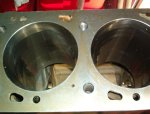
Block back from machinist, had him take off 0.030", so when the pistons get installed, they May be about 0.003" in the hole if my initial measurements were correct. But there's a little hole in the deck (communicates with coolant space) that I never noticed before, about the 5 o'clock position for hole #3 (just left of the lower bolt hole). In Robert's picture of the ic392, right bank, I see what looks like a dimple, so that's what got planed off and exposed. As long as it is well this side of the gasket's compression band, it should be ok....?
 

Attachments

  • Pinhole (Small).jpg
    Pinhole (Small).jpg
    43.4 KB · Views: 685
block back from machinist, had him take off 0.030", so when the pistons get installed, they May be about 0.003" in the hole if my initial measurements were correct. But there's a little hole in the deck (communicates with coolant space) that I never noticed before, about the 5 o'clock position for hole #3 (just left of the lower bolt hole). In Robert's picture of the ic392, right bank, I see what looks like a dimple, so that's what got planed off and exposed. As long as it is well this side of the gasket's compression band, it should be ok....?

No problem at all. So long as it is outside of the fire ring it is fine..... As you said.
I see those on 99% of these blocks. Some are hardley noticable others are small holes. I think they are remnants of wire used to hold the sand casting shoe together or line it up.............. I am guessing. :eek:
 
Robert,
thanks for the reply. I have a head gasket on order so I'll fit it up when it comes in to confirm. Seeing that hole gave me one sleepless night.

Looks like I'll be kissing 8.3:1 for a c.r., if my quench space comes in around 0.043" or thereabouts. I'm trusting this was the right move.
 
Robert,
thanks for the reply. I have a head gasket on order so I'll fit it up when it comes in to confirm. Seeing that hole gave me one sleepless night.

Looks like I'll be kissing 8.3:1 for a c.r., if my quench space comes in around 0.043" or thereabouts. I'm trusting this was the right move.

Your cr of 8.3 seems low.
 
Low as in should be higher, or low as in I made a math error? (always possible and I welcome having those errors pointed out :d). So here are my assumptions:

808.51 cc (my calculation of 4.145 bore x 3.656 stroke)
9 cc (gasket volume)
10 cc (relief volume)
decking the block actually removes some swept volume, so the 7.33 cc assumed at being 0.033" in the hole becomes about 0.7 cc @ 0.003" in the hole via simple ratio'ing
91 cc for my combustion chamber (ic 196/392 head casting 434514c2, directly measured).

808.51 + 9 + 10 + 0.7 + 91 = 919.21. 919.21 divided by 110.7 (91 + 10 + 9 + 0.7) = 8.3.

Since I'll be running some boost, wouldn't even 8.3 be on the high side?
 
So if my 8.3 calculation is essentially good, then is it low, close enough, or high? Of course, it is what it is, but still...
 
Depends on what grade of fuel you are willing to spring for and how manifold pressure you want. 8.3 and 8 pounds will need premium +. If it were me ( it isn't) I'd have the 10 cc piston notch enlarged to drop your cr to 8>1.
 
The question becomes one of how much can be taken out of the top of the piston. Plugging numbers into the kb calculator gets me to around 8:1 if I use the following numbers: 91 cc combustion chamber, 4.145 cylinder diameter, (here's the iffy number - gasket diameter - 4.3? I know it's not perfectly round and has deviation for the exhaust valve - what do you use?), 0.040" gasket thickness, deck of 0.003" with the key here being the relief volume. If it comes with 10 cc and is enlarged to 14 cc. My question is will the piston top handle that sort of massaging. Looking at the cross section of the existing relief, it can't go much deeper, but it could go wider/longer - could another 4cc come out of it? I don't know where the material would otherwise come from, other than envisioning flycutting the piston top portion to a circle about 3" diameter (centered to the center of the piston's diameter) which would yield a roughly d shaped relief (because of the existing d shaped relief), and about 0.120" deep.

This May just screw up what's going on during the compression event, or weaken the piston, I have no idea, other than "where do I go from here". If this is a reasonable path forward, then I'll need to get the rotating assembly balanced - again.
 
Don't worry about the compression dynamics. IH was manipulating cr.

Balance. Are your pistons hung yet? If so don't even screw with your cr. A bit of boost retard and or diligent timing control and you'll be fine. One benifit of a higher static cr is better off boost performance and faster spool up.

You're doing fine. Dont' stress over this.
 
Robert,
we're past the point of me stressing, 'cause I'm already stressed silly over "what have I done here?" :d

I considered the information posted here that involved mostly others, about quench, so when I had a 7.9 c.r. And 0.073" quench, which I guess meant no quench, plus using boost, I went for the zero-decking thing and a quench of 0.043" or thereabouts, thinking I could benefit from whatever beneficial effect that would have. (it was also posited that a lower c.r. W/o quench was more detonation prone than a higher one w/quench. No argument there). But I ended up with 8.3 c.r. And that was making decisions after the pistons were installed on the rods (how does one determine deck without pistons mounted on rods?). Your concern to not mess with them is because you can't remove them and reinstall without ruining the wrist pin fit? (I'm guessing here). If so, then 8.3 is what it is.

But maybe I'm not seeing (or what I didn't see!) is that, for argument sake (not having kb's chart in front of me) that 7:5 and 9 lbs boost gives the same pressure as say 8.3 and 5 lbs boost. So overall, if I limit my boost to say 5 (maybe 6?) then I would end up in about the same place - around 11:1 or so (per the chart) anyway, so no biggie. If that's the point, then I'll go ahead and work with it. It should be a good runner (for a 4 popper) w/o boost. Better than original, anyway.

If the thing with the wrist pins isn't the reason, if I had to spend some bucks relieving the pistons and having then reweighed and matched (I understand they don't spin the piston assy's on 4poppers), then I'd not rule out going that route.

Regarding boost. It is conceivable that this system will generate 7 lbs, maybe a tad bit more (I knew a guy with a 152t setup and he had a gauge on it - they could actually do that in good tune. And my stockish corvair setup could pull 9.2 lbs., verified via datalogging with a map sensor. Surprised hell out of me). The whole point is that I always anticipated running 91 octane, possibly mid-grade, but never considered regular. I want to waste-gate it at 7 lbs. For "insurance". I also don't want to blow any head gaskets. At least my deck and head are now truly flat.

Dialing in the timing and retard will be quite easy using the megajolt/edis system.

Any additional thoughts will be greatly appreciated.
 
Last edited:
Got the felpro head gasket. It appears that that little hole is about 0.025-0.030" from the edge of the fire ring. :eek6: wow that's close, but good enough?
 
The head drains into the large cavity where the tappets are. Oil drains into the crankcase through a large hole in the rear of the block. Towards the middle/front of the block in this area there is a circular drain that is plugged with what appears to be two discs pop riveted together. Getting the crud out of there is difficult and I'm going to drill out the rivet. Is this plug even necessary?
 
The question of how to wastegate this application to keep my boost at 5 lbs.

The pics of these parts have been posted previously. Cast iron wedge, cast iron manifold, and the cast iron elbow to which the turbo is bolted. Nowhere really to mount a wastegate or tap off pressure to go to a wastegate. I am not keen on modifying these very rare parts.

Two thoughts: one is to have the cast iron elbow duplicated in steel (weld appropriate steel flanges to ends of a suitably curved section of heavy wall pipe). To this a steel wastegate flange could be welded. $$$$

other is more attractive if it will pass a sufficient volume of exhaust gas. The intake manifold has the provision for egr. I can weld a small wastegate flange to an egr block off plate (or some comparable configuration) and bleed off pressure through that passage. It's my understanding that small exhaust leaks can kill boost, so why wouldn't a controlled "leak" through a hole 1/2" in diameter work? Plenty of small wastegates out there.
 
Mark don't take this the wrong way but why are you messing with these old parts? You have spent a lot of time making sure the engine is up to snuff. Why not us a modern turbine. Another note is if you over speed the old turbo it will grenade and your engine is on the receiving end of the shrapnel. :yikes: you have no way of knowing the stresses the 196 will put on the 152 sized unit till it is to late. Stepping over dollars to save dimes.


Unbeleivable advances have been made in efficiency and size.
I have a gt2554r that is going on my bored and stroked 152. More boost earlier and with less back pressure and heat.
 
Robert,
no offense taken, and I really do appreciate your input so far. I'm actually seeing an engine coming together now. Thirty years ago I rebuilt my first 196, which worked fine for what it was, but this build is better. Certainly better parts, and certainly better "technique" due to your recommendations.

The turbo itself May be the only part to update, as I'm not inclined to fab custom plumbing of any sort to support a turbo (that's simply a project I don't want to get involved in). So if there was a suitable turbo I could hang onto the elbow, I'm open. It's a t4 flange. I also see that there are turbos with integral wastegates. So it would be a matter of seeing what would match up. Still have to limit things to 5 lbs.

Of course, then with a different turbo there's the question of the carb. One day when I'm retired and have tons of time I'd like to do efi which is unquestionably the way to go. But this is not that day.

Right now I need to get the engine together. For the initial start-up it will have to be stock - the original 1bbl and exhaust and prestolite distributor. I need to ensure it will start right up and run for 20 minutes. That's not the time to sort out the crankfire system or an untested carb. And maybe put a few miles on it to work out any bugs.

At worst, what will I have? Some assumptions here. A fresh engine with a properly done valve train (cam, valves and guides)
proper clearances.
Proper quench.
Around 8.2-8.3 c.r. (looks like true stock was really about 7.9)
an improved cam grind.
Should be a smooooth runner since it's been balanced.
The crankfire system makes for an ignition system far superior to stock for precise timing and no spark scatter. My experience is that that also smooths out an engine.
If I left off the turbo, would run well with regular? I certainly hope that's the case.
If I left off the turbo, performance much better than the day it rolled off the assembly line, and probably same or better mileage.
If all that's so, then I'll be a happy camper. :thumbsup:
 
The turbo itself May be the only part to update, as I'm not inclined to fab custom plumbing of any sort to support a turbo (that's simply a project I don't want to get involved in). So if there was a suitable turbo I could hang onto the elbow, I'm open. It's a t4 flange. I also see that there are turbos with integral wastegates. So it would be a matter of seeing what would match up. Still have to limit things to 5 lbs.

t3/t4 turbine inlet's are common. The gt 25 I have is a t25

At worst, what will I have? Some assumptions here. A fresh engine with a properly done valve train (cam, valves and guides)
proper clearances.
Proper quench.
Around 8.2-8.3 c.r. (looks like true stock was really about 7.9)
an improved cam grind.
Should be a smooooth runner since it's been balanced.
The crankfire system makes for an ignition system far superior to stock for precise timing and no spark scatter. My experience is that that also smooths out an engine.
If I left off the turbo, would run well with regular? I certainly hope that's the case. yes it should run well on 87 pump gas. Also be a more drivable engine. Way more low/mid range torque and hp and

See red text for my response.

Garrett has a huge amount of info here.
http://www.turbobygarrett.com/turbobygarrett/products/turbochargers.html
 
Reality time. I fit up that felpro pt gasket with the head dowels in place. That hole is not under the fire ring but is just about to it. Conceivably I can judiciously trim the locating dowel hole without adverse shifts to the ring rings themselves to shift it a tad more favorably.

The garrett site is great. Question, though, is aren't most (all?) new turbos lacking the compressor side seal necessary for a draw through since everything now is efi? That's simply not where I can go at this time. Of course, then you blow through a carb. I've seen how others have done that and the key part seems to be getting a rising rate regulator suitable for a carb. I know some have used the regulator from a maserati bi-turbo, surely there are other options. What "fuel management" system did you plan on for your 152?
 
It either is under the fire ring or it is not. Having more or less distance between the two does not not change things. If combustion gasses get past the ring it is over. I could only offer the possibility of peaning in some raught copper and stoning off the surface till smooth. Or fill the hole with your favorite sealant and clean the deck.

Seals are availible for all of the common turbos to work under negative pressure. Garrett can supply them that way.

Im setting mine up blow through and using dhla 40h delortos speced for the lotus esprit turbo. Seen below
 

Attachments

  • P1010396 (Medium).JPG
    P1010396 (Medium).JPG
    78 KB · Views: 660
Last edited:
I'm looking at that hole and getting a sinking feeling, as it isn't really a clean hole. Looks like this was a small, corroded void uncovered when the block was surfaced. I'll fret about it tomorrow. In the meantime, I've put a "wanted" on the forum for a ic196 block as I May have to go down that road. Life's handed me worse setbacks. :rolleyes5:

edit: to try to put it to rest. My previous technique for measuring May have been defective. I now laid gasket on block with locating dowels. Used marker to blacken deck inside fire ring. Lightly scraped black w/metal edge to establish inside edge of ring. Remove gasket. Micrometer to measure gap (line of inside edge to edge of hole. 0.140"). Best measurement of width of fire ring on gasket (uncompressed - does that thing spread out once torqued down??) seems about 0.110" in that area. So it would seem 0.030" is "huge". Only concern would be edge erosion, but is that happening with the coolant holes? Probably not.

I pulled out my 1980-ish copy of mcginnis' book and worked some numbers manually, then began plugging numbers into some of the turbo calculators on the web (turbocalc is good and there's one from a site called "squirrelperformance"). Came to similar results, but a calculator is better. My overall parameters are simple. A roughly 200 c.I. Engine with a max rpm of say 4,400 (real world limit of 4k), boost starting at around 2,800 -3,000 rpm, done at 4k. One of those calculators came at it from the standpoint of "how much hp do you want?" and based on fuel burned (I used 12:1 a/f ratio, what should the bsfc be? They indicate 0.55?). If a stock 196 had a nominal rating of 110 hp and I plug in 140, then boost can come in around 5 lbs. Depending on other assumptions. I realize it is more nuanced than this, but the process is really doable. Where things get puzzling is what volumetric efficiency to assign at different rpm/boost levels. These are old 2-valve engines so I'm guessing 80%? 85% tops? Older turbo efficiencies are around 65-70%? Newer are what? And inlet temps. Plugging in those values make for big differences. Garrett's tutorials are really helpful, but it's obvious there's no substitute for experience in these things.
 
Last edited:
Back
Top