


You are using an out of date browser. It may not display this or other websites correctly.
You should upgrade or use an alternative browser.
You should upgrade or use an alternative browser.
T407/TF 727 Band Adjustment
- Thread starter Michael Mayben
- Start date

Craig
Active member
Edit...
There is one way to clean something, that is disassemble to the base components, and mechanically clean with appropriate processes, then prelube with appropriate materials as it's being reassembled maintaining cleanliness. Just one frog hair present onna spool valve can cause it to stick inna bore and if it's a blind hole ya May have no way of removing it!
What is the appropriate process / solvent ?
Prelube with appropriate materials, vaseline?
What kind of frogs have you been catching

Michael Mayben
IHPA Tech Moderator - Retired & No Longer Online
what is the appropriate process / solvent ?
Prelube with appropriate materials, vaseline?
What kind of frogs have you been catching
First off...ya gotta watch out for any frog with any hair...that shit is like a titanium brillo pad and will destroy anythin' it gets near, it can abrade just through mental telepathy.
Horneetoads (texas breed) ain't got no hair so they is safe to have arount.
As an assembly aid when doing either manual gear work (as in stickin' needle/roller bearings and for pre-lube) or slushbox, I use a product that's been around since slushboxes wuz invented, it's known as "transemble" and supplied by ags co. Out of muskegon, mi. I just pick up a tub fairly often at the local auto supply I frequent. It's completely soluable in gear oil, atf, or any other petro-base product ya might find in power transmission stuff. I use if for all kindsa stuff but not for lubricating hydraulic/rubber components in brake work!!! I have another product I use for that. Transemble will not goop up inna valve body if a wad hits a critical area in the hydraulic circuitry.
If I'm simply dropping the pan for tranny service with it installed in the rig, then after it's dripped for awhile, I use a pneumatic siphon gun and blow down the innards with naptha/paint thinner (not turpentine!!!)/varsol/stoddard solvent (all petro-base) and let it drain/evaporate. Yes...makes a dam freakin' mess!
When doing an overhaul...I pull the tranny and power wash the outside using a degreaser concentrate. Then it gets ripped apart.
Depending upon how bad the guts are, sometimes the valve body is simply set aside and submerged inna pan of atf and not touched until re-install.
If the valve body is gonna be gutted out say for a shift kit, then it all goes into an enclosed pan of either lacquer thinner or berryman's chemtool (not the stinkeeazz carb dip!!!!) and is soaked until I'm ready to modify/reassemble. Each piece is then inspected for use and reassembly as needed after drying with air and lubing with either transemble or atf depending upon what I'm doing.
As for sterilizing the case itself, after it's gutted out, it gets completely power washed using the concentrated degreaser. Most likely it will also be badly oxidized/discolored but who cares? I paint all my trannys after a build anyway and don't put any effort into surface prep, these are not trailer queen units and no paint is gonna stick very long under a trail rig!
If I want the case to have a near polished appearance, then I'll take it to one of several local operations that have a large industrial detergent-base parts washer that blasts the case leaving it looking like it's been "endurashined" that will last until air hits it and the oxidation process starts all over! But normally no one I do work for will pay that kinda cash, costs me approximately $45 to have a case done, it's simply not worth it for me, it's how clean it is inside that matters! And I assure ya, mine are sterile inside!
I only have had one use for vaseline in my lifetime, but that is real old technology nowadays and it smells like shit! But with hope and change coming into play now, I think we need to buy mucho stock in the corps that manufacture vaseline, I'll stick with transemble since it tends to repel suits and politicos...especially in illinois.

Major Screwup
Member
Now that's attention to detail!
Do you put yore tools in the autoclave between jobs? That's the only step ya missed!
Do you put yore tools in the autoclave between jobs? That's the only step ya missed!
Michael Mayben
IHPA Tech Moderator - Retired & No Longer Online
now that's attention to detail!
Do you put yore tools in the autoclave between jobs? That's the only step ya missed!
Naw...monte takes care of makin' sure the tools go into the autoclave onna monthly basis...that way our medical insurance covers that expense with just a co-pay.
But yore one to talk!!! How about tha bawlman sharin' with us hommees how you clean that rocketscience bearing quapo you fab??? How do ya clean them plastic bearings??? Does tha cat lik 'em clean?
Somehow I just don't see ya cleanin' them stellite bearings using comet, mr. Clean, and tideebowl!
Major Screwup
Member
naw...monte takes care of makin' sure the tools go into the autoclave onna monthly basis...that way our medical insurance covers that expense with just a co-pay.
But yore one to talk!!! How about tha bawlman sharin' with us hommees how you clean that rocketscience bearing quapo you fab??? How do ya clean them plastic bearings??? Does tha cat lik 'em clean?
Somehow I just don't see ya cleanin' them stellite bearings using comet, mr. Clean, and tideebowl!
Like all procedures at bt, that's classified info.
 they have to be surgically clean when they leave the shop. We use ultrasonic cleaners as well as several homebrew cleaning devices.
Then the customer can f*** 'em up anyway they see fit!
Michael Mayben
IHPA Tech Moderator - Retired & No Longer Online
Exactly what I thought t! That's why you do the rocketscience shit and us lowlifes just blow naptha on everythin' and inhale deep!

GK_Slick
Member
Ok two questions here for a quick refresher. Should there be a gasket sealer used when replacing the pan and what surfaces if so? And, what do the pan bolts get torqued to?
I have never used a gasket sealer on a trans pan because I was told the fluid causes enough gasket swelling I didn't need it. And if my memory is right I think the torque was somewhere 11-14 ftlb?
Thanks in advance
I have never used a gasket sealer on a trans pan because I was told the fluid causes enough gasket swelling I didn't need it. And if my memory is right I think the torque was somewhere 11-14 ftlb?
Thanks in advance
Michael Mayben
IHPA Tech Moderator - Retired & No Longer Online
Gk...
First the pan...the sealant I use will vary according to the type of gasket I'm using. As for the "swelling" of any gasket that's urban myth stuff. If a gasket swells it's the wrong material for the application.
I will never use any type of "rtv" product on anything, especially onna tranny pan! If the gasket is plain old cork, then I stick it to a clean pan using either permatex #97, hylomar, or gasgacinch (thinned version of p-tex #97). Once that is set up a bit, then another superthin coat goes on top of the gasket and the pan goes into position.
If it's a cork/rubber composite gasket, then the above applies.
If it's a rubber gasket, then the above applies except...do not use the hylomar, it kinda "lubricates a rubber gasket and it will squish out of position when the bolts are snugged.
If it's a vegetable fiber gasket (looks kinda like thin corrugated cardboard). Those are coated with a pressure/heat sensitive coating that will "cure" once the pan is tightened in place, I use nothing on those and ya must be certain the pan rail and pan flange are clean and dry.
If it's one of the molded/reusable gaskets such as supplied under the mopar source, then those go on dry also.
Pan bolt torque...all of the t-407/tf 727 pan bolt torque callouts I've seen in the IH service references are wrong as they show a foot/pound designation! That is a misprint carried over since 1972!
I do not use a torque wrench on these fasteners. I do use a 1/4" drive ratchet, 4" in length whether on the bench or under the vehicle. I "snug" all the bolts inna cris-cross pattern. Then go back and get about as tight as I can with one hand/wrist...I'm not limp-wristed, but I do have some limited mobility in my primary "torque" wrist nowadays so that serves me well! Just get 'em all to the point where ya can't feel any additional gasket compression. Once the tranny has temp-cycled a few times, then I go back and re-check/snug and call it good.
Don't know that I have ever done any tf 727 that did not have at least one pan bolt missing or stripped from a previous service attempt! That is why the 5/16"x18tpi helicoil set is in my "tranny tool" box!
The chrysler-recommended toque spec for those pan bolts is 150in./lbs. In many tests, I've found my method results inna nominal 90>100in./lbs.
Imho, much of the "pan leakage" is caused by atf migration through the pan bolt threads, not the gasket itself if a sealant is used, the same condition as exists regarding I-4 and sv engine valve cover retainers/fasteners. I have a possible "fix" for that I'm playing with right now but I'm not ready to sign off on it yet! Stand by, we'll announce when it's viable (if it's viable!!). If this works out, ya could always perform the mod after the fact without dropping the pan again.
First the pan...the sealant I use will vary according to the type of gasket I'm using. As for the "swelling" of any gasket that's urban myth stuff. If a gasket swells it's the wrong material for the application.
I will never use any type of "rtv" product on anything, especially onna tranny pan! If the gasket is plain old cork, then I stick it to a clean pan using either permatex #97, hylomar, or gasgacinch (thinned version of p-tex #97). Once that is set up a bit, then another superthin coat goes on top of the gasket and the pan goes into position.
If it's a cork/rubber composite gasket, then the above applies.
If it's a rubber gasket, then the above applies except...do not use the hylomar, it kinda "lubricates a rubber gasket and it will squish out of position when the bolts are snugged.
If it's a vegetable fiber gasket (looks kinda like thin corrugated cardboard). Those are coated with a pressure/heat sensitive coating that will "cure" once the pan is tightened in place, I use nothing on those and ya must be certain the pan rail and pan flange are clean and dry.
If it's one of the molded/reusable gaskets such as supplied under the mopar source, then those go on dry also.
Pan bolt torque...all of the t-407/tf 727 pan bolt torque callouts I've seen in the IH service references are wrong as they show a foot/pound designation! That is a misprint carried over since 1972!
I do not use a torque wrench on these fasteners. I do use a 1/4" drive ratchet, 4" in length whether on the bench or under the vehicle. I "snug" all the bolts inna cris-cross pattern. Then go back and get about as tight as I can with one hand/wrist...I'm not limp-wristed, but I do have some limited mobility in my primary "torque" wrist nowadays so that serves me well! Just get 'em all to the point where ya can't feel any additional gasket compression. Once the tranny has temp-cycled a few times, then I go back and re-check/snug and call it good.
Don't know that I have ever done any tf 727 that did not have at least one pan bolt missing or stripped from a previous service attempt! That is why the 5/16"x18tpi helicoil set is in my "tranny tool" box!
The chrysler-recommended toque spec for those pan bolts is 150in./lbs. In many tests, I've found my method results inna nominal 90>100in./lbs.
Imho, much of the "pan leakage" is caused by atf migration through the pan bolt threads, not the gasket itself if a sealant is used, the same condition as exists regarding I-4 and sv engine valve cover retainers/fasteners. I have a possible "fix" for that I'm playing with right now but I'm not ready to sign off on it yet! Stand by, we'll announce when it's viable (if it's viable!!). If this works out, ya could always perform the mod after the fact without dropping the pan again.
Last edited:
Pardon my math -- doesn't 150 in lbs = 12 ft lbs (approx)?
you could use a 3/8" drive torque wrench -- if you are real careful and have a "light touch" -- torque to 9 ft lbs; then to 11 ft lbs...
But,
michael's 1/4" drive technique works real well on at pan bolts -- including the "re-torquing" after a few "heat cycles".
I have used the same 1/4" drive technique a number of times over the years...
you could use a 3/8" drive torque wrench -- if you are real careful and have a "light touch" -- torque to 9 ft lbs; then to 11 ft lbs...
But,
michael's 1/4" drive technique works real well on at pan bolts -- including the "re-torquing" after a few "heat cycles".
I have used the same 1/4" drive technique a number of times over the years...

ronmc1954
Member
Robert, your real close on the math:
to convert foot pounds to inch pounds, multiply by 12.
To convert inch pounds to foot pounds, divide by 12.
online conversion - torque conversion
Nice automatic conversion table
ron
to convert foot pounds to inch pounds, multiply by 12.
To convert inch pounds to foot pounds, divide by 12.
online conversion - torque conversion
Nice automatic conversion table
ron
Michael Mayben
IHPA Tech Moderator - Retired & No Longer Online
I've received several calls and emails regarding the "type" of kickdown control I previously mentioned...the "full throttle kickdown" system vs. The "part throttle kickdown" system.
More than a few folks think their tranny is "broke" because the kickdown system doesn't work as they think it's supposed to. Again...because ihc did not fully explain the differences in various t-407 transmission designs in appropriate service manual sections over the years, there is really no way to understand "what" is supposed to happen and how to service it just by depending upon those references. The cts 2313 ('78 and later sii) manual is the worst offender, while it does contain two complete service segments regarding the tranny variations, they did not point out the differences and in fact actually mixed up and transposed the illustrations so that no sense can be made of the valve body variations!! And the parts lists for the variations likewise do not contain definitive illustrations...just "frame number cuts" that mean nothing to a hobbyist/non-pro mechanic.
The most common kickdown system found in IH apps is the "full throttle" control. What that really means is that if the system linkage is correctly adjusted along with the throttle cable/rod, the loud pedal must be depressed near wot in order to "command" the tranny to shift back to second gear from direct/high gear at road speeds under say 60mph. And that is all dependent upon having the oem gearing and tire size!
That full throttle kickdown will occur at varying points, I'm just throwing out a "general" scenario, every vehicle is gonna behave a bit differently. And this information is only pertinent to a tf 727 (or a tf 904), it has nothing to due with a 700r4, a th350, a c6, a bw 11, etc. These trannys each have their own variation of how kickdown is controlled, ya can make no comparisons amongst all these boxes! And after 1973 or so production...the "emissions thang" reared it's head and many of the kickdown scenarios changed for all oem manufacturers.
The "part throttle kickdown" module was added to the 727 valve body by chrysler beginning sometime in 1974. But not all oem customers received that setup, not all trannys received that setup, and it May have been somewhat randomly applied over the years.
What this means is that kickdown will occur at a lower road speed/engine load/throttle plate angle without having to floor the loud pedal. That serves to keep the tranny ratios more closely matched to engine load (primarily an emissions deal) and also reduced "hunting" of the up/down shift points under light throttle application. This would have been particularly noticeable onna Scout II due to it's extremely "heavy" stance vs. Engine output, one more reason why performance of those rigs is considered kinda sluggish when compared to similar vehicles with a much lower curb weight.
The only way to determine which valve body your tranny May contain...is to drop the pan and look!
If...you have adjusted the kickdown linkage correctly (and that will vary somewhat by platform and model year), and it still will only kickdown say at 48mph when ya floor the pedal, then ya gotta "full throttle kickdown" system. By far the most common found in IH stuff.
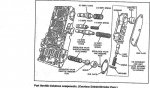
The valve body I posted in a previous post shows a full throttle kickdown system, with no "add-on" module mounted.
I don't currently have a part throttle kickdown valve body to take some pics of for illustrations. But here's some line art from carl munroe's definitive reference which shows the "part throttle kickdown" module added to the valve body as part of the governor control. That's the stuff in the bold outlined box to the right of the drawing.
More than a few folks think their tranny is "broke" because the kickdown system doesn't work as they think it's supposed to. Again...because ihc did not fully explain the differences in various t-407 transmission designs in appropriate service manual sections over the years, there is really no way to understand "what" is supposed to happen and how to service it just by depending upon those references. The cts 2313 ('78 and later sii) manual is the worst offender, while it does contain two complete service segments regarding the tranny variations, they did not point out the differences and in fact actually mixed up and transposed the illustrations so that no sense can be made of the valve body variations!! And the parts lists for the variations likewise do not contain definitive illustrations...just "frame number cuts" that mean nothing to a hobbyist/non-pro mechanic.
The most common kickdown system found in IH apps is the "full throttle" control. What that really means is that if the system linkage is correctly adjusted along with the throttle cable/rod, the loud pedal must be depressed near wot in order to "command" the tranny to shift back to second gear from direct/high gear at road speeds under say 60mph. And that is all dependent upon having the oem gearing and tire size!
That full throttle kickdown will occur at varying points, I'm just throwing out a "general" scenario, every vehicle is gonna behave a bit differently. And this information is only pertinent to a tf 727 (or a tf 904), it has nothing to due with a 700r4, a th350, a c6, a bw 11, etc. These trannys each have their own variation of how kickdown is controlled, ya can make no comparisons amongst all these boxes! And after 1973 or so production...the "emissions thang" reared it's head and many of the kickdown scenarios changed for all oem manufacturers.
The "part throttle kickdown" module was added to the 727 valve body by chrysler beginning sometime in 1974. But not all oem customers received that setup, not all trannys received that setup, and it May have been somewhat randomly applied over the years.
What this means is that kickdown will occur at a lower road speed/engine load/throttle plate angle without having to floor the loud pedal. That serves to keep the tranny ratios more closely matched to engine load (primarily an emissions deal) and also reduced "hunting" of the up/down shift points under light throttle application. This would have been particularly noticeable onna Scout II due to it's extremely "heavy" stance vs. Engine output, one more reason why performance of those rigs is considered kinda sluggish when compared to similar vehicles with a much lower curb weight.
The only way to determine which valve body your tranny May contain...is to drop the pan and look!
If...you have adjusted the kickdown linkage correctly (and that will vary somewhat by platform and model year), and it still will only kickdown say at 48mph when ya floor the pedal, then ya gotta "full throttle kickdown" system. By far the most common found in IH stuff.
The valve body I posted in a previous post shows a full throttle kickdown system, with no "add-on" module mounted.
I don't currently have a part throttle kickdown valve body to take some pics of for illustrations. But here's some line art from carl munroe's definitive reference which shows the "part throttle kickdown" module added to the valve body as part of the governor control. That's the stuff in the bold outlined box to the right of the drawing.
Attachments
ronmc1954
Member
Well michael; I have to bough to you again! I re- adjusted my kickdown band and linkage, and it worked!! Going 40mph I can step on it and it will kickdown into 2nd and floored it shifts into 3rd about 60mph. 60 might be a touch high I don't know what rpms are but it sounds like it might need to shift at about 57mph. A minor adjustment on linkage will fix that.
Thanks, excellent post!
Ron
Thanks, excellent post!
Ron
Michael Mayben
IHPA Tech Moderator - Retired & No Longer Online
Great ron! You just performed a typical $800>$1000 major overhaul if you had trolled aamco on this little issue!
Ain't maintenance a wonderful thang???
Your full throttle upshift to third point is just fine! I'm running my trailerdragger tranny set up to shift to third at 64mph displayed on the gps, not the speedometer. This is not a superaccurate/supercritical point, each tranny/vehicle will vary a bit. That is why you see the "tolerance" for shift points in any technical reference.
Even better..it don't take a scan tool, a computer, and electricity to do this, it's all mechanical majik using the principle of the screw thread!
Ain't maintenance a wonderful thang???
Your full throttle upshift to third point is just fine! I'm running my trailerdragger tranny set up to shift to third at 64mph displayed on the gps, not the speedometer. This is not a superaccurate/supercritical point, each tranny/vehicle will vary a bit. That is why you see the "tolerance" for shift points in any technical reference.
Even better..it don't take a scan tool, a computer, and electricity to do this, it's all mechanical majik using the principle of the screw thread!
Good day, michael:
have a 1977 SSII, with 727 tf,345 w/2bbl. Holley. Pertronix ignition in a Holley dist.. Bought the thing in 1992 from the original owner with 52,000 original miles. I now have 262,000 on the truck. Both front and rears have traclocks. Other than that, fairly stock.
The trans. "blew" at 54,000. Don't know what happened, it just blew. Took the truck to a trans. Shop that used to do "overflow" work for International dealer. They built my trans. With a shift kit, extra clutch pack and a rv converter. Like I said, it's got 262,000 miles. I change the fluids religiously every 10,000 miles.
I do most of the work myself, but have never had the trans. Serviced re: adjusting the bands. It has always shifted extremely well and has never given me problem.
Question: in reading your thread re: adjusting the bands, will doing this "harm" anything?
have a 1977 SSII, with 727 tf,345 w/2bbl. Holley. Pertronix ignition in a Holley dist.. Bought the thing in 1992 from the original owner with 52,000 original miles. I now have 262,000 on the truck. Both front and rears have traclocks. Other than that, fairly stock.
The trans. "blew" at 54,000. Don't know what happened, it just blew. Took the truck to a trans. Shop that used to do "overflow" work for International dealer. They built my trans. With a shift kit, extra clutch pack and a rv converter. Like I said, it's got 262,000 miles. I change the fluids religiously every 10,000 miles.
I do most of the work myself, but have never had the trans. Serviced re: adjusting the bands. It has always shifted extremely well and has never given me problem.
Question: in reading your thread re: adjusting the bands, will doing this "harm" anything?
Michael Mayben
IHPA Tech Moderator - Retired & No Longer Online
Adjusting bands is a simple periodic maintenance deal richard!
There is actually a considerable amount of travel in the servos that apply and release the bands, so therefore there is an extended maintenance interval regarding that issue. And...I too have rebuilt these trannys that had 150k+ miles on 'em in dodge pickups used in the oil patch back in texas. Those rides had never been maintained until they started slipping and were kept in service until they wouldn't untrack. They then got a simple, standard rebuilt and continued to be abused day in and day out!
Had the tf 727 been designed so that the low/reverse band could have been adjusted externally, not doubt we would have done many and that would have become part of what we called "major tune-up" back in the old days!
I understand your reluctance to fix sumthin' that ain't broke...but if ya let the low/reverse band go too long, there is a possibility that the servo will "flop" in it's bore (most common when engine is in fast idle on a cold morning and ya drop it into reverse), or the low /reverse band simply breaks under the same condition. So then ya got a "no-go" sitch to deal with.
Once that servo figgrs out it can flop at will, then it kinda takes on the habit! Lottsa aftermarket "cures" for that, but unless yore pumpin' 500+hp through one and abusin' it severely, it won't flop unless the band gits real loose (that also allows the apply strut to jump out of it's seat and then the band can't actuate at all).
The low/reverse band takes all the abuse due to normal driving patterns!
Great question, thanks for bringing this up!
There is actually a considerable amount of travel in the servos that apply and release the bands, so therefore there is an extended maintenance interval regarding that issue. And...I too have rebuilt these trannys that had 150k+ miles on 'em in dodge pickups used in the oil patch back in texas. Those rides had never been maintained until they started slipping and were kept in service until they wouldn't untrack. They then got a simple, standard rebuilt and continued to be abused day in and day out!
Had the tf 727 been designed so that the low/reverse band could have been adjusted externally, not doubt we would have done many and that would have become part of what we called "major tune-up" back in the old days!
I understand your reluctance to fix sumthin' that ain't broke...but if ya let the low/reverse band go too long, there is a possibility that the servo will "flop" in it's bore (most common when engine is in fast idle on a cold morning and ya drop it into reverse), or the low /reverse band simply breaks under the same condition. So then ya got a "no-go" sitch to deal with.
Once that servo figgrs out it can flop at will, then it kinda takes on the habit! Lottsa aftermarket "cures" for that, but unless yore pumpin' 500+hp through one and abusin' it severely, it won't flop unless the band gits real loose (that also allows the apply strut to jump out of it's seat and then the band can't actuate at all).
The low/reverse band takes all the abuse due to normal driving patterns!
Great question, thanks for bringing this up!

Michael Mayben
IHPA Tech Moderator - Retired & No Longer Online
ok my tranny has been acting funny this month. When I accelerate it seems to downshift then slip between the 2 gears. I dropped the pan and saw a few metal slivers and no black gunk in this one. Would a band ajustment bring her back to normal operations?
That is always the first thing to do, along with replacing the filter and of course the oil. Part of normal periodic maintenance, if the tranny is treated to good times onna regular basis, these can last virtually forever without an overhaul (if not thoroughly thrashed!).
Your symptoms sure indicate a band adjustment is needed, especially if this has come on somewhat gradually over time and become a bit worse week-to-week if used as a dd.
And does it do this only when cold?, only when hot?, or anytime?
Mm, thanks for the info on servicing a 727. You had answered my previous post about two month ago, and I am finally getting around to doing this adjustment. (finally got the nerve)
I have a couple of questions:
you refer to 72 inch/pounds for the two adjustments (kick down and reverse). I have a ft. Pounds wrench, what is the correct setting for this? Or did I miss it in your write-up?
Also, I have about 150,000 on the 727 and was wondering, will the "2 1/2" turns adjustment still work? Or do I take into consideration the wear of the bands? Or did I miss that too?
I have a couple of questions:
you refer to 72 inch/pounds for the two adjustments (kick down and reverse). I have a ft. Pounds wrench, what is the correct setting for this? Or did I miss it in your write-up?
Also, I have about 150,000 on the 727 and was wondering, will the "2 1/2" turns adjustment still work? Or do I take into consideration the wear of the bands? Or did I miss that too?
Michael Mayben
IHPA Tech Moderator - Retired & No Longer Online
I think I got the magic # (the ft/pounds inch/pounds thing)
it is 6 foot pounds for the adjustment (72 inch lbs.), right?
Sorry I didn't respond, we're building a tranny and shooting a video of the process right now!
Yes,...72in/lbs = 6 ft.lbs.
The band adjustment "specs" are always the same, no matter if new parts are installed, or servicing a 200k unit! The only time you use a different spec...is for the later variations or if the performance/aftermarket band replacement calls a different spec.
I have failed!!!!!!!!!!!!!!!
I can't find any auto parts store that has a "inch/pounds " wrench. Not a frickin' one!! Autozone, pepboys, not even napa!!.
My torkwrench only goes down to 10 inch/pounds. Also, you were right about the socket. I guess I wil have to track one down.
Anyway, I dropped the pan, checked the residue (not much), only a thin "grey" film on the pan. Very clean fluid though. Buttoned her back up, filled her up and went driving to check her out.
I have never had a problem with shifting. When I had the tf rebuild (circa 1992), I had a rv converter put in, a shift kit, and an extra set of clutches (6 vs. 5). I have about 150,000 miles on it, have changed the tranny juice every 10k-15k miles.
I went back to the shop tha built it, told them this morning about my tranny, they remembered me!!!. They told me I could bring it in for an adjustment/servicing ($125.00). I said that it ran alright as of now and if it does, is it needing a servicing? They said if it has no problems, leave it alone.
The shift is clean and crisp! Also, looking at your pictures, you have about 1/4 to 1/2 inch of bolt stud showing above the lock nut. I have about 1/4 max!! I thought about just taking of the lock nut and doing the adjusting thing, and then putting back the lock nut.
Anyway, locg story short, I would like to "adjust" the tranny based on your previous posting. Sounbds like good common sense. My question is: the 72 inch pounds thing: will "feeling it" at about "less than 10 inch pounds" work? Or are you dead set on the 6 foot pds/ 72 inch pounds thing??
Three hours under my ss2 is very relaxing!!! Unfortunately, I have a wife that wonders why I love to lie on my back so much, on the cold cement!!!
I can't find any auto parts store that has a "inch/pounds " wrench. Not a frickin' one!! Autozone, pepboys, not even napa!!.
My torkwrench only goes down to 10 inch/pounds. Also, you were right about the socket. I guess I wil have to track one down.
Anyway, I dropped the pan, checked the residue (not much), only a thin "grey" film on the pan. Very clean fluid though. Buttoned her back up, filled her up and went driving to check her out.
I have never had a problem with shifting. When I had the tf rebuild (circa 1992), I had a rv converter put in, a shift kit, and an extra set of clutches (6 vs. 5). I have about 150,000 miles on it, have changed the tranny juice every 10k-15k miles.
I went back to the shop tha built it, told them this morning about my tranny, they remembered me!!!. They told me I could bring it in for an adjustment/servicing ($125.00). I said that it ran alright as of now and if it does, is it needing a servicing? They said if it has no problems, leave it alone.
The shift is clean and crisp! Also, looking at your pictures, you have about 1/4 to 1/2 inch of bolt stud showing above the lock nut. I have about 1/4 max!! I thought about just taking of the lock nut and doing the adjusting thing, and then putting back the lock nut.
Anyway, locg story short, I would like to "adjust" the tranny based on your previous posting. Sounbds like good common sense. My question is: the 72 inch pounds thing: will "feeling it" at about "less than 10 inch pounds" work? Or are you dead set on the 6 foot pds/ 72 inch pounds thing??
Three hours under my ss2 is very relaxing!!! Unfortunately, I have a wife that wonders why I love to lie on my back so much, on the cold cement!!!

Scoutboy74
Moderator
Richard, this adjustment does require the precision of the inch/lb wrench, or in the absence of that, a ft/lb wrench that will adjust low enough. Guesstimating won't get it. The amount of adjustment bolt protrusion visible is directly proportional to how worn the band is. This will be different for every transmission and is not an alternate means for adjusting the band tension. The shortcut is the shortcut, and that's the procedure outlined by mm. Do you have a harbur fake tulz or any specialty type tool store in your area? I had the same trouble locating an inch/lb torque wrench. The best I was able to find was a 3/8 inch drive ft/lb clicker wrench that starts at 5 ft/lbs. That was an hft special. It's a far cry from mayben's ultra-hip, old-skule inch/lb wrench, which I had the privilege of caressing in my own hands just a few hours ago, but it gets the job done. Wrench envy suks!
but it gets the job done. Wrench envy suks!
Michael Mayben
IHPA Tech Moderator - Retired & No Longer Online
Yes, the hf "micrometer-style" torque wrench will work just fine!
The 72 in./lb. Setting is to simply provide a universal standard that is measurable for "pre-load" for mechanics that deal in this arena. Any slushbox that uses "bands" (late model electronic boxes do not), use the same process, this is not unique to the tf 727 alone!
Band adjustment is just like fluid/filter change, it's a maintenance procedure so that the tranny won't fail due to long term wear without compensation! With proper maintenance, these units can easily go 200k or longer in daily service! Once a band (or clutch) starts slipping, the tremendous heat generated spikes and from then on, it's downhill in fairly short order.
And there were several different length adjusting screws used, so "stickout" is not an indicator of proper tensioning or "wear" of the band actuation system on any box.
The old skool torque wrenches are known in the trade as "deflecting beam" design are very serviceable if handled carefully over the years. For those of ya interested in 'em, just goggle-up "deflecting beam torque wrench", sears used to sell 'em for $12.95 before harbor freight started killing sears/craftsman brand!
Scoutboy, bryce, and I had a huge long dead politician's weekend (great fun and male bonding took place!!!) trying to wrap the 727 rebuild video, but we ran into quite a few problems regarding scoutboy's core that had been previously botched. I learned much new stuff myself I'd never encountered before, and the failure of that trans was the result of someone installing the wrong/butchered kickdown servo in the past. This deal is compounded by the fact that the trannys we used for the teardown portion of the shoot are not the same unit as we are using to rebuild for scoutboy, and I did not tear that one down from the beginning, so we're finding schnizz here that trever did not know anything about when he pulled it down, otherwise we would have been able to correct the problems outside of the video shoot weeks ago! This is all part of the educational process, and for me, that began nearly 50 years ago and continues to this day!
So...we did not wrap this project afterall, now we gotta spend one more weekend completing the video shoot and scoutboy's tranny before the finished product is posted for reference.
The 72 in./lb. Setting is to simply provide a universal standard that is measurable for "pre-load" for mechanics that deal in this arena. Any slushbox that uses "bands" (late model electronic boxes do not), use the same process, this is not unique to the tf 727 alone!
Band adjustment is just like fluid/filter change, it's a maintenance procedure so that the tranny won't fail due to long term wear without compensation! With proper maintenance, these units can easily go 200k or longer in daily service! Once a band (or clutch) starts slipping, the tremendous heat generated spikes and from then on, it's downhill in fairly short order.
And there were several different length adjusting screws used, so "stickout" is not an indicator of proper tensioning or "wear" of the band actuation system on any box.
The old skool torque wrenches are known in the trade as "deflecting beam" design are very serviceable if handled carefully over the years. For those of ya interested in 'em, just goggle-up "deflecting beam torque wrench", sears used to sell 'em for $12.95 before harbor freight started killing sears/craftsman brand!
Scoutboy, bryce, and I had a huge long dead politician's weekend (great fun and male bonding took place!!!) trying to wrap the 727 rebuild video, but we ran into quite a few problems regarding scoutboy's core that had been previously botched. I learned much new stuff myself I'd never encountered before, and the failure of that trans was the result of someone installing the wrong/butchered kickdown servo in the past. This deal is compounded by the fact that the trannys we used for the teardown portion of the shoot are not the same unit as we are using to rebuild for scoutboy, and I did not tear that one down from the beginning, so we're finding schnizz here that trever did not know anything about when he pulled it down, otherwise we would have been able to correct the problems outside of the video shoot weeks ago! This is all part of the educational process, and for me, that began nearly 50 years ago and continues to this day!
So...we did not wrap this project afterall, now we gotta spend one more weekend completing the video shoot and scoutboy's tranny before the finished product is posted for reference.