Scout II Ignition issues

Either/or, not both. A new gb amplifier keeps everything stock. The pertronix kit negates the gold box. If it were my rig and my money, I'd go with the pertronix, but the choice is yours to make.
 
Removing/replacing the dist cap has nothing to do with whether or not the starter will engage. In fact, the distributor and ignition coil could be completely removed from the engine without preventing the starter motor from cranking over.
Consequently, voltage measured between the coil and distributor is meaningless when it comes to diagnosing problems with starter engagement.

The battery is your power source. Everything electrical begins there. It is the first item that should be status checked before attempting electrical diagnostics. Never assume that it is all good simply because the engine cranked over last week. That was then, this is now. By the way, do you have any idea how old your battery is?

Begin by measuring the surface charge with your dvom across the terminals and report your reading. As previously mentioned, the surface charge of a fully charged, good battery will register at or near 12.8 volts.

Next, trace the battery positive cable across the engine bay down to the starter solenoid on the opposite engine side. Ground your black probe to the frame or engine block and probe the large terminal lug on the solenoid with your red probe. Readout should be nearly identical to the one taken at the battery. What do you get?

Your readings at this point will indicate either a charged or a discharged battery. The next course of action depends on those results.

edit...now I see you deleted your previous post. What's up with that?

 
Last edited:
Thanks for the reply, I fixed the problem. I just noticed that the gearbox was shifted into drive. My fault I'm sorry. Thanks again though
 
I think your disconnected wire is the stock wire for the thermostat. It looks like you have another in its place now though.
 
Figured out how to use the timing light. How do you loosen the distributor to rotate it? Lots of frightening things happened while it was running not limited to flame in the carb jets, fuel being squirted out of the carb jets, and lots of loud banging. Not sure if that helps at all. Thanks
 
There is a bolt running through the hold down bracket at the base of the distributor where it penetrates the engine block. Loosen, but do not remove this bolt. That will allow you to rotate the distributor as necessary. All the symptoms you described indicate an engine that is way out of time. Since you have an inductive timing light, remember to time off cylinder #8 which is the rear most location on the passenger side bank. Do that to get it close and running fairly well. Then you can follow the power timing link mayben provided once you have it road worthy and ready for optimal fine tuning.
 
Got her all timed out and she runs pretty well now. Thanks for the replies. Only issue now is the carb just started leaking like crazy. Thinking about just buying a 2300.
 
Good deal. The carb behavior is completely predictable. There's no way a long neglected carb is ever going to function properly without first being completely disassembled, surgically sterilized, and then rebuilt with correct gaskets etc.
 
So now my question is, rebuild or buy a 2300? If I go with a 2300 where do I get one and will it need to be modified to fit? Thanks
 
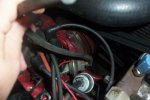
Hello, I recently upgraded the ignition to the pertronix ignitor with flame thrower coil. I noticed a loose hose near the distributor while I was installing the part and I can't figure out where it connects to. I have a 1974 Scout II - 345v8 - 4speed. Any suggestions?

Thanks,
don
 

Attachments

  • Loose Hose.jpg
    Loose Hose.jpg
    40 KB · Views: 1,598
You should have a vac diagram on the cowl but there's one on here in a thread.

It goes to the other side of the carb to a t that connects to the temp control vac control.
 
It looks like you're holding the hose that is attached to the vacuum advance canister on the distributor. This should be connected to a ported vacuum source, usually found on the bottom front or passenger side of the carb, depending on which one you have. Also, for future reference, its better to start your own thread in the sub-forum that most closely pertains to your specific issue.
 
Alright, just went to start my Scout, and I can't get it to start at all. Tried starting it multiple times, gas is getting through the spark plugs were wet when I took them out. Tried starting fluid, but nothing. Right now I have that pertronix ignition with the flamethrower coil. And help would be greatly appreciated. Thanks
 
Alright checked the voltages on the coil. When battery is on-10.6 volts. When being cranked-8.5ish volts. It seems to be the same problem I've been having since day one. Any more tests to run?
Also, wire going from coil to distributor-10.6. When cranking-made my multimeter freak out and shocked me. Probably nothing but both times, now and way back when, when the Scout didn't want to start, was just after it had been filled up with gas.
 
Last edited:
10.6v tells me the battery has been depleted due to all the cranking you've done while unsuccessfully attempting to start the engine. Voltage readings from a depleted battery don't mean much beyond confirmation that the battery is low. If you recall from earlier posts, a fully charged battery will display a surface charge of roughly 12.8v at the terminals. That's where you begin testing. You should get a nearly identical reading at the coil + terminal with the key switched on momentarily. Be very careful not to leave the key switched on with the engine not running for more than ten seconds at a time. Minor voltage drop during starter cranking is normal, but 8.5v at the coil is insufficient to fire the engine. The starter must be turning over very slowly at this point.
 
The whole time I was cranking I had my battery charger hooked up. I used the 50amp start function to no avail. Just checked the battery terminals and got a 12.69 volts. Am I losing some voltage somewhere?
 
First off, I'd hold off using the high amp starter helper. If you're doing so much starter cranking that the battery is being depleted before the engine starts up, you've got issues. No sense in adding insult to injury by burning up your starter motor from excessive cranking without sufficient cool down time.

A voltage drop is a strong possibility. You can and should find out for sure. Start with a reading at the battery terminals when fully charged. Record that. Next, move down to the starter solenoid. Ground the black probe and probe the red to the large lug. Record that number. This is with key off and no cranking. Readings should be nearly identical. If not, there's issue number one. Either a connection is loose between the battery and solenoid or there's too much corrosion built up. Next step is to trace the 10ga wire from the large solenoid lug up to the bulkhead connector. Probe the connector on the firewall side, record the number and then move inside and probe the cab side of the connector. At each junction, there should be little if any drop. If you see more than a couple decimal points at any junction, it must be addressed. Let's check those results and we'll move on from there.
 
Back
Top