Power Problems

Yes. It is a vanishing art. Glad you at least found what sounds like a competent parts person. When you get the new stuff and get it installed, you'll need to adjust the idle mix settings. Try turning each screw in one full turn from where they are now and see how she runs and vacuums. You're welcome.
 
Frustrated again,
put the 55 jets in. Now I am only pulling 15hg's.
1-1/2 turns out each side.
If a get a straight tac, will I beable to get the numbers we need to figure out the vaccume?
 
Its alright. This is a war of attrition. The positive to take from this so far is that the jet change had a noticeable effect on mixture screw position in the direction we want them to go. The engine wouldn't even run before at 1.5 turns out. As I've indicated from the beginning, it is next to impossible to dial these settings in while still guessing at engine speed. I'm not going to make any promises about what having a tach connected will do other than tell us exactly how fast the engine is turning, which can have a major impact on the adjustments you're making. It ads to our knowledge base. Knowledge is power. You think the speed is around 700, but what if its actually 900 or higher? That small amount could throw things off. There could be some other factor influencing the vacuum reading that we have not addressed yet. Maybe it is excessive engine speed. Maybe there is a minor vacuum leak after all. What we're doing is experimentation through trial and error. Sometimes a change makes things better, other times it uncovers another issue that was previously masked from view.
So was your starting point with the screws the approximate 2.25 turns out I suggested? Where was the vacuum reading at that point? Did turning the screws back out from there have any effect on the vacuum or did you not try that direction?
 
I get it. It's still frustrating, but I'm not giving up.
Ok, I started 2-1/2 turns out with the vaccume gage hooked up, started out at 15hg, and there was no noticeable chage, needle had just a slight bounce until I hit about 2-1/2 to 2-1/4 turns, anything below that and the hg dropped. So after about half hour of playing with the screws sometimes as little as 1/8 turn, I shut the rig down and counted the turns. They lay a approximatley 2-1/2.

Sooooo. I have two options at this point as I see it. Please let me know if I am out of line.
1. Buy/borrow a dwell meter and dial in the dizzy, set the timing, then fine tune the idle screws, or
2. Upgrade to an electronic ignition, wich will allow me to skip the whole dwell thing, and I won't have to worry about messing with points, less maintenance. Then set time and fine tune screws.

I know the ei will set me back $100 or so, but it might just be better for the long haul.
Please let me know what you recomend.
Thanks.
Wade

 
I'm a little confused now. In the previous post you said 1.5 turns out. Anyway, electronic ignition is nice for the reasons you mentioned. However, this May not be the best time to throw another variable into the mix. Points are simple, cheap and pretty reliable once they've been set. They do require a little maintenance, but not all that often. Your engine can and will run well enough to plow snow on points. You're not that far off right now. Ei can always come later, but its up to you.

So how is the engine running since these latest changes? Better, worse, same? If it seems to idle well enough where things are, see if you can reduce the idle speed some. Not to the point of being rough or stalling, but just see what it will tolerate. Engine speed too fast is the real impediment to setting the mixture screws accurately. Since you have to guess on engine speed, it would be better to err on the slow side, as long as the engine will cooperate. When things are as they should be, turning the idle mix screws in (lean) will increase engine speed slightly as you approach the sweet spot. And please do observe your vac gauge as you go.
 
I appoligise... 1-1/2turns is correct. I lookk at the keyboard when typing not the screen, because I'm just not that good of a typer.

I am tracking with all up to this point.
I will look around for a dwell tac. I read that dwell angle is critical in order to set the timing properly spceially with a rig of this age. And who knows what the po has done. I know I have had the rig for a while but this is the most I have done to it mechanically.

Initailly the rig was running rough. Once I got the float bowl filled it seamed to calm dowm, it is not idleing as smooth as before, it sounds like it is stumbling slightly, so I turned up the curb idle screw. It's not as smooth as the 51's but not bad. The setback is the 15hg of vaccume. :/

once I get the dwell meter I will let you know and we can go from there.
 
Last edited:
Sounds like a plan. Since the engine starts and runs reasonably well, that means ignition and air/fuel delivery are reasonably close. If they weren't, the thing would be hard to start and run like garbage, if at all. Close means there's room for improvement. But, if you need to plow some snow in the meantime, go for it. Just because it isn't dialed to a gnat's ass doesn't mean you can't use it.
 
First off. I want to wish everyone a merry Christmas.

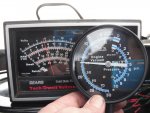
Pic attached of rpm's and vaccume pressure.
A friend let me borrow his old school dwell meter.
Dwell is set at 32 deg, I konw it's a little on the high end, but man is that a pita to adjust. Timing is set with a light at 10bdtc, anything lower and it stalls out.
Rpm's are right around 700.
Idle screws are 2 turns out,and pulling about 16hg of vaccume.
Doesn't run real smooth like before, but maybe these numbers will tell us more.
 

Attachments

  • dwell 007.JPG
    dwell 007.JPG
    167.5 KB · Views: 335
Last edited:
Merry Christmas to you. 32 dwell is fine. 700r's also fine. 4 steps larger jets should not cause a vacuum drop at idle. 10 degrees of timing advance is fine, but retarding the timing from there even all the way back to 0 should not cause the engine to stumble and die. That's a red flag. This timing was taken using the #8 wire, correct? I think you need to do some checking for a vacuum leak. If you have some carb cleaner, you can do some well aimed squirts around the carb base, vacuum hoses and fittings. Just prevent the mist from getting sucked directly into the carb airhorn as that will give a false positive. If you notice the engine speed increase for just a second right as you spray, you just found a vacuum leak where the spray landed.
 
I will be working on the rig tomorrow. Weatherman is calling for 8-12 inches of snow starting tomorrow afternoon. I will try to post throughoutthe day on progress or setbacks.
@ scoutboy, yes I am timing off the #8. The rig has never been able to idle at tdc since I have owned it. I will go over all the vaccume ports in the am, and look for leaks around the carb base.

@ chappie. I reviewed the link, and believe I fall into senario 4. I already know from conversation with scoutboy that my oil is way to thin. I will be correcting that shortly. The needle doesn't bounce erattically just a slight pulse. Thanks.
 
Last edited:
That would be something if it turned out to be scenario 4. Your idle is still rough. We might consider advancing your timing a few more degrees to see how that effects idle quality and vacuum. Lets keep that on the backburner for a bit while you proceed as planned.
 
I want to make sure I am going thru the steps correctly.
1. Seal all vaccume leaks,
2. Set dwell, should already be good,
3. Set timing, questionable...
4. Adjust idle mixture screws,
5. Set curb idle.
Done, right??
 
1. Yep
2. Dwell angle won't change overnight from where it is now. If you want to get it closer to 28 degrees, then the point gap will need to be increased a little. So for instance if the gap was set before using a 16 thousandths feeler gauge, try using a .019. After many revolutions, the rubbing block on the points will wear down, gradually closing the point gap and increasing the dwell.
3. Skip to 4 and 5. If you can't get any appreciable improvement, then see what happens as you advance the timing just a smidge. No more than 4 degrees additional. The engine speed should increase slightly as the timing is advanced, so adjust that down accordingly.
 
Just got back inside from pulling my hair out.
Good, I'm glad I am tracking the process.
I sealed 2 small leaks, I found no leaks around the carb base, but noticed that if I sprayed just a little in the carb itself the vaccume would jump to 18hg. I know you said this is a false positive, what does that mean? I know what a false pos is, but why/how does the shot in the carb produce that result?
I put the dwell/tac and vaccume gage back on.
I appoligise for messing around to much before I got your message. I figured getting the timing back to within 5deg would be a good thing so I retarded the timing to 5deg bdtc, it didn't stall this time but it runs rough, kind of like it's chugging.
The motor idles at 700rps, but it is a rough idle, I am now only pulling 15hg of vaccume, and the screws are out 2-1/2 turns.
When I punch the gas quick the needle drops to 0 and then only comes back up to about 23 and then slowly (about 5 sec) it settles in around 15. I will put the timing back to the 10deg it was before, and start the process all over again. I should be back in about an hour with results.
Oh. I don't expect anyone to be checking, I just want to post as the information is fresh in my head. I know we all have jobs to tend to. I have off so I have the luxury of posting when I need a break.
Thanks
 
Big brother is watching as you conduct your experiments out in the lab. The false positive I referred to would display as a brief increase in revs, similar to a feather press on the throttle. The spray is combustible, so when it gets drawn into the engine, it briefly increases the fuel portion of the a/f mixture. My interpretation of the vac needle going up when you sprayed into the carb is that the a/f mixture is too lean, ergo the mix screws are turned further in than the engine wants them to be, same as before. So why not get radical and start with them 4 turns out? That's a long ways, but we May as well know what that does to the gauge reading.
 
Thanks. I have to run out for some gas, the rig is on e. Quick update.
I took the timing back to 10bdtc. The rpms are at 850 and the vacumme at 16hg, if I try to adjust the curb idle down to get the 700 I need the rig will run for about 20 to 30 secs and then die. As long as the ilde is above 850 it will sit there and run.
Also, you said that curb idle shoud have no effect on vaccume, so if I am idleing at 1500 or 700 rpms the vaccume should be the same???
My vaccume changes with the idle.... Ie.. I have had the vac up to 18, but when I turn down the ci to 700ish the vac drops to 15/16. Am I missing something else??
 
I May have said that there is no little to no vacuum signal present from the ported source connected to your distributor vacuum advance at idle, but I never said that engine speed has no effect on manifold vacuum. Engine speed has every effect on manifold vacuum, which is why I was concerned that your idle May have been too fast causing the lower reading. We now know that wasn't the case thanks to having the tach connected. You see this play out on your vac gauge when you stab the throttle. The further the throttle plates open up, the higher the engine speed gets and the lower the vacuum goes. That's why when attempting to get the highest vacuum reading at idle, it is imperative that the idle speed not be too high. If it is too high, that means the throttle plates are opening and vacuum level is dropping. Hopefully that clears things up.
 
Tracking, I misunderstood.... Sorry.
So here is my next big delima.... How do you get the hood open when the hood release cable breaks???
I plowed some snow and it ran pretty good.
I was going to do some more tinkering in between snowflakes and bam. Now I can't get the hood open. :{
 
Last edited:
Oh no!!! I've never had to deal with this (knock on wood), but I know it happens on occasion. There is a little tab or lever that the release cable connects to as part of the latch. Normally, pulling on the knob from inside moves this lever towards the firewall which releases the latch. It will be hard to see from underneath, but that's the only way you will be able to engage it using a really long screwdriver or similar object. Push it back towards the firewall and hopefully your release spring is strong enough to pop the hood up an inch so you can then lift it open the rest of the way. New release cables are available from IHPA. Good luck.
 
Whew.... Got the hood open, no broken cable after all, just loose clamp.
So after plowing out half the hill(neighbors). Rig is running perty good. Did a little more tweeking.
I took the idle mix screws out the 4 turns with no real improvement. They sit at 3-1/4, pulling about 17-1/2 hg vac, and idleing at 700rpms. After a minute or two, teh rig drops down to about 500rpms and pulles 10-12 hg vac. If I adjust the ci up to 700 and tap the gas it goes up to 1000rpms and won't drop down, it will just stay there for as long as I let it. ??????

I did notice that if the gas is just fethered the throttle will not go all the way back to full closed position . if that makes sense ? there is a spring attached to it to pull it back and it appears to have good tension on it, but it feels like the mechanism sticks . if I punch it, it's good . only happens when it's worked easy . it eventually goes back but takes about a minute to get there .

I will defintley have to work on a dual battery setup to power the plow . but that is another project.
 
Last edited:
You lucked out on the hood. I'm glad you've been able to get some work out of the ol' gal plowin' the back 40 amidst all this experimentation. Sounds like ya got some kind of intermittent or temperature related vacuum leak. Does this rpm drop from 700 to 500 happen in conjunction with you applying the brakes, or is it just completely random? One thing you could try is to disconnect the vacuum line from the brake booster and plug the loose hose end. See if that keeps the rpm and vac from dropping as you putter around. If it does, you've just discovered a vacuum leak inside your brake booster. Of course the brake pedal will will feel extra firm without vacuum assist.
As for the sticky throttle, take a close look at your throttle cable. Disconnect it from the throttle linkage. Work the linkage without the cable connected to see if it binds up at all. The cable could probably be slicked up with some graphite lube.
 
The drop in rpms happens when the rig is just sitting there idleing. I was playing with the mixing screws adjusting them 1/8 turn at a time just trying to fine tune the vaccume and the rig just droped to 500 and chugged. I eased on the gas and it went back up to 700, I let the rig run for a good 10 minutes and it continued to do the same thing about every 2 minutes or so.
It did stall on me twice while I was plowing .
I will check the break thing on Saturday.
The throttle cable has a little slack in it, checked that a couple times.
It almost feels like the butterflies are sticking, and have to be forced to close all the way.

About jets? If I am understanding correctly. The farther out the screw comes the more fuel is being added to the mixture?
Should I consider larger jets once we get the our issue figured out, to get to the magic 1-1/2 ish turns? That might fix the throttle issue. I have noticed that it only happens when I have to drop the ci down to compinsate for the 3-1/4 turns out, at 2 turns the ci screw doesn't seam to have the same play, but the vac drops to 15. Just a thought.... I should only need to adjust the mixture again.
Sorry to be a pain. I am not only trying to get the rig running, but also trying to understand why and how things work so I can fix it if I breakdown in the middle of nowhere.
Thanks again for all you time.
 
Last edited:
Back
Top