Holley 19XX Series Carb Stuff

Your napa parts dude is just cross referencing the wells part number to their house echlin kits:

carburetor kit
product line: echlin fuel system
interchange mfg.: wells manufacturing
interchange mfg. Part number: ck368
compare crb 25577
price unit 32.97 each

Or

carburetor kit
product line: echlin fuel system
interchange mfg.: sierra equipment
interchange mfg. Part number: ck368
compare crb 25213
price
unit 45.97 each

While these kits May work for your application, they are not a wells kit.
See my post above for a pic of the contents of the 25577 kit, which so far has all the parts for my 1904.
 
^Mike(May I call you Mike or would you rather michael? :lol: don't want to disrespect), I called my local napa and to my surprise they actually were able to source a wells ck368 rebuild kit......

But they had two different kits for that part number.

One of them cost $45, the other cost $32. Do you know about these two seperate kits and what is actually different about them?


I'm assuming that this kit would be good for a 1960 along with the 1904 Holley's, correct?
Thank you.

Most folks refer to me as the "old sumbitch azzhole", so I answer to anything. I'm 80% deef so it don't matter if I don't hear 'em!

The ck 368 wells number is unique to wells' part numbering system. The napa version of the kit is a bit different but works ok though I don't use 'em at all due to the typical exorbitant napa cost (both wholesale and retail) and the fact that the actual supply of the kits through the napa warehouse distribution is erratic and not dependable.

There are always "other" part number kits that might work on some of this stuff, but that has really tightened up in the last few years due to part number "consolidation" throughout the industry. What that really means is that no single kit is totally correct for any one application! And that is not just in the case of the 1904 mixer. This whole carburetor/parts/kit deal has never been exact and always a "fitzall" kinda deal where a pro mechanic knew how to make the stuff work by sometimes blending parts from two different kits, then saving the leftovers to use on some other oddwad variation carb in the future. I do the same thing, after 10 years of dealing with 1904 I got a pretty good stash of "stuff".

I'm working diligently right now to put together a correct kit for the 1904 as used on most IH applications. Same for Ford. We'll be "assembling" our own ihon carb kits that can be custom inclusive for our customers desiring to diy these carbs. The bulk parts are slowly trickling in so this is not a simple "stick the parts inna bag" kinda deal. We'll make an announcement about this once all the pieces come together.
 
on re-inspection, it turns out that the accel pump diaphragms are different, but the one in the kit is longer than the one I pulled out!!! The old pump shaft is 1-1/4" long, the new one is 1-1/3". So I could be good to go.

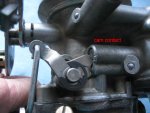
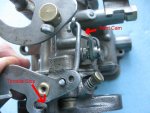
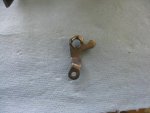
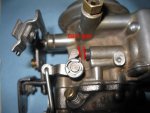
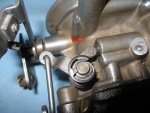
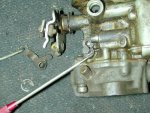
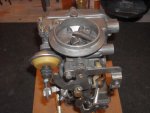
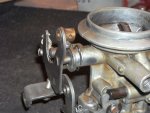
This carb has been jacked with. The cam arm was bent and the arm tweaked in such a way that the cam contacted the carb body preventing the throttle from opening all the way.

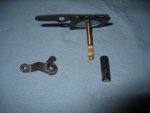
Additionally, it had a short pump shaft and a short pump shaft sleeve.

Someone must have bent the parts in an effort to make the short shaft pump deliver some fuel.

I gently straightened the cam and bent the arm so that the cam no longer contacts the carb. I also added a plastic washer (snap cap washer) on the camshaft to remove some slop. I think maybe there is supposed to be a spring there.

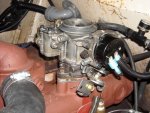
The pictures tell the story.

In order to move forward I need a long shaft sleeve to go with the long shaft pump from the kit. I figure it will add about 0.15 to .18 to the total length of the shaft. Any ideas on where I can get one?
I could probably weld a piece to the sleeve, but that would be stretching my fabrication skills.
 

Attachments

  • 1904 cam.JPG
    1904 cam.JPG
    55.2 KB · Views: 675
  • 1904 throttle.JPG
    1904 throttle.JPG
    63.1 KB · Views: 1,088
  • 1904 pump, sleeve, cam.JPG
    1904 pump, sleeve, cam.JPG
    30.7 KB · Views: 581
  • Bent Cam.JPG
    Bent Cam.JPG
    39.3 KB · Views: 569
  • 1904 cam gap.JPG
    1904 cam gap.JPG
    33.5 KB · Views: 868
  • 1904  WOT.JPG
    1904 WOT.JPG
    38.7 KB · Views: 604
Greg,

what you are finding is exactly what I see nearly every day when dealing with these carbs that have been butchered in the past! Most especially amongst the Ford folks and their versions.

There are many variations of the basic 1904, and I'm certain I'll never see all of 'em. But every one of 'em is a challenge, this is never a simple "rebuild" process. And that is exactly why folks have such trouble with this stuff, it's been scruud over so bad in past life there is no way a hobbyist can figgr out the nuances. And regarding the accelerator pump system, that is the major issue with these mixers (along with crapped main well).

How many times have we read that "Holley (carter, zenith, rochester, etc.) carbs are crap", "those carbs were no good from the factory", and shit like that??? We're dealing with 40, 50, 60 year old parts here that have been butchered for ages!

My rant for the day!

Anyway...send your snailmailing address to:

michael@IHPartsAmerica.com

I will send you the pump plunger you need, along with a correct steel pump cam. Once you get the parts, simply stick your "wrong" stuff in the mail back to me so it can go to help someone else. Use pump cam as a sample to see how the oem bend was formed.

The connecting link I see in your pic is actually for the nylon pump cam version. It can be made to work with the parts you have, but it takes some real patience to bend it so that it does not bind and allows full travel of the throttle shaft both at idle and at wot, check that very closely...this is a tedious operation! The link can be bent carefully and is how it's "tuned", but just yesterday I actually broke a link when making the adjustment, they are very brittle! I don't have any additional "proper" links for ya, but you can make that one work. I do have some spare links for the nylon cam versions.

"most" (certainly not all) Ford-pattern 1904 carbs use a completely different link that is a reverse image of the one used in ihc apps. And the actuator holes in the throttle arm are in a different position also. That is because the six cylinder Ford apps require a "different" pump shot, and likewise the six cylinder ihc engines are "different" as compared to the 152/196 apps. All these "differences" are what goes into making up each list number variation of these carbs (and any other carb also).

 
michael
thank you very much!
I tried to send you an email yesterday, but your box is full.
Cheers.

Hmmm...I just sent myself a test email to the IHPartsAmerica.com addy and it came through instantly. There is no email box on the ihon server that can overload, all email to that addy is pushed instantly to another address and I pick it up from my droid.

Use this address:

rodelizrd@gmail.com

All my email addresses push to the same location. And I do not use outlook, outlook is not allowed to live in my shophouse!

edit: real strange I just got an "overload" message myself (belatedly) even though the test message pushed through, I'll see what's going on now.
 
Last edited:
Michael
got the parts yesterday and tried an install this morning.
Its obvious I will have to seriously tweak the connecting arm.
My measurements indicate that the arm should be about .95". This is estimating the adjustment of the throttle stop screw and measuring the distance between the hole on the throttle arm and the hole on the cam when it just contacts the plunger.
The arm that I have, in its current configuration, is 1.372". When I put it all together, I have to compress the plunger to get the cam on the cam stud, and of course wot won't be happening.
So... I'm contemplating my next step, but right now I'm all tied up with my snow farmer job.
I'll post up some pics when I get a chance.
 
Continuing the theme of this thread, here is yet another variation of a "19xx" mixer.

This is a Holley 1908. Virtually identical to most variations of the 1904 with the major difference being a "hot air choke" system that is integrated into the main body. 2-3/4" throttle body stud spacing, same venturi diameter as the 1904 used on the IH 152 and some sixbangers.

Like all the rest of these similar series, this one was set up originally for an automatic transmission application as it had a "dash pot" installed in the boss. This particular unit is a list 1598-2a which was intended for a '59>'60 rambler equipped with the 196 engine (a rambler 196, not an ihc-produced 196). It also was most likely oem with the "visi-flow" glass fuel bowl.

I have just reclaimed this carb from the parts pile using a fresh main well. The hot air choke cap was eliminated and a current design Holley electric choke cab substituted. Because the nylon fast idle lever was still in perfect condition and even it's control spring un-botched, this is a perfect example of this carb now. The main well reconditioned by Robert results in possibly the best idle quality I've seen yet in one of these carbs, this one is very exceptional.

This one will be retained in my personal collection and run on the 152 stroker motor on occasion. This carb will start the mule motor instantly when dead cold with one push of the loud pedal, it goes right to a 1200rpm fast idle and operates flawlessly, every bit as functional as any efi conversion.

The throttle linkage has not been finalized yet. I do not want to modify the oem setup in any manner, so the mods needed to use on my mule motor will all be bolt-on stuff with a positive return spring.
 

Attachments

  • Holley 1908.jpg
    Holley 1908.jpg
    81.1 KB · Views: 1,914
Hello,

I bought an old judson supercharger for my mga. The kit is now with judson expert george folchi awaiting a rebuild. I've been told by a fellow mga and judson owner that you are the place to rebuild the Holley carb used on these kits. He says you're the only ones who can repair the ecomonizer valve, which is apparently one of the main failure points of these carbs.

The kit I bought included 3 Holley carbs, all of which are in rough looking shape. Out of the three, I'm hoping that at least one can be rebuilt to like new condition. I've talked to george folchi and, if I decide, he's willing to ship the carb(s) to you. I know it's hard to be accurate without seeing them, but could you give me a rough idea what it would cost for you to do a rebuild, what your turn around time is, etc, etc.

Thanks a bunch,
andy
 
Sure andy, the rebuild cost is currently $135, with an additional charge of $45 for a remanufactured main well if needed. Not all of the 19xx series carbs need a main well however, in many cases I just clean the one you have internally and there is no extra cost for that.

Current turnaround for a 1904 is two weeks nominal.

The return shipping cost will be $10.95 added in.

Ship to address is:

IH Parts America-oregon
michael mayben
42790 leaburg dr.
Leaburg, or 97489

once it's completed I'll send you and email, at that point you call IH Parts America down in Grass Valley and take care of payment and I'll ship it back to ya!
 
Thanks for the quick reply micheal. I talked to george folchi and he's going to ship you 2 of the 3 carbs that came with my supercharger kit. I'll get you to rebuild both so that I have one as a spare. He's sending them out tomorrow morning, so hopefully you should get them shortly.

Cheers,
andy
 
thanks for the quick reply micheal. I talked to george folchi and he's going to ship you 2 of the 3 carbs that came with my supercharger kit. I'll get you to rebuild both so that I have one as a spare. He's sending them out tomorrow morning, so hopefully you should get them shortly.

Cheers,
andy

Send me both your and george's email addresses so I can keep ya both updated.

My email here is:

michael@IHPartsAmerica.com
 
Greetings to the list,
can someone show me a photo of the choke shaft retaining pin in a Holley 1904? I have the manual from the old car manual project but I dont see this thing anywhere. One of my 1904s choke has about an inch of play in the shaft direction the other none and they look exactly the same.

Help please!
 
That service manual you see scanned in on the old car manual project was printed in 1953 or '54. While it's certainly worthwhile, it is also a very basic manual for that carb as used on some Ford products of that era. It's not even close on many other variations of the 19xx carb series!

Typically, there are at least four different choke systems used on these carbs also, along with some variations of how the choke system is rigged. Some used no clip whatsoever to retain the choke shaft, some used a small "e"-type clip to center the shaft, some were a hot air choke with no retention, etc.

This picture shows a customer's 1904 I did recently that was complete but had several components badly damaged including a broken throttle shaft. You can see the typical clip used to locate the choke shaft in the top/left of the pic.
 

Attachments

  • DSCN0016.jpg
    DSCN0016.jpg
    98.2 KB · Views: 1,105
This is a pic of a different 1904 done in the last several months, you can see the choke shaft retainer clip in that shot also.
 

Attachments

  • 1904 Choke shaft retainer.jpg
    1904 Choke shaft retainer.jpg
    57.4 KB · Views: 1,883
Thanks for the info michael. The carb in question is actually one I had sent to you last spring. I have had it on rebuilt motor in my shop for a while, only running her twice. I put the engine and a new transmission in my truck last week but discoverd I was having throttle stop issues because the choke keeps backing out when its fully open. I have a rubberband around the throttle body holding it in place right now but thats not a good solution.

I have three 1904's here and none of them seem to have any sort of retaining clip. That raises the question if there is actually something on the back side of the choke shaft in the float bowl, but none of the diagrams show anything. That being the case, what can I do to keep the choke shaft from backing out?\

if there is no hole through which the pin slides (in the little cut away towards the end of the choke shaft) can I drill on and make a retainer?
 
There is nothing "inside" the carb choke system that acts as a retainer.

The best thing to do is simply send me the carb and let me take care of whatever is happening. As previously mentioned, many of these carbs use nothing for the choke. But...it's entirely possible that the carb itself had been previously serviced and the choke shaft replaced with a different design. I have seen that before on carbs that came out of the holly restoration operation.

And I have seen the "rubber band" deal before for the same issue. But the choke cable setup also serves as a stopper for the choke shaft so this is never a problem in the normal run.

So...simply box it and send it, I'll service it as soon as it arrives and get it right back to ya with either a different choke component set or actually "repair" what is there now. And of course as always, there will be no charge at all for this!

Sorry you are having this issue, I run every one of these carbs on the test engine and always catch stuff like this if it happens since there is a short choke cable connected also during test. This is very unusual!
 
Ok john, here's a shot of your "repaired" carb.

While the body had the slot, the actual choke shaft did not have the retaining groove for the clip to engage. That tells me that at some point in the past, the choke shaft had been replaced with a different part, that is a very common item I find on these carbs.

As previously mentioned there are several variations of the choke shaft retention system used. I should have fixed it when I had the carb for build but I simply overlooked that issue.

I did not replace the choke shaft, I simply used a die grinder and fabricated a retaining groove in the shaft itself. Once that was done and the choke shaft properly retained, I tweeked the throttle lever for proper alignment.

The box will be shipped on Monday, you should see it Wednesday.

Again, I'm sorry I let this happen, it won't be an issue for anyone again!
 

Attachments

  • JS 1904 choke.jpg
    JS 1904 choke.jpg
    60.7 KB · Views: 1,299
I got a carb question for you.

I just recently bought a brand new old stock Holley 1940 off of ebay. I machined a custom adapter and installed it on a 22r toyota engine (2.4 liter) and it works great I bet the engine didn’t run this smooth when it left japan.

However I want to try and lean the carb some to get the best fuel mileage as possible. I haven’t pulled the top off yet to check the jet size but with the research I’ve done it should have ether a #68 or a #61.

Questions:
I think I will start out trying a #55 do you think this would be a good starting point?

Do these carbs use the same jets as the 4 barrel carbs?

Can the jet on the power valve be changed, if so is it the same style jet?

Any other advice you have on tuning this carb to get better fuel mileage would be appreciated.
 
I got a carb question for you.

I just recently bought a brand new old stock Holley 1940 off of ebay. I machined a custom adapter and installed it on a 22r toyota engine (2.4 liter) and it works great I bet the engine didn’t run this smooth when it left japan.

However I want to try and lean the carb some to get the best fuel mileage as possible. I haven’t pulled the top off yet to check the jet size but with the research I’ve done it should have ether a #68 or a #61.

Questions:
I think I will start out trying a #55 do you think this would be a good starting point?

Do these carbs use the same jets as the 4 barrel carbs?

Can the jet on the power valve be changed, if so is it the same style jet?

Any other advice you have on tuning this carb to get better fuel mileage would be appreciated.

There is a huge difference in fuel flow volume between a #68 main jet and a #61!!! Likewise a huge difference between a #61 and a #55!

A carburetor is "jetted" through a process of elimination regarding using an exhaust gas analyzer and/or simply reading the spark plug color. I have no idea what kind of basic jetting would be used for that engine application.

The first thing you will need to do is determine exactly what jet is currently installed, and you work from that point.

A Holley 1940 carb, like all other versions of the Holley series uses the same main jet pattern, all the jets are interchangeable as far as actual mounting dimension.

The economizer (power valve) is the same exact unit as used with the Holley 22xx carbs and is encapsulated. The actual part number used is a single item as far as I can tell. It does have some "gradient" capability built in but nothing that can be changed. The biggest issue is simply having a system that actually works!

These carburetors were designed from the beginning as an emissions device, not a performance application. There really is nothing per se to be done as far as an upgrade other than rebuilding it completely with new components and then simply determining the jetting for your particular application.
 
Back
Top