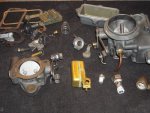
Holley 19XX Series Carb Stuff

Hi michael

it's been a long and troubled ride getting the car running again, and I have run the new engine in using the standard su carbs.

I have now refitted the judson using the carb you built for me. It's not a happy beast.

I have put the 64 jet in and made sure the float is set correctly like your photo before closing everything up. I can start the car, and it will idle and rev quite happily, but under load it just isn't producing any power, in fact it is bringing less than the su carbs were producing. Driving up hills, it just doesn't want to go, downhill it runs just great.

I have left all the non-carb engine settings exactly as they were with the su carbs, all I have done is unbolt the sus and bolt on the judson.

Do you have any suggestions ? The spare Holley I have produces exactly the same symptoms, so I'm not saying it's an issue with your carb, but I am struggling to figure it out, and I have another two potential customers for your services coming from australia and California to try it out in 13 days time.....

Help!

Dominic
 
Let's work through this methodically.

The su carbs are totally different animals compared to any Holley 1904, different operating systems entirely.

My first suspicion, your fuel bowl inlet pressure is way low, especially for the 1904 and a blower. Confirm that fuel bowl inlet pressure is between 4psi and 6psi with a minimum flow volume of one pint in 20 seconds of cranking.

Don't know what the original judson setup was as far as the fuel pump. The su carbs are simply larger versions of gravity-feed motorcycle carbs and I have no idea what their fuel flow requirements are.

Your analysis regarding the driving characteristics of uphill vs. Downhill certainly point to this issue. The actiual fuel level/float setting should not be changed beyond what my original settings were at this point.
 
Thanks for the fast reply

the fuel pump delivers 10 gallons (imperial) per hour at 5psi, so it is on spec to deliver enough fuel. The pump worked fine with the judson before the new engine (same spec as the old one) was installed. It shows no sign of having any issues, it's an electronic version of the original su electrical pump.

let's work through this methodically.

The su carbs are totally different animals compared to any Holley 1904, different operating systems entirely.

My first suspicion, your fuel bowl inlet pressure is way low, especially for the 1904 and a blower. Confirm that fuel bowl inlet pressure is between 4psi and 6psi with a minimum flow volume of one pint in 20 seconds of cranking.

Don't know what the original judson setup was as far as the fuel pump. The su carbs are simply larger versions of gravity-feed motorcycle carbs and I have no idea what their fuel flow requirements are.

Your analysis regarding the driving characteristics of uphill vs. Downhill certainly point to this issue. The actiual fuel level/float setting should not be changed beyond what my original settings were at this point.
 
Want to jump in here and give up some fuel economics from the proverbial bsfc (brake specific fuel consumption) hand book....
All recip gasoline engines will require between .4 and.45 lb gas/hp/hr @ stoichiometric air fuel ratios ...period. No if ands or butts...

1 gal imp will make 16 hp for one hour.1 gal imp= 7.29lb
10 gal imp (your fuel flow) will theoretically support 160 hp under optimum conditions...

You must also assume you can get all of that fuel into the fuel bowl past the inlet needle @ 5 psi. I suspect not likely so unless the inlet valve is up sized from the stock over the counter one. We often end up drilling the seat up sized for blower applications.

Now that I got the preaching out of my system.... :lol:

as a rule of thumb, on a new super charged application, if you are unable to see a bit of black smoke upon rapid application to wot you don't have enough fuel. Keep jetting up until you know it is fat and or experience a degradation in performance. Often the first thing you should notice it a pronounced reduction in upper rpm power and even babbling of the exhaust note. See evidence of it on the plugs then we know which way to go.

Question and answer time.....

1) what manifold pressure are you acheiving at the moment if looses power and have witnesed on a manifold pressure gauge?
2) what is your fuel pressure at that same moment?
3) what is the ignition timing expected to be under those conditions?
4) what is the existing crankcase ventilation and is it different from oem?
Hth Robert
 
Last edited:
Thanks Robert!

I have no idea what main jet was used in those original judson conversions. And right now I don't have time to try and investigate the possibles. Is the jet you are running currently "supposed" to be ballpark?

And this "uphill and downhill" deal sure leads me to suspect a fuel delivery issue for the 1904 that for some reason does not affect the su.

Also, is the ported vacuum advance on the upper side of the carburetor being used or is it blocked? At idle, that port will show no vacuum. Vacuum increases with engine rpm since this is a ported vacuum location.
 
Man I haven't been vocal lately because all is good but I replaced the fuel pump and added filters and tuned with the mityvac to get 19hsg and when I did I got a little black smoke out of the tailpipe. I know this is off topic but I am glad this is somewhat normal for the tune.
 
When I ripped that carb apart dominick, the major accumulation of both teflon tape and some kind of thread sealant could be seen which was clogging the inlet passages. This is a picture of the unit upon disassembly.

Also, the vacuum tube for the spark control was clogged with debris. That is a Ford application carburetor and as such incorporates a "spark valve" threaded into it's throttle body.

I have no idea why or how that stuff (ignition advance components were used originally, but no doubt something here is not right for this engine setup regarding the use of the judson/1904 setup. So my suggestion is to first disconnect/block the vacuum advance (if it's being used) and see what happens.
 

Attachments

  • Judson 1904.jpg
    Judson 1904.jpg
    83 KB · Views: 801
Thanks

I'll crimp it closed with a pair of hose clamps and go for a tour around the block after rush-hour and report back.

Dominic
 
The forum seems to have lost my post from earlier, or I didn't press the right button before leaving the page

crimping and disconnecting the vac advance did nothing to alter the problem. I have checked the plugs, and come to the conclusion that the 64 jet is far too Rich. I'll change it out for one two steps down tomorrow evening.

I did try the other jets before putting the sus on, and had the same problems. I wasn't sure if the timing was right at that point, but now I am sure that it runs on those settings with the sus, it should be fine with the same settings in the judson - all I have done is bolt the sus off and bolt the judson on, nothing else has been touched, and everything else is as new (so is the judson btw)
 
Changing the jet caused a whole array of other running problems to come to the surface. It's now running like a pig even at idle, even when I reverted to the 64 jet. It seems therefore not to be a carb issue (or at least not just a carb issue)

I have swapped the coil, no change
I can disconnect each plug lead and it runs just the same without any noticeable change.
Changed leads and distributor cap, no change
advanced and retarded the timing, each time with no change.

I'll bolt the sus back on and set up the engine again according to the book, get it running smoothly, and try again with the judson an Holley combo without a 59 jet and no other changes.
 
Thanks for the replies.

At the moment I have reverted to the standard su carb setup to resolve another issue. The strong suspicion at the moment is on an ignition failure, because the oem setup is misfiring and measurements on the engine analyzer show almost no kv on the ignition on cylinders 3 & 2, so we think the electronic ignition is failing. I'll get a standard set of points and a condenser from a friend later this morning and fit those. If that stops the misfire, then I will reinstall the judson & Holley setup.

Manifold pressure is not measurable (don't have a gauge to do that at the moment. Same for fuel pressure, but there is always fuel in the float bowl (I can switch off when the car is stumbling and then check the contents, so it doesn't appear to be starvation - this same setup worked fine before
crankcase breathing is original, and I have used this same mechanical setup on an identical engine in the past with no issues here.
Timing is set to 13 btdc according to spec,
 
Loosing firing signal on cylinders is a very common issue with the lucas distributor. Those units were garbage when manufactured and only get worse over time. No doubt the mechanical advance unit has way too much play in it, and the firing signal has been getting worse each time you run the motor.

I'd pay no attention to base timing at this point. Rebuild/replace the distributor and then time it from scratch!

And again, I have no idea how/why the vacuum advance is set up on the entire judson unit. And that is based upon how botched the carb was when I received it. That is a Ford carb with a vacuum-actuated "spark advance" part threaded into the throttle body. What do the original judson instructions suggest for the ignition setup?
 
The standard judson timing is 10 btdc which is close to standard for a 1500 or 1600 engine, but has to be modified slightly for unleaded fuel. The later 1622 engine that I have has a standard timing of tdc.

The original judson instructions call for no vacuum advance, but experience with a number of installations (including my last engine) shows that the economy and power are better with it attached.

The lucas distributor has been completely refurbished and is better than new, and when I checked it internally everything was tight, free from any slop, and correctly assembled. It has been curved to the judson, and again worked perfectly before the crash that broke the crank in the old engine. It's not bent either.

I really suspect it is the pertronix unit that is in its death throes, I have the new parts to revert to points and condensor, and will fit them tomorrow evening and report back
 
Hey guys, been a while. I went out to start the Scout today (1904 carb) and it didn't want to start. I pulled the air filter and it looked like I was getting very little accel pump and not really getting any prime. The engine had been turned over a lot trying to start, so I expected the bowl to be full. I pumped it about 10 times in a row and it finally started up. Shut down and tested the pump again and it was giving a solid shot of fuel. So I think the bowl was empty, or nearly so, and not filling from the starting crank. (it's been a while since I ran it, so an empty bowl itself isn't a problem).

So I'm trying to figure out the explanation. One thing is that I have a plastic in-line fuel filter down after the selector switch. It has a lot of air in it. Like both the inlet and outlet appear to be above fuel level. Could that be the problem? And if so, how do I get the air out? It's oriented sideways, maybe it needs to be vertical?

Another thing, maybe or maybe not related: lately when I start it up and it starts to warm up, it really wants to have the choke stay a little bit on where it never needed it before (coolant temp ~150 degrees). If I push the choke in it's fine until the last quarter inch and then it will abruptly die if I go further. I can't tell if it wants the richness or the extra idle. It didn't used to be this way. Any ideas?

Thanks for any help.
 
First verify the running fuel pressure at or as close as possible to the carb. It needs to be above 3 but below 5 psi. Mine will run fine a bit below 2.
 
I'll see what I can find out. I'm not sure if I have a gauge available to check.

By the way, I remember you said you had your 1904 set up so that it even puffed a bit of black smoke if you punched the accelerator. Mine always seems on the verge of fuel starved when I do that. What did you change to get it nice and Rich like that?
 
by the way, I remember you said you had your 1904 set up so that it even puffed a bit of black smoke if you punched the accelerator. Mine always seems on the verge of fuel starved when I do that. What did you change to get it nice and Rich like that?

Nothing really...... Other than seting it up per factory specs...

The critical items are fuel pressure, fuel level, accelerator cam indexing etc..

The accel. Cam has a flat spot that presents intself to the plunger rod when the throttle is released. It must be beyond parellel to the plunger face while at idle. By beyond I mean starting to lift the instant the throttle is moved even one degree. This is adjusted by bending the actuator link. The more of the crook you take out the longer the rod and the more beyond parallel with the plunger the cam flat spot will be.


The main wells have some very critical tiny air holes in the main emulsion tube that can become easily blocked. When they do get bocked you end up with a flat spot between the idle jetting and the main jet (high speed).
 
Hi michael,

I have the judson installed on my car and am attempting to get everything "tuned" so I can enjoy some summer driving. I'm having a problem with a fuel leak at the float bowl cover. I've snugged the four screws that hold the cover on so that they're tight, but I find it's still leaking after/while the car is out for a run. Is there a secret that I don't know about? I haven't tried the 2nd carb that you rebuilt yet so I don't know if it will leak as well.

Thanks,
andy
 
Either carb should leak not andy! Each was test run on my engine for at least 30 minutes. That setup uses a fabricated fuel inlet pigtail that simply plugs into the fuel feed line which is a simple piece of 5/16" rubber fuel tubing with a clamp. Occasionally I do find one I've built that leaks somewhere, so I trace it down and make whatever fix is needed and the customer never knows the difference.

So...comparing the two carbs I did, one had a fairly "bright" surface finish (gold tone) overall, and one had a much more subdued color, otherwise they are basically the same units. Which one is the leaker at this point? I have the pics of both carbs up on the screen right now for confirmation.

In reviewing the pics of the carb builds, the one with the pale body color was lightly surface prepped where the bowl meets the body. The bright gold one I did nothing to the body as it was already perfect.

Tightening the bowl screws works up to a point, then the threads begin to strip, or...a tiny crack develops adjacent to the threaded hole which allows liquid to seep.

So take a clean rag or paper towel and carefully wipe away any fuel residue. Then start the engine and determine exactly where the leak point is by observation and I'll then determine what we need to do to make a correction.

Those two carbs do not have the separately-installed bowl vent as is used on most applications for ihc. The fuel bowl actually vents only through an internal passage which is connected to that 3/16" passage tube installed in the top of the venturi segment.
 
Back
Top