Holley 19XX Series Carb Stuff

michael,

are the stromberg or fish carburetors worth pursuing in your opinion? Yes, it looks like the fish will be remade, but it is a very expensive piece. An expert on judsons said that another "upgrade" is a weber 32/36. He did not specify the benefits of a weber, but did mention that it would need an adaptor to work. Space, actually height, is already an issue for this setup, so adding a spacer May not be an option. Do you do work on the strombergs, fish, or webers? What benefits do they offer?

Luckily in the mercedes case, the utilitarian 190 used a different engine than the sporty (at least sporty looking) 190sl. Back in the 80's I purchased a head for a 190, thinking they were the same, and upon receipt saw the significant differences. The 190sl was still not very "powerful", but the judson was reported to add 40% more power. Much better than stock! And even if it does not add a great deal of power, it looks cool as hell!!!!

Great links!! I remember that paxton also made a kit for the mb 190sl. I have read about them, but have yet to see one on a car.

Looking at post #2, I now understand! I do not have one of these. Yet another thing to add to my search! Let me know if you know anyone that May have one of these. Dominick got back with me. The only suggestion he had did not turn up anything. Still waiting for judson to return my email. Still lookin'.

Thanks,
Tom

I'd say in your case, the fish or stromberg would be of no benefit other than the "wow" factor (mainly the fish)! Strombergs used to be layin' around in junkpiles everywhere, but they are a cult item now with the retro-rodders and rat-rodders.

You are exactly right, the judson target market was the very utilitarian "compact" cars that were beginning to revolutionize the American public's car-buying habits! Alotta difference in trying to herd a 36hp beetle down some cart path in bavaria vs. Winding one out on the predecessors to the interstate hiway system in the western u.s.!

As for the weber...I'm trying to fall in love with the 32/36 progressive...but so far I'm coming up short. I've just spent the better part of three days at the carb bench doin' a slew of 1904, couplea Holley 2300, a thermoquad and trying to make a weber dgv work worth shit.

My entire day today was spent running three different 1904 carbs to verify performance before shipping out. Then I installed the weber on the mule motor using the crapola adapter (I have several of those) most folks use to adapt to a single hole intake manifold. Right now, I'm not impressed at all!

More regarding the weber mixer is in this thread:

http://www.forums.IHPartsAmerica.com/fabrication/846-IH-152-196-intake-manifold-rework.html

And tonite, I'll update this thread regarding what I've learned about the webers over the last several days:

http://www.forums.IHPartsAmerica.com/carb-tech/1281-alternative-I-4-engine-carburetion.html

My suggestion for an action plan for ya would be:

I have a 1904 carb ready to go and boxed for ya if you decide ya want it. Tested and jetted like we discussed previously. With that unit we know that when ya mount the judson and work through all the glitches you will encounter, at least the carb won't be a tuning issue.

Then you send me your current 1904 for a core against the one we have for ya. I'll rebuild at my leisure and "hold" it for you on the shelf . If you need it back, then we'll treat it as an outright purchase.

This way, you are keeping a minimum investment in this deal in order to "make run".

Once I finally get a handle on this weber stuff (there are many different weber mixers along with many other mixers that could do the job), we can deal with that with either a new one (very easy to obtain), or maybe a reconditioned unit.

I can see several issues with "adapting" a 32/36 weber to your judson set right now, I just don't see the benefit of complicating things at this point, ya need to make it a driver first! Then down the line we can do many different thing with the carb...including a larger 1904 or a Holley 1920 (or even a 1940).

If you want to pursue a fish (a vintage version), Robert kenney has close ties with socal speed shop, maybe they could kick one up but ya better be prepared to step up to the plate!
 
Can you tell me the cost of the 1904 that you built for me? Please price it both ways, outright purchase and the price if I supply a core.

I agree that I will go with what we know works first!

Thanks!
 
Michael,

happy new year!!!

I never received any information on the price for the 1904 that you built for me. Could you please re-send it to me?

Thanks! Tom
 
michael,

happy new year!!!

I never received any information on the price for the 1904 that you built for me. Could you please re-send it to me?

Thanks! Tom

Hell Tom, I dropped the ball!

Jeff has the pricing for ya...call him at 530-268-0864 and discuss. I'm just the hired hand, Jeff handles the bean-count!

As soon as ya make a buy, Jeff will send me a packing slip and I'll get it out to ya by usps priority mail. It's sitting in the box now with your name on it!
 
Last edited by a moderator:
I just got my rebuild kit for my 1904 ( on a 1957 International s110) and the needle valve is way longer then the original one. I got the whole assembly witht he kit so should I just change it all out or use the old needle valve? Thanks for the help.
 
I just got my rebuild kit for my 1904 ( on a 1957 International s110) and the needle valve is way longer then the original one. I got the whole assembly witht he kit so should I just change it all out or use the old needle valve? Thanks for the help.

What is the brand and part number for the kit you acquired? Are you certain it's the correct kit for the application?

I've encountered this same thing before, the "long" needle/seat is used in a 1908, a similar but different carb. Sometimes the packaging gets mixed up when the kits are assembled. Some of the internal parts are the same, some are not.

I'll venture that your accelerator pump diaphragm in that kit is not correct either! It must match the old one exactly as to hole position and "length" of the plunger rod. There are at least three variations of that part, they do not interchange indiscriminately.

Post pics of the old and new pieces for more information.
 
We talked earlier in this thread about hesitation on acceleration and possible accel pump issues (1904 carb). The accel pump looked decent, based on a simple visual of the fuel stream, but I didn't pursue the issue any further (since I was rebuilding everything). The engine is now rebuilt and I'm just starting on trying to make sure I get the most out of it.

What I notice right off, without even doing much test driving (still need a muffler!) is that the engine can't stand a healthy stomp on the gas while in neutral idling. If I stomp on the pedal the engine will drop away hard like it's going to die and then finally come back to life and rev up. Where do you think I should look? This seems similar to a hesitation on acceleration, but not quite the same since I'm not putting any load on it. Would it still be accel pump, or something else?

Thanks!
 
we talked earlier in this thread about hesitation on acceleration and possible accel pump issues (1904 carb). The accel pump looked decent, based on a simple visual of the fuel stream, but I didn't pursue the issue any further (since I was rebuilding everything). The engine is now rebuilt and I'm just starting on trying to make sure I get the most out of it.

What I notice right off, without even doing much test driving (still need a muffler!) is that the engine can't stand a healthy stomp on the gas while in neutral idling. If I stomp on the pedal the engine will drop away hard like it's going to die and then finally come back to life and rev up. Where do you think I should look? This seems similar to a hesitation on acceleration, but not quite the same since I'm not putting any load on it. Would it still be accel pump, or something else?

Thanks!

That 1904 of yours was assembled and test run on March 19, 2008. I'm looking at the documentation and pics right now. Two years ago to the week!

If it has a strong, solid stream of discharge from the accelerator pump shooter when you operate the throttle lever, then it's working properly. However, during this period of time when the engine was inna basket, I have no doubt that fuel deterioration has taken place. That can result in "sticking" of the accel pump inlet and discharge check valves inside the main well. Those are not user accessible and must be extracted by removing the blocker plugs.

Also, the main well I put in your carb was a replacement from a donor that was in perfect condition, your original main well had the economizer poppet laying in the bottom of the fuel bowl when I tore it down. You should have a copy of the build sheet for that unit I sent to ya along with the carb, it outlines all the faults and corrections.

Incorrect idle mixture setting will also create a stumble when the throttle is rapidly opened under load.

Your carb version has the nylon accelerator pump actuator cam. Verify that the cam has not cracked and is "flexing" which prevents a full pump shot.

The "adjustment" for the accelerator pump is performed by moving the position of the operating rod on the throttle lever, and bending it (after removal) as needed. Once you have verified the discharge stream at the shooter nozzle and determine it's correct, then move the operating rod from the bottom hole where I placed it, to the upper hole on the throttle lever. Then verify that the throttle will open wot without binding. Doing that greatly increases the pickup point of the accel pump system providing a bigger shot much sooner.

Be very careful when diddling with that fragile nylon pump cam, they can break easily since they are over 40 years old! I do have a few new ones but you do not want to know the cost!!

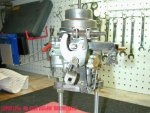
The attached pic is your carb on the build stand showing the position of the accel pump link when I assembled it.

I don't remember which distributor your engine is running. But if the dwell and base timing are incorrect (retarded), the result will be severe hesitation when the throttle is winged.

The dwell factor for the Holley distributor (either version) is 52*. The dwell factor for the delco distributor is 72*, huge difference!!! Base timing is the same for either distributor application. I don't use a timing light on these engines, I do the "power timing" deal described in this thread:

http://www.forums.IHPartsAmerica.com/ignition-tech/2122-ignition-power-timing.html
 

Attachments

  • DSCN0014.jpg
    DSCN0014.jpg
    74.1 KB · Views: 1,453
Last edited:
Thanks for the help. For some reason I didn't think of timing for this particular symptom. I just had the timing set somewhere that seemed reasonable, but it turns out it could handle way more. I don't know what the deal is, but I cranked that thing up to almost 25 degrees before I could get it to knock. The throttle acts much happier now. Still not much "get up and go" on this thing though. I suppose it's just kind of heavy for a 4 banger - though I have no top, gutted interior, no heater, not much of anything. It's about as light as it can be short of removing the doors and tailgate (which I May do to stop the rattling).

I just read your power timing thread again, and that's what I did, though I didn't think to readjust the idle mixture. I'll go do that now. Any trick there other than just turning it in until it runs rough, then backing out a little?

By the way, is it normal for these carbs to whistle at idle? Something in there is making a high pitched whistle and I'm 90% sure it's just the air through the carb. I can hear it at stop signs clear as day (no top).
 
Idle mixture is adjusted after all other adjustments are locked down. Simply diddle the screw for best idle quality.

Carb whistle?? Yeah, that's pretty common...most noticeable when no air cleaner is mounted or one of the aftermarket open element air cleaners is installed.

I believe it's caused by air movement past that roll pin that is pressed into the choke shaft ya see when you look down the throat. That pin is a design element that creates a disruption in airflow adjacent to the point where the main metering circuit is dumping metered liquid into the air stream.
 
I think stuff is running pretty well now. I drove the Scout on its longest trip ever (by me) to the muffler shop for pipes. This uncovered a leaking radiator cap and leaking master cylinder. These should be easy enough to resolve.

The last thing bugging me is that the engine is going "put-put-put" a little at idle when not hot. It's hard to explain, but it's like the engine is running mostly smoothly, but interrupted every second or two by a "put" or "put-put-put" thing. It's not loud. If you put your hand at the exhaust pipe you feel a little puff of air when it does it. My guess is that it must be missing? But why would this improve when it gets hot, and is there anything I can do to fix it? Playing with the choke doesn't seem to help any. Any ideas?

Thanks for all the help.
 
every "putt" you hear is a cylinder misfire.

Dialing back the timing seemed to help some. It's strange because I think I had it at the best spot for power (max for no knock). I'll have to experiment with it some more, but I think it's telling me to back off a little.

The reason I thought I had 20+ degrees of advance is because my idle speed was too high. I didn't realize I wanted to be all the way down to 500 or less. That seems very low to me. When I got it below 550 or so the advance leveled off at somewhere between 5-10 degrees. It looks like the centrifugal was kicking in on me and putting it up to 20 at 700-750 rpm where I was. I need to get a tach too, because the little meter I'm putting on the coil jumps around like crazy.
 
Remember to disconect and plug the vacuum advance before timing. I set timing to 34-36 total timing. Initial plus all availible centrifugal. Your IH May take more than that as it is not a so called quench combustion chamber and requires more time to burn as a result.

I have mine at 36 no ping and runs fine for what I expect and it is the same as yours.
 
remember to disconect and plug the vacuum advance before timing. I set timing to 34-36 total timing. Initial plus all availible centrifugal. Your IH May take more than that as it is not a so called quench combustion chamber and requires more time to burn as a result.

I have mine at 36 no ping and runs fine for what I expect and it is the same as yours.

I see no difference with the vac advance connected or disconnected. There appears to be no vacuum at all from the carb (to the distrib) at idle. Isn't this as it should be, where the vac advance comes in off idle? I know there is some debate about this, where some people advocate running manifold vacuum to the distributor, but I don't think that's the factory design. Right?
 
I see no difference with the vac advance connected or disconnected. There appears to be no vacuum at all from the carb (to the distrib) at idle. Isn't this as it should be, where the vac advance comes in off idle? I know there is some debate about this, where some people advocate running manifold vacuum to the distributor, but I don't think that's the factory design. Right?

You are correct about your vacuum understanding as it pertains to timing and idle advance vacuum.

But are only setting base timing, but inorder to verify total timing you need to increase the engine rpm until the mechanical advance maxes out. That will be some where like 2500-3000 rpm. If you leave the vacuum hooked up it will pull in just about all of the vacuum advance and that is not what total timing is. Total timing is only initial + centrifugal.

Using a dial back timing light set at 36 degrees turn the distributer till the hub Mark lines up with the "0" Mark on the timing cover. An sv will run fine at 36 total. If it pings below the point where centrifugal advance maxes out, the centrifugal advance is coming in to early or the vacuum advance is not falling off quickly enough.

I will alter total timing based on what the engine likes. I feel that power timing causes a chase your tail effect and when fuel and manifold pressures are variables, one needs to be a constant. For the most part power timing is a cover up for a poorly curved distributer and you can never get best max hp and torque by setting timing to where it pings. It should be on the ragged edge through out the entire rpm range at wot. (repeat statement) again if it pings below the point where centrifugal advance maxes out, the centrifugal advance is coming in to early or the vacuum advance is not falling off quickly enough. But it will like 34-36 total.

Don't get me wrong, I think power timing has it's place if one only wants to get the most outa what the factory stuff is capable. I believe in getting the most out of an engine period including altering its parts to optimum. This is not possible for the average guy and I want to make sure that is understood.
 
Last edited:
Finally got the 80 running on all 4, still got valvetrain noise, but thats another issue. The 1904 idle mixture screw doesnt seem to have any effect on the engine. Its sposed to be rebuilt, but that doesnt mean anything. Is there someone who can do a rebuild/refurb on these carbs?
 
finally got the 80 running on all 4, still got valvetrain noise, but thats another issue. The 1904 idle mixture screw doesnt seem to have any effect on the engine. Its sposed to be rebuilt, but that doesnt mean anything. Is there someone who can do a rebuild/refurb on these carbs?

Sure is! Look at this thread for more info:

http://www.forums.IHPartsAmerica.com/new-products-IH-only/3479-IH-only-north-fuel-systems-shop.html

I have three 1904 units in process right now for ihon customers, usually always have at least one going on, we do far more of those than any other mixer!

Call Jeff at 530-268-0864 and he'll get this started for ya . He'll give ya the dropship info and the carb will come to me for freshening. Once it's completed, ya settle payment with Jeff and he'll send me a packing slip and I'll return directly to your ship to address. Turnaround onna 1904 right now is about seven business days.
 
Last edited by a moderator:
Thanks michael...........these 1 barrels are greek to me, and reading about the economizer valve issues, seems it should be let to a pro on these carbs.
 
Michael, new to site but should of found it years ago. My 65 Scout 80 is in fine shape but the carb acted up about a year ago, just dumping fuel down the intake and outside down the engine.
So, I had a local mechanic put a kit in it and it hasn't been the same since, wont idle with anything less than about half choke and does a lot of backfireing through the carb. If you open the choke it will die. No adjustment what so ever on the air screw.

I've read every post in this thread and really don't see an outright solution. I can see where timing and distributer May need attention. I might add, I did replace the fuel pump with pretty much the same as origional, has the vaccum booster, and I'm seeing on here fuel pressure is critical.

I don't keep this in town so I need to arm myself with knowledge, tools and parts when I go down to the cabin.

If I don't have any luck, would it be wise to just start over on the carb? If so I'll bring it back with me and send it to you.

Thanks, jon
 
Back
Top