Holley 19XX Series Carb Stuff

Yep charles, yore carb has the nylon accel pump cam.

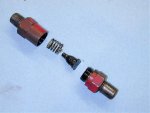
Here's a shot of the "cleanable" ac sparkplug pcv valve disassembled. There is a tiny orifice directly through the middle of the "cone" valve. That hole must be open and tends to clog with carbon and blowby/grunge as you describe. I clean those with a gas welding torch tip cleaner and carb spray, sometimes takes an hour or so to carefully drill through the orifice and open it up! Sounds like you already did that!

If the pcv was previously restricted/plugged, then the carb idle mixture can be affected! So now, re-adjust the idle mixture screw. When everything on the motor is "normal, that screw usually ends up at about 2.5>3.0 turns out from seated for reference.
 

Attachments

  • PCV 1.jpg
    PCV 1.jpg
    83.1 KB · Views: 3,029
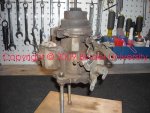
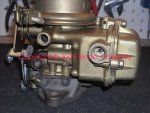
Continuing with the identification of single venturi carburetors used in many ihc/amc-produced engine apps, here we have a Holley 1920.

These carbs were significant redesign of the venerable Holley 1904/1906/1908 models. These were considered the first true "emissions" carbs used in ihc Scout 800 apps, for the introduction of the 196 and the implementation of the amc 232/258 engine installs.

These units share many components with the 1904 internally, but used a nitrophyl float unit, and much improved economizer valve/main well assembly. And...these are monolithic carbs, meaning the main body and the throttle body are a single casting. Idea was to increase the integrity of the assembly to prevent any fuel vapor loss to the atmosphere since evaporative emissions systems were introduced to IH vehicles during the same period.

The actual fuel bowl is the same part as used with the 1904, though the entire vent scheme is engineered specifically for the 1920.

These emissions carbs were used for a relatively short production cycle and were dropped in favor of an even more modern design...the Holley 1940 we looked at previously.
 

Attachments

  • Holley 1920.jpg
    Holley 1920.jpg
    111.4 KB · Views: 3,552
The 1920 shown in the pic here is the first one I've done in at least 25 years! So this one's a refresher course in how to build one.

Some time back, michaelp, one of our members here, sent me a box full of various Holley 1v carbs and parts to preserve for posterity. Primarily 1904 stuff, but there was a partial 1920 included in the pile.

So I compared the main well from that carb with the one I currently have on the bench for reconditioning. Significantly different.

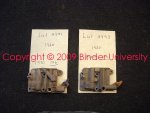
As can be seen in the pic, the main well on the left is a "two stage" version, the actuator lever seen on the right side end has two tips that engage the actual economizer/power valve "valves", one slightly ahead of the other. That lever is operated by a vacuum piston which is exactly the same part as used in the 1904.

The main well shown on the right is a "single stage" version, only one economizer/power valve element.

Again, this is because the carb on the left is an "evolved" 1920, two model years ahead of the one on the right. Again, the economizer system has much to do with emissions and drivability, no doubt Holley, ihc, and amc had to address customer complaints in a relatively short production cycle.

A careful analysis of both main bodies tells me that these main wells are interchangeable, the drillings in the main bodies of both versions are identical.
 

Attachments

  • 1920 Main Well Comparison.jpg
    1920 Main Well Comparison.jpg
    104.4 KB · Views: 3,004
I have read through this thread, lots of good info on the 1904.

I have what I hope is a simple problem. The vacuum port on my carb acts as if there is no passage to the barrel.

When I take the carb apart, I can see the passage in the bottom of the main body where the vacuum should come from. This passage is clear.

The strange thing is that the matching hole in the throttle body is a blind hole that does not go anywhere.

Where is the vacuum source for the advance port suppose to come from?

This is on a 1966 1000a bg241

thanks
 
Welcome to the ihon forum paul!

I just completed the same carb you reference for another member here. The version for the ihc six cylinder motors is a 3" center-to-center mounting pattern throttle body.

The ported vacuum signal originates in a tiny hole on one side of the throttle boy just "barely" above the throttle plate. Any vacuum signal that originates above the throttle plate is referred to as "ported" or "timed" vacuum, that is what operates the vacuum advance unit on your distributor as you know.

The vacuum signal for the economizer actuator is a manifold vacuum source...it's taken from that small hole on the manifold side of the throttle body. However, on the ihc applications of that hole, there is no corresponding port in the intake manifold flange to feed it! Thus, there is a tiny hole drilled below the throttle plate that intersects that hole, it's orifice size serves as a "control" point for the economizer actuator.

Any carburetor May have multiple points through the throttle body or venturi where ported vacuum signals May be tapped, they are designed to "cascade" into effect based upon overall vacuum level through the venturi and are part of an overall emissions scheme which gets very complicated! At least your engine has none of that crap!

When your engine is tuned for maximum performance, you should see between 2.0" and 4"hg of vacuum at the ported vacuum fitting for your distributor at curb idle. That is unlike many other carburetors which will show 0"hg at curb idle at their ported vacuum fitting.

There are many subtle differences amongst all the 1904 carb list numbers that were used on the ihc four cylinder and six cylinder apps. Several different accel pump actuators, choke actuators, various venturi diameters, main jets, mounting flange dimensions, etc. Some of it interchanges much of it does not.

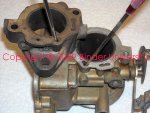
This pic shows the two ported vacuum "feed" passages, I've stuck a probe in each. Those mating surfaces are sealed by the throttle body gasket when the carb is assembled.

The carb I show in this classified is either the same list as yours or just a few steps removed:

http://www.forums.IHPartsAmerica.com/parts-sale/1774-Holley-1904-carburetor.html
 

Attachments

  • 1904 Ported Vacuum Source 002.jpg
    1904 Ported Vacuum Source 002.jpg
    89.3 KB · Views: 3,462
Thanks for getting back to me so quickly

your description of the carb matches exactly to what I have. The only issue is that the port in the throttle body does not have the drilled passage into the barrel just above the throttle plate. I have cleaned and inspected the area very carefully and it is just not there.

Can you post a picture of the are where the hole comes into the body? I guess I can drill it although it will be on a slight angle. Do you know what size it is suppose to be or is the size critical?

My guess is that this was missed somehow at the factory. The truck this is going is an all original numbers matching with
10,000 miles. Also, the carb that is on it is not the original, the stamp number on it of 158708r91 indicates it is a service carb based on the microfiche. My guess is that the carb was replaced when the original was crudded up from sitting. It is very possible that the previous owner never drove it enough to notice the problem.
 
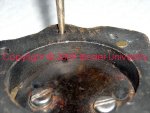
This is a macro shot of the orifice location in the throttle body bore for the ported vacuum signal.

When you locate that point for drilling, make sure the throttle plate is complete closed/seated in the bore. Notice how the hole is just partially covered by the leading edge of the throttle plate. That position is what "controls" the vacuum level at that point.

That hole appears to have been drilled at a slight angle as you indicated. I've verified that the size of that hole is a #51 drill or .067". I have a set of plug gauges I use for determining orifice sizes such as this.

The angle of that hole is not real critical, as long as it intersects the passage in the throttle body. But where it's leading edge is placed is kinda critical in order to not end up with too much vacuum at idle for the distributor advance diaphragm to see.

I surely don't doubt the hole was never placed...no tellin' how carb parts May have been mixed and matched over the years!!!

I've just completed that same carb for john in alabammee. He's got a great story to tell on the forum here about his truck which belonged to his granpa!

He'd sent his carb to the Holley "restoration shop" a few years back. But later the throttle shaft broke (very common on the 19xx mixers) so he was able to get a replacement shaft from Holley and then sent the carb to me for checkout and installation of the shaft. When I looked through the carb, I found several things wrong with it due to the fact that Holley had substituted wrong parts into granpa's mixer! So it took some time to work through the details and get granpa back on line! Just yesterday, I received granpa's distributor from john so it can be freshened also.

Keep us in the loop regarding your ride, sounds like a "special" one!!!
 

Attachments

  • 1904 Ported Vacuum Source Throttle Body 003.jpg
    1904 Ported Vacuum Source Throttle Body 003.jpg
    103.2 KB · Views: 3,452
That's what I needed. I will locate the hole very carefully and drill it.

You have been a big help, I have been confused by this for weeks. Glad I found this website. I have found out that real experts like yourself on old IH are hard to find.

I will let you know on my progress on getting this truck back on the road. Next issue is the brakes, as you can imagine, the brake fluid doesn't look too good after 43 years.
 
Michael

I drilled the hole as you showed and the vacuum advance works correctly.

I still have a problem that is probably very common to the 1904.
The body of the carb is distorted from the bowl screws being over tightened over the years. The bowl leaks and using a new gasket did not help.

How can I fix this? I have some permatex 2a which is resistant to gas. Can this be used on the gasket to seal it up better?

I also bought another 1904 list 1420 that is in great rebuildable condition except for the same leak due to the distorted bowl. By the way, this is the correct carb for my truck and it had the vacuum port hole.

Any suggestions will be appreciated.
 
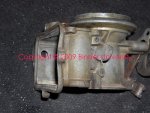
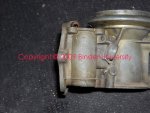
You are right, this is the number one issue with a 1904/1906/1908 carb...the distorted main body where the fuel bowl seats!

These carbs are made from a cast zinc process, the throttle body is cast iron. The zinc is relatively soft and malleable...up to a point! When that point is exceeded, it cracks. Some of the these main bodies will show stress cracking around any of those four screw bosses. Those bodies are usually declared scrap as fuel will always seep.

But, if there is no visible cracking, ya can fix 'em to a degree. The bowl itself is usually not damaged/distorted from over-tightening, it's always the main boy screw bosses.

I use a flat platen, large belt sander with an 80>120 grit belt...or a conventional belt grinder with the same belt and carefully lay the main body perfectly flat on the belt and apply very light pressure to the fuel bowl raised flange. Just enough to achieve a flat surface there. By relieving the flange, it allows the bowl to seat against the gasket and not bottom out on the main body due to distortion. It's very easy to "flatten" the flange just enough to prevent the bowl bosses from bottoming.

Some of the carbs have the p/n and list number stamped on the boss for the fuel line connection fitting. If so, that number set will be removed in the sanding process so record it for future reference if needed.

I do this process on every 1904 I service, it's standard procedure.

A 1920 carb uses the same fuel bowl (zinc) as the 1904 series, but those main bodies are cast aluminum and do not distort as easily as the zinc bodies so they are usually in good condition going in.

The 1904 in this pic went through the Holley restoration shop a few years ago (notice the very poorly done chromate job) and never had the main body repaired! This is a $500 restoration!!! Leaked like a bitch when the guy got it back! I've since fixed this one and corrected all the wrong parts that the resto shop installed! Notice the bowl is bottomed out on the main body!
 

Attachments

  • Holley Resto Shop Botch.jpg
    Holley Resto Shop Botch.jpg
    88.5 KB · Views: 3,788
Here's another recent 1904 recondition I did, again you can see the bowl bottomed out, this is a "before" shot as I received the carb.
 

Attachments

  • Warped 1904 1.jpg
    Warped 1904 1.jpg
    78.9 KB · Views: 2,093
Here's a cracked main body, this one seeped fuel continuously, so I installed a used main body and re-installed the original parts along with a kit.
 

Attachments

  • Cracked 1904 Main Body.jpg
    Cracked 1904 Main Body.jpg
    64.4 KB · Views: 1,941
Mike, have you had a chance to go thru any uh them my-t-fyne fwb units yet? That one with the schwinn throttle linkage looked ready fer immediate service.
 
This is funny as hail!!! That 1904 with the bendix brake reaction arm on it...I pulled it apart a few days ago and it's actually pretty decent for a builder though the main well is scruud, someone had completely pulled the economizer out and tossed it away! So that meant it has a main jet equivalent to about .500"!!!!

Of course, I removed the fabbed throttle lever and set aside after taking pics of how scruud over a po can make shit! Even a fwb kain't do that!

Then,...today...mendomikee is here and we're going over uncle ed and developing a rehab plan for the old bastard. The pos GM carb on ed is a pile and we wanted to drive unca while mikee is here. So I installed a fresh 1904...but the throttle arm needs to be "backazzwards". So I dug out that bicycle brake arm and mounted in the fresh carb and guess what....we went cruzzin'!!

Check out uncle ed's thread, we'll be updating tomorrow once we get the front wheel and brake system back on.
 
Now I been accused of keepin' secret schnizz away from the great unwashed masses here on ihon. So here's the story...

At the bee raffle I won a really fine fabbed Scout II tie rod that can also be used as a skid plate, high dollar sukker. The fwbeez ganged up on me inna moment of inebriation/celebration and scruud me out of it with a trade for a buncha junk carbs...real junk carbs and their ain't no scrap market for pot metal! Worst thang, the raffle ticket was momma's, so she really scored the tie rod/skid plate.

Next mornin' she wanted to know where the tie rod wuz, I told her it was under the sleepin' bag in my trailerbunk along with the mossberg cruiser slamcockin' sidearm. Only I lied so she'd leave me alone until we got home from tha bee.

When we got home and I unpacked them junk carbs, I found a 1904...but it wuz a freakin' Ford carb sumbody had scruud over bad to put it onna Scout 80! No doubt one onena them crapballs at cambo's joint! Hadda reaction lever froma dam kids chinee coaster brake bicycle tied on ta make a throttle arm, classic IH skinflint workaround!

So I parted out that carb as it was beyond redemption. Next thang I know, I need a "reverser" for uncle ed so I can install a carb that'll let him breathe guud.

So now them other fwbeez down south know I kin juryrigg jes' like them when called upon!
 

Attachments

  • Edcarb.jpg
    Edcarb.jpg
    102.2 KB · Views: 1,913
Hail, that luks dam near oe! Nuthin' wrong with that gittup. Wut kinda welcome shud I 'spect from momma come next month? You know that whole tierod deal wuz a john & cambo scru job. Me and jerry wudn't have nuthin' tuh do with it.:devil:
 
hail, that luks dam near oe! Nuthin' wrong with that gittup. Wut kinda welcome shud I 'spect from momma come next month? You know that whole tierod deal wuz a john & cambo scru job. Me and jerry wudn't have nuthin' tuh do with it.:devil:

Momma gonna welcum a fwbee like normal, she done got over the scruuin' I took...she straightened up right quick when I pulled tha slamcocker outta the bunk with no tie rod attached. She'll be even more congenial if she lands that j.o.b. In bend tomorrow, she's bunked over there tonite for anutha round of interviews.
 
Hey michael,
my name is henry. You helped me out a couple years ago when I first ever saw a 1904. Anyway now I am on my Scout 80/800 project. It is a 152 all stock pretty much. City driving is at 5000 ft. If that matters. I have been driving the Scout to work for about a week now. I just installed a new accelerator lever, the nylon one broke. As I was working on it after the repair today, I noticed a fuel stain. There is a leak. I had never seen the leak until today. I also think I have another issue with the economizer. I am not sure if I have two issues or the economizer one is causing the leak.

First off the leak. It is only visible only after shutting down. Fuel seems to drain from the bowl into the throat and drip out around the butterfly shaft. It only happens sometimes. And I am thinking this is why I had notice sometimes having to crank a bit to get it started... Only sometimes. I think I am having to crank in order to fill the bowl after it has drained.

Now a problem I think I am having with the economizer. When I first got the Scout I was leaking through the accelerator diaphram. So I got a kit from napa. Replaced the diaphram and also the economizer diaphram. During this time I noticed that the economizer valve down in the body seems to be real wobbly. It seems to go to the side when the plunger from the diaphram pushes on it. Now today after the repair to the lever I went ahead and put the vac. Guage on it to play with the mixture. I found out that at times I can screw in the mixture screw and the vac will come down and other times I can screw it all the way in and the eng. Will not die or even make the guage come down at all. It seems like possibly the leak I talked about is actually fueling the eng. When the mixture screw is fully seated. Then when I shut it down it just leaks out. I am thinking the valve is not seating and I am always in power mode.


Any thoughts? Not sure if maybe I would be better of having you take a look at it, if that is something you would want to do. I dont mind that except I would be left without a toy while you are working on the carb.

Let me know if I need to better explain anything. Thanks for your time -henry
 
Last edited:
Hail yes I remember ya!

The erratic operation of the economizer poppet is a common issue as you have found out!

If the poppet hangs open, then it runs super Rich all the time once the carb transitions off the idle circuit. If it hangs closed, then the symptom will be a significant leanness at wot or any time you create a low manifold vacuum condition (such as when accelerating).

What I would do only right now is simply adjust the float so that the fuel level is significantly lower than it is now. These carbs are very tedious regarding fuel level in the bowl...and the "specs" given for float level in typical kit instructions don't mean squat!

The fuel leakage from the throttle shaft penetration is caused by percolation of the fuel in the bowl after the engine is shut down. And then when ya go to re-start, there is liquid fuel puddled in the intake manifold plenum which creates the overly-Rich situation until the motor cranks and clears it's throat! Adjusting the float level to significantly "lower" will cure that problem as long as the actual needle/seat is closing off and holding.

So try lowering the fuel level, that is a no cost repair!

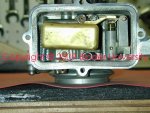
This pic shows the main body inverted and the weight of the float only pressing on the float needle. Notice the "angle" of the float as compared to the mating surface of the fuel bowl, it's not parallel. That is typically the float adjustment that works best for me, that is an eyeball deal I do on every 1904/1920 I service. And that has been verified extensively using the sight glass fuel bowl which Robert kenney fabbed for me!
 

Attachments

  • Float Inverted adjusted.jpg
    Float Inverted adjusted.jpg
    113.5 KB · Views: 2,491
Back
Top