

Mark Pietz
Member
So close to getting it off the stands but getting the carb to run half-way right is now the obstacle. Solutions May realistically take several weeks - or more - since I think I'll need some special bits, plus my day job has thrown me some curves and I'll be traveling more…
the mechanical stuff is easy, the tuning stuff is the pain if you are plowing new ground, which I most certainly am. I'm sure Robert will confirm that fact. Here's what's going on:
1) the carter yh side draft is a good, but not ideal, choice for what I'm doing. But webers are $$$$$, so it's the carter. I have some slop in the linkage which keeps the throttle from closing tightly. That will require a spot weld on the lever-thingie attached to the throttle shaft, re-sizing the hole on my bracket to the little cross-shaft doesn't move around (will post a pic to illustrate, but much of the problem is in this area), and adding an additional return spring and lever to that side of the carb. Again, a pic will illustrate the issues.
2) icing. Heavy frost built up on the exterior of the adaptor between the carb and the turbo compressor housing. The housing itself quickly warms - a relative term - from the a/f mixture it is mixing, even at idle. Yesterday I added the hot air tube from the snorkel back to the cast iron elbow and ran it. The adaptor now seems to only be cold and the frost has been greatly reduced. This shows that sufficient hot (100 degree plus) air is going into the carb. Much as I hate to think about it, I am thinking of pulling the adaptor and adding a block to its underside, by this I mean casting a block of zinc (900 degree melt temp, which is less than aluminum) to the existing aluminum casting, which shouldn't hurt the adaptor, and then drill it for a hot coolant passage. This should cure the adaptor's need for heat.
3) but the real problem is that the carb seems to be loading up and won't rev clean or crisp after warming and the choke comes off. Couple of thoughts on this: to make sure I'm Rich enough under boost while tuning, I put in the richest rod available. This rod/jet combo is custom made for these, since oem rods and jets are no longer available. The jet is a new edelbrock jet and the rods are machined to match oem flow specs, come in stock flow, and 3 richer steps (and three leaner steps) for tuning. I May be running "pig Rich", in fact hope that's the case as the fix is easier. I have the oem stock rod and jet and these were suitable for a 164 c.I. Engine but I'm 32 c.I. Bigger than that. But as this engine turns sloooow by comparison, that May at least put me back in the ballpark for crispness and decent throttle response while running n/a. If this is the problem, then I can tune from there.
I have an 02 sensor in place and found an old k&n a/f meter I forgot I had. I can hook it up to see what my a/f is (has those little lights). At least it will show if I'm running laughably Rich!
4) the yh had a problem with the float controlling fuel shut-off when the original 0.081" inlet float valves went away and were replaced by aftermarket 0.101" valves, or so it is reported. Flooding was common. I went to a custom ball-bearing valve style which helps some, but I am staring at probably running a return line and a regulator to get fuel pump pressure below 5 psi (my Scout pump puts out a healthy 5 psi). These are not insurmountable problems, but do have known solutions. This basic setup on my corsa worked perfectly so I know this can be fixed. It's just frustrating to have to do this so close to getting it on the road.
Edit 1: warmed it up. The k&n a/f meter indicates around 15.1 at idle, and vacuum is steady at 16.5 inches, which is good. Blipping the throttle isn't crisp but seems to be like if you have too much accel pump squirt (know what I mean? What they call "blubbering"?). But this doesn't seem to be reflected in the a/f meter, which runs no richer than the ideal 14.7 "light", maybe one light richer. Fast idle (2,500 rpm) it runs at those same lights, I.e., around 14:1 it May also be partly due to the fact that the intake tract is much longer, I.e., throttle blade much further away from the valve train. The adaptor runs tepid/cool, and the compressor housing is very warm, so whatever fuel that enters the turbo ends up being quite mixed and hot in the manifold, which is one benefit of a turbo. I don't seem to have any vacuum leaks (sprayed starting fluid around all joints and idle did not change). I think I've solved the problem of the leaking oil feed line.
Edit 2: pulled the carb. I definitely need to tighten up the linkage so the carb will return to idle. The little bracket swedged to the end of the throttle shaft is really loose and is half the problem, the other is linkage further down the line. A couple of tack welds will set some things right in this area. Looks like the fitting in the base of the adaptor (nipple for the pcv hose) wasn't screwed in tight. May have been a vacuum leak here. Took carb apart. The special ball-bearing float valve had rough threads and I didn't get it screwed into the carb top cover as far as it could go, so I think that fuel May have been coming into the float bowl around the threads. I have other evidence that the float level May have been way too high, as well. So now I am resetting everything and tomorrow should have it put back together and then we'll see what was what.
Scout is off the stands! Just need to get decent throttle action and a repeatable return to idle before I take it for a drive.
the mechanical stuff is easy, the tuning stuff is the pain if you are plowing new ground, which I most certainly am. I'm sure Robert will confirm that fact. Here's what's going on:
1) the carter yh side draft is a good, but not ideal, choice for what I'm doing. But webers are $$$$$, so it's the carter. I have some slop in the linkage which keeps the throttle from closing tightly. That will require a spot weld on the lever-thingie attached to the throttle shaft, re-sizing the hole on my bracket to the little cross-shaft doesn't move around (will post a pic to illustrate, but much of the problem is in this area), and adding an additional return spring and lever to that side of the carb. Again, a pic will illustrate the issues.
2) icing. Heavy frost built up on the exterior of the adaptor between the carb and the turbo compressor housing. The housing itself quickly warms - a relative term - from the a/f mixture it is mixing, even at idle. Yesterday I added the hot air tube from the snorkel back to the cast iron elbow and ran it. The adaptor now seems to only be cold and the frost has been greatly reduced. This shows that sufficient hot (100 degree plus) air is going into the carb. Much as I hate to think about it, I am thinking of pulling the adaptor and adding a block to its underside, by this I mean casting a block of zinc (900 degree melt temp, which is less than aluminum) to the existing aluminum casting, which shouldn't hurt the adaptor, and then drill it for a hot coolant passage. This should cure the adaptor's need for heat.
3) but the real problem is that the carb seems to be loading up and won't rev clean or crisp after warming and the choke comes off. Couple of thoughts on this: to make sure I'm Rich enough under boost while tuning, I put in the richest rod available. This rod/jet combo is custom made for these, since oem rods and jets are no longer available. The jet is a new edelbrock jet and the rods are machined to match oem flow specs, come in stock flow, and 3 richer steps (and three leaner steps) for tuning. I May be running "pig Rich", in fact hope that's the case as the fix is easier. I have the oem stock rod and jet and these were suitable for a 164 c.I. Engine but I'm 32 c.I. Bigger than that. But as this engine turns sloooow by comparison, that May at least put me back in the ballpark for crispness and decent throttle response while running n/a. If this is the problem, then I can tune from there.
I have an 02 sensor in place and found an old k&n a/f meter I forgot I had. I can hook it up to see what my a/f is (has those little lights). At least it will show if I'm running laughably Rich!
4) the yh had a problem with the float controlling fuel shut-off when the original 0.081" inlet float valves went away and were replaced by aftermarket 0.101" valves, or so it is reported. Flooding was common. I went to a custom ball-bearing valve style which helps some, but I am staring at probably running a return line and a regulator to get fuel pump pressure below 5 psi (my Scout pump puts out a healthy 5 psi). These are not insurmountable problems, but do have known solutions. This basic setup on my corsa worked perfectly so I know this can be fixed. It's just frustrating to have to do this so close to getting it on the road.
Edit 1: warmed it up. The k&n a/f meter indicates around 15.1 at idle, and vacuum is steady at 16.5 inches, which is good. Blipping the throttle isn't crisp but seems to be like if you have too much accel pump squirt (know what I mean? What they call "blubbering"?). But this doesn't seem to be reflected in the a/f meter, which runs no richer than the ideal 14.7 "light", maybe one light richer. Fast idle (2,500 rpm) it runs at those same lights, I.e., around 14:1 it May also be partly due to the fact that the intake tract is much longer, I.e., throttle blade much further away from the valve train. The adaptor runs tepid/cool, and the compressor housing is very warm, so whatever fuel that enters the turbo ends up being quite mixed and hot in the manifold, which is one benefit of a turbo. I don't seem to have any vacuum leaks (sprayed starting fluid around all joints and idle did not change). I think I've solved the problem of the leaking oil feed line.
Edit 2: pulled the carb. I definitely need to tighten up the linkage so the carb will return to idle. The little bracket swedged to the end of the throttle shaft is really loose and is half the problem, the other is linkage further down the line. A couple of tack welds will set some things right in this area. Looks like the fitting in the base of the adaptor (nipple for the pcv hose) wasn't screwed in tight. May have been a vacuum leak here. Took carb apart. The special ball-bearing float valve had rough threads and I didn't get it screwed into the carb top cover as far as it could go, so I think that fuel May have been coming into the float bowl around the threads. I have other evidence that the float level May have been way too high, as well. So now I am resetting everything and tomorrow should have it put back together and then we'll see what was what.
Scout is off the stands! Just need to get decent throttle action and a repeatable return to idle before I take it for a drive.
Last edited:
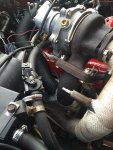
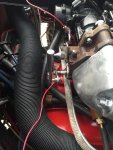

 underhood clearance is limited and a down draft isn't in the cards, at least as far as I can see. IH only got away with the 152t and the 1-bbl Holley only because under hood clearance in an early was significantly greater. The real solution, though, is efi. Period. (don't let bill usn-1 see I posted this!
  ). But that's for down the road….
 smells like hot, dry exhaust that hadn't been run through a cat. I did the paper towel thing against the tailpipe and it stays clean and quite dry. I don't smell anything unusual.
 I need the Scout to be a driver right now more than anything else. So my plan is to carefully remove all these pieces and box them up, for some future day, and put the original parts back. I'm hoping that a few oil changes will clear out the aluminum fines that resulted from the bearing failure. Hope I haven't done any real damage to the engine, but time will tell.

