IHC Vehicle Distributor Identification

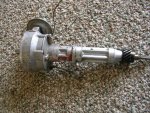
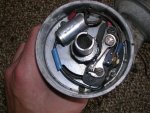
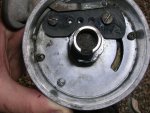
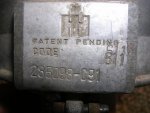
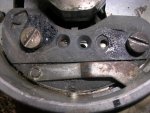
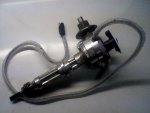
Pictures of Holley straight point distributor

this was traded in on a reman Holley curved point distributor which I installed a petronix kit on. My Scout has never ran better than now after rebuilding the carb and the ignition upgrade. This site has been a great help.
 

Attachments

  • DSCN2888.jpg
    DSCN2888.jpg
    146.2 KB · Views: 1,824
  • DSCN2889.jpg
    DSCN2889.jpg
    89.2 KB · Views: 2,067
  • DSCN2890.jpg
    DSCN2890.jpg
    79.3 KB · Views: 1,611
  • DSCN2891.jpg
    DSCN2891.jpg
    68.9 KB · Views: 1,400
  • DSCN2892.jpg
    DSCN2892.jpg
    76.3 KB · Views: 1,697
Thanks for posting the pics 77!!! Great shots that really tell the story!

The straight point distributor works just fine as long as the plastic insulator is not cracked/distorted which occurs over time. When that happens it's impossible to keep the dwell set and the vacuum advance movement becomes erratic or simply "sticks".

Other than the breaker plate system and the dedicated vacuum advance (we have re-manufactured advance canisters is stock now), the distributors are identical to the later Holley/IH 1510 sparkers and can be converted. The straight point units can also be used as a core for a mag trigger conversion but require some additional work to do so.
 
thanks to monte and his fil ron, I was able to add to the distributor collection here at binder u. So we can continue updating this thread.

This a prestolite idn-4000 series electronic distributor. These units were phased into light line vehicle production towards the end of the m/y '77 production run. However, they commonly May be found in "retrofit" applications on any I-4, sv, mv, lv engine application, sometimes as a replacement for the Holley 1530 gold box system.

Easily identified due to the use of the male cap terminals, the "square" section design of the body below the cup, and the removable portion of the vacuum advance assembly which retains the calibration spring.

The white wire found in the harness pigtail is used as part of the emissions-related dtm system on some vehicles, and has nothing to do with actual distributor operation. In many applications that wire is simply hanging and not connected to anything.

These are outstanding sparkmakers!

I found one of these distributors in my pile of parts, no gold box or anything else is needed? Will a high output coil improve this distributor? What kind of upgrades to other components would you recommended for optimizing this distributor set up?

Thanks for any help on this.
 
Last edited:
All electronics (including the amplifier) are built into the prestolite idn distributor variations. The electronics are underneath the breaker plate assembly.

Those are outstanding distributors, but if the amplifier takes a hike, then they are very expensive to repair. Service parts are readily available (including electronic guts) for those units.

There is no benefit in changing to any other coil to use with that distributor. The oem coil (same as used with breaker points) is capable of producing in excess of 20kv when used with that distributor and that upper limit will never be bumped on a basically stock engine. That system is inductive, and as such, the coil produces only the voltage needed at any one firing opportunity to ionize the plug gap. On average, that is a nominal 4kv>7kv on a new fresh sparkplug and around 10>12kv on a typical plug with say 10k miles of service on it.

Say you mounted a msd "blaster" coil on that engine with that distributor. The "turn ratio" of that msd part provides a theoretical upper limit of around 30kv (only 10kv greater than stock). But again, that engine will never see the need for that kind of "voltage available" unless you open the plug gap up to over 0.100" which is totally stupid!
 
Okay, thats some good news there! Another question I thought of was this distributor came off my 78 345, will it need or even can it be re calibrated for use on the 72 392 with the comp cam in it or is it just plug and play
 
okay, thats some good news there! Another question I thought of was this distributor came off my 78 345, will it need or even can it be re calibrated for use on the 72 392 with the comp cam in it or is it just plug and play

Any "emissions" distributor could benefit by having it recurved by someone who specializes in this business. It is not difficult to do, but is best done on a machine made for that purpose and performed by someone who has access to various springs, small parts, etc. For doing this work.

But in order to simply run the motor once you have it going, simply install the prestolite and wire it properly. We've posted the wiring information around here time and again!

There is bound to be an old time garage or speed shop in anchorage that does this stuff using a distributor machine. If not, then contact philbin electric in portland, or...they are on the 'net and great folks to deal with.
 
Brand new to this forum so please excuse me if I'm not doing this right. I have been viewing this site as a visitor and have found that there is a lot of IH experienced people here so I have become a member.
I have a question regarding an International distributor that I need help answering. I would like to identify my distributor/ingition system in my 1977 IH loadstar w/446 engine.
I have been having trouble with no spark after the engine is warm and must cool off before it will run again.
The numbers on the distributor are : 446918-c92 0467
I am enclosing pictures of the dist. And control electronics.
The IH dealer in my area says there are no parts available for it so I either need to find parts or convert it to one of the petronics systems?? Can anyone point me in the right direction.

international_truck_electronic_ignition
[/img]

international_truck_distributor_2


Bob's photo album
 
Welcome to ihon Bob, we accept all customers/members and if we can't help ya we'll send ya to folks that can!

I'm not really familiar with your exact vehicle at all, but it does share many components/systems with the stuff that we are intimately familiar with.

The distributor/ignition system you have is a Holley gold box electronic unit, from your picture in your album it appears that it is the version with both a tachometer drive and the segment used to operate an engine governor (in conjunction with the carburetor).

However, your "gold box" is most likely not "gold" in color but is either black or silver. The "gold" cover amplifiers were used in the light line applications, black or silver in medium duty apps. We have "gold" amplifiers available here new, but not the black or silver versions.

However, I'd recommend the exact path you have suggested...convert the unit to a pertronix trigger which eliminates the need for the amplifier at all. And...your same ignition coil will work just fine.

The condition you describe fits the failure mode of the amplifier exactly...over time heat finally kills 'em.

So...which pertronix? The pertronix application guide/catalog is very ambiguous in this regard as the only listing they show for a mv 404/446 is for the prestolite electronic distributor...that is incorrect in your case!

The correct pertronix conversion for your distributor would be the one that is specific for the gold box system...pertronix p/n ho-181.

I've attached a .pdf of the distributor technical specifications for your distributor based upon the part number you referenced. Ihc refers to that particular model distributor as a "1530" whether used with the tach drive/governor or not. 1530 identifies it as a Holley electronic trigger (hall effect), and all variations of this distributor are covered in depth in the IH master service manual for all these vehicles, cts 2300 which is around 3,000 pages in depth!
 

Attachments

  • MV 404_446 Distributor Specs.PDF
    651.2 KB · Views: 2,439
Thank you so much for the information.
Reading this forum I knew I was onto something, seeing the years of experience from both the moderator and guests.
My hunch was correct.
Great site!!!!
 
Hello techies again,
purchased and installed a pertronics ignition in my Holley distributor and it works great... While installing it I noticed that the vacuum advance canister does not work.
I have read on this forum that there is someone that re-builds them but does not specify who.
So, my question is whom and where?
Thank you for your help in advance!
Bob in ohio
 
Last edited:
Ain't it great when stuff works Bob??

The vacuum canisters used on the Holley distributors are a weak link always. We haven't been able to source those through conventional auto parts sources for many years.

I can't check the actual inventory at the primary shop in Grass Valley from my location. But...we "should" have a few of those vacuum canisters on the shelf for your distributor that are remanufactured for us. We send 'em to our rebuilder in batches of ten at a time, they only tool up to do vacuum motors in a production run once per month if they have enough cores to justify a setup. And, they deal wholesale only. Here's a link to the distributor cans in the online store:

remanufactured vacuum advance unit for Holley distributors - International Scout parts
 
continuing on here with distributor I.d., here's a delco cast iron body distributor. These units were used in both I-4 and sv applications, only difference is the breaker point cam lobe configuration (either four lobe or eight lobe). In some cases, the vacuum advance can and overall advance curve varied so for positive id ya need the number off that aluminum band wrapped around the lower distributor body. That number can then be crossed over in the specifications charts in the appropriate service manual for details regarding the setup.

I personally think that these distributors were the best units used, extremely durable as compared to a Holley. The top bushing is lubricated periodically from the oil cup as shown.

The breaker point gap/dwell is adjusted with the appropriate hex key through the sliding window in the cap.

What is the proper oil to lubricate the bushing with?
 
brass only! --Jeff

I have the gold box ignition - replaced wires-plugs-cap-rotor-coil-cond-installed ho-181 pet - can not get fire to plugs- have not pulled dist- is it possible the dist is loosing ground via hold down clamp being dirty/oily - also the just discovered the diaphram in vacum advance is leaking - - what can I try next
thanks for any & all help
 
Welcome to ihon chig!

With the pertronix conversion, the distributor ground is not important. However, the rest of the wiring for a gold box-equipped vehicle is completely different compared with a pertronix installation in a breaker point vehicle/distributor.

And...unless p-tron changed the instructions for the gold box install recently, the instructions are very ambiguous.

Did your p-tron kit have a black delrin "spacer" segment that is separate from the magnet wheel that you placed over the original reluctor? If so, then it goes down over the reluctor first, followed by the magnet wheel. That properly locates the magnet wheel in relation to the p-tron pickup module.

Review this thread:

http://www.forums.IHPartsAmerica.com/ignition-tech/3706-no-spark.html
 
this thread will be a repository of information regarding any and all forms of ignition distributors used in ihc vehicle applications over the years. We'll discuss both breaker point-triggered inductive units, along with the electronic trigger units which were phased in during the early/mid 1970's.

Hello - have the Holley/elctronic gold box setup- could not get fire to plugs aftr replacing cap-rotor-coil-plugs-wires still no fire - went with pertronix ho-181 - still no fire - vacum advance cann now leaks - so I feel the best thing to do is just replace yhe distributor and upgrade - do you have have any recomendations on which one - I thank you in advance for your help
johnny
 
Yes, vacuum advance cans for any Holley distributor are not available new, but we have remanufactured units on the shelf in the store right now:

remanufactured vacuum advance unit for Holley distributors - International Scout parts

Why give up on a pertronix-converted distributor??? No doubt something is wrong with your wiring setup if you can't make it operate correctly. Thousands of these units are in service every day.

New distributors for IH applications are available from mallory in both point-type and in the unilite electronic unit. However, they do not come with a drive gear installed, you have to supply the drive gear and set the endplay at the time of installation.

Remanufactured/converted delco hei distributors are available under the dui (davis) brand in our online store also. These are hei upper portions married to an IH-pattern lower:

performance dui hei distributor - International Scout parts
 
next up we have a Holley "gold box" electronic distributor system (IH model 1530 designation).

The gold box label can be a misnomer...depending upon which IH platform these units were installed in, the electronic module could also be either silver or black in color.

The distributor body, shaft, and mechanical advance is essentially the same items as used in the Holley breaker point distributors (cast aluminum body). However, a "reluctor" is present in the electronic distributor which takes the place of the breaker cam component in the points unit.

There were many different part number distributors used throughout all IH applications, the differences are in the mechanical advance curve, and in the vacuum advance canister calibration.

This design is referred to as a "hall effect" trigger and that trigger must be used in conjunction with the properly matched electronic module, the hall effect sensor in the Holley unit will not trigger an aftermarket ignition box such as a mallory 6 series, msd 6 series, etc.

Regarding the distributor in the pic, the vacuum can is dead...a common fault regarding Holley distributors as found on IH stuff in general. New cans are not available any longer, however, a few companies do "rebuild" non-func vacuum cans routinely.

The electronic module is currently available as a new replacement as well as the trigger/sensor.

This is an edit to correct the air gap spec previously posted:

if the trigger is ever removed from the body for either cleaning or replacement, then the "reluctor air gap" must be set using a non-magnetic thickness gauge, that spec is 0.008" +/- 0.002".

Thanks in advance for your help
I have a dist just like the pictured here - installed the ho -181
ignitor - still no fire to plugs - saw a pic that showed I believe a prestolite a ground wire from sensor - to dist - ok do u think I could have the wrong cap? Have the Holley style - please feel free to call me -cell 432-296-8991 - work 800-677-2747 anytime !!
Thanks again
johnny
 
Please post a pic of your actual distributor.

Yes, it's possible that it has the wrong cap, that would certainly lead to mis-identification. But...a Holley gold box system also has the electronic module mounted on the firewall. A prestolite electronic distributor has the electronic module inside the distributor.

I sometimes use the prestolite cap on a Holley distributor, but a few modifications must be performed in order to do that in a correct manner.

A prestolite electronic distributor has a pigtail coming out of the body with three wires, the third wire (normally white with a female single connector) which you referred to as a "ground" is not a ground, that is the sensor lead that goes to another electronic item on the firewall known as the "dtm" module and is part of the emissions system and has no functionality actually as far as the basic ignition system is concerned.
 
The fsm calls for .030" end play of the distributor shaft. That sounds like a lot.
I found a brass friction washer that fit and reduced the end play to .012" hoping to get more accurate timing.
I still have not started the engine and now have second thoughts about my modification.
Should I try it or take out the shim and go back to .030" ?
 
the fsm calls for .030" end play of the distributor shaft. That sounds like a lot.
I found a brass friction washer that fit and reduced the end play to .012" hoping to get more accurate timing.
I still have not started the engine and now have second thoughts about my modification.
Should I try it or take out the shim and go back to .030" ?

I know what the "manual" specs are, and I totally disagree with 'em. In fact, that same "spec" goes back into the stuff produced prior to wwii which has nothing in common with the stuff we're talking here!

And...the expansion rate of a cast iron delco or a cast iron Holley distributor is virtually nil at normal engine temps! The aluminum distributors maybe expand a slight amount. But...I've heated a scrap Holley distributor with a torch nearly to the point the aluminum surface oxidation layer was weldable (with proper flux) and measured only a 0.002" decrease in end play, that is a far higher temp than any distributor will ever see!

The Holley, the prestolite, the aftermarket mallory, are all cast aluminum, not billet material. The prestolite and mallory are simply finish-machined a little nicer and "appear" to be billet material, the prestolite looks like a high pressure die casting to me.

All the distributors currently running in my rigs are set up with 0.010" endplay. The mag trigger converted units we'll hopefully be able to offer through ihon in the future will be set up at 0.010>0.015" endplay when they leave the shop.

The prestolite also uses a "thrust washer" between the mechanical advance and the top body bushing. That bushing has a stamped shoulder in it to center it in the slight chamfer at the top of the bushing. Likewise, between the gear and the end of the body, the selective fit washer also has a shoulder to "center" it, then the actual shim is inserted after selective fitting, most have at least two washers in that location, many have three.

A brass shim/washer will work ok for awhile, but no doubt they will wear fairly quickly. I see steel shim washers in the prestolites that are significantly worn also, don't know why other than the material used was not a proper hardness to serve as an endplay shim.

Overall the cast iron delcos are by far the best as far as "endplay" and retaining proper spacing. But they do have major issues with corrosion since the mechanical advance stuff is on top and the access window for the breaker point dwell setting is usually missing or stuck in a position that allows moisture and grunge to enter.

 
I'm trying to identify the correct replacement vacuum advance unit for my distributor. The vehicle is a 1968 Travelall 1000 with a 304 and automatic transmission. The distributor is a Holley 1510. I've read on this thread that there should be a number pressed into the arm of the vacuum advance unit but on mine the arm is absolutely devoid of markings on both sides. The outer housing of the unit, however, is stamped with "677-5". Does that mean it would be 5 degree unit?
 
There is a cast-in "pad" on the side of the distributor body which will have the ihc part number for that distributor stamped in place, along with a series of other numbers. If you will post the number, I'll make a positive id of the distributor in question, and be able to refer you to the exact specifications for that unit by part number.

Not every vacuum advance unit has a single digit number stamped on the actuator arm. And if there is a number present, it refers to the point at which the vacuum signal begins to overcome the internal return spring. In other words, it refers to the point where vacuum advance just starts to operate the breaker plate.

The slight variations in the vacuum advance unit calibrations came into being most generally with the more stringent federal emissions requirement circa 1968 and again in 1973. That is why the variations in vacuum advance callouts. In actuality, in the real world of engine operation a slight difference in vacuum advance "kick-in" is totally un-noticeable.

In virtually all part number occurrences of the 1510 distributors of the era you describe, the initialization of vacuum advance is given as a 5-7* "tolerance".
 
Back
Top