Holley 23XX Series Modular Carb Stuff

Thanks for the input so far. To make the story a bit clearer. As mm probably knows, I often swap back and forth between my *legal* 2210c and my built-up/tuned 2300, depending on the biennial time. About two years ago, I pulled the 2210c off and installed the 2300. It idled roughly on one barrel (iirc, the right side), and the right side idle screw had little effect, but the left side idle screw functioned normally. The carb came stock with the blue gaskets, and I obtained a new set of gaskets, removed the fuel bowl/metering block, cleaned them up (incl air and aerosol) and installed w/ new gaskets. Pretty much the same idle. After the second time, iirc, the idle prob was gone.

Now, I just did the swap again 2300 for the 2210c, and the same rough idle thing is happening. I did have the fuel bowl/metering block off a month or so ago for a cleaning, but re-used the blue gaskets. Did not seperate the main body and throttle body, but did tighten the screws.

Like I said before, plugging the right side primary idle air bleed jet (the outboard one visible in the carb throat and in front of the venturi) makes the idle quality better and rpms slightly increase.

So, this tells me that the internal idle mixture (in the metering block) is too lean, yes? Air leak in metering block gasket, most likely. Just exacly where, is the mystery to solve.

I was reading my old Holley carbs book (dave emanuel, s-a design books - 1980) to refresh my knowledge on the Holley metering block/idle circuit details.

I think I've got a spare new blue metering block-to-main body gasket around to try in there, too.


And on the rotor/hub issue: I've got a good friend (Scout owner, too) whose Dad owns a production machine shop and has a large lathe and access to disc brake lathe adapter cones. The plan is to take both hubs, sans rotors, down there and turn the inner surfaces (the hub-to-rotor surface) true and smooth. Then I'll re-install and see how off the rotors are. I think it's only about .005-.008 off, at the braking surface.
 
Like I said before, plugging the right side primary idle air bleed jet (the outboard one visible in the carb throat and in front of the venturi) makes the idle quality better and rpms slightly increase. So, this tells me that the internal idle mixture (in the metering block) is too lean, yes? Air leak in metering block gasket, most likely. Just exacly where, is the mystery to solve.

Plugging the air bleed richens the iafr two ways by reducing the air introduced into the idle fuel emulsion and increasing the fuel flow due to an increase in the fuel signal strength

I think I've got a spare new blue metering block-to-main body gasket around to try in there, too.

For sake of finding once and for all wether air leak or fuel restriction exists, only swap in the new gasket without doing anymore cleaning. Problem goes away than it was a air leak if not than it is a fuel issue.

I would like to know also as I have only had one proven air leak issue with the center hung carbs. In most cases the metering blocks have been off and on 25 times between new gaskets doing tuning at the track

Robert
 
I'll be at work the next two days, so I won't be able to get to carb tinkerin' until thurs or fri.

Hey, at least I've isolated the problem to the right side...
 
Hello : I am new to this forum. I have a '65 co 1700 loadstar with 345, 2300g carb., and IH ( Holley? )1510 dist. The governor is disconnected and I have some questions related to both the distributor and carb. If I can figure out how to post some pictures, can you help me with my questions ? I have been reading your info on 2300 carbs and various distributors - very informative ! Nothing else like it that I have been able to find - anywhere ! Thanks, jeb
 
Welcome to the forum jeb!

Of course we can help!!!

And one of our members here has a "back country" fire truck just like you described that I've worked with. The pics in this thread of the 2300g are the carb I built for that ride. The governor system on it is non-func because the distributor has been changed out, so it operates like a light duty vehicle system...no governor function.

And another member here has just picked up a used 2300g that I've been helping him with.

I do have a real nastee 2300g on the shelf here for reference, guess this might be a good opportunity to go through it and bring back to life??

So bring it on!

The best thing to do here is start a new thread for your carb issue, that way it helps greatly for the "search" function here to index! That in turn helps other folks!
 
Hey Mike do you have a 2300 series carb for orange? Possibly one witha an electric choke?
 
Last edited:
I recently acquired an IH-remanufactured Holley 2300 list 2977 clean, in the box with the dealer sticker still on it. The overwhelming temptation is to just pull the sticker and install it as-is (on the 304 in my friend's '74 Scout II), but it looks like replacing the old style gaskets and other non-alcohol-resistant components first is probably a better idea. Any thoughts? Wwmmd?*

*what would michael mayben do? :d
 
I'd run it as is if ya think it's "like nu"!

That will get ya a few years of service before gasoline is eventually banned from use by the feds and ya figgr out how to power your 'lectrik motor conversion from moonbeams bounced off owlgore's ass. Here's to ya owl-->:ciappa:

but...put a screwdriver on every scruuhaid ya see on that mixer and tighten!

Then once ya have it mounted and fired up, set the fuel level in the bowl once it's warmed up.

I'm jealous! I'm building two similar carbs right now for ihon customers, one issa 2997.
 
Thanks for the quick reply, Mike! I'll make sure she's together real tight and let you know how things work out. I can't wait to see my pal's rig back in service -- especially knowing it would offend the goracle. :p
 
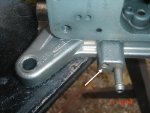
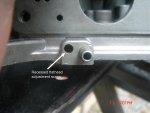
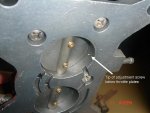
What does the recessed needle screw on the front of the carb base adjust? It's not the idle mixture screws, but ports below the throttle plates. See photos for more detail. All components are described below.

Holley carb model 2300 part 442163-c91, list-6391-1. Sticker showed it was a reman unit from the 90’s. Currently mounted on my 1973 1310 4x4 pickup. 345 engine, t-19 trans, NP205 transfer case, d70 front and rear with 4.88. Everything is basically factory original.

IH 1510 distributor 433142c91 updated with petronix ignitor II. Original vacuum advance was a 3, but I've replaced with a functional 5.

Thanks,
nick
 

Attachments

  • 1.jpg
    1.jpg
    48.7 KB · Views: 1,101
  • 2.jpg
    2.jpg
    60.3 KB · Views: 1,102
  • 3.jpg
    3.jpg
    59.3 KB · Views: 937
  • 4.jpg
    4.jpg
    40.1 KB · Views: 999
  • 5.jpg
    5.jpg
    52.7 KB · Views: 2,319
Some list number have that port...though in many cases it's plugged with a lead ball, after the adjusting screw is lightly bottomed out in the control orifice where you can see it protruding.

It controls a vacuum bleed to the metering body and is not used/active on that particular list #.

I built one of those same carbs last week for an ihon customer, first one I've run across in several years.

Good eyes man! Good question!
 
Can anyone help me find out what jets I need. My carb is running extremely Rich. I believe its a 2300 series carb. I found two sets of numbers on it. One located right above the air fuel ratio screw on the right side of the carb( looking at it from the left side of the car #6392-3 and on that I found that under where the air filter goes #7448-1. I live at 6500 feet.

Thanks
 
That carb would be a Holley 2300 aftermarket replacement with a "center-hung" float/fuel bowl system. Outstanding replacement carb for any 304 or 345 IH motor.

Out of the box it had #62 main jets and a #65 power valve. For operating altitudes of sea level to 3000ft., that works "ok" though I normally set 'em up with 60 mains for the carbs we do at ihon for customers. That is a starting point for jetting and the enduser must verify and adjust as needed.

For operation at 6500ft.+, I'd jet it at #58 for a starting point and go to a #45 power valve. Once the motor is fully up to operating temp, adjust the idle mixture screws for highest manifold vacuum. At your altitude, best vacuum that could be achieved would be 12">14"hg. A properly tuned motor at sea level will make 19">20"hg.

The ignition system must be totally up to speed and base timing dialed in before making any tuning adjustments to the fuel delivery system...imperative!! A 304 or 345 can run up to 12*btdc base timing using "regular" grade fuel at that altitude.
 
I don't understand your question...do you mean a rebuild kit?

If so, then yes, the hly-37-1543 is the correct kit for your list number carb. Most any full service parts house will have those hanging on the wall...an extremely fast moving part.

It will not contain any jets as jets are rarely ever changed in a carb rebuild. It will include a new #65 power valve which is not the best calibration for your altitude but is not a deal-breaker. Power valves are available separately from any retailer that sells Holley stuff. Same for jets, they are sold in blister paks of two in all sizes from #40 (the smallest orifice) to #110. Main jets needed for any IH engine application tend to be much "lower" in numerical value. And Holley jets are not "sized" the same as edelbrock, carter, rochester, etc.

Typical main jet range used across the board in IH sv and I-4 carbs is between #65 at the largest, down to #51 as the smallest (rated in liquid fuel flow volume). And those are values used for specs which represent "sea level" operation which is the industry standard.
 
Last edited:
Thanks alot for the quick reply. Sorry for not explaining clearer. I want to lean out the carb a bit. So im wondering what I need to accomplish the task. Including part numbers if you could.
 
thanks alot for the quick reply. Sorry for not explaining clearer. I want to lean out the carb a bit. So im wondering what I need to accomplish the task. Including part numbers if you could.

Part numbers for Holley gasoline jets always begin with a prefix of 122 followed by a hyphen and the actual jet number by size. This a #58 jet would carry a Holley p/n of 122-58.

Part numbers for modular carb power valves likewise carry a prefix of 125, followed by a hyphen and then the number for the power valve calibrations such as "45", "65", etc.

Two stage power valves are id'd with a code number that crosses over to the first and second stage actuation point.

Take a trip through the new Holley website and parts catalog at:

Holley performance Holley products

And educate yourself regarding the various tuning components available.
 
Back
Top