Holley 22XX Series Carb Stuff

Sorry I missed this boyz...I been actually doin' meaningful work around here...got rookies enrolled at binder u. That take much supervison, we're trying to finish off installation of a highly modded after market 30 gallon fuel tank tonite. Tanks' under pressure test right now.

Lower the float to whatever makes it not drool liquid down the throats. Again, scruu tha specs, make it work!

Don't know about any "Holley pop", if it's spittin' back through the intake, then a valve(s) hangin' open or the timing is somewhat retarded. Again...scruu tha timing light, advance it until ya get detonation under load, then back the timing down a touch until it goes away.

A 22xx won't "blow" the economizer/power valve if it spits back through the intake like really old Holley modulars might. If the pv was blown (or loose), then extreme richness would be experienced as the power valve is equivalent to 5>8 steps Rich over the size of the main jets. And this richness could not be "adjusted out" with the idle mixture screws.

Is there any lifter noise that won't go away? If so, that could be a valve that is trying to stick from lack of lubrication...that comes on very slowly over time. The lifter rattle is a key to that if present, valve is sticking in guide (trying to seize) and/or a rocker arm is partially seizing.

As in some of the other threads you've no doubt now read, do a visual of the carb fuel/air delivery by looking right down the bores while opening the throttle slowly, were a face shield for eye protection! Watch for "globs" of liquid fuel forming/drooling, and of course, look for a heavy, solid accel pump discharge "shot" each time the throttle is whacked.

Do you have the oem-installed "heat dam" base gasket between the manifold flange and the carb? The one with the "projection" under the fuel bowl, not just the thick base gasket?? That is a fel-pro supply part, originally spec'd for the Scout II with this carb, fel-pro # 60677. And did your carb kit include the "thick" throttle body-to-main body gasket? That is also a heat insulator, not just a gasket.
 
Regarding the "altitude" thang...and we're talkin' carburetors here...not fuel injection...

If you have a carb jetted ragged edge for your "normal" operational elevation, and you are running the ignition system at maximum advance for the fuel grade used (in my case, always "regular" whatever that means at that point in time), then occasional detonation (ping) under heavy load can be experienced. And that would be with a distributor that has been "curved" for max performance, not a woreout oem distributor.

That basically describes tuning one of these motors for max power/burn efficiency and charge density (non-heated intake manifold) and has nothing to do with "factory spec", "emissions spec", etc.

Then without changing anything except the operational altitude...the rule of thumb for non-forced induction, gasoline-fueled engines is for a 3% power drop for every 1,000ft. Increase in elevation. And likewise, that represents an approximate 3% in air/fuel ratio "richness" over the same range. Again, this is rule of thumb/seat of pants stuff ya can take to the bank.

Most folks don't wanna re-jet a carb unless they May be staying at a different elevation for an extended period of time. Some improvement in drivability May be experienced by tweeking the idle mixtures though, but then when the elevation decreases, another adjustment will be needed.

The increased richness due to the lower air density at altitude will actually tend to "cool" the combustion charge, allowing a slight increase in base timing without going into detonation. It serves to "mask" detonation in a roundabout fashion.

Adding an adjustable timing control to an add-on capacitive discharge "box" such as an msd 6 series, or the mallory 6 series allows the base timing to be electronically controlled from a dash-mount potentiometer control specifically mated to the box being used. The result is a driver May vary the ignition base timing while under way, based upon fuel octane and carb jetting, thus allowing a possible increase in performance which May somewhat offset the lack of performance created because of the operational altitude.

This is not for everyone to diddle with, only for folks that like to scruu with stuff that ain't broke! But especially helpful when using old iron for towing duty in mountainous terrain. My typical pattern of usage throughout the years takes me with and without the 6500lb. Trailer from sea level/1100ft. To 10,500ft. (shophouse elevation is only 670ft.), at ambients of 5*f>95*f on many days. My engine setup runs well from sea level to about 7200ft. Before it really starts ta suk! An adjustable timing control May really improve that sitch...my only concern in this regard is fuel economy when towing at max capacity. 0.5mpg up or down really affects my budget onna 10,000 mile trip. And in just local backcountry rides we can go up to 5300ft. In under 20 minutes.

Tweeking the knob while driving by the tach and vacuum gauge soon becomes routine when you are trying to squeeze out the last drop from a dollar! Most especially say on a looonnnggg continuous uphill pull such as baker grade on I-15 'tween lalaland and hellvegas, or 'tween kingman, az and flagstaff, az eastbound on I-40. Roswell, nm to santa rosa, nm is another killer pull!
 
Last edited:
Thanks michael, will set the float lower and do som timing work. Going wheeling tonite. So we'll find out ,thanks for the advice again.
 
Ok, moved the timing to 13dg and dropped the float to 3/8 inch from 3/16, reset mix screws and idle. Runs good, great acceleration with no detonation. Seems to have alot better seat of the pants feel. Numbers are as follows

13 degrees timing sv 304a
21in vac
30 dwell
700 rpms 670 in gear
acel pump in slot 2 with rod adjusted to get full pump shot

ran truck about 60miles last night, plugs seem a little lite on color. Carb has 52 jets thinking of stepping up to 54. This May help with power and driveability.
Just gonna keep on fixin what aint broke ,hopin to get some better results.
 
Also, would love to get rid of the factory choker on top of the carb. Anyone got any pics of a home grown air intake? We do a lot of muddin and rocks down here in georgia so a snorkel type would be great any advice and pics would be great.
 
Even better results!!!!!

What'd I tell ya! The 266/304 motors luv timing! And of course, doin' all this has nothing to do with "smog specs"!! Even though if ya ran a idle-only three gas smog check I bet it will actually be better numbers than right off the assembly line.

When ya hit the lottery, swappin' ona centerhung 2300 list 0-7448 will really make it sit up and beg! And then ya can put any homebrew snorkel on it ya can rig up.

See this thread for "maybe" a boneyard workaround for a different air cleaner for a 2210/2245:

http://www.forums.IHPartsAmerica.com/ignition-tech/825-dui-install-345-stock-2bbl.html

The single snorkel intake plenum from specter products (I use the dual version) will allow any kinda plumbing ya can dream up.

The oem air cleaner systems on all "dry"-type IH applications were a "silenced" design and greatly strangle these motors. Just putting a free-breathing air intake system on 'em will give a seat-of-the-pants (and audible!) kick! And enough increase in air available (depending upon throttle plate angle/load) to warrant at least two steps richer in main jet size using a Holley carb of any design.
 
Gonna look around for a old air box got a connection on old cars at a friends grandads back yard picture that old cars in a back yard in georgia. Well it could be his front yard not real sure where the front door to the trailer is . Lol yea air flow seems to help these mills. Lost a big vac plug last weekend after a intake pop. When you touched the throttle it was alive!!!. On switchin to a 2300 they are hard to find here unless you buy new. [to many dirt track cars]. Also do I need the 350 or 500 cfm. Advance auto has the factory reman 2300 for 136.00 plus core. But im scared it will be junk due to the fact they bead blast their cores to clean them.
If all else fails, I found a 79 midas edition with a 345 thermo quad Scout I might do an engine swap.
 
The Holley list 0-7448 is the only carb ya want if you are looking at a great upgrade. It can have the electric choke added.

The list 0-4412 (500cfm unit) is not suitable at all for any IH motor. It cannot have an electric choke conversion added.

I do have a fresh 4412 right now (actually have three of 'em) that will go on my rpt-manifolded (is that a word?) on my 392, but only after I complete all the ignition systems testing. It will be used as a comparison unit for performance/milage and will sit on an adapter, which is not the best way but is the only practical way for this experiment.

The 2300 conversion is what is under discussion in this thread along with a pic of the kit that ihon offers and will soon show up in the online store. Everything is included except an air cleaner since that will vary greatly depending upon exactly how your rig is set up!

http://www.forums.IHPartsAmerica.com/carb-tech/739-rebuilding-2300-list-2977-carb.html

The only "reman" version of the 7448 to use is a Holley-reconditioned unit. We're trying to get a line on those onna regular basis from Holley, about $100 less, but the supply is very erratic and not something we can depend upon.
 
Hot damn !!!!! Went wheeling today. Put the old girl thru some tough paces. Lots of hill climbing and decents. Some serious mud too. Carb is really acting great. No hesitation , cold or hot, no more dying on hills and when you get her bound up in some serious shit she gets madder than hell and just starts diggin. Thanks for the advice !!!!! These little tweaks got her woke up!!!!. Now I've just got to get a borgeson shaft to get rid of that pesky rag joint. They have a mind of their own with no steering. Lol let me know if these are available from ihon and a price this is a must she's been upside down due to this already and it almost went today. Once again thanks for the help. Brad
 
Best 2bbl carb setup

I am not a carb guru so I am going to start out simple. I have a 1973 scoutt II with a 345v8, auto transmission. It has a 2bbl carb that I believe is a 2210 based on the pictures in this post. My carb is giving me alot of problems at altitude - above 6000ft. We run alot of trails above 7500 ft at some good angles at times. I have upgraded the dist to a presolite with an msd coil from IHOnly. I have had the float lowered and adjusted for off-roading in the hills - supposedly. The carb floods often and just generally does not run well above 6,000 ft. It runs well down low except it is cold blooded and has a good bit of hesitation...I can put up with that as long as it runs in the hills.

First - what would be considered the best 2bbl carb for the 345. I would like to start out with a good system first and then fine tune.

Please just provide any advice you can off and ask any questions. I would also like peoples opinions on using a fuel pressure regulator. This seems to be popular around here for the mountains.
 
Gotscout73, lets start with some basic info: what's the list# it is on the float bowl and a few pics would be nice also need to verify the carb you have 2210, 2245 or other.
As I learned earlier in this thread concerning alltitude timing can play a roll along with the jet(s) size.
So knowing the numbers you are running will also help, such as degree of timing, dwell and vacumm, any emmisions.
Have you done any work to the carb?
I am not the carb expert michael is but this info will help us find out whats going on.
The hesitation down low and alltitude flooding, there is a good long discusion with towpainter3 covering just that in this thread.
Post back here when you have more info.
Ron
 
Dayem...you kidz are catchin' on fast!

Gotscout...follow through with what ron has tossed out. And...post up all yore engine deetale including the list number and IH part number stamped on the bowl. I need to see what the oem setup on it is. Has it previously been opened up and had a complete reconditioning process performed?

If it is a 2210/2245, those carbs are definitely not altitude friendly! That is because they are smog throwaways, and have very little that can be done for 'em in the way of "tuning.

The current design Holley centerhung 2300, Holley p/n 0-7448 is the perfect carb for your sitch! Infinitely tunable to any degree. I work with more of those than anything else. Check this recent thread regarding that mixer:

http://www.forums.IHPartsAmerica.com/carb-tech/739-rebuilding-2300-list-2977-carb.html

I set those carbs up so they are right out of the box when ya get 'em. There are a few additional "tweeks" that can be made to enhance offroadablity also, that adds about $45 to the overall cost just for the parts, I set 'em up for no additional labor charge since the bowl is already off for doing the jetting for your engine setup.

All Holley carbs (except the high end race stuff, dominator, etc. Are rated for a standard fuel inlet pressure of 5.5psi at sea level. And that is exactly what an oem IH mechanical fuel pump supplies. Above say 5000ft., I suppose you could add a regulator set for 4psi. But, I've run my rig up to 10k on several occasions makin' passes in tow-mode in Colorado and never experienced any issues with carb flooding due to fuel pressure, only the loss of power and enrichened mixture due to elevation increase. I don't even bother to stop and twiddle the idle mixtures!

And I need much deetale regarding your ignition setup. Is your distributor a prestolite electronic or a point-triggered unit???? Which msd coil, iho/ihon sell several different msd coils, some are more suitable for some distributors than others. If you got the distributor from us, then it's prolly a prestolite electronic, those are outstanding units and those were new so wear should not be a factor. What's the base timing right now when the rig becomes unmanageable?

What air cleaner are you using? Is all the emissions componentry in place and functional? If not, what is your setup?

We need deetale, then we can see what we can do!
 
Yes like they say details are everything. Look back at where ive set the float and accel pump . I was havin the same troubles. After some minor tweekage it'll climb straight up without stalling or flooding. I'm not sure of our altitude in georgia and in tennessee where we ride but some of the hills are steep [ real steep].if you need anything just ask.
 
Some details on carb

Thanks for the replies. So here is what I have.

Numbers on carb.
R 6828-1
151911-091
2033

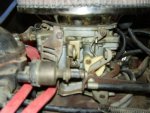
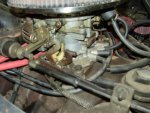
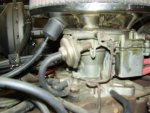
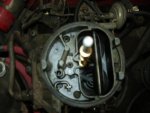
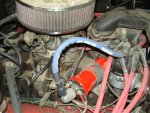
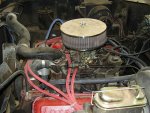
I do not have any emissions stuff on the engine...at least I have pulled off most of what I know about. The dist. Is a prestolite with a msd blaster 2 coil from IHOnly. Timing was set per what Jeff had suggested at the time...not sure what that was. I do not know the vacuum or dwell. I have the old air cleaner setup, but what you see is what came with the truck when I bought it. See attched pics.

For the most part I am open to just getting a new carb set up and then I can have it taken to a competent carb person, to put the finishing touches on per your suggestions. I have the name of a person nearby that sets up alot of vehicles for our area. Thank you.
 

Attachments

  • Carb_Dside1.jpg
    Carb_Dside1.jpg
    56.8 KB · Views: 1,249
  • Carb_Dside2.jpg
    Carb_Dside2.jpg
    65.4 KB · Views: 1,150
  • Carb_Rear.jpg
    Carb_Rear.jpg
    57.1 KB · Views: 958
  • Carb_Top.jpg
    Carb_Top.jpg
    43.6 KB · Views: 913
  • Dist_Coil_Carb.jpg
    Dist_Coil_Carb.jpg
    80.1 KB · Views: 1,018
  • Engine_Comp.jpg
    Engine_Comp.jpg
    102 KB · Views: 1,338
The current design Holley centerhung 2300, Holley p/n 0-7448 is the perfect carb for your sitch! Infinitely tunable to any degree. I work with more of those than anything else. Check this recent thread regarding that mixer:

http://www.forums.IHPartsAmerica.com/carb-tech/739-rebuilding-2300-list-2977-carb.html

I set those carbs up so they are right out of the box when ya get 'em. There are a few additional "tweeks" that can be made to enhance offroadablity also, that adds about $45 to the overall cost just for the parts, I set 'em up for no additional labor charge since the bowl is already off for doing the jetting for your engine setup.


Michael can fix you right up in all aspects
 
Ok got, I'm back...late nite last nite!

The carb referenced is a '74 edition 2210 oem onna 345 "light duty" truck (meaning Scout II). The IH p/n is actually 451911 c91.

That mixer should have #53 main jets, the power valve has no "consumer" designation, that was determined in the emissions lab during development. It's only a single value. Remember, this is an emissions carb and as such has little if any "adjustability"! And "if" the vehicle was originally delivered to the end-user by an IH dealership located above 5000ft. Elevation, it would have had a selling dealer-installed "kit" consisting of different jets, power valve, timing spec, choke setting, etc., etc., so that it was "smog legal" at the customer delivery altitude. Common practice for all light duty new vehicles back in the day.

So the only way to know what main jets it has is look at 'em!

Because of the severe loss of engine performance at altitude, in order to motivate, ya gotta open the throttle bigger! Doing so, drops manifold vacuum to nearly zilch. The power valve "opens" at an approximate 8"hg at sea level, that is it's calibrated setpoint and can't be changed. So when manifold vacuum hits a nominal 8"hg, then the power valve has the effect of increasing main jet size to approximate #59>#61. That is an increase in "richness" of about 15% and couldn't come at a worse time when the mixture is already super-Rich due to altitude. Thus...your perception of "flooding" which is not what is happening.

What to do?

Open the carb and kit it! At the same time I'd replace the #53 jets with prolly #47 to start with. Ya haven't stated what the altitude is where the truck lives...so I'm "assuming" around 5kft.?? If so, the #47 jets should be very close. If ya normally drive below 5kft., then tha bitch will be pretty lean and get worse as ya go down tha hill to the point of lean surge and lean misfire. The jets used in that carb are the standard Holley "gasoline" pattern hanging on the wall in most parts houses and sold in pairs. However, those very small jet numbers May be difficult to find in some markets since no "normal" chryfordrolet Holley performance carb application uses jets that small, they typically run in the 70's>80's. And ya never "drill" on Holley jets, they are not "drilled" at the point of manufacture, but are carefully "broached" very precisely, then each is flow tested for "grading" before packaging. And common number drill bit sets are not the same as the Holley jet sizing system, no relation! So there is no practical way to change a Holley jet to a higher fuel flow value, ya just buy an assortment and swap 'em out...that's called tuning!

The aftermarket Holley 2300 centerhung carburetor "upgrade" we push is infinitely tunable in all circuits! It's a performance carb, not a smog carb....major difference!

When one of these carb setups is ordered, the internals are changed out for whatever altitude and use the owner describes to us. And after the sale, we give unlimited tech support to get it to play nice with your application. There is no charge for that, ya don't take it to someone else to make it play nice! You can change the jetting in it if need be, very simple to do and we step you through that...same as we're doing now.

In the meantime...forget the use of a timing light...power time it! Those motors can run up to 12*btdc static timing at sea level, even more at altitude. There is a limit though...no more than 14* at altitude unless the camshaft was "degreed" at the point of installation and you are using the "straight up" timing gear set with the suffix "r1" on the part number on the gear set.

The msd blaster II coil has a spec'd primary resistance of 0.7ohms, very low. I've not installed one of those in conjunction with the prestolite electronic distributor but I know Jeff has had great success with that. Did you use the msd coil "kit" ballast resistor in that installation?

That distributor/coil setup cannot use the oem "resistor wire" feed from the ignition switch in the "run" position, they require a full b+ feed. Since your '74 rig was originally equipped with the resistor wire ya need to take a look at that, it May be that you don't have the ignition system properly set up, just an idea I see repeated over and over! And...the proper coil "match" for that unit calls for primary resistance of 1.2>1.4 ohms at 70*f.

These electronic trigger ignition systems are very demanding in having proper installation, same as for a breaker point system!

And remember...an IH is an IH! It ain't a chryfordrolet, ain't a tojo, ain't a sammi, ain't a rambler/Jeep, etc.
 
Last edited:
Ok. First, how much for a 2300 carb setup the best it can be? I prefer to trash what I have and go forward...I am tired of ridicule from my Bronco and Jeep friends, even though they can't haul camping gear because they have no room behind the rear seat. I live in the central valley of CA. I drive my Scout for ice cream runs with the wife and kids on occasion and then on to trails that are mostly above 5,000 ft on up to maybe 9,000 ft...so I don't care about performance on the flatlands. It has a auto tranny and will be running 33-34" tires with new gearing after this winter. I will do very little towing, if any. Let me know if you need additional info.

As for the coil, I am pretty dumb but can follow directions, tell me what/how I go about checking the resistance or is there a better coil for the prestolite. I did not use a resistor or add a resistor - it was essentially plug and play. If I remember right the 12*btdc sounds right for timing - I think that is what Jeff told me - but don't quote me.

Thanks for the advice and keep it coming!

An aside - I assume they only make after market aluminumn manifolds for 4bbl carbs not 2 bbls.
 
Last things first...

The rpt aluminum manifold is only manufactured in a 4v configuration, for the 345/392 application there is a spreadbore version...and a squarebore version mounting flange available.

The squarebore version could be used with a 2v carb of the proper configuration if an adapter is also incorporated. In fact, I'll be doing just that in the near future on my 392 as I play around with various performance/economy induction system and ignition system variations.

The adapter would add about 3/4" overall height to the system, so careful selection of an aftermarket air cleaner would allow that combo to fit under the hood of the sii with the oem body position.

Would a 2v carb on the rpt manifold provide any performance/milage increase? Who knows, it hasn't been tried yet afaik! But we will sometime this fall!

If I had to do my personal rpt manifold install all over again, I would use the spreadbore version. Mike Ismail tried to talk me into that but since I'm heavily vested in squarebore carbs and all, I declined. That was stoopid on my part! With the myriad number of adapters out there that also serve as heat dams, if I'd used spreadbore, then any carb combo would be feasible now and in the future!

12*btdc base timing is the perfect starting point for performance tuning of the 304/345 motors, a 392 can't use that much advance! And that is with oem compression ratio and on "regular" grade fuel.

A round figure for the ihon/Holley 2300 centerhung carb conversion kit is $500 plus shipping (approx $15). And that price includes a custom-installed electric choke kit which no other vendor does for the customer! In base form, that carb is only available with a manual choke configuration. And it will be jetted and all adjustments made as close as can be for your application, you would have to make the final idle mixture and idle speed adjustments based upon your engine needs! Same as on an oem carb.

This setup is not "smog legal" in any form, and cannot be made smog-legal in the state in which you reside! Disclaimer: this conversion kit is for off highway use only!:crazy:

no carburetor setup can effectively deal with the range of operational altitude that you describe without jetting changes. But a proper setup, using a two stage power valve (Holley modular carb only) can certainly make the setup usable. And I promise...if it's set up for best drivability at your residential altitude, it won't be optimum for say 7,000ft. And visaversa! But it can be "usable"! Can't have it both ways at the same time!

For determining the blaster II ignition coil resistance...simply use an accurate vom and place one probe on the positive terminal, and the other probe on the negative terminal. Then write down the resulting reading! A digital instrument is far more accurate for doing this since the resistance value is extremely low!

Do exactly the same thing regarding the ballast resistor you have. Those items do not have any kind of "polarity" so just check between the two terminals. Write down and post that figure also.

There are several different oem wiring configurations that were used in Scout II from inception through about 1977. Some of the differences are not shown in the wiring schematics in the service manuals! But I can talk ya through exactly how to wire the system properly if in fact it currently is not. Your wiring harness May have been configured to use both a point-distributor system and an oem gold box system, obviously yours was since it has the gold box connectors you describe. And some sii rigs were config'd with the prestolite electronic sparkmaker oem also, some had gold box...wiring is different for each!

And you need to verify that currently the coil feed to the positive terminal is or is not a resistive wire element. The oem resistive wire element will be an "ivory" color vinyl insulation on a "stiff" inner twisted conductor (iconel-type material, not copper wire), with a woven fiberglas overbraid for heat protection. Strip back the outer wiring loom material and verify that wire all the way back to the bulkhead connector!

Once we know exactly what your configuration is now, then that will determine what we do next!

For the record, it doesn't matter what oem setup is claimed to be in any service reference, what matters is exactly what the rig in question is running now! This stuff is 30+ years old, no telling what has been done with it in the past as it passes from po to po!

All this discussion is something that must be addressed when doing any non-oem ignition work or conversions! For instance, if someone installed a dui distributor/system and tried to feed it with the resistor wire, the results would not be pretty! And same for your prestolite electronic sparkmaker!

My suggestion??? Right now let's make sure your ignition system is optimized, that must be in the bag before making any changes to the induction system! Otherwise, we're back to the shotgun approach.
 
First, from whom do I order the Holley 2300 and discuss the specifics for setting it up so I can get that ball rolling. Not worried about smogging as my model no longer requires that to register it. I prefer the truck run well in the hills and will compromise performance in the valley for trouble free off-roading.

I purchased a vom meter from kragen and did what you said to do on the coil and all I got was a reading of 1 and it was set to read to the o.1 decimal. I think I wasted my money. I will drop by a shop and get a better reading asap.

I think I have the resistive wire you described (after reading it for the 10th time, I think I finally understand what you are talking about). I will verify that to the bulkhead and post that info.

I don't believe I have a gold box...have heard and read alot about them, but don't know what they are. Again, I am not well versed in this stuff. I prefer to be told what the best setup is and do that and not play around too much.

Another thing, I have read some of your posts about using an egr blocking plate. What does that accomplish?

Thanks!
 
Ok got...

Call Jeff/ihon and discuss the 2300 conversion kit and get the pricing...I can't do that for ya. Once ya place an order, Jeff will call me and turn on the process, then I'll set the kit up for you. I now know enough about what you are doing to set the carb up accordingly.

From the time the order is placed, it takes about a week to make everything happen and receive the kit.

I put together all the pieces just like ya see in that other thread, that item has not yet been entered into the online store but will be soon. You will receive one box dropshipped from me with everything ya need in the box, and a copy of your invoice from ihon just like you would find when Jeff ships parts from his location. The carb will have already been set up, the throttle ball stud will have a custom piece that allows your existing tranny "kickdown" to mount right up, all you will need to do is adjust the throttle cable and then the kickdown once everything is mounted...very important!

The idle mixture screws will be set to allow normal starting/idle quality. You will have to of course adjust the idle mixtures for your locale/engine, and possibly adjust the electric choke for your engine, very simple to do, I'll talk ya through all that! Once ya go up into the nosebleed altitude, then ya can quickly re-adjust the idle mixtures and go play! Same thing when ya come back down the hill. No more trouble than checking the oil!

Eliminating the egr is an off road deal only (that's legal beagle-speak). It's not imperative that it's done, but is an "enhancement" for performance/drivability. Let's let it go at that! That carb does include a "ported" vacuum source that can operate the egr if a "tee" fitting is placed on the port. That is assuming your egr valve/system still actually works...that's a whole other story! That is the port on the passenger side of the metering block.

Sounds like the vom ya got doesn't have the resolution ya need for doing real work! The dvom discussed in this thread:

http://www.forums.IHPartsAmerica.co...no-start-problem-long-post-grad-cold-one.html

Is an excellent tool for any user! Ya don't need a "graphing" dvom, just a basic unit to use around the house/shop that has decent resolution and is "auto-ranging".

If you can post some wide and tight pics of your engine bay, it would really help to see what all ya got going on! The "gold box" ignition system has exactly that...a "gold" (or maybe silver!) electronic module (about 3" x 5") mounted on the firewall near the hood latch system. Has a harness with several wires coming out of it. That is the control unit...the pickup/trigger system for it is mounted inside the distributor, under the cap and rotor.

For several years, the actual engine bay wiring harness had both wiring for a breaker point ignition system (the resistor wire) and the "gold box". The prestolite electronic distributor came much later in the production cycle, around '77>'78 and was not used on all Scout II versions, thus we find the three distinct types of ignition systems! There was much carryover however in the wiring harnesses themselves, just several "unused" connectors that allowed for several scenarios.
 
Can anyone tell me where I might find an airhorn gasket for the 2210c the reman kit didnt have one and the local oil and neon lite stores cant help either. Thanks brad
 
Fel-pro bags those up in individual paks. I'll have to do some research for the number though.

Do I need to got try out the new circle cutter I just bought to go into my gasket making tool kit? If I ahd any of those I'd dam shore send one...but I don't! But I can whip some out int e next few days if ya can't find the fel-pros locally.

Have the partmonkee do a look up for an air horn-to-air cleaner gasket for a '78 chrysler product with a 318/360 two barrel carb.
 
Back
Top