Michael Mayben
IHPA Tech Moderator - Retired & No Longer Online
Sorry I missed this boyz...I been actually doin' meaningful work around here...got rookies enrolled at binder u. That take much supervison, we're trying to finish off installation of a highly modded after market 30 gallon fuel tank tonite. Tanks' under pressure test right now.
Lower the float to whatever makes it not drool liquid down the throats. Again, scruu tha specs, make it work!
Don't know about any "Holley pop", if it's spittin' back through the intake, then a valve(s) hangin' open or the timing is somewhat retarded. Again...scruu tha timing light, advance it until ya get detonation under load, then back the timing down a touch until it goes away.
A 22xx won't "blow" the economizer/power valve if it spits back through the intake like really old Holley modulars might. If the pv was blown (or loose), then extreme richness would be experienced as the power valve is equivalent to 5>8 steps Rich over the size of the main jets. And this richness could not be "adjusted out" with the idle mixture screws.
Is there any lifter noise that won't go away? If so, that could be a valve that is trying to stick from lack of lubrication...that comes on very slowly over time. The lifter rattle is a key to that if present, valve is sticking in guide (trying to seize) and/or a rocker arm is partially seizing.
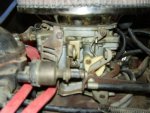
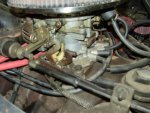
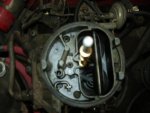
As in some of the other threads you've no doubt now read, do a visual of the carb fuel/air delivery by looking right down the bores while opening the throttle slowly, were a face shield for eye protection! Watch for "globs" of liquid fuel forming/drooling, and of course, look for a heavy, solid accel pump discharge "shot" each time the throttle is whacked.
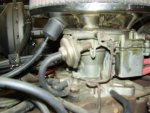
Do you have the oem-installed "heat dam" base gasket between the manifold flange and the carb? The one with the "projection" under the fuel bowl, not just the thick base gasket?? That is a fel-pro supply part, originally spec'd for the Scout II with this carb, fel-pro # 60677. And did your carb kit include the "thick" throttle body-to-main body gasket? That is also a heat insulator, not just a gasket.
Lower the float to whatever makes it not drool liquid down the throats. Again, scruu tha specs, make it work!
Don't know about any "Holley pop", if it's spittin' back through the intake, then a valve(s) hangin' open or the timing is somewhat retarded. Again...scruu tha timing light, advance it until ya get detonation under load, then back the timing down a touch until it goes away.
A 22xx won't "blow" the economizer/power valve if it spits back through the intake like really old Holley modulars might. If the pv was blown (or loose), then extreme richness would be experienced as the power valve is equivalent to 5>8 steps Rich over the size of the main jets. And this richness could not be "adjusted out" with the idle mixture screws.
Is there any lifter noise that won't go away? If so, that could be a valve that is trying to stick from lack of lubrication...that comes on very slowly over time. The lifter rattle is a key to that if present, valve is sticking in guide (trying to seize) and/or a rocker arm is partially seizing.
As in some of the other threads you've no doubt now read, do a visual of the carb fuel/air delivery by looking right down the bores while opening the throttle slowly, were a face shield for eye protection! Watch for "globs" of liquid fuel forming/drooling, and of course, look for a heavy, solid accel pump discharge "shot" each time the throttle is whacked.
Do you have the oem-installed "heat dam" base gasket between the manifold flange and the carb? The one with the "projection" under the fuel bowl, not just the thick base gasket?? That is a fel-pro supply part, originally spec'd for the Scout II with this carb, fel-pro # 60677. And did your carb kit include the "thick" throttle body-to-main body gasket? That is also a heat insulator, not just a gasket.