Michael Mayben
IHPA Tech Moderator - Retired & No Longer Online
Automatic transmissions can last virtually forever as long as periodic maintenance is performed, fluid levels are maintained, and the fluid is not allowed to overheat.
The chrysler torqueflite 727 is consider to be amongst the strongest units ever built, though there were many internal configurations used depending upon the oem platform it was installed in, the vehicle gvwr/horsepower it was spec'd for, and the intended vocational use of the vehicle. The ihc code for the 727 is t407.
The 727 became the standard slushbox for ihc beginning with phase-in for fullsize stuff and Scout II sometime in 1972. And it continued in production up through eop for sii in 1980. They are not "all the same" inside as chrysler made many detail changes over the years, and there are minor differences between sii and fullsize apps internally as well. So it's imperative that ya know "which" version ya got if you are gonna become intimate with it!
But for routine maintenance...they are "all the same".
Standard service procedures calls for dumping the oil (and draining the torque converter if yours has a drain plug, not all of 'em do), cleaning the pan, and do an r&r on the filter.
While the pan is down, why not go a step further and adjust the bands??? That's also a "periodic maintenance" item that has a great deal to do with the life expectancy of these trannys.
We're not gonna go through the drain and fill process, if ya can't figger that out ya dam shore don't need to be messin' with the bands! But there is no black magic involved in band adjustment (though gittin' to the kickdown band on any IH product can involve voodoo). But it does take some tools to do it right.
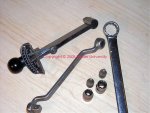
Here's a shot of the tools.
First off...ya need an inch pound torque wrench!! Nothin' fancy, doesn't need to be micro-calibrated. The one in this shot is the jinyoowine chrysler factory tool from about 1958, oriignally built for the "powerflite" predecessor to the 1st gen cast iron torqueflite. It's made by p.a. Sturdevant and is considered to be a "deflecting beam" design though it does incorporate a "click stop" for working blind. The clicker in this pic will be set for 72 inch/pounds which is the magic number we're gonna use.
Ya can also see a torque extension that was originally pinned to the head of this torque wrench. That was to allow easier access to the kickdown band adjusting screw when the tranny is installed in the vehicle. I made it removable many years ago so I could use this tool for other purposes.
The 3/4" box end wrench is nothing special, but that allows manipulation of the adjusting screw locknut for both bands. In some cases, that nut could measure 13/16" or even 7/8". Doesn't matter, just use the correct size wrench!
The actual adjusting screws for both bands have a square head with "round" corners. That means ya gotta use an eight point socket for proper fit. Those can be kinda hard to come by but I find 'em hanging on the wall at the local sears shop. You will need two sockets as usually, the screw heads are two different sizes. I had no idear why chrysler did that back in the early 60's, but they did! So you will need a 1/4" (craftsman 45790) and a 5/16" (craftsman 45791) to cover both.
In later years chrysler changed the adjusting screw design over to a torx pattern. Since it's entirely possible that ya might find late model parts in earlier units, ya might need a torx t20 and a torx t30 in the proper drive size for your torque wrench (the chrysler wrench is 3/8" drive). Torx pattern screws May have also been used for retaining the filter to the valve body in some cases.
That's all the tools needed for band adjustment once the pan is out of the way.
The chrysler torqueflite 727 is consider to be amongst the strongest units ever built, though there were many internal configurations used depending upon the oem platform it was installed in, the vehicle gvwr/horsepower it was spec'd for, and the intended vocational use of the vehicle. The ihc code for the 727 is t407.
The 727 became the standard slushbox for ihc beginning with phase-in for fullsize stuff and Scout II sometime in 1972. And it continued in production up through eop for sii in 1980. They are not "all the same" inside as chrysler made many detail changes over the years, and there are minor differences between sii and fullsize apps internally as well. So it's imperative that ya know "which" version ya got if you are gonna become intimate with it!
But for routine maintenance...they are "all the same".
Standard service procedures calls for dumping the oil (and draining the torque converter if yours has a drain plug, not all of 'em do), cleaning the pan, and do an r&r on the filter.
While the pan is down, why not go a step further and adjust the bands??? That's also a "periodic maintenance" item that has a great deal to do with the life expectancy of these trannys.
We're not gonna go through the drain and fill process, if ya can't figger that out ya dam shore don't need to be messin' with the bands! But there is no black magic involved in band adjustment (though gittin' to the kickdown band on any IH product can involve voodoo). But it does take some tools to do it right.
Here's a shot of the tools.
First off...ya need an inch pound torque wrench!! Nothin' fancy, doesn't need to be micro-calibrated. The one in this shot is the jinyoowine chrysler factory tool from about 1958, oriignally built for the "powerflite" predecessor to the 1st gen cast iron torqueflite. It's made by p.a. Sturdevant and is considered to be a "deflecting beam" design though it does incorporate a "click stop" for working blind. The clicker in this pic will be set for 72 inch/pounds which is the magic number we're gonna use.
Ya can also see a torque extension that was originally pinned to the head of this torque wrench. That was to allow easier access to the kickdown band adjusting screw when the tranny is installed in the vehicle. I made it removable many years ago so I could use this tool for other purposes.
The 3/4" box end wrench is nothing special, but that allows manipulation of the adjusting screw locknut for both bands. In some cases, that nut could measure 13/16" or even 7/8". Doesn't matter, just use the correct size wrench!
The actual adjusting screws for both bands have a square head with "round" corners. That means ya gotta use an eight point socket for proper fit. Those can be kinda hard to come by but I find 'em hanging on the wall at the local sears shop. You will need two sockets as usually, the screw heads are two different sizes. I had no idear why chrysler did that back in the early 60's, but they did! So you will need a 1/4" (craftsman 45790) and a 5/16" (craftsman 45791) to cover both.
In later years chrysler changed the adjusting screw design over to a torx pattern. Since it's entirely possible that ya might find late model parts in earlier units, ya might need a torx t20 and a torx t30 in the proper drive size for your torque wrench (the chrysler wrench is 3/8" drive). Torx pattern screws May have also been used for retaining the filter to the valve body in some cases.
That's all the tools needed for band adjustment once the pan is out of the way.


 )
)