Holley 22XX Series Carb Stuff

hello there. New to the IH community and looking for some help. I recently purchased a '74 100 pickup, with what I was told is a 392, though I'm now wondering if it's a 345. Can't read the plate under the #2 spark plug that everyone seems to refer to, as a wiring loom runs there and the frame gets in my way. Anyway, it's currently not running (was running when I got it last week and has since died and won't start again). I'd like to first figure out which carb I have on there, as I'm also confused about that.

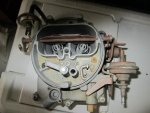
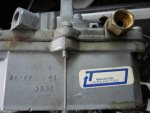
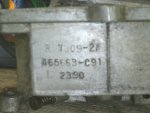
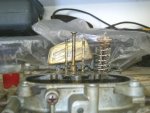
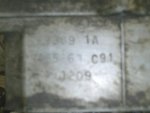
I know it's a Holley, and it looks to have been worked on before, because someone wrote "2245" on the choke plate and the side of the carb in a marker. However, after reviewing the beginning of this thread with the pictures, it looks to me to be a 2210 or some frankenstein carb between the two. The number stamped on the front is a bit hard to read, but from what I can make out it is this:

r 6828
451911 c91
2503

there is also a smudge to the right of the first line that could be an "a" or could just be a smudge/ding.

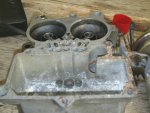
I'll post some pictures below (hopefully, if I can do it correctly) to show you what I mean.

Thanks in advance!
-nelson

A Holley list 6828a is a 2210 oem carb (yours also carries the matching IH part number) for a m/y '74 pickup 345.

The yellow paint marker is typical of boneyard practices for "pull-off" parts.

And...it's had the divorced choke system butchered and a conversion done to manual choke operation.

Hard fact regarding engine availability in the pickups and travelalls from late 1973 production through the 1974 production is a bit ambiguous. The few 392 motors that were used were "reserved" so to speak for use in the 200 pickalls and 500 series cab/chassis as far as the light line vehicles were concerned. Medium duty and school bus chassis got the supply of the 392 that was still available. Otherwise, depending upon dealer order spec, they received either a 304 or 345 sv engine or the amc 401 (in IH-speak known as the v-400).

What are the "numbers" on the vehicle data plate on the driver side door? And if the underhood emissions label is still present and legible what does it say regarding the original engine install?
 
Michael - thanks so much for the quick and helpful reply. I've been immersing myself in this site (specifically the engine/carb info) over the past few days, and am very grateful for the volume of helpful info on here. Other than this site, there seems to be a dwindling amount of support/parts for these old IH trucks anymore.

This is my first carbureted vehicle, though I have had some mechanical experience with fuel-injected vehicles (built/swapped a motor on my Nissan). I'm pretty overwhelmed by all the tiny parts and adjustments on a carburetor, but it seems like there are enough how-to threads on here with detailed photos that I May be able to tackle it.

I also noticed the strange choke linkage you mentioned, as it didn't match up to any of the photos I'd seen of this carb. However, I'm a bit confused, as it has an under-dash mounted manual choke lever in the cab which appears to be stock. The linkage and cable don't really look stock though, so I'm wondering what happened.

Anyway, a brief background of my weeks-old history with the truck might help a bit, so here goes. It ran great when I got it...quick and steady throttle response, fired right up every time, never stalled. After a couple of days, it stalled randomly while driving and I had to pull over. It started up pretty quickly thereafter, but irked me nonetheless. This happened a few more times (seemingly at random...sometimes cold, sometimes completely warmed-up, but usually when I was going from no throttle to lightly pressing on it while coasting) over the next few days. Now, somewhere along the line, someone had installed an electric fuel pump with a manual switch on the dash, which I was told was only to prime the carb after it had been sitting for awhile, but was not to run in tandem with the mechanical pump. After it began stalling, it got me thinking this thing has had fuel-starvation issues in the past. When I inspected the mechanical pump and compared it to photos online of new pumps, it looked like it had been bent/crushed a bit, as the two columns leading to the fuel lines weren't completely vertical and there was a dented area in the main housing. I thought this might be hindering the diaphragm to operate correctly or make a proper seal, so I bought a new mech. Pump and installed it, thinking this would help the problem. The truck fired right up, even quicker than before, and ran strong for a few minutes. I backed it out of the driveway and put it into drive, and as I pressed the throttle lightly, it died again. It started a few times after but the same thing would happen. Now it won't start at all, and is flooding.

After searching around, it seemed like the symptoms I'm having could be traced to vacuum problems or to a choke pulloff or choke thermostat. But it also seems that I don't have those on my carburetor anymore...? I also wondered if the carburetor had been adjusted to operate at a certain (reduced) fuel pressure, and if it is now flooding because of a normally-operating mechanical pump.

I'm sure I've inherited yet another problem-child that was only fixed-up to run long enough to sell, but I'm here to learn how to get it running reliably and for a long time, because I love this old truck, despite its apparent intent to infuriate me. Luckily, I love to learn!

I'll be sure to get the door plate numbers and any under-hood numbers as soon as I get off work and can get to the truck.
 
Man...this is the same story I hear day in and day out!!! In fact, just last Saturday I helped a young feller deal with the same type scenario...but his rig wasn't as badly botched as yours seems to be! I get many emails about this, most folks simply don't wanna discuss this kinda stuff in public since they simply are not knowledgeable and are afraid someone is gonna bash 'em! But that is why we are here, to train ya in how to do this stuff so you can help others when us old farts are gone!

You are right in your assessment I think. What started out as simple and common fuel delivery issue took on a life of it's own as some dumazz tried to work through this in typical boneyard fashion!

We always gotta keep in mind, this stuff wasn't broke when it came off the assembly line! Stuff fails after time due to neglect and lack of maintenance, then the po virus strikes and instead of fixxin' stuff right, they simply crap all over it, then pawn off on someone else...over, and over, and over!!

So...my suggestion...start a new thread here in this sub-forum for your rig only. Put up some nice, well focused pics of the entire top of the engine so I can see the big picture. Then we'll know exactly what we're dealing with from the beginning!

Inadequate fuel delivery is the #1 issue we see in any of this old stuff. That starts at the tank and ends inside the carburetor! So we're gonna service the entire system if ya wanna make this rig right and reliable as a driver. And...that will involve keeping a "budget" in mind as always, we all face that! Bottom line for your issue right now, the carb is trashed internally due to contamination from a grungee fuel system...let's clean it all out and make it right!

All ihc-produced fullsize rides had a position labeled on the dash for "choke" and "throttle". That is because all the cabs/dash assemblies were used for any possible combination of dealer/customer-specified equipment. But for your truck, a manual choke simply did not meet "emissions" specifications and was never an oem item. And...the 22xx series carbs were only produced as an extreme "emissions" carb also and not used in other vocational vehicle applications where the emissions deal did not apply.

The manual "throttle" position was there for when a power takeoff was spec'd on the vehicle for running auxiliary devices such as snow plows, winches, hydraulic pumps, etc., in that case a manual throttle control was fitted but not to be used as a "redneck cruise control"!

So...start a new thread, we'll back up and work through the entire fuel system. I also need to know if the optional dual fuel tank system is currently installed and if the oem fuel tank selector valve is still present. Same for if the entire evaporative emissions system is still present and semi-connected. From your pic, I can see that the carb vent hose is not connected to the charcoal canister presently...but that is certainly not contributing to your current problem.

We can most likely make that carb work just fine using a manual choke...but there are several options regarding that also.

Again...you are not the only one playing with this crap that faces this same thing constantly!
 
Last edited:
Thanks again michael. I will cease my thread-jacking here and start a new thread for my specific problem as soon as I'm able to get home and get more useful information. I'm not sure I can provide you with everything you need to know, but hopefully between my limited knowledge and photo documentation, you can get all you need to diagnose the issue. I really appreciate the support!

New thread for my issue started here: http://www.forums.IHPartsAmerica.co...tional-100-truck-carb-problems.html#post34964
 
Last edited:
Holley performance has tens of thousands of "stuff" available, but because it has virtually no movement in inventory in a 12 month cycle, and is not sold at the retail level (only through wholesale distributors) directly to end users by Holley, why would they show that in a website that costs big bucks to both initiate and manage and for retail customer use only??? They are not in the business of fulfillment to the retail trade, that is what their dealers/distributors do.

The Holley performance website that most folks find on the 'net is a consumer site, certainly not the full service site for use by automotive professionals or others in the trade. And very little of what is currently shown on the website is an oem-grade product which they have not manufactured since the bankruptcy/sell-off in 1989. A 2210 was an oem product with absolutely no presence as an aftermarket replacement or performance upgrade. The Holley modular lines however are the backbone of the Holley carburetor business today, just so happens they were originally developed for oem use only.

We can handle that particular gasket separately also...as long as you order a minimum quantity of 25! And they come from the source that manufactures that particular gasket for Holley, it's not done in-house. I have no need for 24 of those gaskets sitting around for the next 40 years and long after I'm gone.

A 2300 can/will work beautifully on any slushbox vehicle, we have hundreds of 'em running out there, the carb design has nothing to do with that as long as it's properly dialed in, properly linked up and in decent condition. Hell, they were oem on tens of thousands of ihc-produced vehicles running borg warner and tf727 trannys.
 
Mm
here's some numbers per your request on 2210c carbs.

1976 terra w/ 345 automatic
rebuilt carb per thread.
Installed pertronix
spark plug gap set to .039
30d dwell
750 rpm
20" of vac
17d btc or 12d btc? I had a hard time seeing.
Also; live arkansas @ 326 ft. Above sea-level

thanks for your time and help!
 
mm
here's some numbers per your request on 2210c carbs.

1976 terra w/ 345 automatic
rebuilt carb per thread.
Installed pertronix
spark plug gap set to .039
30d dwell
750 rpm
20" of vac
17d btc or 12d btc? I had a hard time seeing.
Also; live arkansas @ 326 ft. Above sea-level

thanks for your time and help!

Those numbers certainly look "normal". Except that even at idle, a base timing of 17*btdc would be way too much, the motor would be trying to "skip", and maybe even trying to detonate when the throttle is opened ever so slightly! I've found that on regular gasoline, at an altitude under 2,000ft., a 345 really responds to a base timing of 10>12*btdc if the distributor is in good condition and the carb idle mixtures are correct.

An idle manifold vacuum reading of 20"hg is outstanding, ya can't get any better than that.
 
Mm
I'm with you on the 17* timing but it's running great and I hate to mess with it? I didn't have the vacuum advance pluged off so would this effect the timing? Is there a sticky or thread on proper way to go throught the whole tune up process step by step? A lot of the times there's bits and pieces on the different steps but not any that I've found that show a step by step from beginning to end of a correct tune-up process? If there is please link me and not flame me for my ignous.:)
 
Hey Mike, here is a question for you, just doing a friend a favor, got a 2210c holly (7309) on a 78 ihc Scout II automatic that I just put a new kit on after soaking for three days in my 5 gall pail of carb cleaner. It has the hics and I mad a "gasket" using a piece of painters tape and a touch of the old style permatex gasket varnish. It appears I have a huge vacuum leak out the top of the carb between the two screw holes on the air horn towards the back, I'm assuming that this is where the hics leads too but didn't want to immediately pull the carb. What gives and what did I do wrong? It runs great if I put my finger over it???
 
The workaround you did for sealing the hic valve is close but no cigar! So you currently have a permanent vacuum leak as you have diagnosed, good job!

The actual bimetal hic valve seals to the carb body with a cork "ring" gasket. When you pull the hic back out, look inside at the actual port and you will see a very shallow counterbore. The cork seal ring fits into that counterbore but it's not self-adhesive. A replacement cork seal should have been included in the kit if it was a standard hygrade 928c.

The nominal measurements on the seal ring are:

od: 0.410"
id: 0.270"
thickness: 0.060"

when the hic valve is placed back inside the rectangular opening, the two small protrusions that contact the cover should protrude about 0.025" above the flange. When the sheet metal cover is screwed down, that compresses the bimetal valve against the cork seal creating the "seal". That in turn will eliminate the vacuum leak you currently observe.

So your masking tape workaround "might" work ok, but it's not thick enough to effect a good seal.

Try again!
 
Ok got it! The gasket I made was for the cover not the flat cork gasket I see what your talking about, the kit instructions don't have a exploded view of the hics and nothing was in there except the by metal strip (which looks to have a "plug" of some sorts attached to it).

Thanks for your speedy reply, I'll get her licked tomorrow~!
 
ok got it! The gasket I made was for the cover not the flat cork gasket I see what your talking about, the kit instructions don't have a exploded view of the hics and nothing was in there except the by metal strip (which looks to have a "plug" of some sorts attached to it).

Thanks for your speedy reply, I'll get her licked tomorrow~!

Just to shed more light on this hic subject,...you mentioned a "plug".

In many cases where the carbs I receive for rebuild are "commercial" remans...the hole for the hic port has had a lead shot (plug) pushed in. That is because they were trying to "convert" the carb from one list number to another.

I don't have an issue with doing that, I've had to do the same myself. But...if you do that the job must be completed! That means also plugging the hole you mentioned that is located inside the air horn, and disabling/plugging the vacuum feed passage in the throttle body for the hic circuit! If the entire process is not done, then the carb will always be problematic and multiple "rebuilds" will have no effect on what is a plain old mechanical deficiency!
 
Thank you michael,

that did the trick she seems to run real well now. Got a slew of other stuff to look after before it's road worthy...thanks!
 
Last edited:
Hi Mike,

I have what I believe is a 2210 taken from a 1975 Scout II. No idea if it is original. I would be glad to box it up and send it to you if you have a use for it or could rebuild it for a fellow binder nut. Here are a couple of pics.

Regards,

greg

p.s. I also have a Holley gb distributor with pickup that I would be glad to donate. It is in pieces, but I think it is all there. There is some end play, but I think it is a serviceable unit.
 

Attachments

  • IMG_0024.jpg
    IMG_0024.jpg
    59.1 KB · Views: 609
  • IMG_0023.jpg
    IMG_0023.jpg
    52.3 KB · Views: 591
I'd be glad to take those parts greg! Stuff like that just helps others who have a real tight budget to work with.

Address:

michael mayben
42790 leaburg dr.
Leaburg, or 97489

thanks!
 
Hi Mike,

carb and distributor when out in today's mail. I hope they can help someone out. You should look for them by the end of next week.

Thanks for all you do to help the binder community.


Greg
 
So I have this carb that keeps over flowing running over the top of the carb. Thats only one of the problems, it also runs terrible and Rich. Im sure it has to do with the overflowing. Im pretty sure its never been rebuilt and the original carb to the 75 Scout with the 345 manual tranny. Ive read alot of the threads and still cant understand the differences in the 22xx series I do have the numbers off the carb.
R 7940 a
483449 c91
1177
my question I guess is should I do a complete rebuild or do you think a gasket rebuild would do? Is it gonna be something that once I'm in there I'll know what I need based on the way parts look? My guess would be the float but its only a guess. Your the experts let me know. Thanks!
 
Hey guys, I'm from vancouver island, bc, and I have a '79 Scout II, with the 345 and the 727, and I'm pretty sure I've got the 2245 on it....

My first question is about this carb dip I keep hearing about.....can I just soak the carb in parts cleaner? Is that the same thing?

I rebuilt this carb about a year ago, and then the truck sat for at least a year, and I didn't really know as much as I've learned from readin this thread, so the kit I got, which I'm sure was the hygrade 929a, had all the right gaskets and stuff, and I think it came with the power valve too, and I changed it because it looked similar to the one that was in it, but now that I've seen the pictures on here, it's the power valve for the 2210, not the taller 2245 one, and it has a brass float ( is that a better float? ), so the po must have rebuilt it too, and put in the wrong one......where do I find the right power valve? I stopped by the parts store today, and they knew about the right carb kit, but he told me that a Holley carb kit for a marine 2300 has the right power valve for the 2245.....I'm not gonna buy a whole nother kit for just the power valve, can you get them seperately? Are used power valves re-usable? Can ya just clean them?

And one more question, the rod that actuates the power valve, how tight is it s'posed to be in it's bore? Is a little slop okay, or should it be friction fit, just loose enough to slide up and down?

Anyways, thanks in advance for the advice..... I really appreciate it.......and sorry for the novel.......
 
hi Mike,

carb and distributor when out in today's mail. I hope they can help someone out. You should look for them by the end of next week.

Thanks for all you do to help the binder community.


Greg

We picked up all the mail last nite greg, the parts you sent are here now!

Thanks again, and if you need any of this kind of stuff yourself be sure to let me know! I know these parts can definitely help other folks in some regard!
 
Back
Top