Holley 22XX Series Carb Stuff

hey guys, I'm from vancouver island, bc, and I have a '79 Scout II, with the 345 and the 727, and I'm pretty sure I've got the 2245 on it....

My first question is about this carb dip I keep hearing about.....can I just soak the carb in parts cleaner? Is that the same thing?

I rebuilt this carb about a year ago, and then the truck sat for at least a year, and I didn't really know as much as I've learned from readin this thread, so the kit I got, which I'm sure was the hygrade 929a, had all the right gaskets and stuff, and I think it came with the power valve too, and I changed it because it looked similar to the one that was in it, but now that I've seen the pictures on here, it's the power valve for the 2210, not the taller 2245 one, and it has a brass float ( is that a better float? ), so the po must have rebuilt it too, and put in the wrong one......where do I find the right power valve? I stopped by the parts store today, and they knew about the right carb kit, but he told me that a Holley carb kit for a marine 2300 has the right power valve for the 2245.....I'm not gonna buy a whole nother kit for just the power valve, can you get them seperately? Are used power valves re-usable? Can ya just clean them?

And one more question, the rod that actuates the power valve, how tight is it s'posed to be in it's bore? Is a little slop okay, or should it be friction fit, just loose enough to slide up and down?

Anyways, thanks in advance for the advice..... I really appreciate it.......and sorry for the novel.......

I fully understand your dilemma, many others go through the same thing!

Your parts "source" obviously doesn't know squat about carbs in general and Holley carbs specifically! Hardly any parts are shared between a 22xx and a 2300 ! Most especially the power valve!!

What I need regarding your carb is pictures of exactly what you have inside the fuel bowl and a good picture of the top of the carb (bowl cover). Once I see what you have, I can then determine what we can do using some parts I May have on hand here.

Many of these carbs are never actually used again once some folks try and service 'em. They simply can't get 'em to operate using the parts kits they bought because they got the wrong kit and the parts dudes have no idea "how" to obtain the correct stuff.

As for a liquid material used for "soaking" the parts, I use only "tyme" manufactured by crc. It is made for soaking carburetor parts and any other internal engine component without causing damage to the parts themselves if used according to the instructions. The liquid currently sold by berryman and gunk is junk, while it has the terrible odor still, it certainly does not clean worth a crap due to environmental regulations from years ago. Tyme is a totally different product and works perfectly well today.
 
So I'm just workin' on getting this carb pulled apart and dipped, before I send ya any pics, but I wanted to ask how much you would want for a 2300 set up for this truck, and what size? 350 cfm or 500 cfm? I have 3 other 2 barrel Holley's off IH motors I can send ya, do ya give any credit or anything for them?
 
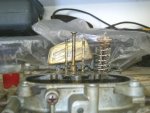
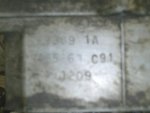
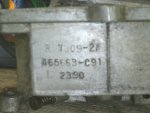
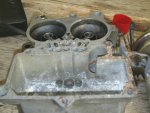
Okay, so the first three pics are the carb off my Scout ('79 sii, 345, 727). The power valve piston isn't moving, yet. I haven't soaked it yet. The power valve is not necessarily the right one, it's the one that came with the rebuild kit I put in it last time. I got water in the carb and it corroded the bottom of the float bowl pretty bad, so I wanted to know if I should be using the parts carb in the last picture instead? I hope you can read the numbers well enough, I can just tell you what the numbers are if they're too hard to make out.

I also want to ask why the 350cfm 2300 is better than the 500cfm one for this motor:icon_question:, will it just not breathe enough ever to need 500 cfm?
 

Attachments

  • HPIM0167-iho.jpg
    HPIM0167-iho.jpg
    104.2 KB · Views: 641
  • HPIM0169-iho.jpg
    HPIM0169-iho.jpg
    126.4 KB · Views: 647
  • HPIM0170-iho.jpg
    HPIM0170-iho.jpg
    111.5 KB · Views: 647
  • Parts1-3-iho.jpg
    Parts1-3-iho.jpg
    87.8 KB · Views: 649
Last edited:
The Holley list 4412 carb is "rated" at 500cfm. It is intended for much higher hp engines running at much higher relative rpm. It happens to be extremely "fat" throughout it's entire operational range and can't be dialed back for suitable use on any ihc-produced engine. We have many threads right here in this sub-forum about this issue!

The Holley list 7448 is the 350cfm version of a similar 2300 carb. However, it is also somewhat different in calibration and in the way it operates internally (compared to the list 4412). It just so happens that for an IH 304 or 345 it happens to be right with very little additional tuning required.

I rebuild carbs that are much more "water-damaged" than yours quite often. It is not fun and takes a lot of delicate internal work with a die grinder, etc. To clean 'em up. But when they are brought back to life they work just fine if the correct parts are installed.

Simply "soaking" these parts in any sort of cleaning solution is only the beginning of the cleaning process. There is much handwork involved in making these items work. The bigtime commercial carburetor folks simply blast everything with glass bead and abrasive media to clean 'em. Then they do not spend the time to really clean up that mess and have also worn down many critical component "sizes" internally.

As for selecting the correct power valve for your carb, it's simply a matter of determining which pv operating piston system you have and then matching the valve. Again, I get these carbs often that have a total mis-match of internal parts because folks simply don't know what they are doing when they make an attempt to service 'em!

I personally have currently far more carb cores than I'll ever use in the remainder of my workdays. The only cores I trade for today are Holley 1904 units that are basically complete.
 
Okay, well, that's cool.....I'm still leaning toward trying to make my 2245 work, because that sounds like the cheapest solution, and I'm not too particular about trying to get any more power per say. And going over it with a fine tooth comb cleaning everything is fine with me too. A buddy suggested piano wire to get all the passages right clean, and I'll be putting some time into it getting it right this time.

Can you tell anything from the pictures I attached, I can take more if need be. As for selecting the right power valve, can you tell which one it is s'posed to be from the pictures I attached in my last post?

And the jets(?) on either side of the power valve in the float bowl both have 54 and an upside down 2 stamped on them. I've noticed that these are chosen for elevation. Is that the right size for the elevation I am at, which is essentially sea level up to like 3000 ft. Ish max.

Thanks again for all the help.
 
Last edited:
The jet size you have is just fine for your operational elevation. But in the wells below the jets you must remove any and all contamination which May be lodged there.

The power valve actuator should be correct for the "short" power valve that I see in the picture also. That is...as long as it actually operates. It should be removed and both the operating piston and the hole made sterile. It should have a spring inside the operating piston.

Make certain that you install a accelerator pump check valve in it's receptacle.

Regarding those two brass tubes, be sure that every tiny hole is clean and flows
 
Thanks so much for all this invaluable info......that should do me for now, but I'm sure I'll be back for something else at some point.....I s'pose before I can get it tuned in, I need to make sure the ignition system is working up to snuff......

Thanks again, all your help is really appreciated......
 
Hey guys, I have a '79 Scout II 304, stick, I think 2245 carb but hopefully you can tell in the pics???
dsc03896.jpg
[/img]
dsc03895.jpg
[/img]
dsc03894.jpg

Anyway I recently did a complete painless wiring harness on it but with being in the military and deploying a couple times it ended up setting there for almost a year! Now that its back together & street legal im trying to get it trail worthy. It idles great and when I hit the gas it sounds great but while driving it starts to bog down like its starving and only gets worse as I drive it and 4th is a nightmare and sometimes backfires..but still idles great! I just replaced the plugs, wires, cap and rotor before I started the wiring. Recently put a new heat riser and fuel filter, even tried a seafoam flush but still stutters.. Any suggestions? The more you dumb it down the better.. Hahah!
 
I just wanted to double check on that power valve, only because the info sheet in the carb kit shows my power valve piston as a 2245 version, and it shows a "tall" power valve to match it in a 2245, but it shows a "short" power valve for the 2210 model....

Also,the accelerator pump check valve, is that under the accelerator pump assembly?
 
Your carb is actually a Holley 2300, oem-type design. It has an external fuel bowl vent that is supposed to be connected to a charcoal canister (the front fuel bowl tube).

It also has a later model manual choke system but it appears to be tied wide open with a ziptie, not a good thing at all! It needs a true manual choke cable rigged on and properly adjusted. A choke system is just as important as any other carburetor system and should always be used except on a true, offroad operated drag race vehicle.

Your operational failure indicates to me that the fuel bowl level is too low. You should remove the brass plug from the passenger side and then adjust the fuel level in the bowl with the engine running. The fuel level should be about 1/8" below the bottom of the thread in the sight hole with the vehicle sitting level.

Our Holley 2300 carb thread is located here:

http://www.forums.IHPartsAmerica.com/carb-tech/512-Holley-23xx-series-modular-carb-stuff.html
 
Last edited:
Hahah, yeah I ziptied it cause the manual choke cable was missing and after it warmed up it would kill itself. So letting it sit for that long would cause this? Just wondering because before it ran great! Thanks for the info..
 
Having trouble finding the full choke cable assembly but I found these electric choke conversion kits Holley 45-223 & 45-224. Just wondering if one of these might work or if you have a current part number? Thanks
 
I can't answer your conversion to electric question, but finding a choke cable for that ought to be easier than falling out of bed. Any parts store, even the cheeseballs that are more intent on pushing slim jim beef jerky and air fresheners still sell 'em. That carb is grungy dude! There is obvious corrosion on the outside. One can only imagine what the guts look like. Looks like eveidence of raw fuel leakage too. If you immerse yourself in that 2300 thread that michael attached, you will find information in there on the appropriate Holley brand refresh kit. I'd say yours is a prime candidate for that service especially if it has not been done in recent memory.
 
With me not knowing anything about carbs, what would be easier; buying a new 2300 or rebuilding the one I have? Remember I know nothing about carbs..
 
having trouble finding the full choke cable assembly but I found these electric choke conversion kits Holley 45-223 & 45-224. Just wondering if one of these might work or if you have a current part number? Thanks

Only the hly 45-223 electric choke conversion set is correct for your carburetor.

Any auto parts will have a universal choke cable kit on hand for around $12 and up.

Again, any carburetor must have a functional choke system to operate properly.

In this sub-forum, we have more information regarding these carburetors than will be found anywhere else on the 'net. Spend some time reading through each thread and you will learn what needs to be done and how to do it.

Just as scoutboy mentioned, that carb needs to be rebuilt now in order to keep this rig going. Typical service life for a carb today used in daily service is around two years.
 
Hi, just wanted to say thank you to all of you on this thread. The information that I gained from you and your problems was the key to me figuring out the solution to mine.
I have a 1978 Scout II, with a 345 engine and a 727 automatic transmission. I was having a problem with the engine surging while holding a consistent throttle and had a rough idle. After reading many hours and a lot of threads, I went through the ignition system ( changed to a pertronix unit, new distributor cap, new wires, new plugs, checked timing). That improved the problem a little bit, but was still surging.
Using this thread I identified my carburetor as a 2210 model (r7309-1a). Took it apart, rebuilt it with a napa kit after soaking, cleaning and blowing every port out with compressed air, I reinstalled it on the engine. The results were great, however, still had a slight surge while driving at 30 to 40 mph. So I went back to the thread and found a possible fix. I took the air horn back off and made sure the power valve accuator was free and not sticking at all, same with the power valve, readjusted the float so more fuel would be in the bowl, and then made sure that the screws holding the air horn down were really tight. Also made sure the acc. Pump was adjusted so the slightest touch would send fuel into the venture.
By doing those last 4 things the truck runs and drives like a dream. The engine is set at 13* btdc, pulls 18" of vacuum and cylinder compression in all 8 are around 150, idle speed is 700 rpm in neutral.
I wouldn't have been able to figure the problem out as soon as I did without this forum. So thank you for that, and I hope I can contribute something positive and provide information that someone else can use to figure out their problem.
Tom
 
Hey everybody I am rebuilding a Holley 22xx, (a 2245 I believe) as I was going through dis-assembly I found that I am missing my pump discharge needle. Were there some carbs that didn't have them? And where can I get a new one? It is off of a 1978 sii with a 304(not California emissions) tf727
 
I recently rebuilt a Holley 2210, which sits on a 345 in my 1976 Scout II. The rebuild went fine, but I forgot to take a picture of how the two external springs connect. I'm guessing one connects to the throttle cable, but I'm at a loss as to where the other connects. Does anyone have a picture of where these springs attach?
 
I recently rebuilt a Holley 2210, which sits on a 345 in my 1976 Scout II. The rebuild went fine, but I forgot to take a picture of how the two external springs connect. I'm guessing one connects to the throttle cable, but I'm at a loss as to where the other connects. Does anyone have a picture of where these springs attach?

Are you referring to the two throttle return springs?

If so, you can go back one page to page 16 of this thread, post #238, which has two photos of the throttle return springs.

One spring should be larger diameter than the other, the small spring goes inside the larger spring for redundancy in case one spring breaks.
 
Back
Top