Holley 22XX Series Carb Stuff

I just finished rebuilding my 2210 with Holley kit 3-887. It still splutters and surges. The kit did not include a new power valve. Can you reference a source that sells the power valve only? Also, I have noticed that there is a mysterious vacuum hole in the throttle body that has been plugged in almost every picture I have seen on the internet of the 2210. My carb has not been plugged! Should I plug it?

Holley deleted the power valve component (both designs) from their service kits for these carbs several years ago. That is why I don't advise the use of that particular p/n kit from Holley.

Also, many times we see these carbs with the wrong power valve and even the wrong actuator installed.

Is the power valve you need the "short" one as shown in post#15, left hand carb in this same thread?

I'm preparing an order for an inventory of individual components for these carbs (and many others) right now. But it's gonna be at least two weeks before I see the stuff here in the shop. So to answer your question..."yes" we will have some individual parts for the 2210/2245, but not right now.

As for the "unplugged" hole you describe...without a pic I can't tell exactly what hole you are referring to. I'm assuming you mean the hicd (hot idle compensation) port inside that rectangular opening in the main body casting? If your carb has no hicd valve inside that segment and the cork seal, and the sheetmetal cover to retain it, then that hole is not drilled through! So no plug is needed. Some of the mixers you see in pics have been converted by some cheezeball remanner who has plugged that hole in order to disable the hicd circuit, but they usually fail to plug all the additional holes associated with it so the end result is poor drivability.

Trace the port out through the entire casting and determine if it's open to the atmosphere when completely assembled or in actuality is not drilled through.

Sputtter and surge???? Did you carefully remove and clean all the brass tubes? Did ya remove and clean/polish the power valve actuator and then verify it's proper operation using a mityvac? Have all drilled passages been meticulously cleaned deep inside (not just soak in carb dip which really does nothing) and then verified for flow using a liquid?

Are you certain that you used the correct throttle body-to-main body insulator gasket for your particular list number? What is your list number and vehicle application??
 
My power valve is the "short" one as shown in post#15.
My carb has the hicd valve inside that rectangular segment but no cork seal. I used a very light/fine line of rtv for a gasket.
I was unable to remove the brass tubes or the power valve piston. The kit instructions noted that they were not replaceable or removable. I did remove and inspect the power valve for free movement per the instructions. But I did not use a mityvac to check it? The passages were cleaned and compressed air was used to ensure they were dry and open.
I am sure that I used the correct throttle body-to-main body insulator gasket. The numbers on the bowl casting are:

r-6620-1
441192 c91
1134

I am using this carb on a buick 350 engine which is in a c10.
I'll probably order the power valve, new float, and hicd gasket if they become available.
 
It is great reading hear. I have a Holley 8450a which I can understand is a 2245. It is not on a IH but on a 79chrysler cordoba. I have nto been able to find much info about the carb except hear. I just got the car and it has sat for some time. I did a complet tune up and got a 928c carb kit for it to rebuiled it. Before I rebuilt it it would not idle after it warmed up. I hooked up a vac gauge and it had a small bounce, so I replace intake gaskets and took care of it. But it will will not idle after it is warmed up. I took a quadjet and bolted it on and it idles fine, so I know it is my carb. Do you have any ideas what I can check or do next.
 
it is great reading hear. I have a Holley 8450a which I can understand is a 2245. It is not on a IH but on a 79chrysler cordoba. I have nto been able to find much info about the carb except hear. I just got the car and it has sat for some time. I did a complet tune up and got a 928c carb kit for it to rebuiled it. Before I rebuilt it it would not idle after it warmed up. I hooked up a vac gauge and it had a small bounce, so I replace intake gaskets and took care of it. But it will will not idle after it is warmed up. I took a quadjet and bolted it on and it idles fine, so I know it is my carb. Do you have any ideas what I can check or do next.

The 2245 list number you posted is indeed correct for a '79 chrysler 360 app inna passenger car with automatic trans, federal and canadian emissions but not California. It also uses a "divorced choke" system operated from a choke stove or "thermostat" located on the passenger side of the intake manifold heat crossover.

If it cold starts ok and goes into fast idle, then the choke system is working (as long as the vacuum choke pulloff is operational).

When ya say "won't idle after it warms up", I assume you mean once the choke is fully open and the fast idle drops to out, then the engine stalls?

Have you increased the idle speed setting using the adjuster screw? And in order to adjust the idle mixtures, the limiter caps will have to be removed to allow total movement, if they have not already been altered in the past. Set the mixture screws to 2.5 turns out from seated for a beginning setting.

If it has a "anti-diesel" solenoid or any form of electric throttle kicker, make sure it's either functional electrically-speaking or adjusted out of the way of operation or it will impede throttle action and make idle adjustment impossible.
 
my power valve is the "short" one as shown in post#15.
My carb has the hicd valve inside that rectangular segment but no cork seal. I used a very light/fine line of rtv for a gasket.
I was unable to remove the brass tubes or the power valve piston. The kit instructions noted that they were not replaceable or removable. I did remove and inspect the power valve for free movement per the instructions. But I did not use a mityvac to check it? The passages were cleaned and compressed air was used to ensure they were dry and open.
I am sure that I used the correct throttle body-to-main body insulator gasket. The numbers on the bowl casting are:

r-6620-1
441192 c91
1134

I am using this carb on a buick 350 engine which is in a c10.
I'll probably order the power valve, new float, and hicd gasket if they become available.

I have totally missed responding to this post! Sorry!

We'll have available the most commonly needed individual parts for the 22xx series carbs real soon! Including power valves that are not included in Holley-supply carb kits, replacement floats (nitrophyl only) and many of the small soft parts.

Power valve actuators (all designs are not available and are not considered to be serviceable. But that is why we've developed a technique for cleaning and sometimes repairing (not always!) the actuator assembly, then verifying correct operation.
 
After it warms up and the choke opens up and take it off fast idle cam, it dies. I have the idle screw all the way in still will die, the mixture srews are set about 2.5 turns. It does not have anti-diesel solinod. If I manually close the choke about 3/4 closed it will run just a little bit. I have about 14psi vacuam at carb base plate, timing is at 14 deg. In the new carb kit the power vavle(tall one) needle does not seat as far up into the power vale as the old one. I am getting another kit to see if it is just a bad power vale, will this affect my idle. I am going to test the power vavle plunger tonight and take some pictures of pv for u. Something is not allowing the carb to get enough fuel for idle. I do not know the history of the car and dont know if this has been going on for some time.
 
after it warms up and the choke opens up and take it off fast idle cam, it dies. I have the idle screw all the way in still will die, the mixture srews are set about 2.5 turns. It does not have anti-diesel solinod. If I manually close the choke about 3/4 closed it will run just a little bit. I have about 14psi vacuam at carb base plate, timing is at 14 deg. In the new carb kit the power vavle(tall one) needle does not seat as far up into the power vale as the old one. I am getting another kit to see if it is just a bad power vale, will this affect my idle. I am going to test the power vavle plunger tonight and take some pictures of pv for u. Something is not allowing the carb to get enough fuel for idle. I do not know the history of the car and dont know if this has been going on for some time.


I tested the power vavle piston assembley and it is working , I tested as you desribed earlier and also uhooked it up to vacum port on a engine, it holds in.
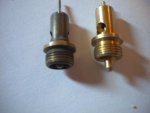
I am waiting on a carb kit to check power valve. I attached a picture of the power valve but not sure if ir worked.
 

Attachments

  • carb 006.jpg
    carb 006.jpg
    36.4 KB · Views: 1,603
Good pic!

The power valve on the left I assume is the "old" one?

When you installed the new one from the 928c kit, did you put that small, conical-shape spring down in the power valve well before installing the power valve? It must have the spring in order to operate correctly.

As you can see, that gradient-type power valve in the kit is a three piece design...spring, poppet, and the body. The length of the poppet is 1.230" overall, I just measured one out of a sealed bag in a 928c kit.

Also one more thing comes to mind here...are ya certain ya dropped the accelerator pump "check" down in it's hole in the main body? If not, when the engine is running, the siphon effect will cause the accel pump system to constantly drool liquid fuel out the discharge nozzles resulting in a super-Rich condition that can't be controlled.
 
good pic!

The power valve on the left I assume is the "old" one?

When you installed the new one from the 928c kit, did you put that small, conical-shape spring down in the power valve well before installing the power valve? It must have the spring in order to operate correctly.

As you can see, that gradient-type power valve in the kit is a three piece design...spring, poppet, and the body. The length of the poppet is 1.230" overall, I just measured one out of a sealed bag in a 928c kit.

Also one more thing comes to mind here...are ya certain ya dropped the accelerator pump "check" down in it's hole in the main body? If not, when the engine is running, the siphon effect will cause the accel pump system to constantly drool liquid fuel out the discharge nozzles resulting in a super-Rich condition that can't be controlled.

Yes I did install the spring, as you can see in the picture the new one, the inside area where the needle goes had not been machined far enough so the needle would not go all the way in place.
I got the new kit today and the power valve was correct, like old one. I spent a few hrs today< at work> looking over the carb spec bye spec, and trying to figure it out. When I dismantled it I did it in a very clean area and on rags, what I found out was there had been no acc pump check in the carb. I did not even notice it on the picture till really studying it. I made a phone calls to the guy I bought it from and he told me that he had carb troubles and had a guy rebuild it but could never get it to run. I figure it had been lost at that time. A guy I work with had some old spare carbs for parts from his race car so we dug and found one. I rebuilt the carb again and put it one. It ran like a top, wow.
Idle at 725, using a muli meter tach
vacuam is 16 of distbutor port
14 deg timing
2 turns on mix needles using tach and vac to set.
I work as a diesel mech at a case IH dealer ship and we get some old IH gas trucks in. I truel thank you for all your info and look forward to keeping up on whats going one. You hit it right on the nose and that is great. :yesnod:
thanks so much.
 
So faulty machining of the power valve component!!! Now that is a strange one! I thought maybe the poppet had just slid back when ya took that pic! Not only did you learn something here, so did I!

That missing accel pump check is a very common issue on many carbs I receive for reconditioning. And the story is always the same..."a pro rebuilt it but it never ran right"! I've done two carbs this past week that were also missing their pump checks, some use a form of a needle, some use a ball bearing with a weight on top.

Thanks for posting here! If ya need anything else regarding them old gasmotor IH junkirons, just ask!
 
1977 traveler
345 w/ t19
Holley straight point
2210c carb.

While off roading the engine would die on some corners and bumps. The engine has been refreshened with just under 1000 miles on it now. The carb was just drinking gas sometimes like it had a stuck valve. Other times the truck would be doing great on gas. The truck has 94,000 original miles on it now and the carb was never touched.

Just rebuilt the carb with the right gaskets, new float, and inspected everything. The jets where #50 which are the orginals from the dealer when bought in Colorado. The elevation is around 6500ft where I live and is offroaded in many different elevations usually much higher. Adjusted everything correctly and it runs great the only issue is on sharp corners or big bumps. During these it acts like it floods out and dies. Sometimess the ideal wil just go irratic for a couple seconds but not die. Any ideas as to why this is happening or any fix actions? Less than 1000 miles on new plugs, cap, rotor, points, and wires.

I also have the pertonix kit coming in the next couple of days so I can upgrade the ignition. Not sure if this will work for the Holley distributor with straight point, but it says all non gold box Holley distributors.
 
Hi master ,

excuse me for the disturb but I own a Holley série 22xx and you have definitely the capacity for help me , this is my bug :

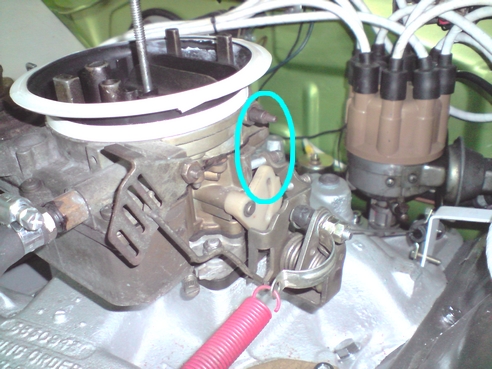
today I instal a new choke thermostatic but the lever is relatively too long for connect the flap and unreasonable force to choke wen I connected ; next wen I push on the flap isn't possible to open this at 100% ; the choke is at zero before the total opening of the flap .


post-123-1279401942.jpg

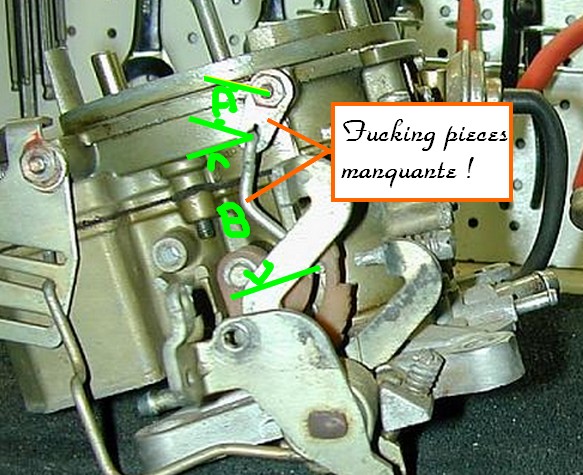
Next I have a second bug , on this carb' I have not this parts


post-123-1279402061.jpg

And if you can I want have the dimensions a and b (axis to axis) please ...


post-123-1279402094.jpg

Cordialy , tof
 
1977 traveler
345 w/ t19
Holley straight point
2210c carb.

While off roading the engine would die on some corners and bumps. The engine has been refreshened with just under 1000 miles on it now. The carb was just drinking gas sometimes like it had a stuck valve. Other times the truck would be doing great on gas. The truck has 94,000 original miles on it now and the carb was never touched.

Just rebuilt the carb with the right gaskets, new float, and inspected everything. The jets where #50 which are the orginals from the dealer when bought in Colorado. The elevation is around 6500ft where I live and is offroaded in many different elevations usually much higher. Adjusted everything correctly and it runs great the only issue is on sharp corners or big bumps. During these it acts like it floods out and dies. Sometimess the ideal wil just go irratic for a couple seconds but not die. Any ideas as to why this is happening or any fix actions? Less than 1000 miles on new plugs, cap, rotor, points, and wires.

I also have the pertonix kit coming in the next couple of days so I can upgrade the ignition. Not sure if this will work for the Holley distributor with straight point, but it says all non gold box Holley distributors.

"lower" the float (fuel level in the bowl), do not use the "specs" in the kit instruction sheet, simply set the float level so it's "level" when turned upside down and resting on the inlet needle.

Simple fix...ya May need to play with this a few times, the new float "floats" differently from the old rotten float and is more buoyant since it's made from a different material. I would say a #50 main jet pair would be correct for your described elevation. If that vehicle was originally sold/delivered new at an elevation above 5,000ft., then the delivering dealer was supposed to install a modification kit that was specified for the actual model/version that would bring the emissions system into federal compliance for operation at/above that altitude. The oem "flat land" main jets would have been either #52 or #53.

A Holley "straight point" distributor would never have been oem on a '77 engine, the oem distributor would have been either a Holley gold box or a prestoite electronic. The ignition wiring for those units and the '77 wiring harness is different when compared to any Scout II that might have used a breaker point distributor. The "straight point" distributor went out of production around 1969 and the breaker plate design was totally changed to the version for the so-called "curved points". A straight point breaker plate will have either a black or green plastic insulator that the points mount to.

The correct pertronix p/n for a straight point Holley is 1482.

The correct pertronix p/n for a curved point Holley (most common) is 1481. They do not interchange unless pertronix has made some design change in the last few months on the latest production!

The correct pertronix p/n for a replacement on a Holley gold box distributor is ho-181.

All three of those part numbers are for eight cylinder distributor apps only.
 
Last edited:
Before ordering the petronix kit I found the following on a site in regards to the kits "part numbers 1481 and 1482 are in fact for IH / Holley v8 applications. I see that part number 1481 is for clockwise distributor rotation (what most of us have) and the 1482 is for counter-clockwise distributor rotation. Otherwise they are basically the same." my distributor rotates clockwise which now leads me to think that this is a real bad case of the po virus which was all over this thing. The vacum lines where all messed up along with the electrical. Do I need to find a different distributor for the newer engines?
 
The distributor direction of rotation for all ihc-produced "sv" engines (266/304/345/392) is clockwise. That is due to the fact these engines use a gear drive for the camshaft, not a timing chain. Therefore...if the IH/Holley distributor being retrofitted is a "curved point" version it must use a pertronix 1481.

There were several other v8 engines produced by ihc but never used in the light line applications, some are rear-mounts, some used front mount distributors.

The internet websites which market stuff like this are full of misinformation. None of them handle enough IH stuff to ever become knowledgeable and could care less about correcting their application guides due to total lack of inventory movement. We deal with this constantly. I'm looking right now in my desk copy print catalog from pertonix which is identical to the version that is posted on their website. While it does not give much detail regarding definitive "which one", I've been selling and working with the pertronix stuff (formerly per-lux) since about 1975. I do know what fits what! If you will look at the pertronix callouts for the ihc applications in the "automotive" section, you will even see that their p/n information does not even jive with the same information contained in the "industrial" section of the catalog. Over the years I have pointed out the discrepancies to the p-tron folks but they have never responded nor have they ever corrected their information. It's not my job to perform a qa function for them!

And when you get into the other distributor variations used with ihc-produced engines (governor systems, etc.) it only gets worse regarding misinformation as few folks ever mess with that stuff.

Post #17 in this thread shows clearly what a Holley 1510 "curved point" distributor looks like inside.

A Holley "straight point" unit has the breaker points mounted to a sliding plastic block (green or black), the vacuum advance actuator arm is also a different shape, otherwise the distributors are identical (except for numbers) with interchangeable internal parts (except breaker plate). A "curved point" breaker plate May be installed in a straight point distributor body as long as the correct vacuum canister is also changed out.
 
hi master ,

excuse me for the disturb but I own a Holley série 22xx and you have definitely the capacity for help me , this is my bug :

today I instal a new choke thermostatic but the lever is relatively too long for connect the flap and unreasonable force to choke wen I connected ; next wen I push on the flap isn't possible to open this at 100% ; the choke is at zero before the total opening of the flap .


post-123-1279401942.jpg

Next I have a second bug , on this carb' I have not this parts


post-123-1279402061.jpg

And if you can I want have the dimensions a and b (axis to axis) please ...


post-123-1279402094.jpg

Cordialy , tof

I see that the carburetor shown in your pictures is a chrysler application...318 or 360??

The new thermostatic choke stove you mounted will need to have it's actuator rod "bent" to a pre-determined shape in order to operate the choke plate correctly, that is how the "final" adjustment for the choke system is made.

I'll have to check my supply of used parts and see if I have something that will work on that carburetor for you. I do have a couple of new versions of that chrysler application carb also.

While you item is certainly a 22xx, the chrysler versions use a totally different main body and throttle body, some of the linkage parts and peripheral items do interchange with the versions used in ihc applications. I'll get back to you tomorrow!
 
the distributor direction of rotation for all ihc-produced "sv" engines (266/304/345/392) is clockwise. That is due to the fact these engines use a gear drive for the camshaft, not a timing chain. Therefore...if the IH/Holley distributor being retrofitted is a "curved point" version it must use a pertronix 1481.

There were several other v8 engines produced by ihc but never used in the light line applications, some are rear-mounts, some used front mount distributors.

The internet websites which market stuff like this are full of misinformation. None of them handle enough IH stuff to ever become knowledgeable and could care less about correcting their application guides due to total lack of inventory movement. We deal with this constantly. I'm looking right now in my desk copy print catalog from pertonix which is identical to the version that is posted on their website. While it does not give much detail regarding definitive "which one", I've been selling and working with the pertronix stuff (formerly per-lux) since about 1975. I do know what fits what! If you will look at the pertronix callouts for the ihc applications in the "automotive" section, you will even see that their p/n information does not even jive with the same information contained in the "industrial" section of the catalog. Over the years I have pointed out the discrepancies to the p-tron folks but they have never responded nor have they ever corrected their information. It's not my job to perform a qa function for them!

And when you get into the other distributor variations used with ihc-produced engines (governor systems, etc.) it only gets worse regarding misinformation as few folks ever mess with that stuff.

Post #17 in this thread shows clearly what a Holley 1510 "curved point" distributor looks like inside.

A Holley "straight point" unit has the breaker points mounted to a sliding plastic block (green or black), the vacuum advance actuator arm is also a different shape, otherwise the distributors are identical (except for numbers) with interchangeable internal parts (except breaker plate). A "curved point" breaker plate May be installed in a straight point distributor body as long as the correct vacuum canister is also changed out.

Thanks,
you have been so much help since I picked up my project. I do have the straight point type distributor which I knew when I ordered the petronix kit. The points screw on to a black plastic base. I ordered a Holley curved point type distributor which will be in tomorrow so I can install the petronix kit I ordered. I will take pictures of the distributor tomorrow before I turn it in as a core to add to the distributor identification section if you want. I wish I had the correct info before ordering the kit, but with shipping, restock fee, and the cost difference it's the cost as buying a reman distributor.
 
The important thing is to get the right system setup now and be done with it! What you have encountered is unfortunately fairly common around here, though most folks don't talk about it inna public forum, they just make a phone call or email! Discussing this stuff in public does help many others with their own projects.

The only drawback to the straight point distributor is that over time, the plastic block cracks from deterioration of the plastic. And I have no idea where to find new ones at this point, the one source I did have now has none left.

On the other hand, the curved point Holley distributor will sometimes wear out one or two of the tiny nylon "bearings" that separate the upper and lower breaker plates. But I have a fix for those and we can normally salvage the parts and make 'em like new again.
 
Hello there. New to the IH community and looking for some help. I recently purchased a '74 100 pickup, with what I was told is a 392, though I'm now wondering if it's a 345. Can't read the plate under the #2 spark plug that everyone seems to refer to, as a wiring loom runs there and the frame gets in my way. Anyway, it's currently not running (was running when I got it last week and has since died and won't start again). I'd like to first figure out which carb I have on there, as I'm also confused about that.

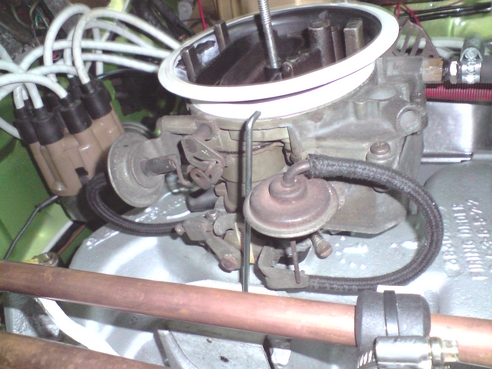
I know it's a Holley, and it looks to have been worked on before, because someone wrote "2245" on the choke plate and the side of the carb in a marker. However, after reviewing the beginning of this thread with the pictures, it looks to me to be a 2210 or some frankenstein carb between the two. The number stamped on the front is a bit hard to read, but from what I can make out it is this:

r 6828
451911 c91
2503

there is also a smudge to the right of the first line that could be an "a" or could just be a smudge/ding.

I'll post some pictures below (hopefully, if I can do it correctly) to show you what I mean.

Thanks in advance!
-nelson
 
Back
Top