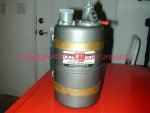
A marvel oiler is designed for the contents to be inhaled by the engine and consumed in the combustion chamber. Those devices went away right after positive crankcase ventilation systems became mandatory by the feds around 1961 in the u.s. Market. In the case of the judson unit, the only way they could be lubricated was with the marvel setup.
A turbo must have a pressure-fed lubrication system, just like an air compressor system on a medium/heavy duty truck for air brake and accessory operation. The turbine setup in a turbocharger spins at a far greater rpm than the rotor or impeller set in a supercharger driven by the crankshaft in either under-drive or over-drive config. And a turbo...by design...reclaims and converts a tremendous amount of heat!
All ihc-produced I-4 and sv cylinder heads have a drilled/tapped/plugged port in one end which is for an oil return line for an air compressor-equipped engine app.
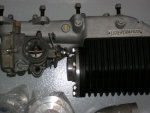
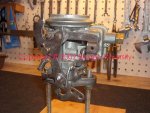
Don't know about that "pot" terminology in regards to this system??? But...when I first realized that these huffers used the 1904 mixer, I thought then that it was a strange choice of carb...but they were dirt cheap and plentiful at that point in time. The stromberg 48 and 97 mixers were considered to to be the hot ticket in a similar carb back then!
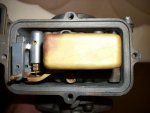
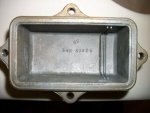
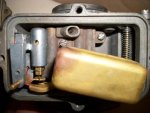
A "fish" carburetor is just that, fish was the brand name! Basically, a clone of a Holley 1904. Same kind of concept as what we have today in a "barry grant" dominator clone of the Holley modular series mixers.
fish carb stories
At this time, it appears the fish has been reborn?:
the fish carburetor manufactured by the brown carburetor company
If you look at all the various vehicles that the judson system was marketed for, you can see that these were not an upgrade that enhanced engine performance to any great extent. For the most part, these vehicle/engine combos were very utilitarian , in many cases, the actual vehicles were extremely under-powered, these were the very first econoboxs way before that term ever existed. And even the "sports car" variations of that era used the same engines as the utility sedans, maybe with an increase in compression ratio, a slightly "hotter" camshaft, and multiple carburetion.
Keep in mind...europe was still emerging from wwii after 10>12 years, the motor vehicle industry was just beginning to come to life and exports of these vehicles to the u.s. Were still in infancy. A freakin' citroen 2cv was dangerous to take out of the neighborhood! A renault dauphine was somebody's cruel joke, same for the first beetles (30hp)! But then along came the 948cc austin motor that grew into the other variations for mg, et al, then the german Ford stuff, then the cooperized mini...and suddenly an entire hot rod/muscle car era dawned...euro-style!
Judson's "competiton" in the u.s. Marketplace was provided by mcculloch superchargers. The stuff they did oem for Ford, studebaker (even the chev corvair) was pure performance-oriented, had nothing to do with enhancing drivability. But the development of the "affordable" small turbochargers for the so-called domestic "compact" market (olds f85, IH Scout 80, corvair spider, etc.) killed the supercharger market since they were less costly to produce and did not have to have an elaborate drive mechanism such as Ford used. Mcculloch later evolved into the paxton system of centrifugal blowers.
the history of paxton automotive | paxton superchargers
A "gmc" blower is based upon the so-called "rootes" design. The judson is a rotary vane design, much like modern, high rpm air conditioning compressors used in the mobile hvac industry.
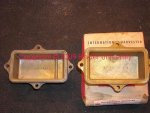
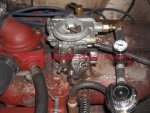
I f you go to the beginning of this thread and look closely at the pic in post #2, you will see the oil bath air cleaner adapter mounted on that example of a 1904. That one has an IH-pattern throttle lever/choke actuator, not the Ford-type.




 that is so rare these days.

 -- what is wrong with a 2cv??? When hitchhiking in europe in 1968, I got a ride in one from dijon, france to geneva, switzerland -- quite "quaint" even at the time..., though, he did not drive it on the "freeway"... He took the "back roads"...