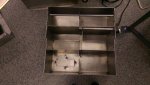
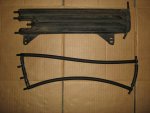
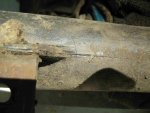
for the time being I've installed a hose manifold in place of
the liquid/vapor separator. It seems likely to work fine so long
as the tank isn't grossly overfilled. I can always put a transparent
fuel filter in the vent line at the charcoal canister to serve as
a sight glass to check for liquid carryover.
After thinking rather hard about what could go wrong with my
hose manifold setup the only scenarios seem rather implausible.
Foaming fuel would be one, but the amount of shaking needed
would make the passengers foam long before the gasoline. Fast
venting (combined with high fuel level) might be another, but
filling the tank is the only time levels change rapidly, and that
venting occurs through the fill vent, not the charcoal canister.
Apart from racing and rock crawling, it seems to me the hose
vent manifold ought to work fine.
Have I missed something?
On the repair, it turns out that decent adhesion to normal 24
hour epoxy can be obtained by:
sanding with waterproof 220 grit sic paper and acetone
lightly flaming the surface with a torch, with minimal heating
rinsing with isopropanol
promptly applying the epoxy (within a few minutes)
the test bond came apart only by prying with a sharp knife.
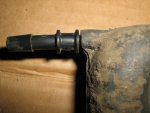
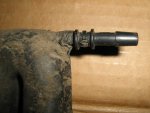
On a joint like the one pictured, with good overlap, if the
gap between hose fitting and tank fill it'll stick better than well
enough. The epoxy is curing now.
In the meantime I'm planning to leave the hose manifold in
place just to see what happens, unless somebody points out a
likely problem. It's clear the hose setup can't be as good as a
purpose-built liquid separator, but the need is unclear to me.
Thanks for reading, and all your counsel.
Bob prohaska