Limited disassembly of a 1980 IC 196

So I can stick one of these somewhere and read out on a multimeter (undoubtedly some conversion factor to go from volt or ohm or whatever to farenheit). I could easily monitor a temp with and without coolant flow through the exchanger. Cool!

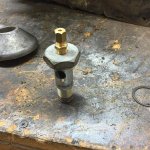
I also looked at the sending unit for the oil temp gauge I am looking at....1/8" thread - smaller than I thought - so that could probably be threaded into that banjo bolt, since all it need do is press the adaptor against the other adaptor - no other stresses since it is supported by the little bracket. Plus, this is permanent and I needed to do that anyway...

Thanks, all. My next opportunity to tinker with this is a week away.
 
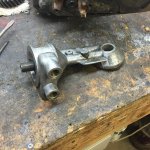
Yesterday I went to pnp to look around, and maybe to score a big banjo bolt and a spare coolant/oil exchanger. Hey, $20, why not? There was a guy under a turbo brick pulling a turbo, but he didn't have the right tools and needed to remove what I was looking for. Of course he destroyed the exchanger in the process. So I scored that banjo bolt, at least, and he said there was another brick a few rows over. So we tackled that one. I had the right tools but it had the other style - regular oil to air adaptor. So why not. I scored that, plus the hard lines, for $15 (it was 25% off day). In that same yard there was a 1958 metro that had come to the end of its days. My, those were roomy inside!

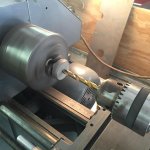
Anyway, I drilled and tapped the banjo bolt for a 1/8" pipe fitting, as that's what I read is the threading for the sending unit for the auto meter z-series gauges I'm looking at (I grabbed a 1/8" fitting to test the threads). I cannot see why this won't work - I doubt that bolt head lost any strength in the process.

Edit: I dropped the oilstat and adaptor into my can of carb cleaner and it didn't occur to me if the cleaner would harm the oilstat. Anyone know how those things work and did I hurt it? Edit to edit: found the answer on the turbo bricks site. Got it apart, can't see how that did any damage.

IMG_1716.jpg

IMG_1718.jpg

IMG_1719.jpg
 
Last edited:
A little off topic. We are in the path of the trail fire. Evacuating now. Got the Scout moved to safety. Among items to "save" are the turbo, manifold and shields. Leaving tools etc. Otherwise we're bugging out
 
We've done all we can and are waiting to be kicked out if it comes to that but we are hopeful. I was able to load up the Scout with all my hard to find parts. Tools can be replaced but you know what I'm talking about. Foresthill's residential area (Todd valley) is on the edge of the fire most neighbors have already evacuated
 
Last edited:
Ok, if you don't mind my saying you seem a bit anal (like me), but if you haven't done so yet, clean out the gutters, remove all debris from around the house. Put a hose on each bib around the house and mow everything you can. A lot can be done to save a house before the fire gets there and if it's apparent you've everything you can the firefighters will do everything they can.
 
We did all that!! A neighbor had a fire fighter friend come over. He got on the sheds roof and cleared it while I cleared leaves. Hung tarp over shed entrance. After this danger passes I'll rig up a roof sprinkler setup. No time yesterday
 
Good! Another big thing you can do is close all the blinds and drapes to prevent the contents of the house from combusting from radiant heat. Better is aluminum foil on the windows and best is 3/4" celotex in the windows to reflect the heat back out. My thoughts and prayers are with you.
 
stay safe. I expect our dept will be sending out a strike team soon.

Now that the dust is settling a bit...exactly what is your relationship to fire? There's a calfire section chief on my vanpool (we're all state workers) and I have a vague idea of the structure.
 
Oh! That explains your handle. Thanks! There was a former fire fighter that assisted me yesterday (as you read above). I asked him if he had ever been "crowned" by a fire. He didn't understand the term. I explained how in 1970 I (and brother) were impressed by the pomona fire department into fighting an arson-set wildfire in the heavily residential ganesha hills bordering the pomona fairgrounds. We and the fire engine crew were simply trapped, so they placed hoses in our hands at certain key spots to keep the fire at bay while they did other things. At close range we watched homes burn to the ground in minutes. Then a wind whipped up and we were all drug under the fire engine as a wall of fire leaped over the truck and continued on. After we crawled out, the fire captain said, "boys, you can now saw you were crowned by a fire and lived to tell the story." I was 18 at the time. I've had a healthy respect of fire ever since then.
 
Just when we thought we were getting past this. The wind has shifted (?) and the west flank of the fire is again moving west. There are six calfire bulldozers now offloaded and cutting a fire break at the end of my street. Low-boys parked in front of my house.
 
Things have settled down now...now on to other things. In preparation for putting the blower back on, I took the Scout out for a hard flog on a hot day (today) and backed it under the canopy, then pulled the plugs for a compression test "just because". The engine now has about 2,500 miles on it since the rebuild. Right after I put about 500 miles on it I took a compression test and it was, 1-4, 150, 130, 150, 150. Today it is 150 across the board by the fourth revolution, and pumps to 90-120 on the first, so I think the rings have bedded in properly. I've put maybe 75 miles on the heat exchanger adaptor and there is no sign of leakage, or even weeping. I have ordered a boost gauge (auto meter 30inhg-20 lb boost, so I get a vacuum gauge as well, what the heck), and a 140-250 f oil temp gauge. Those should be in by next week and installed that weekend. This weekend it goes up on blocks to swap out the d20 for a freshened d300, and the reason that is being done first is that I have wised up and am going to route the exhaust down the right side of the frame and get away from all the tortured bends around things. The front drive shaft will be relieved to hear this. I scored an nos right side tail pipe a while back and will need to weld up new tubing to go from the end of the big turbo outlet tube. Also, there is, I understand, a little more clearance between the frame and a d300 so if I'm running either 2 1/4" or 2 1/2", no problem.

Edit: got the d300 in today and of course, the last bolt on the backside (about 7 o'clock facing forward, as they deleted the 6 o'clock bolt) that goes into the t19 adaptor stripped. So I did a temporary and put a longer bolt in and a nut will just fit between the trans and the adaptor. Grrrr! Plus the front output shaft shim pack weeps and is tightened down as far as I dare. So I'll be removing those and spraying shellac between the shims and reassemble. There will be enough room between the case and the frame for whatever pipe I choose to run. And the switch to indicate front axle engaged gave it up...need to call Jeff and see if they stock those critters...
 
Last edited:
Today decided to replace the adaptor's big banjo bolt with the one I drilled and tapped to accept a 1/8" pipe fitting, I.e., the sensor for the oil temp gauge that should be in the mail....

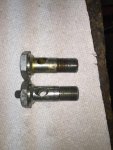
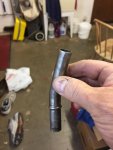
Unscrewed it and screwed in the modified one, along with a fresh aluminum seal/washer. Tightened it waaaay down, got into the cab, fired it up, and then walked around to see if it was weeping. By then oil was spraying all over everything and I lost a quart before I could shut it down. Tightened it down even more (how much left to go before I would strip it I do not know!) fired up again, same oil spraying all over. Yikes!!! This was the mother of all wtf moments. I pulled the modified banjo bolt and thought maybe it was a teeny bit longer in the threads and therefore was bottoming on the threads I tapped into my casting. It would never seal if that were the case, but in fact the exact opposite was true - volvo had a design change in that bolt! In fact it wasn't threaded enough (see picture), so it was still "bottoming" before it would seal. The other bolt I "scored" the other day was the same. Solution was to drill/tap the original one, saving the others for a rainy day where I could still run a die over them and cut the missing threads if needed, but I think that's unlikely I'll ever do that. In any case, I put the now-modified original one back on and it sealed right up. I always expect a goofy part snafu from International, I suppose I can take comfort in the fact that volvo followed in their footsteps.
 

Attachments

  • IMG_1824.jpg
    IMG_1824.jpg
    44.6 KB · Views: 312
For anyone reading this that's toying with going turbo on a four, I was contacted via pm on the bp board by someone who has all the 152t parts except for the exhaust manifold and wedge (sol, pretty much), but is determined to find a solution by having a header type setup fabbed. So I offered to take measurements from my parts and make a wood buck that gives the alignments and measurements of the manifold and wedge bolted up so that the iron elbow, turbo and the rest of it will be located "in space" as if the header were those missing parts. I also have a handle on a solution to the obsolete, unobtanium metal ring "donut" that goes between the 3-bolt manifold's outlet and the iron elbow. The other day I was at IHPA and saw some metal rings on the rack that look suspiciously close....and aren't the donuts used for our 2-bolt setups. I hope to get this buck to the guy in a week or so and I really hope he posts pics of his progress in fabbing a suitable header.

Today I took a stock, shim style exhaust manifold gasket and traced it on some wood. Oh dear - I never realized there is actually a side-to-side difference in the spacing of the bolt holes, a front-rear situation. I had to cut off the heat shield flange portion to get it to lay flat, but had to do this anyway as it gets in the way when bolting up the original turbo parts. I'll bet those guys assembling those engines cursed the engineers. You can't use the gaskets out of the box - you have to cut off pieces and turn one of them upside down to get them to work.
 
I have the drawings I made of the exhaust flanges for my 152 or what ever. I also cnc'd a pair out of 1/2" thick stainless.
 
I told this guy he'd need 1/2" thickness and also need to include the two projections that press on the block below due to cantilever forces.

I really hope he follows through on this.
 
Thanks for the offer! I'll ask him if he's interested in going this route.

I've been sidelined the past few weeks. The honey-do list is now job #1, and I'm taking next week off to begin it . Happy wife = happy life, aka rebuilding the first of two decks off the back of the house. However, I will also have some time during that week to tinker. My gauges came in and I'm anxious to mount those and see how the oil cooler performs. There should also be an opportunity to put it back up on blocks and reinstall the turbo.
 
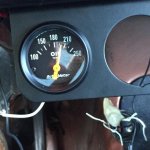
Had some time to mount the oil temp gauge and test it out. This afternoon it was real hot - around 100 degrees. So I turned off the heater so that there was no flow through the exchanger, and went for a spirited drive down the hill, flogged it up some grades, and the temp rose to what I guesstimate is around 200 degrees, maybe 205. Going over the course again, I turned the heater flow on. Coolant that has now entered the block, flowed through it and exits to feed the heater, then goes last to the exchanger. Nothing really changed, although you can see subtle changes in the oil's temp when the engine's temp goes down a little, and vice versa. In mild weather, my coolant temperature gauge doesn't move up as far as it did today, so I'm guesstimating around 180-185 is the norm. It moves to where it did today when things are real hot, around 100. I'm concluding that the coolant and oil are stabilizing each other and probably within a few degrees of each other, which is per the gauge, around 200 f. Under these conditions, I think the oil is running okay, right, Robert?

What I'm going to do next is to braze a 5/8" tube onto the water pipe so the exchanger gets coolant right out of the pump, which is the coolest source, before going into the head and picking up all that heat, which it is doing now. I think this will noticeably reduce the oil temp.

Edit: since the two conditions are so close, I conclude that my oil temp has been running like this before I put the exchanger on. I don't believe that's a bad thing at all. This also tells me I have "reserve" capacity for pulling out extra heat the turbo would add, or even, say, adding a/c and lugging up some long grade on a really hot day. I'm operating at 2,400-3,000 feet and one stretch is 8% grade for a mile, and I keep it floored in 3rd to hold 50 mph, which means I'm spinning around 3,400 rpm. I still think brazing in a tube to pick off cooler coolant is a smart thing to do.
 

Attachments

  • IMG_1835.jpg
    IMG_1835.jpg
    39.4 KB · Views: 324
Last edited:
200-210 is a nice range. The cool coolant will lower the peak but might slow warm up.
In winter run a shut off valve.

I now have a good baseline. The past three days I've had to drive it four times down and back up the hill in this 100 degree heat. When I drive it with the coolant shut off, oil temps go to 210. When I'm pulling one of the grades @ 210, I flip on the heater (coolant) but no fan - just circulation - and in about 10 seconds you can see the needle begin to move down. It seems to settle at what I guesstimate is 200 degrees, which makes sense that's what the engine is running at under those conditions. So there you go.
 
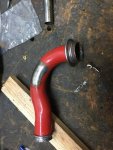
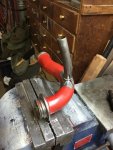
Had a little time this afternoon to tinker. After estimating where to locate the new tube nipple to the water pipe, I removed it and drilled a suitable hole. Btw, the donor tube is actually the turbo drain tube from a corvair spyder/corsa. It fits into a hole in the head to drain to the crankcase. Repurposing GM stuff, heh. I've oriented it and hope to get it to Jeff's this week, for brazing.

IMG_1872.jpg

IMG_1874.jpg

IMG_1883.jpg
 
Back
Top