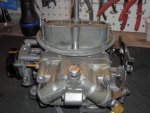
Holley 23XX Series Modular Carb Stuff

Thanks Mike! I actually drilled the float and there was some gas in it which I eventually got out by blowing and blowing up the vapours. And then used it as soon as the repair kit arrived. No scum this time. But I was dissapointed, though. There were only the blue gaskets which I was able to use and some minor stuff like o-rings. But I guess I have the same problem as jon in his thread.

I dare to post some pictures here, ok?

Once again this gasket is not the propper one, is it..
pb050087.jpg


There is this route which is not covered by the gasket.
pb050090.jpg


Look, the wet spots on the rusty plate is what I shook out of the float:
dsc02157.jpg


Here's my power valve, which brings up my first question: is it cool to leave it as is, or shoul I look for some trouble? They didn't pack a gasket for this one(on the right in the picture below),
p146189_image_large.jpg

pb050057.jpg


Here's the arm which pushes accel. Pump diaphragm:
pb050060.jpg


Is this bendage ok? Do I adjust it somehow specificly? I already grinded it so it has continuous smooth surface...
pb050063.jpg


I have the idle needles in this condition, can I go ahead and file them to it's original shape?

pb050081.jpg


Thanks!, martin
 
I have never seem the soldered vent hole fail in the float. I would go looking at the seam. Sometimes, when backfire thru the carb the float bowl area becomes pressurized for a few milliseconds and it'll affect the float. Fuel can enter under pressure but won't let it out because pressure inside float is lower than pressure outside.
I would not reuse that float. You can test it until you are blue in the face by holding it under water etc and it'll act liquid tite but it'll come back to bite your ass. Of course, knowing michael, he has a foolproof method to test a float and then we can both learn something.
Nice pics and presentation, oj
 
Hey michael, been a long time! So the Scout was running pretty well with the carb you supplied; never really perfect but good enough for me since I haven't had any time to tinker on it in the past few months... Long story short it was having a really hard time cold starting. I read many of the posts on here and made some adjustments and it seemed to be doing better... So yesterday I took it out and it died at an intersection, I started it back up and got down to the next intersection and it killed again. Went to start it back up and got nothing. Checked the carb and it appeared that there was no fuel getting through. So I checked the pump (rednecked it and just took off the fuel line, the pump was spraying fuel for about 10 feet out of a 3/8" hose, so I'm thinking it's ok. So I had my brother tow me back home and I pulled apart the carb. Everything looked good inside but all I could figure was that my accel pump maybe wasn't pumping correctly?? I replaced it as well as the power valve and the needle in the float bowl. I reassembled and put it back on the truck... Same exact problem though. I reset the float level to 1/16" below the peep hole and still can't get any fuel into the horn... Nothing dribbling out the shot holes... I'm frustrated! Let me know what you think alright? Thanks man. Looking forward to hearing from you again.
 
Last edited:
I just figured you had given up on us ben after I failed to show down there to pick up that transmission!

Just two weeks ago, my wife reminded me that I needed to take a ride down and get it out of your way! I'll work on another date now and run it past ya! So you must have gotten your pooter issues solved now?? Glad you are back up!

Anyway...what you describe is weird as hell!!!

Can you see liquid fuel in the bowl when you look into the sight port??? If so, then there is fuel inside the metering system. That means the jets are submerged in liquid and that the engine will run!

If you replaced the needle seat combo, then that rules out any debris getting past the fuel filter. Are you sure the fuel in the tank is fresh and has no moisture in it?? Are the plugs getting wet from fuel during the starting process? Is the choke system functioning properly?

If you are certain the accel pump diaphragm is ok, verify the check valve that is in the well. I don't remember if that one has the umbrella (orange silicone rubber) check or has the small "ball" retained by a tiny sheetmetal strap. Anyway, make sure that works.

Also, there are three (at least) different bowl gaskets used on those carbs, only one gasket properly aligns the tiny feed hole for the accel pump shot with the metering body passage to go topside. Same for the metering body-to-main body gasket, it's gotta be the right one. Maybe you changed that gasket out for the wrong version?

When you look down at the shooter (and remove it), you will find either a check ball or a check needle. Again, I don't remember which that carb has, but that check must not be "stuck" otherwise you will have no pump shot either.

I can't find the pics of the carb I sent ya...no doubt they were "lost" when I had all the hard drive and computer replacement issues, I lost many pics from over the years due to the meltdown.
 
As per normal, you're a genius. It was the ball bearing in the accel pump. It had fallen out and I didn't notice it fell out when I pulled it appart. The clip was in place, so I have no idea how it fell out. Lucky for me, my six year old has good eyes and helped me find it on the kitchen floor. Anyways, I put it back in and it runs fine again. Actually a little better than it had before... Probably because I replaced the power valve. I think I damaged the other one when I stabbed the dizzy backwards and had a major backfire through the carb. Anyways, it seems good now except that it stalls when I push the gas (if I push the gas slowly it's fine, but if I put it down hard it stalls and sometimes even dies). Are my jets too big?? I've had this problem for a while and I've just learned to be light footed. Also there's a heavy ticking that wasn't there before. Gonna go read the threads on collapsed lifter/valve noise. And don't worry about the tranny, it's not in my way at all so whenever you're down next swing in, or I'll bring it up the next time I'm headed your way.
 
Ok, just took it on a test drive (I was out of beer) and the ticking stopped after it got up to 190. Still had the problem when I'd floor it, and another weird thing, after it got up to temp it would chug a little while waiting at the stop light... Like it was running out of fuel... Once again, jets maybe? The numbers that you wrote on the carb says that it has 65's installed. Let me know what you think.
 
It's taken some time, but I finally located the folder with the pics of your carb on another computer hd that is barely limping along. Now I remember what we did...

That carb is an oem 2300 with hot air choke. Came off a 345 that I did another swaparoo with a club member. After you decided you wanted it, I converted it to the electric choke cap.

Then we discussed it and you indicated you would rather have the center-hung float system so I installed the bowl from a 7448. I also jetted it for what I thought would work best at your elevation (3kft.). So it got 61 main jets and a 65 power valve. But we never completely dialed it in either due to the issues you had at the time completing the engine build.

For that same carb at under 3kft., I'm now jetting 'em #64 for use with e10 (gasohol). So...if you wanna mess with it, try a pair of say 63 and see how she flies. Power valve between #65 and #85 is what I'd use.

Your kiddo can come up here and spend the day on my floor, there are all kinds of Holley parts down there I can't see!

Once the jets are changed again, then reset the idle mixture, changing main jets affects the idle mixtures as well. Then go test it. If it's "better" but still has a slight hesitation at launch, then move the tiny screw on the throttle lever that retains the accel pump cam to the "other" hole. It it's better leave it alone. If "worse", then put it back where I had it.

Just do one thing at a time. If I was there working with ya, that is exactly what we'd be doing, don't make several changes at once.

Is the fuel "fresh"??? When I say fresh, no older than about three weeks of "sitting" with only a few starts and stops. This e10 shit deteriorates (oxidizes) fast! If you don't run it on a regular basis, then keep the fuel doped with stabil marine grade fuel dope (the blue stuff, not the less expensive red).
 

Attachments

  • BenJ 2300.jpg
    BenJ 2300.jpg
    65.7 KB · Views: 726
K. The new power valve I just put in is a 75. I'm actually running at 4000 ft... Still go with 63's? Maybe I'll just grab an assortment and start messing around with a different set every week until I have something that runs perfect. Another note that might help you is to tell you that my fuel economy has been awful... Like 6-7 mpg. Most of the driving is stop and go, but yuck. I was hoping for 10+ out of this... I need to get some of that good oil ordered up from ihon... I still haven't changed it from my break in oil as I just got it up to 500 miles recently.
 
k. The new power valve I just put in is a 75. I'm actually running at 4000 ft... Still go with 63's? Maybe I'll just grab an assortment and start messing around with a different set every week until I have something that runs perfect. Another note that might help you is to tell you that my fuel economy has been awful... Like 6-7 mpg. Most of the driving is stop and go, but yuck. I was hoping for 10+ out of this... I need to get some of that good oil ordered up from ihon... I still haven't changed it from my break in oil as I just got it up to 500 miles recently.

10+mpg is certainly doable. I'd make certain your base ignition timing is in range, at your altitude you can most likely run around 10*btdc on regular grade fuel. Have you played with "power-timing"??:

http://www.forums.IHPartsAmerica.com/ignition-tech/2122-ignition-power-timing.html

Yes...let's try the 63 (or 64) main jets and see how she plays. But when changing jetting, you must re-set the idle mixtures and curb idle speed once the engine is up to temp!

The #75 power valve May not be the best choice at that altitude but that is certainly not a dealbreaker. That is not the cause of your poor fuel economy!
 
Alright, I'll order up some sets of jets tomorrow. I tried to start it today cold, even though it was running great the other day, and I couldn't even get it to run. I don't know if I've got the choke closing too far or what... It's almost completely sealed off. I can't find any posts on adjusting electric chokes... Any pointers? It's supposed to be in the teens tomorrow morn, so it would be a good time to play with it.
 
For any of these carbs with electric choke, the initial setup is for the tick Mark on the cap to be lined up in the center of the housing (the long Mark).

On "average" however, I usually end up with the cap set to two ticks "Rich".

Ambient temperature has nothing to do with how the choke should be set.

If the engine would not start because it was flooded, then hold the pedal to the floor and that will always crack open the choke plate based upon the design of the linkage. That also provides maximum amount of air through the carb to clear the flood, do not pump the pedal, that only makes it worse as an accel pump shot squirts every time!

Ambient temp does have to do with how fast the engine cranks over, along with the oil viscosity. Temps below 30*f or so will kill battery "ampacity" very dramatically, when that happens (because a battery does not have a high enough "cca" rating), there is not enough juice to both spin the starter and fire the ignition off simultaneously due to voltage drop.
 
Hello, I wanted to share what we took from you kind advices.

So we removed the absurd shitty edelbrock:
dsc02446.jpg


And removed this old gasket:
dsc02449.jpg

Instead of which we mounted the smaller one with bigger holes from the kit:
dsc02451.jpg


Which was so thin that we had to mount washers.
But it worked like a charm and is now much much more smoth and it runs incredibly through whole rpm spectrum

dsc02457.jpg


We didn't check the fuel level in the float bowl yet. Didn't have much time to fully worm the engine. Thanks!
 
Persistence pays off!!! And I don't think us folks over here can appreciate the difficulties you guys encounter dealing with parts issues on these old vehicles. We simply go down the road to the auto parts and find what we need. But then, we would have the same issues when trying to find parts here for a trabant, skoda, or nsu!!

When working with the various intake manifolds and carburetors here, I normally toss the mounting bolts and install studs of appropriate length. That "heat dam" insulator base gasket was an item developed specifically for the ihc-produced engines and then adopted by many other oem manufacturers. While certainly not essential, they do help in reducing fuel "percolation" on a engine package that has been run and then shut down and allowed to sit for say 15 minutes. We have those gaskets in stock always on the shelf. A similar item was used on the 4v versions of that intake manifold along with a Holley 4150 or 4160 carburetor (depends upon model year and platform).

If you haven't already done so, you May be able to actually improve the idle quality by cleaning that pcv valve I see in the passenger side valve cover. Those were made by ac spark plug and are completely serviceable, they are not throw-aways!:

http://www.forums.IHPartsAmerica.com/gas-engine-tech/2244-servicing-cleanable-pcv-valve.html
 
Last edited:
Mr. Mayben

thanks for this site - great info. I'm rebuilding a 2300 from a 69 Scout 800a. The list # is 2977. I've attached a picture showing problems I encountered. The metering body (40) has a broken prong and the metering body vent baffle (38) is missing. It also seems the idle needles are sealed (41, 42, & 43).

Is it ok to put back together without the vent baffle? Should I just proceed without changing the idle needles on sides of metering body. Thanks again - if you have replacements for my metering body and vent baffle, I would like to buy.
 

Attachments

  • carb list 2977.pdf
    197.2 KB · Views: 715
As for not using the "vent baffle" go ahead. That is not something that will make or break the deal.

Your bottom/rear of the throttle body should contain the idle mixture screws, not either side of the main well, those came out later. You will have one pair or the other pair, but not both pair!
 
Could someone help me out with what rebuild kit I would need
for a Holley list#6391-1 and the best place on line to order it
 
That carb is oem on a '72 304.

For all Holley 2300 carbs, I use the Holley p/n 37-1543. You will have to select the proper throttle body gasket from that kit and possibly install one or two additional holes in it.

We carry that kit in our online store here at ihon.
 
It's fun and games time again.

I have a 1972 1010 pickup with auto trans, air, 345. The vehicle has 63,800 miles on it, I have owned it for 16 years and put 5000 miles on it.

The carb is a 2300 list 6386 with a stove pipe choke. I have rebuilt this carb 3 times with modest success. Meaning; I have managed to limit the turbo lag and get it to not stall and run reasonably well. Fuel mileage around 11 mpg as best as I can figure.

It has been sitting for about a year, having been started and driven only to relocate it aound the property. The other day I decided to have the a/c charged which required a 44 mile round trip to the fair burg of gts. Pass oregon. I charged the battery the night before. In the am I started it up and it idled badly, requiring a 5 minute warm up at about 1750 rpm ( a guess)
never would idle right. I decided to try getting to town...

It surged as if it was a lean surge up to about 2500 rpm ( a guess)... Under load it ran just ok... But medium to light throttle it surged. About 15 miles down the road I noticed that the fuel was low. I stopped to get 5 gallons. Battery was flat and would not restart... Swell so now I have a buggered carb and a defunct battery. Got a jump and decided to return home.

I cooled the engine off... I checked the float level.. A scrid below the hole. I pulled off the float bowl cover expecting water or silt or rust. Nothing.. Just fuel. I cleaned the needle and seat, removed and cleaned the mains... Reassembled it and took it for a drive. Same lean surge, won't idle. I turned the idle up to make it run... It loped and fluctuated. Lots of squirt from the accelrator pump.

So, I removed the carburettor.... I have a carb kit that will be here wed....
Carb soak and basket ready to go...
But my feeling is... Here we go again.. About 50 bucks into overhauling this marginal excuse for a carb just to have the vehicle run badly for another 1000 miles so I can do this again.

I have read all the posts and threads on the 2300 carbs here over the past couple years... What gives with this carb ?
Why so problematic... Granted I May not be doing the super primo job of an overhaul as with someone elses vast experience, but I have worked on carbs before and have a serious background in overhauling what I consider the worlds best carb, the su.
Still have all my tools and gauges for these.. But that doesn't solve my problem with this 2300 list 6386.

Should I overhaul it one more time, get a replacement as suggested by one IH parts supplier for $260.. With a unit they sell that supposedly will not only solve the turbo lag, but clean up the running and increase my fuel mileage..
Or is all that possible by properly overhauling this carb ?

Btw the dist vac comes off a spigot that faces front in the base of the carb that has a "t" with another vac hose coming from the vac block at the right side back of the top of the engine.... Never did know if this was correct, but that has how it has been since I've owned this rig.

I like this truck... But this carb situation has me where I am close to offing it if there isn't a way to significantly improve
performance and mileage.

Any advice or assistance would be greatly appreciated...

From the weed capital of the us.
 
Back
Top