Holley 19XX Series Carb Stuff

Dominic,
best to be on the Rich side and lean for best performance. Sounds like you have your power problem solved.

Now on to va (vacuum advance). The va will only function at or below say 50-75% of max attainable manifold pressure on your 1904 under non supercharges conditions. As soon as the super charger begins boosting close to ambient pressures the vacuum diaphragm will relax and rest at its fully retarded position. You will only have centrifugal and initial to deal with. Shooting from the hip here because I dont have specifics on your engine, initial + centrifugal advance should be no greater that 34-36 degrees at the crank at full ambient manifold pressures. Once the judson begins making pressure above that you should plan on 1-1.5 degrees of retard per pound of super charger pressure on pump fuel.
 
Ok I have a 1904 that I rebuilt about 6 months ago. Everything runs great. Idles perfectly and acceleration is good. But recently it started leaking gas after shutdown around the carb/manifold gasket area. I turn of engine and after about 5 mins gas starts squirting out from gasket area. I guess it is boiling? Do I just need to replace the carb gasket or do I have a bigger issue?
 
Hello, I have been working on my Scout for awhile now and I am now getting ready to start driving it but the Holley 1904 carb is just working horribly. I have been looking at upgrading to a weber 2bbl, or was just thinking about rebuilding the carb I have. So I was wondering is the Holley 1904 carb good or would I be better off with something totally different?
 
I just pulled a 1904 off a 53 r-132 with a sd220 engine for a rebuild. The previous owner "rebuilt" it already, but the accelerator pump isn't working so I'd guess a check valve is still stuck or installed incorrectly. The first thing I noticed after pulling the carb, all 3 tabs on economizer diaphragm cover have crumbled and broken off. Is there anywhere to source this part short of buying a parts carburetor? I can probably "fix" it with jbweld, but I'd rather have a proper replacement cover.

Thanks - hopefully that's the only unusual part I'll need to get it up and running, but no way to know until I strip it apart this week and check everything.
 
Last edited:
I am rebuilding my spare carb because my Scout has started to perform poorly and I believe that it is a carb issue. The carb currently on the truck was rebuilt in 2010 (see earlier posts in this thread).
This spare is a list number 2494 holly 1904 that came with the truck. I last rebuilt it back in maybe 2008 and included mayben's 1904 carb mods for rough trail. The carb looks relatively clean on disassembly.
I am not sure of a good way to test the economizer poppet. It stands up straight and has good spring. I unscientifically tested it by applying vacuum with my lips while depressing the poppet with my tongue. Appeared to work.
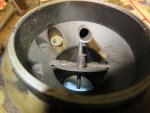
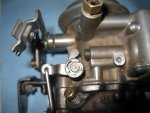
On the choke plate there is a vacuum valve with a tiny spring. See the pic. What is the purpose of this valve and does it need to be replaced or serviced?
I am also trying to figure if the accelerator pump is going to work since the shaft on the pump diaphragm from the kit is slightly longer (.084) than the part that I am replacing. This carb has a plastic cam. I'll know more on this when I put it back together.
 

Attachments

  • IMG_2727.jpg
    IMG_2727.jpg
    50.9 KB · Views: 562
  • IMG_2811.jpg
    IMG_2811.jpg
    58.7 KB · Views: 495
  • IMG_2808.jpg
    IMG_2808.jpg
    59.7 KB · Views: 523
  • IMG_2805.jpg
    IMG_2805.jpg
    59 KB · Views: 525
That little valve on the choke plate is to let air in after it fires but before you can open the choke a bit to keep it from choking out. A simplecleaning and operational check is all you need to do.

At for the pump rod being longer? I have to ask where you got the kit? I use the ones IHPA sells and they work perfect. Can't say for the others sold about.
I know there are three or more variations of the pump rod across the 1904's.
Before you can measure the rod you have to install the end with the locking ball and spring. That determines the proper operation.
 
Robert - thanks for the clarification on the choke plate valve.
The kit is a napa 2-5577 kit that I purchased back in 2010 - before the IHPA kit was available. Cost then was about $30.
I assembled the diaphragm/spring/shaft and installed it with the cam in place. There was some pretension on the springs while tightening the main well screws. The plunger is in contact with the cam and there is full plunger movement. I think this particular carb would work fine with either shaft.
The pump shot will need to be verified.
 
Reading back in post #45 in this thread, carbs with the plastic cam must use the short plunger shaft. Conversely, carbs with a metal cam must use a long plunger. The metal and plastic cams are mounted to different bosses on the carb body.
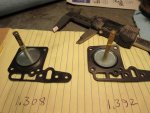
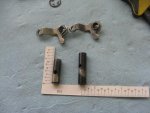
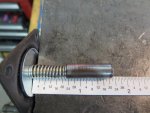
Using the wrong combination will either yield a gap between the cam and plunger (see the pic) or an assembly with so much spring taken up that a good pump shot with wot are prohibited.
The combination of the short plunger with a long pump rod yields an assembly with a total length of 1.65". The assembly I took out (and there is no guarantee that it was "correct", although it functioned correctly) was about 1.56".
My understanding is that there are pumps available with an even shorter rod.
I have attached a picture with both a short and long plunger showing that the short plunger is 0.98", and the long plunger is about 1.25".
I hope this makes sense and might help somebody determine the right combo for their carb.
 

Attachments

  • IMG_2991.jpg
    IMG_2991.jpg
    62.8 KB · Views: 496
  • IMG_2986.jpg
    IMG_2986.jpg
    47.5 KB · Views: 512
  • IMG_2812.jpg
    IMG_2812.jpg
    62.6 KB · Views: 510
Hi I've been searching all the forums for a fix on my 1920 Holley. Is on an 70 aristocrat Scout 800 amc 232 i6. It is backfiring through the carb. When you feather it the rpms can go up. You can't hammer it or have it under load. Ive tried numerous things. I've cleaned it out about 5 times, freed up the advance, I've advanced and retarded the timing every way possible, adjusted the mixture screw, replaced cracked exhaust manifold, rebuilt it the carb last time (really help with the pump shot) still.. No dice. The only way I can get it to run smoothly is to run it with the choked pulled out, which I don't want to do all the time. This however lets it run smoothly without fire shooting through the carb. I am stumped any advice I'd appreciate.
 
I am not the most knowledgeable on the site, but it seems obvious that if your truck won't run without choke, you have a fuel starvation issue. Backfiring at the carb would verify this, although there are other reasons for a backfire at the carb - like a bad cam, stuck valve, etc.
You haven't mentioned whether this carb/engine combo worked previously? Did you do something to change the fuel system? Is it jetted properly for your elevation?
Given y,n,y answers above, my first guess would be that, even though you have cleaned and rebuilt, there is a clogged passageway, clogged jet, or your economizer is not working correctly.
Another real possibility, and perhaps the first thing to check and adjust, is your float level. Try raising the fuel level a tad and see if that helps.
Good luck!
 
Thanks for the reply greg. I'm in ohio so my elevation is only like 1200 feet or so above sea level. When I bought the truck it had problems. I knew it had a manifold crack/leak which I assumed was the biggest problem. I replaced the manifold with a good one. It idled fine and I drove it around the block. I've done nothing to it besides clean and rebuild it with a kit from mikes carburetors carburetor-parts.com it came with gaskets, check ball, plugs, economizer, accelerator pump ect.. The kit matched the stamped numbers unlike the first couple kits I bought. The jet I believe has a 62 stamped in it. I assumed it wasn't getting enough fuel also. It has a good strong pump shot, good idle and the when light on the pedal appears to have a smooth secondary supply of fuel. I measured the fuel in the bowl it is right at spec possibly a /32 above. I tested the economizer with a vacuum pump it functioned pretty easily and that port is really clean. It also has the 2 stage metering block if that is any help. When I screwed in the mixture screw all the way it idles worse.
This is what I tried today. I sprayed starting fluid on any possible place that would have any vacuum. I used a vacuum gauge messing around with the idle mixture screw. I set it at the highest point of vacuum, again. I did try two other carbs today. Another one I rebuilt and one from my uncles truck. The one off of the truck I know is a good working carb (rochester) did the same thing. As did the other rebuilt one (another 1920 Holley). I pulled it from a dodge dart. On the other Holley I had an open vacuum port that I sprayed starting fluid on just because with no drop in idle. I eventually plugged it it had a good amount of suction from it. It just left me scratching my head. I know one of the three carbs for a fact works great. Do the signs still point at the carb? Also used my brothers spotting camera down one of the cylinders. It had a fouled plug and we also found a scratch in the cylinder wall. Could this be the problem? I was planning a rebuild a little later but was hoping to at least get it running decent enough to maybe drive around town if I needed too. I will probably take your advise and adjust the float some more. Also there is also another screw just behind the fuel bowl. I have read that it is a secondary air bleed screw??? It is froze in place and was covered up. The Holley from the dart has one also I didn't attempt anything with them in fear of ruining something out of stupidity I will try and put up a picture of the screw.
 
Last edited:
Here are a couple pics of that screw. I have no idea of what it's for. I've seen some just with a blank spot no screw and some with one. Most of the ones with it are sealed off with something. I'm assuming it's not supposed to be adjusted.


What was your vacuum reading at idle? Steady?
With three different carbs all doing the same thing gotta suspect something else.
Have you done a compression check? Pulled one plug wire at a time to note change (or no change) in rpm/vacuum? Spark at every plug? Changed out the plugs for new?
Gotta say it - spark plugs wires in correct order? Cap and rotor in good shape?
 
Yeah I checked the firing order it is set to the manual but at this point I wish I did something stupid like that. At least it's an easy fix. It has all new plugs. Also replaced the fouled one. Rpm steady at idle. It drops in rpms when each plug wire is pulled. I did not think to check a drop in vacuum when I did this. I will have to go back and try that. It will be a week or so before I get back to it.
I also ran gas from a give gallon can and put a known good working electric fuel pump on from my other Scout with a regulator on it. Still no change. So fuel is getting to the carb so I'm marking that one off the list. I tried tightening the intake bolts some more to make sure they didn't back out. They were all tight.
If it helps here's some engine background. It has new intake and exhaust gaskets (I've heard of people using two gaskets for warping but I've never tried), sprayed all around the intake still couldn't find any leak.
It has 960000 showing on the odometer and it runs strong when choked. It has new plugs, set points, set timing, some gaskets (intake, exhaust, intake, water pump), new water pump, changed exhaust manifold.
 
While the body had the slot, the actual choke shaft did not have the retaining groove for the clip to engage. That tells me that at some point in the past, the choke shaft had been replaced with a different part, that is a very common item I find on these carbs.

The quote above is from a few years back and can be found here (along with photos of the clip and slot):

http://forums.IHPartsAmerica.com/43505-post158.html

I've got the same problem on my 1904 that I have on my 59 IH b120 pickup. The throttle shaft was replaced at some point, so there is no longer a groove. Whoever replaced also decided to discard the clip. The issue is that the throttle shaft has about 1/4" play in it. That enough for the throttle idle screw on the throttle lever to slip past the outer disk part of the choke shaft and wedge. That causes the throttle to stick open a bit.

1) is there a replacement retainer clip available somewhere? It seems like that particular clipping mechanism isn't all that common...so I've yet to find one.

2) any more information on grinding a groove in the shaft would be appreciated. With neither the clip nor a grooved shaft, it's going to be hard to add the groove.

Any suggestions would be appreciated.

Von w.
Los alamos, nm
 
In the interim, I've threaded a couple of nuts on the throttle adjust screw. That keeps the screw from slipping and wedging. I know the nut was a 28 tpi nut, but don't recall the diameter off the top of my head. It works for now...while I search for a more permanent solution.
 
Ok I'm back I checked and went over everything a bunch more. Still can't figure it out. I've looked into a couple things. I thought it might be the 2 stage economizer/power valve. Like it wasn't getting the right vacuum drop to let it kick in. My carbs body says it's part number 398235c93. Which is listed for the amc 232 in te Scout which it is. As I was looking in the parts catalog there were two different versions depending on my chassis number. Mine called for a insulator like it had but a different carb and flange gasket. The book calls for 233757r1 gasket with the correct 1920. It's also the same as the 196 engine. The other gasket that goes with the carb I have(the later chassis number one) calls for 384859c2 and doesn't mention an insulator. Does anyone know the difference in the gaskets? I see that most of the gaskets have cutouts and things like that for the vaccuum underneath. The flange gasket I got in my kit was solid all the way across.
 
Back
Top