

You are using an out of date browser. It may not display this or other websites correctly.
You should upgrade or use an alternative browser.
You should upgrade or use an alternative browser.
Engine Cooling Systems and Components
- Thread starter Michael Mayben
- Start date
Eric VanBuren
Member
found this, here
That's like a 1/4"seems a bit tight, my old Chevy is like a 1/2" will measure tonight.
That has got to be a misprint, they show that same # for tube spacing on a rad, maybe a bad cut & paste job by the writer or editor?
I have never seen a fan that close to a rad in any oe aplication, engine driven or electric. Rigs that were oe w/o a shroud are usually in the 1" +/- neighbor hood. On vehicles with a shroud the 50/50 to 70/30 in/out rule applies depending on the exact shroud design and the fan is often several inches from the radiator. In the v-6 GM rwd's of the late 70's and early 80's there is around 5-6 inches between the radiator and the fan, since the engine bay was designed for a v-8.
Just for the heck of it I went out and measured the wifes oe e-fan car and found about 1 3/8", if any where you could run a fan at 1/4" its with an electric. Underhood on a modern car is very tight, if they could get away with less space between the radiator and fan they definitely would, and if it cooled better at that distance they would take a tube or two out of the radiator to save $.25 and a couple of ounces of weight.

Craig
Active member
I think eric is correct in that it's misprint. Were talking the fan tip to shroud. A tig welding school buddy called to today about something else and I asked him about his Scout radiator setup, his is stock, but his friend put a Chevy radiator out of a diesel truck in his diesel Scout. He cut the inner body section and change the mounting to match. He said it gave him more sq inches of cooling.
Eric VanBuren
Member
are you boyz talk'in tip clearance to the shroud or to the radiator? The linked paragraph followed a deal on fans and shrouds, so I understood it to explain how to "fill" a shroud.
Upon rereading it I think you are correct they are talking about filling the opening. I still think the ~1/4" is way too tight for an engine driven fan, just not enough room for engine to body movement.
Craig
Active member
upon rereading it I think you are correct they are talking about filling the opening. I still think the ~1/4" is way too tight for an engine driven fan, just not enough room for engine to body movement.
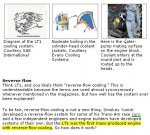
Maybe for a nylon fan, but a steel fan will cut the shroud up when you hit a hard bump. I found another article same mag. And they stated the lt1 was the first production motor with reverse flow cooling. Ha! The IH mill is 30-40 years ahead then. Good to know the IH motor has the best cooling design with reverse flow, full flow by-pass and dual acting t-stat.
Here's is the article And still a good read.
The weather is hot again, so I drove my Scout to work this morning. Wanted to do some ir gun checking to measure the temp drop across the radiator when it's a 100 outside.
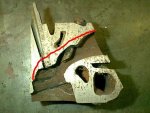
Edit.. Adding a cross section of the IH head for reference. Notice the rust build up on the upper passage.
Attachments
Last edited:
Craig
Active member
I guess my current setup is working better than I thought.
It's 105 outside and I just drove home on the freeway (20 miles)and my temps were 210, I speeded up to 2,700-3,000 rpms and the temp got to 225, but thats it. I got off the freeway and within 5 minites I was at 195 or less
that was running the fan on low the whole time too. Still never got my switch installed yet
It's 105 outside and I just drove home on the freeway (20 miles)and my temps were 210, I speeded up to 2,700-3,000 rpms and the temp got to 225, but thats it. I got off the freeway and within 5 minites I was at 195 or less
that was running the fan on low the whole time too. Still never got my switch installed yet
Last edited:

I guess my current setup is working better than I thought.
It's 105 outside and I just drove home on the freeway (20 miles)and my temps were 210, I speeded up to 2,700-3,000 rpms and the temp got to 225, but thats it. I got off the freeway and within 5 minites I was at 195 or less
that was running the fan on low the whole time too. Still never got my switch installed yet
Craig,
you seem to be cross posting about your "overheating problem" all over this forum and others. Let me point out a few things about your set up -
1- your engine is fairly new(rebuilt) and I have found thru the many years that I have worked on/repaired/overhauled these engines that these IH engines have a tendency to run warm when new(rebuilt) until the engine breaks in(15,000-20,000 miles ought to do it).
2- you are driving a highly modified Scout with fairly large tires(37's to recall) with what I would consider tall gearing(4.56's if again I recall correctly) in the midst of a hot sacramento summer.
3- your Scout with its modifications weighs I'm sure at least 6000#'s(educated guess) which is at least 1200 plus pounds over stock.
4- you are running a cooling fan set up that was not factory on these rigs.
5- you are running a fuel injection system that May not be 100% properly tuned.
If your engine was truly overheating it would be blowing coolant out of the overflow.
I know from day one you were not happy with the cleaning job the engine machine shop performed on your cylinder heads. You brought in to me a core which was in poor shape. The engine shop did the best job that they could with what chemicals they can use to clean your heads/block. If you are not satisfied with the service we performed on your engine than bring it back to us. I will for no charge tear your engine back down, have your block recleaned along with your cylinder heads, and reassemble all under warranty as long as this fix's your problem. If this doesn't fix your problem than I would want compensation for my wasted time. So if you are absolutely confident that by recleaning your heads/block that it will fix your "overheating problem" by having the heads recleaned than bring it back and I will do what any honorable shop would do and thats make sure that each and every one of my customers is 100% satisfied.
Craig
Active member
How would the shop clean them if they could not before? I know randy has similar issues, did his block and heads look like mine, maybe you did not install the freeze plug on his and don’t know.Craig,
you seem to be cross posting about your "overheating problem" all over this forum and others. Let me point out a few things about your set up -
1- your engine is fairly new(rebuilt) and I have found thru the many years that I have worked on/repaired/overhauled these engines that these IH engines have a tendency to run warm when new(rebuilt) until the engine breaks in(15,000-20,000 miles ought to do it). [Craig]
Warm would be nice, but it wants to boil over and I have to pull over and let it cool down
2- you are driving a highly modified Scout with fairly large tires(37's to recall) with what I would consider tall gearing(4.56's if again I recall correctly) in the midst of a hot sacramento summer. [Craig] Correct
3- your Scout with its modifications weighs I'm sure at least 6000#'s(educated guess) which is at least 1200 plus pounds over stock. [Craig] I can have it weighed if that helps
4- you are running a cooling fan set up that was not factory on these rigs. [Craig] I’ve tried 2 different factory fans and now have a dodge viper electric fan on there, not for fun that’s for sure, just trying to get the Scout to not overheat. At this point it’s the best thing as I can pull over the let it cool down with the hood open and running at an idle. With the stock fan setup I could only turn the engine off and wait for it to cool down.5- you are running a fuel injection system that May not be 100% properly tuned. [Craig] I have made several adjustments to get it running good, even bill says all my data looks good. Do you have any recommendations?
If your engine was truly overheating it would be blowing coolant out of the overflow. [Craig] I don't like to get to that point, but it has happened. It boiled over at hollister, outside temps were in the 70's. At this point I suspected a bad fan clutch, and switch to a fan that’s bolted directly to the water pump. I normally stop and let it cool down before it gets that far. Once the temp gets to 210 I watch it very close. 225 is my upper limit before I pull over.
I know from day one you were not happy with the cleaning job the engine machine shop performed on your cylinder heads. You brought in to me a core which was in poor shape. [Craig] You never said anything, I have more heads, does the inside of the engine look the same? the engine shop did the best job that they could with what chemicals they can use to clean your heads/block. [Craig] Agree if you are not satisfied with the service we performed on your engine than bring it back to us. I will for no charge tear your engine back down, have your block recleaned along with your cylinder heads, and reassemble all under warranty as long as this fix's your problem. If this doesn't fix your problem than I would want compensation for my wasted time. So if you are absolutely confident that by recleaning your heads/block that it will fix your "overheating problem" by having the heads recleaned than bring it back and I will do what any honorable shop would do and thats make sure that each and every one of my customers is 100% satisfied.
I read on line that reduced flow through the heads is a cause for overheating. Am I drawing at straws at this point, sure! I've have been very detailed trying to improve the cooling, I have made progress taking ideas Mike has said here and other fourms. I personally don't have a way to test the water flow through the engine and heads. I can get a bore scope and pop open a couple freeze plugs and look around, maybe something will show up. I know your very detailed and figured you would have said something if you thought it would be a problem. But you know this is the first time you said the core was poor. You only said it was good because it had the older r1 timing gears. I could have brought you another core or bought one of yours. I mean a core is like $200 vs the $4,400 to have the engine remanufactured. I have always just wanted to drive my Scout and that’s all I still want. I have some 31" tires I can test drive with; I can pull the winch, and even the doors and top to lower the weight back down to stock and report back.
Thanks
Craig

Lou
Member
Craig, from your lt1 post I found some interesting information regarding cooling system detail at this site: evans cooling systems - high performance engine cooling and power production. Also interesting is that jack evans has a lawsuit against GM over the reverse cooling design of the lt1.
Question; has anyone here actually corrected a major volute/impeller clearance issue and seen an improvement in cooling temps?
Question; has anyone here actually corrected a major volute/impeller clearance issue and seen an improvement in cooling temps?
Last edited:
Craig
Active member
Cool stuff lou. Pun intended. I have been checking my temps and have noticed the radiator has less temperatue drop from inlet to outlet then before, so yes some improvement was made in my case. Would be nice to have a water pump dyno to measure the difference.
Jeff called and told me to bring it by and they would check it out. He mentioned I should try the 195 t-stat too.
An auto mechanic friend told me to move the tranny and power steering coolers elsewhere to get more airflow to the radiator.
Jeff called and told me to bring it by and they would check it out. He mentioned I should try the 195 t-stat too.
An auto mechanic friend told me to move the tranny and power steering coolers elsewhere to get more airflow to the radiator.
Craig
Active member
Just a follow up as lou is still wanting to know if the water pump is an issue for him.
Lou what you're interested in is the temperature loss across the radiator (dt)and the actual temperature of the outlet. The radiator should drop at least 20 degrees and preferably more. More importantly, the outlet temperature of the water should be below the setpoint of your thermostat. If you're running a 180 degree thermostat, an outlet temperature of 165-170 should be observed even in the hottest weather.
If the dt is low (less than 10 degrees) and/or the outlet temperature is high, that indicates insufficient heat transfer. That could be either low airflow or blocked tubes. If the dt is ok, the outlet is lower than the thermostat setpoint but the inlet temperature is significantly higher than the thermostat setpoint, that indicates that there is insufficient coolant flow!
I need a better way to record data. I'm thinking of installing a temp sensor in the outlet of the radiator. I find that once the temp goes 30-40 degrees over the set point (t-stat) I can't pulled over and take a reading fast enough to know what really happening at the radiator outlet.
Lou what you're interested in is the temperature loss across the radiator (dt)and the actual temperature of the outlet. The radiator should drop at least 20 degrees and preferably more. More importantly, the outlet temperature of the water should be below the setpoint of your thermostat. If you're running a 180 degree thermostat, an outlet temperature of 165-170 should be observed even in the hottest weather.
If the dt is low (less than 10 degrees) and/or the outlet temperature is high, that indicates insufficient heat transfer. That could be either low airflow or blocked tubes. If the dt is ok, the outlet is lower than the thermostat setpoint but the inlet temperature is significantly higher than the thermostat setpoint, that indicates that there is insufficient coolant flow!
I need a better way to record data. I'm thinking of installing a temp sensor in the outlet of the radiator. I find that once the temp goes 30-40 degrees over the set point (t-stat) I can't pulled over and take a reading fast enough to know what really happening at the radiator outlet.
Last edited:
Lou
Member
Craig, thanks for the input. I need now to set aside a weekend to go through the list of details to sort this out. On that list are the basics such as verify timing (I'm sure it's at 5deg) and log the ir gun readings on the various points shown in this thread. I'm looking forward to pulling the pump and getting clear on the clearance issue. Right now my biggest issue is time. With any luck I'll have much of this pinned down before I get to the fall rallye at lake francis. At least now I have a plan.
Craig
Active member
Had a long talk with Darren (jeffs out of town) and we discussed a lot of ideas.
Here are next steps.
1. Test each cylinder temp at each freeze plug using a fluke meter and temp probe.
2. Test the input and output of the radiator using the fluke temp probe.
3 take the Scout the smog test station and put in on the dyno and measure the output. Looking to see if my o2 sensor is off and possible lean issues.
I visited a couple places today and found a shop that would work with me, but he wanted to work on it in the morning, vs the hot afternoon. I will take the fuel pressure gauge, timing light and laptop to make adjustments if needed
edit: I posted the numbers in my fuel injection thread as thats where I can make changes. He did say is was a bit lean and I turn up the fuel pressure a 1lb and he said that made a difference, but the computer will compensate it back to what "it" thinks is correct once it learns.
Here are next steps.
1. Test each cylinder temp at each freeze plug using a fluke meter and temp probe.
2. Test the input and output of the radiator using the fluke temp probe.
3 take the Scout the smog test station and put in on the dyno and measure the output. Looking to see if my o2 sensor is off and possible lean issues.
I visited a couple places today and found a shop that would work with me, but he wanted to work on it in the morning, vs the hot afternoon. I will take the fuel pressure gauge, timing light and laptop to make adjustments if needed
edit: I posted the numbers in my fuel injection thread as thats where I can make changes. He did say is was a bit lean and I turn up the fuel pressure a 1lb and he said that made a difference, but the computer will compensate it back to what "it" thinks is correct once it learns.
Last edited:
Lou
Member
A little more anecdotal input. I just spent the weekend with an old high school buddy at his family cabin. He's been a john deere mechanic for 30 years and restores cars on the side. I described the sv pump impeller/volute clearance issue and he says deere's have the same setup issues. He sets the clearance anywhere from .007-.015" and he's never had any trouble. He agrees that as the clearance increases the cooling ability drops. I do need to pull my pump and check my clearances. Time, it's all about time.

Monte Lauer
Active member
here is a picture of my new fan setup. I do not have a shroud because of the body lift, but that May change. I used a 18.5" flex-a-lite stainless steal fan and a 2" universal extension.

Ok, I put about 100 miles on the new setup yesterday. The external temperature was in the low 90's. I am still running the stock temp gauge, but it never left the 1/3 Mark. I am still not running a shroud yet, but I feel awfully good about this new fan setup.

Michael Mayben
IHPA Tech Moderator - Retired & No Longer Online
I have one of those same fans in the shop now monte. This one measures an actual 18-1/4" tip-to-tip.
The opening inna oem sii shroud measures a nominal 19-1/4". So given the fact that the oem mounts the shroud slightly "offset" to one side as a "noise control" feature, you should be ok when ya set up a fresh oem shroud. Ya May have to diddle the four mounting holes in the shroud-to-radiator relationship to keep the shroud in the proper orientation vs. The fan blade tips to prevent a collision when the vehicle is "flexed" such as inna hard turn either direction, or in other on-road driving sitches.
The opening inna oem sii shroud measures a nominal 19-1/4". So given the fact that the oem mounts the shroud slightly "offset" to one side as a "noise control" feature, you should be ok when ya set up a fresh oem shroud. Ya May have to diddle the four mounting holes in the shroud-to-radiator relationship to keep the shroud in the proper orientation vs. The fan blade tips to prevent a collision when the vehicle is "flexed" such as inna hard turn either direction, or in other on-road driving sitches.
Monte Lauer
Active member
I have one of those same fans in the shop now monte. This one measures an actual 18-1/4" tip-to-tip.
The opening inna oem sii shroud measures a nominal 19-1/4". So given the fact that the oem mounts the shroud slightly "offset" to one side as a "noise control" feature, you should be ok when ya set up a fresh oem shroud. Ya May have to diddle the four mounting holes in the shroud-to-radiator relationship to keep the shroud in the proper orientation vs. The fan blade tips to prevent a collision when the vehicle is "flexed" such as inna hard turn either direction, or in other on-road driving sitches.
10-4. I am on the hunt for a shroud now.
Michael Mayben
IHPA Tech Moderator - Retired & No Longer Online
Always pimpin' tha guud schnizz dude...always pimpin'!
fan shroud for 72'-80' Scout II w/ v8 or 4cyl - IH Parts America Scout
fan shroud for 72'-80' Scout II w/ v8 or 4cyl - IH Parts America Scout

ihpartschad
IHPA General Manager
10-4. I am on the hunt for a shroud now.
fan shroud for 72'-80' Scout II w/ v8 or 4cyl - IH Parts America Scout
Go brand new.