Holley 19XX Series Carb Stuff

hey Mike,

first off thank you for the wealth of information here--it has made my life so much easier! I have recently picked up a '66 Scout 800 and the carb is great--except for a missing pump discharge nozzle. I can't seem to find one anywhere! Is this a treasure hunt item or do you know where I can get one? Thanks again for all your advice and help!

Part sent!
 
Thanks for the really fast reply. The other one I have is nos and was out of a judson kit for a austin healey sprite, so it has the wrong jets for the mga setup. I put a list in the box of the bits that I need to have that one as a working spare, and would be grateful if you could send those back with the refurbed carb.

Thanks
dominic
 
Hi michael

how's it going - my new engine and gearbox are back, car is back, and I'll be ready to start installing as soon as I can.

Dominic
 
hi michael

how's it going - my new engine and gearbox are back, car is back, and I'll be ready to start installing as soon as I can.

Dominic

The remanned main wells for the 1904 carbs just came in on Friday from Robert, I've been out of town all weekend so no work was done. I'll complete all outstanding 1904 carb builds this week that are/were waiting for main wells.

I'm playing catch-up today for ihon and waiting for a new cell phone service to arrive so my communications link has been very poor this past week due to at&t cell service outage, all that will change tonite (I hope!!).
 
Michael,
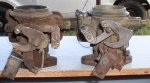
I just bought a late 68 s800 that has the 196 engine. The carb was missing. I searched through my spare carb pile, and found a 1904 that didn't fit, due to it was for a 152 (carb on the left). Then I found a 1904 p/n 158798 r91 list 1238-1 (carb on the right).

I believe this is for a 240,264,282 engine. Problem is the choke linkage is backwards (circled). Can I swap the linkage from my 1904 on the left in the picture, and make this carb on the right work? Just looking at it, it appears if I remove the two screws that hold the choke butterfly on, I could then remove the linkage arm held on by one screw. Assuming I can get those two screws off without breaking them...
Is there a trick to this step?

I maybe could then relocate the round cable clamp that would need to mount approx. Where the "a" is stamped on the carb on the right.

Thanks for your help!
Eric

edit:
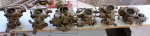
added second picture showing my single barrel holly stash. The one circled fits the manifold. Might be an option.
 

Attachments

  • Carb-001 differences.JPG
    Carb-001 differences.JPG
    38.4 KB · Views: 553
  • Holleys.jpg
    Holleys.jpg
    34.7 KB · Views: 488
Last edited:
Hey eric!

Like I mentioned above, I'm in communications hell right now. I received your vmail but can't call out! And I'm in the process of activating the new phone which is an android os that is totally different from anything ive set up in the past.

Let me study all the pics you sent when I have time early tomorrow morning and I'll give ya a call if I can make at least one of the phones work! If not, I'll go borrow a neighbor's landline!

Technology certainly suks sumtime...but then being in alpine, you are fortunate to even have incandescent lighting!
 
hey eric!

Technology certainly suks sumtime...but then being in alpine, you are fortunate to even have incandescent lighting!

You mean remote like when I was the only one in the 6th grade in a two room schoolhouse?:yikes:

I'll be more than happy to send you pictures of any different views you need.:icon_heart:
 
Hi michael

I tried calling, but guess your communications hell is still ongoing...

Any news on the carb and spares ? - the car is all back together and ready to go as soon as the carb turns up

thanks
dominic
 
Hey michael, been busy as hell and havent had a chance to ask. The 1904 that you built for me has a horrible off idle hesatation, been there from the git-go, other than that is performs great. Any ideas on the cause?
 
Michael
lots of great info here, thanks.
Hopefully this question hasn't been asked and answered somewhere - I didn't see it.
I have a '66 Scout, 152 fired by a pertronix set at 11* btdc. Within the last two years I have replaced all the ignition components - wires, cap, plugs and of course the pertronix. I set the timing to best low idle both by ear and with a vac gauge. I am at 8700 elevation so all of my driving is at 8-11,000 feet.
Two years ago I went through the 1904 carb (list # 2494) and installed a rebuild kit and did the "rough trail" mods that you recommend. At that time, my research indicated that I should be jetted around a 59 main, 62 being the stock main jet.
Now I'm not so sure. Th truck runs pretty good, especially since I redid the leaky exhaust system. Idles fine, no bog when you stab it. A little underpowered, but hey, its only a 152! It'll get up to 65 mph, eventually.
So my question is - what is the recommended drop it jet size for high altitude running at various elevations? And are there any other carb mods that can be done to compensate for the lack of o2 at altitude?
I have seen several different concepts here and there and quite a bit of anecdotal information. I also understand that the final jet size can only be determined by fine tuning and experimentation with an individual motor and vehicle set up.
Tia

 
hey michael, been busy as hell and havent had a chance to ask. The 1904 that you built for me has a horrible off idle hesatation, been there from the git-go, other than that is performs great. Any ideas on the cause?

That carb was thoroughly tested before I shipped it out on a 196 with a super-fresh ignition system (motor has bad case of piston slap though).

You must run a fuel filter before the fuel pump, and also a second filter before the carb. The tiniest bit of any debris will end up in either the needle/seat or the main well.

Then, the idle mixture must be optimized for each engine install, do that with the vacuum wiper "booster" disconnected/plugged if it's still functional on the fuel pump. Other wise it provides a "false" vacuum reading that will mask any real vacuum leak.

Last of all, after verifying all tuning parameters, if it still hesitates at tip-n, then move the accel pump link to the upper hole on the throttle arm and see what happens to increase pump shot and bring it in sooner.
 
michael
lots of great info here, thanks.
Hopefully this question hasn't been asked and answered somewhere - I didn't see it.
I have a '66 Scout, 152 fired by a pertronix set at 11* btdc. Within the last two years I have replaced all the ignition components - wires, cap, plugs and of course the pertronix. I set the timing to best low idle both by ear and with a vac gauge. I am at 8700 elevation so all of my driving is at 8-11,000 feet.
Two years ago I went through the 1904 carb (list # 2494) and installed a rebuild kit and did the "rough trail" mods that you recommend. At that time, my research indicated that I should be jetted around a 59 main, 62 being the stock main jet.
Now I'm not so sure. Th truck runs pretty good, especially since I redid the leaky exhaust system. Idles fine, no bog when you stab it. A little underpowered, but hey, its only a 152! It'll get up to 65 mph, eventually.
So my question is - what is the recommended drop it jet size for high altitude running at various elevations? And are there any other carb mods that can be done to compensate for the lack of o2 at altitude?
I have seen several different concepts here and there and quite a bit of anecdotal information. I also understand that the final jet size can only be determined by fine tuning and experimentation with an individual motor and vehicle set up.
Tia


Welcome to ihon!

Kinda amazing that a 152 will even start and idle at altitudes above 7500ft. Ain't it! It's lungs are pretty pitiful!

Much of my personal knowledge of jetting for various carbs used on IH stuff has now changed due to the forced use of e10 fuel, I'm still in the learning mode again and always appreciate feedback from folks as to what they find at various altitudes running various carb/engine combos. My rule of thumb for e10 currently with Holley carbs is to go up in size two steps for e10. In your case, that would put the main jet back about oem number (#62 for sea level>3,000ft.).

Also, keep in mind that the "sealability" of the economizer poppet valve May have changed for the worse over time! When that happens, the deteriorated poppet allows liquid fuel bypass around the main jet which causes the mixtures (including idle mixture) overall to gradually go Rich. I work with these carbs quite often where the main jet has been reduced in size by more than 10 steps to compensate for a bum economizer poppet...but that doesn't work!

Jetting is always going to be a compromise when dealing with altitudes above sea level. I use 5,000ft. As the magic number where "change" becomes necessary for optimizing performance. Then 7500ft. Is the next step.

Rule of thumb for any normally-aspirated, gasoline-fueled engine is a loss of engine power of 3% for every 1,000ft. Increase in altitude above sea level. And....that is accompanied by a loss of manifold vacuum of 1"hg for every 1,000ft. Also as compared to whatever the engine will make at sea level. So we just have to adjust our mental calculations regarding "specs" when tuning this stuff at altitude so we don't chase "no problem" problems!
 
I have driven my 152 powered Scout 80 in mammoth lakes California in the 9000-11000 ft range many times and for weeks at a time. Totaly stock 1904 but a tad of cam shaft tweak in the engine. Runs great for the most part with the exception of lower power. If I lived up there full time to start with I would jet it down .005" from sea level standard jetting. Your 59 is really .059" and the stocker 62 is .062" opening diameter. Take .005 from the .062 and run a .057. With that in mind your .059 is very close and probably close enough.
 
that carb was thoroughly tested before I shipped it out on a 196 with a super-fresh ignition system (motor has bad case of piston slap though).

You must run a fuel filter before the fuel pump, and also a second filter before the carb. The tiniest bit of any debris will end up in either the needle/seat or the main well.

Then, the idle mixture must be optimized for each engine install, do that with the vacuum wiper "booster" disconnected/plugged if it's still functional on the fuel pump. Other wise it provides a "false" vacuum reading that will mask any real vacuum leak.

Last of all, after verifying all tuning parameters, if it still hesitates at tip-n, then move the accel pump link to the upper hole on the throttle arm and see what happens to increase pump shot and bring it in sooner.

Will see if I can get into it this weekend and play with it. Have the filters on it and will stick a vac guage on it and re-tune the carb and timing to see if that helps. Thanks for the info.
 
my rule of thumb for e10 currently with Holley carbs is to go up in size two steps for e10. In your case, that would put the main jet back about oem number (#62 for sea level>3,000ft.).

So does that mean that if I lived at sea level I should jet up from 62 to 64?

if I lived up there full time to start with I would jet it down .005" from sea level standard jetting.

I think I will do a plug and vacuum check and then try the 57 jets and compare. I am also going to try jetting down my 345 w/ 2300 to a 48 jet from a 50. Maybe I'm chasing the wind.
 
so does that mean that if I lived at sea level I should jet up from 62 to 64?


I think I will do a plug and vacuum check and then try the 57 jets and compare. I am also going to try jetting down my 345 w/ 2300 to a 48 jet from a 50. Maybe I'm chasing the wind.

What I described is pertinent only if you are forced to run true e10 fuel on a normal/continuous basis. Does not hold true for fuel labeled "May contain up to 10% ethanol" which is not the same blend. All this is dependent upon your local/regional enviro-nazi mandates.

The 1904/152 combo is extremely sensitive to jetting, even a slight amount of leanness will result in the engine spitting back through the carb when under load and at a throttle plate angle greater than 50%. Most v8 engines will simply exhibit a "surge" at cruise with a a main jet selection that is slightly lean, the 152/196 will simply drop a cylinder at random until the throttle plate angle is reduced, that is characteristic of the I-4 engine.

But...if the economizer poppet is allowing liquid fuel bypass at cruise, this whole mixture deal is upset and the actual jetting requirement for any driving condition/elevation is completely whacked off the scale.

I receive 1904 carbs for rebuild quite often with main jets installed in the #48>#56 range (for 152 applications),...and under examination show the economizer poppet to be totally missing! So the main well has been jetted down 10 steps or more to make up for the super-Rich condition provided by the missing poppet! That is a bandaid that does not work. Once the carbs are repaired, the main jet must be restored to it's original value as a starting point for performance validation.

I'm fortunate to have a really old skool exhaust gas analyzer that is portable, I can drive down the road with it in the seat and actually read co and hc under any load condition, then correlate that to spark plug insulator color. It's really an eye-opener to watch when the economizer valve actually actuates under load, even though the actual instrument reading has a significant lag in display.

If you will the list number on the 2300 Holley, I will give you the oem setup regarding main jets for sea level spec. Most in that era were #52>#54, so a #50 would certainly be in the range of substitution for 5,000ft. And above. But...that was on real gasoline that contained real tetra-ethyl lead, not this shit we call gasoline forced on us today.
 
After doing a lot of studying up on the 1904 I decided that since I was going to try jetting down (to a #57) that I might as well do another rebuild. I probably did a poor (unedjecated) job last time, anyway.

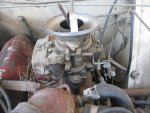
I had another 1904 on the parts Scout so I figured I'd work on that carb instead of immobilizing the running Scout. The parts rig hasn't run for at least 10 years. See pic below.

So I pulled the 1904 and was pleased to find the same 2494 list number as on my Scout.
I dissembled the carb and found a #60 main and a main well that has an apparently functional economizer poppet valve - that is it moves and returns to the "up" position.

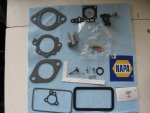
The accel pump was stuck in there pretty good, but it finally came out. I have a metal "cam" actuator. I had ordered up a napa 25557 kit shown in the pic. Upon comparison, the accel pump shaft in the kit was shorter than the one I removed. From my reading here I know that the short shaft pump will not work with the metal cam.

So my problem is - where can I get the correct accel pump for my metal cam actuator? If the plastic cams are the more common, would any kit come with the longer shaft pump?

I've got the carb soaking now.

edit: on re-inspection, it turns out that the accel pump diaphragms are different, but the one in the kit is longer than the one I pulled out!!! The old pump shaft is 1-1/4" long, the new one is 1-1/3". So I could be good to go.
Also, while researching this issue I came across two different part numbers for accel pump diaphragms. I am assuming that one is the long shaft, and one is the short - but I couldn't say for sure which is which. The two napa pns are crb 24147 and crb 24186.
 

Attachments

  • 1904 Stripe.JPG
    1904 Stripe.JPG
    111.9 KB · Views: 660
  • NAPA 25577.JPG
    NAPA 25577.JPG
    94.9 KB · Views: 601
  • accel lever.JPG
    accel lever.JPG
    99.7 KB · Views: 598
  • accel cam.JPG
    accel cam.JPG
    90.3 KB · Views: 523
Last edited:
I've got two 1904 carbs with the steel accel pump cam torn down right now. Both had the correct accel pump element, the carbs are just tired!

There are actually three different length accel pump element "rods" that are attached to the diaphragm and used in 1904/1908/1960 carbs. They measure:

1.292"
1.310"
1.398"

the one you "should" need for your carb would measure 1.398" nominal. However, there is enough take-up/travel when using the 1.310" item also.

Hopefully, we'll soon have all three pump elements on hand, they have been ordered from the manufacturer.

A wells ck368 kit includes an accel pump element that measures 1.310" if it's packaged correctly (that has been an issue in the past), so that one will work with either type accel pump pusher/spring due to the location of the slot for retaining the ball. I don't know if that is by accident...or by design! It doesn't matter as long as full accel pump stroke can be achieved based upon the cam ramp and the fulcrum mounting position (and link rod adjustment).
 
Last edited:
^Mike(May I call you Mike or would you rather michael? :lol: don't want to disrespect), I called my local napa and to my surprise they actually were able to source a wells ck368 rebuild kit......

But they had two different kits for that part number.

One of them cost $45, the other cost $32. Do you know about these two seperate kits and what is actually different about them?


I'm assuming that this kit would be good for a 1960 along with the 1904 Holley's, correct?
Thank you.
 
Back
Top