T-407/TF727 Variations and Parts Differences

Michael Mayben

IHPA Tech Moderator - Retired & No Longer Online
I've recently been working with some "later" Scout II 727 slushboxes and now have an opportunity to document some areas that need special attention when making repairs or performing a complete overhaul. For the most part, this involves paying special attention to "parts" when using either good used components, or new components as replacement items.

Sometime in the late stages of the so-called "1977" production run on Scout II, the 727 was changed to an updated version. This was because chrysler designed the upgrades in order to bring the transmission apps in line with future emissions regs, and to be able to offer the infamous "lockup" torque converter system in their light duty vehicles. Thus the design changes trickled down into the IH and amc apps also.

When working with specifically the IH-version 727, you must have the part number for the trans being serviced handy in order to make certain any replacement parts, either new or donor/used are suitable. I'm gonna say one more time...the urban myth that has been perpetuated in these forums for many years regarding "the 727 transmissions in IH stuff are all the same" is total bs! End of story! Generalizations regarding components such as this will eat your lunch at some point!

This is also true when working with chrysler 727 apps as they used many variations over time. And yes...many components interchange between IH, amc, and chrysler variations...and many do not!

The first part I'm gonna discuss is the valve body. In other threads in this sub-forum you will find pics and descriptions of the "full throttle kickdown" valve body that was used in all pickalls and Scout II 727 apps up through sometime in the '77 sii production run.

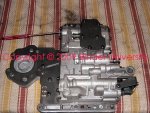
This pic shows a "partial throttle kickdown" valve body as used in a 1978 Scout II with an sv motor. Several reasons for the change to this design...but the major one was "emissions" and to prepare the valve body to be used with the lockup torque converter system which thank goodness...IH never embraced on the Scout II!

This valve body is identified as having the add-on module mounted to the earlier design valve body. There were also some internal valving mods incorporated into this valve body, part of the continuing evolution of this transmission as the automotive industry changed.

When using the IH parts list for the Scout II platform, you will see many references to vehicle serial number and transmission assembly part number made for identification of parts. This information is critical when dealing with these transmissions! Nowhere in the IH parts lists or service manuals are these subtle "changes" discussed and described! You just have to figgr it out! Information such as serial number cuts and component changes were covered in individual service letters to the dealer and we generally don't have access to those.

Next question...does the part throttle kick valve body backfit correctly on an earlier 727??? I don't know! I'm fairly confident it will and will allow the trans to operate correctly...but until I can personally try that and test that combo, I will say no!

I'm working now with a p/n 492448 c91 trans (m/y '78 trans, but m/y '76 vehicle which means this tranny was swapped in at some point in time and is not original to the vehicle...sound familiar?) that worked perfectly after trans overhaul by a pro for 16k miles. It was later damaged during an engine r&r and subsequently had the pump replaced with a unit from an unknown source tranny. Once it was re-installed and tested, it had no forward drive but did have reverse.

The problem??? The used replacement pump that was installed will not provide pressure to the rear clutch so that the vehicle will launch in breakaway. The oil porting is not compatible by a long shot!

We'll look at that next!
 

Attachments
  • Part Throttle Kickdown Valve Body 004.jpg
    Part Throttle Kickdown Valve Body 004.jpg
    150 KB · Views: 7,627
Last edited:
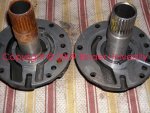
Here we see side of the oil pump reaction shaft support which seals the oil pump gear chamber to the oil pump main body.

The support on the left is the "early" version, notice that it has only one plugged rifle-drilled passage (that's what appears to be a ball bearing pressed in the hole...it is!).

The support on the right is the '78 and later version, the allen key is pointing to the second drilled/plugged passage on that part. That is a major change in the reaction shaft support from the early part.

These two parts will mount to either pump housing, but they will not interchange correctly between "early" and "late" transmission pump assemblies.
 

Attachments

  • Pump Passage Plugs.jpg
    Pump Passage Plugs.jpg
    134.8 KB · Views: 7,222
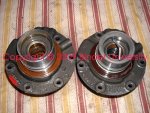
This is a shot comparing the opposite side of the two reaction shaft supports.

The one on the left again is the "early" version. It does have a tiny hole drilled into the counterbore, but that hole leads to a totally different point and is not used to charge the rear clutch with oil when called upon. That support channeling is totally different internally and cannot be seen inna photo.

The support on the right is the '78 and later part. The charge passage is clearly visible at the pointer. Oil travels through that passage when commanded by the valve body to energize the rear clutch pack.
 

Attachments

  • 727 Pump Reaction Shaft Support.jpg
    727 Pump Reaction Shaft Support.jpg
    119.2 KB · Views: 6,654
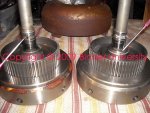
This shot compares the two variations of the input shaft which is pressed into the rear clutch hub and also retained by a purpose-design heavy wire retaining clip.

The shaft assembly on the left is again the early version. You can see the "charge" port between the two cast iron sealing rings, that is the passage which feeds the clutch piston when the valve body command is provided.

The shaft assembly on the right is the '78 and later version. The pointer shows the point at the shaft/hub interface where the tag end of the retaining ring is located...and that is the point of oil passage to the clutch piston for that version!!!

So...those shots show a big change in parts that can really scruu with ya if ya try and mix 'em up!

However...the oil pump housing (the big part!) and the oil pump gear sets are interchangeable.

In the case of the transmission with the "no breakaway" issue previously described, the entire oil pump of the correct version was replaced with a complete oil pump assembly from an early transmission...that won't work obviously!
 

Attachments

  • Input Shaft Oil Passage.jpg
    Input Shaft Oil Passage.jpg
    115.1 KB · Views: 6,910
During some recent tf 727 rebuild operations, scoutboy74 and I have noticed an additional parts difference which could really create some issues when folks are attempting to "convert" a 727 by swapping around the output shaft.

Typically, this might involve swapping either a small block or big block mopar motor into a Scout II, where the oem chrysler 727 that mates with the engine, needs to have a Scout II output shaft and transfer case adapter grafted on. Or...something like swapping a Jeep 727 output shaft for a d300 transfer case, into a Scout II transmission. Or...converting an early Scout II 727 (say m/y '73) to use a "late" Scout II/d300 "texas" pattern adapter housing that uses a bull gear.

In my particular case, I'm installing a dodge motorhome (unknown vintage) output shaft into an ihon customer's pickall 727 trans (vintage 1973) that is going to receive a gear vendors under/overdrive system.

The issue here is the front planetary carrier-to-output shaft spline diameter. Sometime in the late '74/early '75 time frame, chrysler changed the spline od of the shaft, therefore the id of the matching spline "hub" segment on the front planetary carrier also changed.

If you study all versions of the parts lists for all IH model vehicles, you will see a change in part number for the various components. Depending upon which platform you are researching, that change is denoted either by a chassis number cut, or by the actual part number for the affected transmission assembly (in the case of IH stuff, the part number is stamped on the pan rail). However, no where in either the various parts lists or service manuals is this change pointed out specifically. Most likely, this information was provided to an IH service dealer by issuance of a service letter (bulletin) that went to both dealership service departments and the parts department.

Bottom line is...when swapping around output shafts on these slushboxes, you must use the entire planetary assembly that matches! If that is not feasible, then you must verify that the output shaft you will install, is a proper match for the front planetary carrier to be used. And this is something that must be verified by either using a caliper, or by actually trying to "mate" the planetary carrier with the shaft spline.

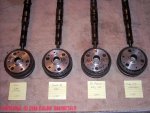
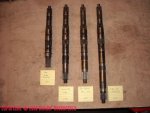
This shot shows left-to-right...a Jeep/d300 output shaft with carrier, a Scout II/d20 output shaft with carrier, a pickall output shaft with carrier (2x4 and 4x4 are the same part), and a dodge motorhome output shaft with carrier.

Notice that all four for the planetary carrier ends of the shafts appear identical, the spline count on all samples is 28. However, the Jeep and the Scout II shafts are the "smaller" diameter versions, those both measure a nominal 1.190" and use a carrier with a matching id. These carriers are an easy slip-fit over the splines, but must be snug with no discernible back-and-forth slop. They are retained to the shaft by a selective fit snap ring.

However, the pickall and the motorhome shaft spline measures a nominal 1.210". That means, that unless you pay close attention to this area, the larger spline will only fit the larger planetary carrier. However, the smaller od shaft could be installed in the larger id carrier, resulting in a really sloppy fit that would result in very premature gross failure of the transmission.
 

Attachments

  • Output Shaft_Planetary 003.jpg
    Output Shaft_Planetary 003.jpg
    78.9 KB · Views: 7,467
Last edited:
While I have all these parts available at one time, let's look at the other end of the output shafts so ya can see the variations that might be encountered.

Again, left-to-right, we see a Jeep shaft setup for the slip coupling used with it's companion d300 transfer case. Next is a Scout II 4x4 version for use with a d20 transfer case. Then a pickall shaft, those are used in either a 2x4 app or with a NP205 divorced transfer case, the same trans is use in Scout II 2x4 installs. On the right is the dodge motorhome shaft, which is a 12" unit. Those are also found in shorter and longer versions, ihc also used two versions in their motorhome chassis applications. To further confuse, my research shows that chrysler also used some ihc-produced engines in dodge motorhomes, those would have ihc-pattern bellhousing/transmissions!!

The Scout II output shaft here is the bastard of the bunch! It uses a reduced diameter to match up with a very "special" ball bearings used only in the Scout II transfer case adapter. This bearing issue has been discussed and documented in other threads in this sub-forum, ihon has on the shelf, custom made replacement bearings for the Scout II transfer case adapter housing, along with the double oil seal replacements.

The Scout II shaft and the pickall shaft are not interchangeable! The pickall shaft could be re-machined and turned into a Scout II shaft if needed...but only if the front planetary spline is a correct match!
 

Attachments

  • Output Shaft Comparison.jpg
    Output Shaft Comparison.jpg
    69 KB · Views: 6,768
Ok this really helped me but I need help. I got a running 440 and tranny from a 76 dodge titan motor home I want to put in my charger but I need to change it over to the long tailshaft and gears which tranny should I look at for donor parts the tranny I have is a 727 I'd really like to keep the motorhome tranny because it is really heavyduty I guess any help you supply will help me thanks a lot
 
ok this really helped me but I need help. I got a running 440 and tranny from a 76 dodge titan motor home I want to put in my charger but I need to change it over to the long tailshaft and gears which tranny should I look at for donor parts the tranny I have is a 727 I'd really like to keep the motorhome tranny because it is really heavyduty I guess any help you supply will help me thanks a lot

The motorhome tranny is "heavyduty" only in the respect that they could have one additional clutch in each clutch pak as compared to some passenger vehicle versions, they have a ball bearing to support the output shaft in the tailhousing (instead of a bushing), and they have a four pinion planetary setup instead of a three pinion unit. Some motorhome versions also have a parking brake set located on the tailhousing, others do not.

It would be somewhat easier to simply use a regular passenger car donor trans to install in the charger just like the trans that came in it. Those can be built to any degree of "heavy duty" your budget can stand! In actuality, simply using the B&M "transmission in a box" parts kit will accomplish the most bang for the buck.

Unless you are building a 600hp+ real hemi (not the current poser hemi) to go in the charger, the "built" oem tranny would be overkill.

You May be able to use the four pinion planetary from the motorhome if the model year changes are observed as far as spline diameters of the output shaft and the planetary carrier. This "model year change" stuff I don't believe is really exact, the change was phased in, but the actual transmission part number for the assembly would tell the tale.
 
I have a question. I used to work on some motorhomes with the loadflite version of the 727. Did IH use them?
It had a separate planetary in the tailstock for a split shift so it was 6 speeds forward (often used in dumptrucks up till '77 as well) I had one off a 361 that I was going to put into the '61 fargo w600 with 383 rb with hemi heads (ex-canadian military truck) but we couldn't find the correct flexplate. Sadly, it was an 8 bolt crank plate, same as used on hemis back then, but no-one could find it.
 
A "loadflite" was simply a torqueflite installed in a pickup, medium duty, or motorhome chassis. Had a few different parts internally but not anything that makes a difference to us.

The two speed secondary was an "add-on" type deal that was not used in all loadflites.

Flex plates for all common chrysler variations are available out in the aftermarket, both balanced and non-balanced. We just picked up a "special" version for a "b" block chrysler to be able to run one of the B&M high stall converters, the flex plate also came from B&M.
 
The case on the 2 speed secondary type trans is quite differently plumbed, but the clutches and planetaries in the front are basically the same.
 
Is it a pretty big production to swap out one of the motorhome 727's and put it in a '73 Travelall? I see the output shaft must be longer since the tailhousing looks to be inches longer.
I found an old motorhome with a 392 and 727 auto with the motorhome only having 26k miles on it. I could sure use that on my old Travelall if it isn't too costly....
 
If tail and output shaft are indeed different, then the donor unit will need to be torn completely down to swap in the appropriate shaft. I would want to inspect any unit of questionable condition and history before I swapped it in anyway. I realize this is a low miles unit, but seals do dry up and get brittle in units that have sat non-rotated for long periods of time. I think at minimum you'd be looking at replacing lip seals and sealing rings. The frictions and bands would need to be inspected for excessive wear also. The condition of the fluid and residue in the bottom of the pan will tell you a lot about the overall condition.
 
Some of the motorhome 727s came with a fixed yoke output and others came with an extra planetary in the tailstock to make it a 6 speed auto. (at least in dodge motorhomes they did)
 
With all due respect, I believe you are mistaken about the extra forward gearing available in any stock tf 727 configuration. It is true that some, but not all of the heavy duty application units such as those found in motorhomes did have 4 pinion planetary gearsets as opposed to the more common 3 pinion planet sets found in most light duty applications. As has been discussed previously both on this forum and others across the net, the only function of the extra pinion was to increase strength and load tolerance. The gear output ratios remain the same across the board as do the available number of forward gears. There are some options in the aftermarket primarily from gear vendors that allow one to install a lower ratio first gear as well as the ability to double the forward gearing from 3 to 6, but they ain't cheap, and nothing close to those items have ever been conclusively identified or documented as existing in stock form. If you can prove it with clear pictures in contrast to the stock parts, more power to you. In the absence of conclusive proof, its just beer-thirty conjecture, which we try to limit on these tech pages as much as we can.
 
They are called loadflite a-345 and only used a couple years due to mopar going out of the big truck business. It essentially gave 6 speeds forward, but no o/d till the 888 trans came along in late '79

21-01-74t%20page2.jpg
 
Thanks for posting this. I'm still not seeing where the six forward gears are. The description states that there are four speeds via an underdrive. Looks like it was only offered in certain dodge trucks and coaches. Highly unlikely that it ever found its way into an IH offering.
 
Just a footnote to this recent a-345 discussion in case it sparks anyone's interest. The unit does provide four forward gears. The additional gear is via an underdrive which provides a lower first gear ratio. The remaining gears are standard 727 stuff, with top gear remaining as 1:1 direct drive. This could possibly be workable in a fullsize 4x2 pick-all, if one was somehow able to find a complete compounder unit. The first drive shaft would obviously require shortening. I don't know how or even if this would couple to a divorced t-case. My strong suspicion is it would not. I know it wouldn't work with a Scout II married t-case. Maybe it could be fitted into a 4x2 Scout...perhaps a terra/traveler with the longer prop shaft. No doubt there would be considerable fab work involved in any case.
 
These a-345 automatic transmissions were used in dodge trucks in '74, '75 and '76 behind 318, 361 and 413 dodge v-8 truck engines.

How this would bolt up to an ihc v-8 engine is a mystery.

Also, it does not have a parking pawl but does have a drum brake on the reduction unit.
 
It mounts to the rear of the case, not directly to the engine. That portion of the case is the same for all applications.
 
Scott, you're right about the parking pawl rod deletion and that is because the compounder unit replaces the normal tailshaft housing, which also necessitates the drum brake. I'm curious about the interface between the trans output and the compounder. I wonder if a special output shaft is required along with matching planetary gears? I'd love to have a good look at one of those units separated from the trans. An exploded view would also be cool. I imagine the damn things are basically hens teeth, so that likely falls under the category of wish in one hand, poop in the other. If somebody reads this and has one, please, by all means, post some pics from all possible angles. Hell, tear the damn thing apart and rebuild it in a special build thread. I'm thinking this unit might possibly be the source of all those fairy tales that have been bandied about for decades concerning the mythical low gear sets that supposedly "came installed" in some heavy duty 727 units...and yet no one has seemingly been able to produce conclusive evidence that they actually exist. This unit does provide a low first gear, but it sure as hell isn't in the form of lower gears inside the main case.
 
Sorry been busy (surgery, recovery, trying to get projects out of the upcoming rotten weather, etc) I had 2 of those trans and the compound gear worked like a split ratio (2 speed) rear diff. It would start out in compound low, then c2, c drive, then the compounder would lock and it would go to 2nd gear then drive (you could run 1st locked but it was almost the same ratio as drive & compound)
one I had was in a dodge 5 ton chassis motorhome ('77) and the other was in a '77 IH 1 ton with amc 401 (aka IH 400) both were canadian models
the compounder was simply a planetary with a band and just the reversal of the current o/d units use in dodge and Jeep mopar o/d trans.

How common was the allison 540at down here? I saw a couple behind 345s in candian junkyards over the years (I got one, scored a mopar bell and put it in my buddy's '61 fargo w800 5 ton when he lost use of a leg in a motorcycle accident)
 
I have a a727 out of a '75 Scout which we are rebuilding. This transmission has been opened and messed with by someone before I got it. The accumulator spring is missing, does this model have one? 2nd question: is the kick down servo on this model usually the controlled load version without an inner spring?
Thanks
 
Back
Top