Clutch slave hose

It is actually a 9 1/2 inch clutch disk diameter and a 7/8 major diameter spline input shaft for the t90 behind a 152 in the 80.

That maybe considered a 10" idk.
 
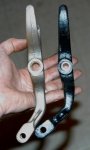
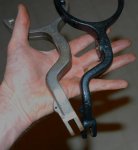
I May have bent the fork. I happened to have another fork in my parts stash and held it up to compare. It didn't look the same, so I pulled it out. The black one is the mm rebuild. The angle is clearly different. They are clearly different designs all around though; the black one is thinner. This might be able to explain a lot. What do you guys think?

Assuming I did bend it, the big question is how. I assume they shouldn't just bend from normal use/abuse of the clutch pedal. And I never really worked the pedal hard until I was already having a problem anyway. :confused5:

9870d1273547503-clutch-slave-hose-fork1.jpg


9871d1273547503-clutch-slave-hose-fork2.jpg
 

Attachments

  • fork1.jpg
    fork1.jpg
    24.4 KB · Views: 547
  • fork2.jpg
    fork2.jpg
    29.1 KB · Views: 558
Unless the fork was bottoming it should have worked. When you ran in to the cover it probably bent and popped your hose.

Verify the pp finger heights. You can bolt it to the flywheel with the disk instelled. The referance a dimension it comperable to the disk thickness. I recall .315 or so from the manual.

You do have a manual don't you? Look at the clutch section for detail.
 
unless the fork was bottoming it should have worked. When you ran in to the cover it probably bent and popped your hose.

Verify the pp finger heights. You can bolt it to the flywheel with the disk instelled. The referance a dimension it comperable to the disk thickness. I recall .315 or so from the manual.

You do have a manual don't you? Look at the clutch section for detail.

Yeah, I have a manual. Right now everything is still in the vehicle except the fork. I'm wondering if it really bent, or if there were different style forks for different applications? Just staring at it, I can't be sure it bent. The paint looks perfect still... Would it crack a little if it bent? But then if it didn't bend I really have no other explanation for the symptoms getting worse, unless the pp itself is changing.

Can I check the fingers with the clutch still in the vehicle?

The easiest thing will be to install the other fork and see if everything just works. If it does, then I'll start looking at the flywheel cover as a possible culprit. The style is different from my original one, maybe it's from an 800 or something and interfered with the fork leading to a bend.
 
There are at least two, possibly three variations of the throwout fork. Those were only used on Scout 80, a Scout 80 has a totally different arrangement, nothing like that one and no hydraulics. At some point in time, ihc changed the forging dies to provide a greater cross-section in the beam area of the fork

those forks normally don't "bend" unless heated, I have cores quite often that have been bent in order to change the travel due to the wear situation on the collar and the fork tips. And I have a rudimentary fixture I use to verify each core before repair, though it's always easy to see if they have been bent abnormally in the past.

So what you have is the wrong throwout geometry, resulting in adequate clutch pressure plate travel. Something has caused this, that fork didn't leave here with the wrong angle to the dangle! And your description of the original problem is that the dragging issue of the clutch release came on gradually.

All these type parts we furnish have a lifetime guarantee (my lifetime) from this end. Send me an email with your current shipping address and I'll send you a replacement, I must receive the black fork shown in your pic back however so I can determine what happened. Use the following email addy for me so I will see it when it streams in and make sure it doesn't fall in the spam can:

michael@IHPartsAmerica.com

A description of the clutch throwout used in a Scout 800 is addressed in this thread:

http://www.forums.IHPartsAmerica.com/transmission-tech/911-Scout-80-t18-four-speed-swaperoo.html

Your clutch cover and the disc should be inspected and rebuilt if needed by a professional friction materials shop. Either or both of the components can be actually manufactured from scratch by the folks I use locally. The release finger "height" must be set correctly for each type of clutch cover, the original geometry for the s80 hydraulic actuator was based upon the use of the angle link clutch cover. It does not take much wear at all of the disc to really alter the release travel distance, long before the clutch starts slipping due to wear.
 
What do you think about the theory that the problem was caused by the flywheel cover? The "new" cover I got fit fine but was of a very different design than the original. It is fairly heavy steel and has a double lip on it (flat side if I recall). If the fork was fighting that it May have eventually bent. Is this possible an 800 cover or something?

Another thing that might be nothing but might be very relevant: the slave pushrod is very Hard to get back in. The clutch pp springs can push it back, but the little spring does squat. I can't move it by hand. It sat 24 hours with the little spring pulling and never came to the stop. I don't remember it being like that before, but maybe it was? If I have some sort of one way valve failure mode going on, that won't help matters. What do you think?

Edit: I see that the cover is certainly not from an 800 after scanning the other threads you linked. It is a different design though. Maybe they changed over the years?
 
Last edited:
what do you think about the theory that the problem was caused by the flywheel cover? The "new" cover I got fit fine but was of a very different design than the original. It is fairly heavy steel and has a double lip on it (flat side if I recall). If the fork was fighting that it May have eventually bent. Is this possible an 800 cover or something?

Another thing that might be nothing but might be very relevant: the slave pushrod is very Hard to get back in. The clutch pp springs can push it back, but the little spring does squat. I can't move it by hand. It sat 24 hours with the little spring pulling and never came to the stop. I don't remember it being like that before, but maybe it was? If I have some sort of one way valve failure mode going on, that won't help matters. What do you think?

Edit: I see that the cover is certainly not from an 800 after scanning the other threads you linked. It is a different design though. Maybe they changed over the years?

The cover damage should be classified as consequential damage. It did not cause the problem but was caused by the rooc problem which in my opinion was/is the pressure plate.

The slave is likely hyperextended and the piston is protruding out of the bore causing it to rock and bind. It should under no circumstances ever have to be that far extended. I'll try to get a picture of my setup tonight for referance.
 
I got your email, I have a replacement fork in the works for you right now (paint is drying!), the one I'm doing is the "r2" (860296-r2) revision with the thicker beam cross-section.

As for the flywheel dust cover, I've only seen one version for the Scout 80, there was only one transmissions setup offered for Scout 80 also. It's a fairly light gauge sheetmetal cover.

All the Scout 800/four speed (pancake bellhousing for the t-18) dust covers used with the 152 and 196 engines are plastic. I have two of those. However, I know I've not seen all of everything that was ever available, it's possible that some steel dust covers were used on some models. The 152 and later the 196 engines with both three speed and four speed trannys were also installed in some pickups, those May use another variation dust cover, I don't know right now if they used the pancake bellhousing common to Scout 80/800 or not. I'd have to deeply research that!

If your dust cover is indeed heavier gauge, and the slot is not proper for the travel of the slave/pushrod, then it's possible that the fork could be bent by the tremendous pressure the master/slave can generate (about 1500psi) if the fork bottoms out before the slave is extended it's normal working distance.

What you describe regarding the slave not retracting, tells me the piston is cocked in it's bore, that indicates a hyper-extension! There is no one-way check valve in either the master or the slave, that system does not use a residual pressure valve as found on brake hydraulics. The bore size on the oem cylinders must match, they are both 5/8" bore oem. They are also available in 3/4" bore size. Total available "working" travel distance of that slave is 1", however when everything is correct and all parts are new/rebuilt, the actual travel distance from slack pedal to full clutch release is about 3/4" nominal.

If needed, certainly relieve the slot in the dust cover so that no contact is made between any component and the slot. In fact, when you re-assemble, leave the cover off and test drive for several miles, that hurts nothing! Then you can look up inside and observe all the relationships between the clutch release components.

We're sorry you are having such a problem! But this is a very strange deal and we need to add to everyone's knowledge base here! Of course, there is no charge on your part for the replacement part I'm sending you and it will have a new pivot bolt setup (and bushing) also, so be sure to enclose the old one with the bent arm when ya return it, that will also help me figgr out what's going on here!

I have n=5 forks here for cores now, two are the r21 version, the other three are the r1 version. The "bend" in the lever on all is exactly the same. One of 'em shows signs of a po grinding on it where it comes close to the slot though, I bet someone did a swaperoo and found that one made contact also and tried to modify the arm. I've welded it up and reground so it is now useable.

The r1 version does not appear in the last gen Scout 80/800 parts list, nor does it appear in the cross-reference or the price list which is used for crossing part numbers also.

By the way, I was wrong about the four banger s800 not using the hydraulic clutch actuator, the right-hand drive version did use a hydraulic clutch, as did "some" left-hand drive, there was a production change according to the parts list.
 
I have set up a replacement clutch throwout fork for ya.

I see the issue here now.

I've kinda "custom fit" the bushing in the thick beam fork (r21 suffix) I just finished, that means it gets mounted to a bellhousing and tested for articulation.

What has happened is that the fork has a limit to it's travel when it contacts the bellhousing "pad" when the pedal is depressed. In other words, your slave has "over-traveled" the ability of the fork to release the pressure plate over and over and has bent, that took one hell of a force from that cylinder!

No doubt ihc discovered the same thing about three years too late before they beefed the fork, but that still did not solve the problem of the fork bottoming out on it's stop on the bellhousing.

The root cause...the "travel" of the release of the clutch cover (pressure plate) is not set up correctly, the "release lever-to-flywheel distance" (some call it "release finger height") is not correct. Those clutch setups are extremely tedious since the very short throw of the entire release mechanism has very little forgiveness in freeplay adjustment,...again, it's more like a toggle switch than anything else with a really short pedal travel between engaged and disengaged.

This is why so many of these forks/collars/throwout bearings/slaves/pushrods are scruud up on the s80, it's a totally scruud up geometric problem! Plain old shitball engineering originally.

As the clutch disc wears due to use (just like brake shoes/pads), the clutch slave has to travel "further" to release the clutch cover/pressure plate. Then the wear on those fork tips that I rebuild, and the wear in the throwout collar groove eats up the travel distance, there is alotta slack, but not unclamping of the clutch cover. That means the clutch "drags" all the time, no matter how the pedal freeplay is adjusted. You can see this in nearly every fork, where the release fingers on the clutch cover have eaten into the fork (and making a hell of a noise for many miles!) some of 'em are so bad I can't save 'em, others I weld up which actually "stiffens" the repaired area once it's dressed down.

Your clutch appears to be fairly fresh? What's the story behind the parts?

It's gonna need to be removed and checked on the jig at a rebuilder, or checked by you using a flywheel for a redneck jig. The process is in the service manual.

If you simply grind more relief in the bellhousing stop pad, then the slave is going to continuously over-travel and soon the bore won't be able to hold a hydraulic cup and it will do nothing but leak continuously. And the replacement fork I'm sending you tomorrow will bend also.

If...you still have the original fork pivot bolt and nut, then use it with the replacement fork. The bushing has been burnished for that diameter. I supply that replacement bolt/washer/nut setup because most folks have a pivot bolt that's totally worn out, broken, or missing. I've not installed the reducer bushing in that fork, if you need to use the replacement pivot bolt, then install the reducer bushing also and then cut it to length. Those bushings are "oilite" bronze (oil-impregnated), but the bushing bore still needs to have a thin film of grease as well as the shoulder on the pivot bolt.

Your rig (and all others!) has had this issue developing for a very long time. As the clutch wears in a normal fashion, the release unit just can't cope with "normal wear" and have the pedal travel/freeplay adjusted to compensate, this is a design fault. When a clutch is remanufactured it must be set up to the original specification, rebuilders have all that data in references for every clutch application ever invented, they just have to set it up correctly.
 
Here's another important piece to this puzzle. I was investigating the seeming one way valve situation with the slave cylinder and I finally figured out what was going on. I did have a one way situation happening because the pushrod from the clutch pedal was adjusted too far in. It never released far enough to connect the reservoir to the output. I slackened it up some and the slave is now nice and soft.

But this could partially explain the bent fork. Once it got into this one way mode, every push of the pedal just pushed the slave pushrod further out. Some nasty stuff was going on. In addition to the bent fork, the band the holds the slave cylinder down is also distorted.

By the way, what's the trick to installing the fork with everything else together? Somehow I got the old, smaller one out, but heck if I can get the bigger one in. Do I need to use a prybar or something to push the throwout in and out of the way? I was curious to check out the geometry with the fork I have before your fresh one arrives.

I'm not ignoring the potential clutch/pp issue, but I want to see the problem with my own eyes before I tear all my work apart. This clutch setup was in the vehicle when I bought it. I really have no idea of the history.
 
Been keeping up on this thread with interest. Alot of good information here Mike. Wish I had some of this when I was re-doing the clutch stuff on my 80. When I bought my 80 (13 years ago), I could barely get it up my driveway because the clutch was slipping so bad. I pulled it apart and soon discovered what the problem was. The prior owner somehow put the clutch plate in so that it was only contacting about 1/2 of the surface of the flywheel. I believe there were some adjustment points that weren't adjusted properly. Anyway, there was a moon shaped area of clutch material bonded to the flywheel. So I ordered a new clutch plate, pressure plate, to bearing and pilot bearing from kragen (didn't know about ihon in those days). Had the flywheel resurfaced, and put it all back together. It worked alot better (no slipping), but I had to pump the clutch peddle to get it to disengage. The po had also put some sort of strange slave cylinder on it that was not stock. It had the mounting bracket integral (welded?) to the cylinder, and didn't seem to work right. So I ordered the forklift slave that gets talked about and a new hose. Also got the stock bracketry off of ebay. As I was putting it back together, I noticed alot of play in the fork. Took the fork to a machine shop and had them build the pads back up, and put a bushing in the pivot hole. Put it all back together, and it has been working perfectly for years. No more having to pump the clutch peddle to disengage, no grinding, just smooth clutch action and shifting.

A few years back, I picked up an nos fork from ebay that I've got sitting in a box somewhere (at my place in az I think).... I'll have to check that one to see what flavor thickness it is.

Mike, keep up the good work!!!!
 
I get enough emails and phone calls about this issue that I should make a sticky out of the big picture!

Your description john is just one more variation to add to the po virus vaults!

The most common is simply lengthening the slave pushrod because (according to the po) it's "too short" from the factory!

A guy I know in texas called one day with the same issue on his pair of Scout 80 rides. But he said one of 'em had a cable-operated clutch. After seeing his pics finally, someone had taken vinyl-covered dog tie-out cable and some galvanized ring-eye pulleys for turning blocks and actually rigged a rat's nest of leverage to operate the clutch beginning at the pedal! It probably actually worked for about an hour.

The deer lease folks in the texas hill country that use these Scout 80 rides once a season and then let 'em set can do wonders with creating po virus. There is no limit as to how they can attempt to make one continue to actually move under it's own power year after year as it returns to the earth in small particles of rot, the ultimate form of motor vehicle recycling.

Yes, that buys additional travel, but within a few thousand miles the fork breaks in pieces inside the bellhousing and turns into ied shrapnel! That is because the clutch cover release fingers finally saw their way through the cast steel fork!

And yes, there are two variations of the girling slave, the crappy one IH used which clamps in place and moves around so that pushrod travel is eaten up, and the bolt-on style. The beefed-up "conversion" setup I've been working on so long will use the bolt-on slave since it's positively mounted. And...the japanese clones of the girling stuff are most commonly found in the bolt-on config.

The parts used in the lift truck and vocational vehicle industry do not have this issue because they never used the true "girling" crap that required the special sauce hydraulic fluid. And...their mount systems and actuation designs were engineered for use in a 24/7 industrial environment where any vehicle down-time is totally unacceptable!

The wilwood versions were developed many years ago as high quality replacements for the crappy castings produced by girling and their licensees! That developed into their acceptance throughout the motorsports industry for all kinds of actuation scenarios. Back in the 70's when sand rails and "dune buggies" based on cut-down vdub floor pans were all the rage, we used 'em for home-brew "cutting brakes", now an entire industry exists just for sand buggy hydraulics.

Charles, I think you have hit on the root cause of the situation here, like I said before, I've never encountered this after a proper repair was made using the reconstituted parts.

As for re-installing the fork without tearing out the clutch, I don't know, I've never had/tried to do that, I always work with the stuff on the bench or when replacing a clutch/flywheel onna four banger in the vehicle. No one has ever informed me of a "clearance" issue using the r21 fork when trying to trade it out without removing the clutch, but then not many folks ever get involved in this and even understand how all this stuff works, they just want "parts" that aren't butchered!

So...we are all learning new stuff here and regarding the nuances of these s80 crapballs, our education will never end! If it ends, then the fun is over and we move on to dealing with yugo resurrection.
 
Last edited:
I got the fork today and it went in pretty easily. I don't know what's different compared to that other one I couldn't get in. The geometry looks good. In fact, it's too good. With the slave cylinder pushrod I have, I can push it all the way until the slave is bottomed out (it goes easy now) and the eye won't line up with the fork eye (with the throwout touching the fingers). So... I hope I do in fact have a pushrod that is longer than stock. I bought it from iho a while back. It measures 3.5" total length. Can you tell me what the stock length is? Hopefully shorter, and if so, can you sell me one?

Thanks for all the help.

Edit: I'm only about 1/8" too long by the way. With everything as it is now, I'd think 3" would be a good length to have a little margin.
 
Try loosening the slave bracket attach bolts and see if you can get enough movement to give the room you need. Did you back off the stop?

Glad things are moving forward for you.
 
try loosening the slave bracket attach bolts and see if you can get enough movement to give the room you need. Did you back off the stop?

Yeah, maybe the bolts will give some slop. If it works, it'll still be tight. I want to make sure I get the throwout off the fingers.

You mean the stop the fork rests against coming back? It's not installed yet, but I don't think it comes into play here since I'm trying to go the other way anyway.

I would like to understand why it's so tight though. Hopefully it's that my actuator pin thingy is extra long. 3.5" is as long as the whole slave cylinder, so the pin sticks out the length of the piston in the cylinder.
 
Your pin is 3.5"long? I May have one I can measure for reference of measure the stick out on my 65'. I you think that would help.
 
I took a photo and got the measurement. Give me a few minutes to Mark it up. I could not find a push rod but the assembly dimension should do.

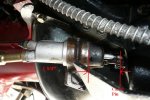
The 1 3/4" dimension is. There is about 3/16-1/4" of slave stroke before to bearing touched the pp fingers.
 

Attachments

  • P1010368MUmed.JPG
    P1010368MUmed.JPG
    72.8 KB · Views: 578
Last edited:
All the pushrods I have are bootyfab junk from all directions, I need an oem pushrod myself to use for mockup. I bet Isa has one!

The one I have that May be closest to oem measures rounded tip-to-center of the eye, 2-3/4". One of the worst of the bootyfab units measures about the same.

So I'm suggesting that your pushrod was fabbed and is not oem, that is common when folks try and lengthen the throwout stroke that ends up with the clutch eating away the throwout fork from hard contact. Maybe use an old drill bit cut down to make a test pushrod and then rig it to test stroke with. Now that everything is back to original as far as throw, see if the nominal 2-3/4" length appears to be ballpark. Then you can cut down your existing pushroda a small amount at a time until the throw is perfect. But make sure the pedal free-play at the pedal/master interface is right, so the master is not partially depressed. I have several master cylinder pushrods that are booty-fabbed also to try and make the clutch work, some of these donors had both pushrods scruud over which only makes the entire actuation geometery worse!
 
Mine's a little tighter than yours. I'm a little over 1.5" when the throwout is touching, maybe 1 9/16". So, if I use your 3/16" number for slop, I'm at 1 3/8" to your 1 3/4" between slave collar and fork eye. 3/8" difference. I suppose that's within tolerance for these old rigs...?

I haven't tried loosening the mount yet. I can't tell if it's original or not. Is your slave tight in its mount? I have two of those mounting bands, and my slave is a little jiggly in both of them. It would work fine, but I put a strip of gasket material in there to make it tight.

Maybe when mm checks in he'll know the length of a factory actuator pin.

Thanks for the help.

Edit: this was response to Robert. I previewed it and walked away thinking it was posted.
 
Last edited:
2 3/4" would certainly work, though it could be longer and still work too. I'm a little unclear on what happens when it's too long. I think from other threads of yours I've read, you are saying that there really is nothing to stop the fork from going right up into the clutch pp body and getting shredded if the throw is too long? If so, that's just awful design! Ideally then, what stops the travel? Does the pedal stop up against the firewall, or the slave or master reach full travel? The slave only has a little piece of wire holding its piston in if I'm looking at it right...

With the fatter fork it looks like the fork hitting the bellhousing could be a hard limit, so ideally that would bottom out before the fork hit the clutch housing?

I want to make sure I go about the tuning process properly.
 
2 3/4" would certainly work, though it could be longer and still work too. I'm a little unclear on what happens when it's too long. I think from other threads of yours I've read, you are saying that there really is nothing to stop the fork from going right up into the clutch pp body and getting shredded if the throw is too long? If so, that's just awful design! Ideally then, what stops the travel? Does the pedal stop up against the firewall, or the slave or master reach full travel? The slave only has a little piece of wire holding its piston in if I'm looking at it right...

With the fatter fork it looks like the fork hitting the bellhousing could be a hard limit, so ideally that would bottom out before the fork hit the clutch housing?

I want to make sure I go about the tuning process properly.

The components within the IH bell housing are basically the same as has been used since clutches were introduced.

There is no stroke limit for the tob. Only the design of the master and slave. All limits/specifications assume things are assembled correctly.

Yes the pedal does hit the firewall well actually the Scout has a small round bumper that the pedal bottoms on.

Hydraulically the system can not hyper extend, 5/8 slave with a given stroke, 5/8 master of a limited similar stroke under normal conditions never over strokes. In your situation things were not correct and you ended up over stroking the tob and pp till the levers bottom on the disk hub (deduced not witnessed). Not ever possible when set up per proper technique. Not saying you did a poor job but using it to explain why no hard stops are built in to a master slave system.

Proper pedal free play, proper tob to pp clearance and a properly assembled and adjusted pp you will never have a bottoming issue.

As the friction disk wears down the slave piston will be positioned further and further into the slave bore. Make sure you have enough remaining so the piston doesn't bottom. Back the fork stop off and by hand pull the fork back into the slave till it bottoms. That is your wear limit. You will need to monitor the tob free play as you drive your Scout over the years. The free play will go away as the clutch wears.
 
If the pedal goes all the way to the bumper, doesn't that always correspond to the same range on the slave? How could it go further as the clutch disk wears? Is it because the clutch pp fingers stop it when things are more fresh, and it doesn't actually go to the stop?
 
I was referring to the release position like when your foot is off of the pedal. As the clutch disk wears(looses thickness) the pp fingers reach further toward the through out bearing. Thus the slave will need to be able to retract further.
 
I was referring to the release position like when your foot is off of the pedal. As the clutch disk wears(looses thickness) the pp fingers reach further toward the through out bearing. Thus the slave will need to be able to retract further.

Oh okay. That makes sense.

I trimmed my pin down a little bit and everything seems to be functioning well now. There was a little bit of shimmy and noise (not much, but some) when the to just touched the clutch, like with the weight of my foot on the pedal. It seems to have gone away after the test drive though. Should I worry?

Also, the little spring I have on there doesn't always seem to draw back the fork to the stop. I can easily bring it back by hand, so I think maybe I just need a little stronger spring. It makes me wonder though, should there be any grease at all on the tranny snout for the to to ride on? I think I asked this when I was assembling everything and the answer was no, but it seems odd to have no lube on a friction surface like that. I think I put a film of rem oil on there but nothing else.

Anyway, it seems I dodged a bullet not having to pull the clutch or anything. It's seems to be working perfectly now. :icon_rotate: now back to dialing in the engine.
 
Back
Top