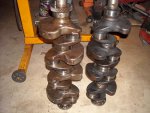
I'm still gathering components for the stroker motor, the lack of cubic dinero definitely slows down this process.
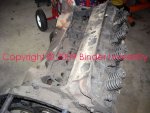
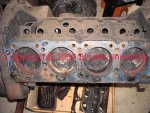
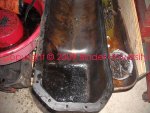
But since I'm in shop cleanup/purge mode I'm prepping the peripheral components for the build as I scavenge though my pile of donor schnizz.
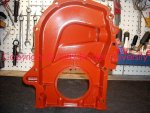
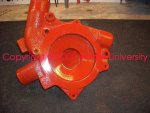
Here's a shot of the prepped timing cover interior. This cover has had the oil filler removed and the hole blocked with the appropriate core plug...which happens to be the same size plug as used to fill the penetrations in the oem-design aluminum intake manifold.
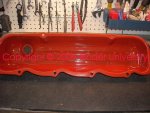
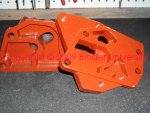
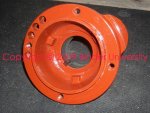
Then the interior of the cover (and all internal engine component surfaces except fasteners) was shot with what is generically referred to as "glyptal":
home page
I'm using a version of the stuff manufactured by aervoe industries labeled as "insulating epoxy coating", p/n 401:
welcome!
Many years ago, in engine building, we used rustoleum "red" primer and applied with a brush, a very time consuming and nasty job. Idea is to seal the interior of the sterilized engine with a product that is very "slick" and will shed oil readily, while sealing the porosity of any castings and embedding any microscopic particle that might rise to the surface of the metallic components during operation. In the old days, "glyptal" was a much more advanced product to use, but also was much more difficult to deal with in it's old formulations.
This type product is typically used today in commercial electric motor shops to insulate freshly re-manufactured armatures, coils, etc. Two cans of this stuff will do an entire engine internally, including the head(s). It must be masked off any bearing saddles and kept out of machined/threaded penetrations as it builds a thick film and can be difficult to remove once it cures. It's also really not something ya wanna breathe so a rated respirator should be worn when applying. When it cures, it's nearly identical in appearance to powder coat.



 thanks guys! I love this forum!

 I vote stay with a carb. Maybe dhla's od dcoe's. 28-32 mm chokes. Way more torque and hp. Efi is for emissions imo
  the wrong way, but there seriously isnt a way to get a new cam either? Wow, this is gonna be rough. Thanks -Mike
 100 hp easy 150 ft./lb May take stroking the 152 crank and boring .060 over to 160 inches