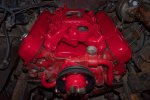
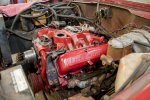
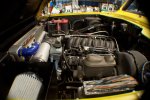
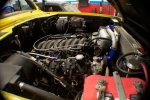
intake manifold bolts

matthew thomas

New member
Hello,
I am putting the intake manifold back on my 392, and have now cleaned up all of the bolts and noticed that there are four 'copper' bolts. I did not have the bolts sorted as they came out so I now need to get the information to properly put them back home.

I read on binderplanet that they are for the crossover/ center four bolt holes in the intake. I have also read that I should just replace them all(and washers) with new grade8 hardware. Any thoughts?

Thank you in advance,
-matthew
 
hello,
I am putting the intake manifold back on my 392, and have now cleaned up all of the bolts and noticed that there are four 'copper' bolts. I did not have the bolts sorted as they came out so I now need to get the information to properly put them back home.

I read on binderplanet that they are for the crossover/ center four bolt holes in the intake. I have also read that I should just replace them all(and washers) with new grade8 hardware. Any thoughts?

Thank you in advance,
-matthew

I've moved your thread to a more appropriate sub-forum!

Yes, those copper (or bronze) plated bolts are for use at the exhaust crossover. Are they necessary? Inna word...no! Unless...you doing some kinda 100 point restoration where that kinda stuff matters.

Here'sa thread regarding intake manifold r&r from a while back:

http://www.forums.IHPartsAmerica.com/carb-tech/76-beer-can-maneefol-guapo.html

I use new grade 8 hardware with grade 8 sae (smaller od) flat washers. They should be the proper length also (same as oem). I treat all of the bolts with hylomar (or ya can use permatex #2) on the threads, that acts as both as an anti-sieze and also seals the threads of the bolts which penetrate the intake runners in the heads. If ya don't seal those threads, you will have small vacuum leaks. Do not use rtv!!!!!

All of the hardware supplied with the rpt aluminum intake manifolds that we market is grade 8 with a black oxide finish.
 
I humbly thank you for your expertise there, I really do.

Where exactly can I find that aluminum intake for the 392? I was unaware that one was currently available.

I'm heading to get some new grade 8 bolts and hylomar!
Thanks again for your help! It means a lot knowing that you're getting good information.
-matthew
 
Ihon had a batch made a while ago, but they have all sold. Unless you can find someone that is selling theirs, then at this time you are out of luck. Good luck on your project!:cornut:
 
Actually...by directly contacting Jeff at IH Parts America, Isa Ismail at Isa's IH, or the actual manufacturer of the rpt line, Mike Ismail at IH only, one of 'em May be able to kick up a new 345/392 rpt intake.

Michael is correct, no recent production has occurred regarding the 345/392 version in either intake flange variation. But ya never know who May have what since some of this stuff was held back for various projects that May not have materialized.

And used ones do pop up from time to time...but not mine, it's priceless in my world and it's serialized from Mike in my name!!!!
 
Thanks for the info and the encouragement...

Okay, now for another question. (perhaps I should rename this post? Because I'm heading into uncharted territory for me and I am sure to have more questions about this project)

can someone please show me a side by side comparison of the factory spreadbore vs squarebore 4bbl manifolds? I just now noticed something that made me go hmmm, and I've looked and looked through the forum here, and elsewhere, and can't seem to find that for some reason.

The mounting surface under The carb on my 'new to me' manifold is not flat as my previous one was. I can take photos of exactly what I'm talking about and post them tomorrow. This has me a bit worried, but it's just because I have no experience with this at all, and don't fully understand what I'm looking at.

Thanks to other threads here, I am pulling the welch plugs and installing new ones tomorrow after inspection of the interior of the manifold. And am going to find a rubber valley pan gasket. I have a cork one newly installed dry, but now know about the permatex on the bolt threads and I definitely want this done the right way.

Also, I got my carb back from the local shop that rebuilt it for me, and I just don't have the warm and fuzzies about it. It still looks pretty dirty inside, like perhaps it wasn't a complete job... It had liquid dripping out of it as I carried it home. Anything I should be looking for to know for sure if it has in fact been rebuilt? I am kicking myself for not coming to you guys with my situation a couple of weeks ago. Well, lesson learned.

By the way, I have utilized your very thorough information on the entire pre-lube process already and I really appreciate that. It's a big reason that I'm here. I'm looking forward to supporting IHOnly n with all my future purchases.
And thank you again for your help.
-matthew
 
Great followup matthew. This makes it real nice to address each issue you May have!

I don't have a spreadbore intake in the shop right now for comparison shots for ya. But...the mounting flange design of the rpt manifold is quite different when compared with an oem manifold...and that is totally dependent upon the vintage/application of the actual oem manifold, there were many produced, they are not "all the same" by any means.

I do have many shots of the actual carburetor variations however, but rather than speculate and lead ya the wrong direction, let's take a look only at your stuff! An awful lot of these manifolds have been "converted" using the wrong adapters and such, the carburetors used don't match the manifolds, the choke systems are butchered and workedaround, etc. That is not saying conversions and adaptations can't be done effectively, but they have to be right or ya gotta non-starter/non-driver to contend with and soon loose interest in the rig and get rid of it or trade for a chev!

The rpt manifold patterns/molds are done on the last generation intake manifold with egr. That allows them to work with any engine setup. If ya don't wanna use egr, ya block it. If ya don't wanna use the divorced choke stove, then plug the holes. Those manifolds will go backward to the beginning of the sv engine production.

But...I need pics of your exact setup as that is really all that matters right now, not someone else's! That way we don't miss anything or confuse ya with incorrect advice/info!

I do know exactly what your concerns are, but I need the pics to confirm! You are correct though, if the right parts are not used with the spreadbore manifold/carb install, drivability will be terrible!

As for the valley pan gasket, either type works just fine for me, I have no preference for either. I glue the gasket to the valley pan after it's sterile. If the gasket you have is the rubber/cork composite, I use either hylomar or permatex #97 (that is also the "thin" version of good old 3m gorilla snot or yellow weatherstripping adhesive, it's a contact adhesive). If it is the rubber gasket, then never use hylomar as it acts as a lubricant and the gasket will squeeze out. On those I use only the 3m or the permatex #97.

Carburetor questions? Let's use this thread to work through your intake manifold stuff. Then post a new thread just for the carb (with pics and complete id info) in the "carb tech" sub-forum, that way it greatly enhances the ability for others to perform keyword searches regarding similar concerns! I'll be glad to critique your carb work, it's always a challenge to look at this kind of stuff and figgr out what's going on!

Since obviously this rig is not your dd (or at least not your only dd!), then you have the time to do all these repairs correctly, that is a real plus!
 
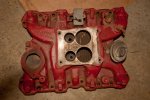
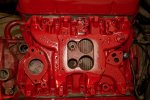
Okay, here are photos of my two intake manifolds...

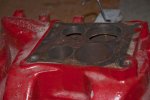
The first intake came with my 'new to me' 392 that supposedly came from an '80 Scout II.(I have also installed the t-19 and Dana 300 from the same truck into my '72) note that the intake is flat across the top, and that it is broken at the thermostat housing, which is why I'm replacing it with the second manifold.

attachment.php


attachment.php


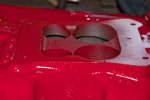
The second intake is not flat across the top, it is recessed under the carb. What gives?

attachment.php


attachment.php


Thanks for the help, I really appreciate knowing these things definitively. And hopefully these photos once properly explained will help the next guy who doesn't know this stuff either.
I'm now on to post my carb photos for more clarity.
-matthew
 

Attachments

  • intake1.jpg
    intake1.jpg
    82.7 KB · Views: 5,867
  • intake1A.jpg
    intake1A.jpg
    59.8 KB · Views: 3,971
  • intake2.jpg
    intake2.jpg
    92.1 KB · Views: 4,638
  • intake2B.jpg
    intake2B.jpg
    48 KB · Views: 3,840
Last edited:
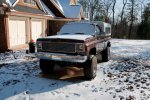
Oh yeah, thought I'd share my current daily driver... That is until I get my Scout up and running again. Man I miss her!

We call this our "bear trap" because we would put our garbage in her for a while there and we had a bear climb up and dent the hood, scratch up the plexi-glass rear camper window, and break one of the brake lights out... Oh well, it adds character we think.
 

Attachments

  • chevy.jpg
    chevy.jpg
    56.6 KB · Views: 2,384
Great story here matthew, something I've never seen asked or addressed on any other IH-related forum!

First off, do not toss that original manifold that has the tstat housing ear broken off! If you have the broken piece, I can fix that one! If ya don't have the broken piece, I can still fix it, just takes more effort! And it ain't gonna be some redneck workaround, once it's repaired you will not be able to tell it was ever damaged.

On to the differences...do you see the ihc part number cast into the runner for cylinder #7?. The numbers are the same except for the suffix...the early spreadbore manifold is a "c1", the later one is a "c2". The c2 unit is a supercession unit that is backwards compatible.

The spreadbore manifold with the carter thermoquad was first introduced for some IH 345/392 on the m/y '74 pickups and travelalls. That would be the c1 unit. There May be some oem Scout II produced in mid/late calendar year 1977 that also had that manifold.

At the time, the carter thermoquad was a fairly new design and did not have an extensive track record of performance and tuning quirks, most especially on IH applications. While it was an excellent mixer when properly set up, the major advantage it offered due to the tiny primary and the massive secondary throttle valves resulted in a kinda grossly "uneven" fuel distribution especially at idle and when operating in the "tip-in" mode. But based upon the emissions criteria at that point (both federal and kalifornia versions), it still passed muster.

Keep in mind, the secondaries only begin to actuate when manifold vacuum is low and the air mass above the secondary air valve is great enuff to open the flap against the balance spring. So when the secondaries do open, it's a massive dose of fuel/air that is intro'd to the plenums all at once, the secondary side if this carburetor has no idle or accelerator pump system to aid in that transition, that is a huge hurdle to overcome!!!

Prior to the '77 model year production (by then only the Scout II was still alive in the IH light line production arena), emissions specs tightened to another level for all manufacturers. Keep in mind, this was long before we had to smog this stuff in an active mode on a dyno or rollers, emissions testing was only done at idle. However, the emissions numbers were important throughout the operational range of the vehicle as far as the feds and the manufacturers were concerned, that is why we find that "deceleration module" mounted on the firewall of some of these vehicles!

Since the uneven air/fuel distribution characteristics of the spreadbore carb now really screwed up the smog numbers, a change had to be made that was the cheeepest possible solution, remember, IH was badly on the ropes at that point in time and every penney that had to be spent in achieving target emissions goals on the engineering/production side was reflected quadruply in the retail price of the vehicle!

So...the existing manifold casting and blank was simply "undercut", a very cheep tooling change and handled on the machining line before the engine blocks hit the transfer line!

What that does is ties all four of the intake "plenums" together with a common crossover right at the top. That manifold is actually a very sophisticated design since it's a "medium-high rise" design with an "air gap"!!! That is the same design used in nearly all aftermarket performance manifolds that are considered "streetable"! The identical edelbrock design for other engines has no performance advantage over this stock intake,...other than weight!

It also enhances idle quality and tip-in significantly, while allowing an overall "leaning" of all the calibrated circuits in the matching carburetor. Therefore, idle emissions levels were able to be met with a very inexpensive engineering change. At the same time, the ignition system calibrations were also tweeked, all this can be easily seen when ya sort through all the specs in the service manual and the extensive "service letters" issued to dealers by ihc at that point in time explaining all this guapo so mechanics knew how to deal with it...and how their tuning/service methodology they had used for quite some time had to be upgraded as well!

In some motorcycle and other forms of high performance engine work that use multiple carburetion apps, we call that kinda stuff..."balance tubes", "crossovers", etc. It does the same thing on a four cylinder motorcycle engine with one carb per cylinder, it simplifies carb synchronization tremendously, and vastly improves the off-idle characteristics since back in the earlier days they had no accelerator pump circuit included like the carbs used today in full emissions motorcycle apps.

Because the 4v carburetor that IH had used for many years on these engines was the Holley modular (either 4150 or 4160) "square bore" design, this huge difference in primary-to-secondary throttle plate diameter did not exist, and fuel/air distribution was not an issue (except in trying to build a super-hi performance motor). However, the last generation 4v manifolds used on the square bore apps did have a balance circuit machined into the intake flange, but it was done in a different manner,...and the carburetor "pre-heat" path was also changed up. But the oem Holley 4v carbs also had a rudimentary "crossover" machined into the base of the throttle body, that was to allow a more functional vacuum signal for the power brake booster and also enhance the operation of the positive crankcase ventilation (pcv) system when they were changed over to the "closed"-type pcv system mandated by the feds.

All versions of the rpt manifolds are "flat" at the carb interface. That allows anyone to have custom machining done if desired, along with the port injection bosses to be final machined if needed for running port efi. The rpt manifolds also do not have the vacuum tap inserted into the rear of the plenum like an oem manifold does. So provisions for that must be made in some manner, and every user has a different approach to that. In fact, I'm gonna update that thread I referenced for ya to address that issue and what I've done about it just in the last few weeks.

 
Last edited:
Mr mayben, I thank you for your very thorough information. So, if I understand correctly, the c1 manifold with the 'flat-top' and broken ear, that came on my "1980" 392, would have come off of an earlier model engine than an 1980? Hmm, I suddenly need to do some more research I think.

Thanks again for the great information! And I believe that I have located a thermoquad carb for my application. I'll know more later in the week, and will definitely keep you posted.
-matthew
 
I think what you are finding in your collection matthew, is a typical mish-mash of various components that have been assembled over time.

The 392 was never an option engine for any Scout II platform. That is not to say that one could not have been installed by dealer or even some one-offs from the assembly line for a particular purpose and customer that had some kinda pull.

The entire sv engine production ceased sometime in 1984, but the 392 that was installed in the medium duty trucks from 1980 thru end of production had the engineered tstat housing that had been used since the start-up of the 266 and on the 152 after sometime in '62 based on service parts information we have. So it was only the m/y 1980 Scout II that had the reduced cost cooling system.

The last production of light line vehicles in which the 392 with the spread bore and thermoquad was available would have been "some" pickups, cab and chassis, and travelalls designated as m/y 1975. There is a designated 1976 model "500" series cab and chassis in the historical data however.

Year model can be somewhat ambiguous in some states due to the way that new motor vehicles were titled and registered at the point of sale. And most especially in some of the southern states that had no title laws and did registration only. I've been involved with two IH trucks we took out of your state that were not titled, and when georgia did enact a title law due to threats from the feds, they determined that it was not necessary to title vehicles older than 25 years iirc. When we attempted to title one vehicle in texas, it was no problema...but the one that got sent to California became a total nightmare, not only because of "no title", but also because of the emissions crap!

As for your actual engine, shoot some pics and post of the top section of the water pump housing where the bypass connects, along with the water neck you are going to use and we can see what else ya got. I have some good pics of a virgin 1980 Scout II that clearly shows the changes in the cooling system along with a few other points, so once I see your pics, we can make the comparison!

I have a good friend down in leesburg, ga who also started his Scout II career with a bastard ride! It should not have had the "last gen" 345 motor in it but it did, since he didn't know anything about what we're discussing here at the time, it ate his lunch until after many back and forth sessions with pics we finally worked through all his mis-matched parts!

Because of the significant interchangeability of all the peripherals on these engines, it almost the norm around here to find no telling what is installed on any one rig unless the owner bought it new! And we do have several folks who post here on a regular basis who are driving rigs they purchased new or when they were only one or two years old.

However, what items appear to be a direct swap, usually always have some slight or significant nuance that creates issues once the component is installed. And intake manifold variations (with carburetors) are one item we deal with quite often. Electrical components (especially ignition stuff) is another major clusterfook! Then when we get into the engines that were in school buses and have boneyarded into scouts, that just adds to the drama!
 
Okay, gulp. Here we go... Fingers-crossed.

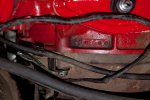
The stamping on the passenger side reads:
v392 e
12241 35

this is the truck that this engine supposedly came out of. The engine was sitting on a roller stand behind the truck in a garage in daytona beach florida. The seller told me that this Scout came from Colorado. That's all I know.
attachment.php


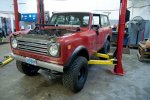
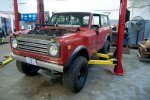
And here it is sitting in my '72 Scout II.
attachment.php


attachment.php


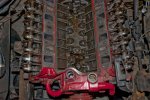
The way it looked inside when I opened it up to begin the pre-lube process.
attachment.php


The 'water-neck' coming off the thermostat housing was missing from this engine. I found some very large pieces of it(I believe) behind the water pump when I took it off to replace it with a new one. So, I am planning on using the one from the '72.
attachment.php


And the numbers at the back if that helps...
attachment.php


Thank you for your insight. I really appreciate it. And please let me know if you need a better photo of anything...
-matthew
 

Attachments

  • engine4.jpg
    engine4.jpg
    88.6 KB · Views: 4,479
  • engine3.jpg
    engine3.jpg
    76.4 KB · Views: 3,548
  • engine2.jpg
    engine2.jpg
    97.7 KB · Views: 4,051
  • engine1.jpg
    engine1.jpg
    72.5 KB · Views: 3,884
  • engine5.jpg
    engine5.jpg
    98.6 KB · Views: 6,525
  • engine6.jpg
    engine6.jpg
    95.5 KB · Views: 691
  • engine61.jpg
    engine61.jpg
    194.9 KB · Views: 3,792
Last edited:
On your unbroken manifold the casting date is visible between the carb mounting and t-stat location. Here is how to decifer the year code.
http://www.forums.IHPartsAmerica.co...ng-345-a-3.html?highlight=code+date#post16641
It is hard to tell from the angle of the pic put it looks like it was jan 31 of ? For that manifold. The block appears to have been cast on feb 16 73, if the last digit is a w.

There are also casting dates on the heads, and exhaust manifolds. If all the parts left the factory together then the dates should be fairly close together. Of course that doesn't guarantee they spent their life together, but makes it very likely.
 
Last edited:
Hmmm, the picture (& serial number of 122.... If correct) of this 392 casts some doubt on the "year code" letter info that is in the link eric posted (which I posted / "copied".)

the picture in the link eric posted of the tag ( 4 6 w ) is from my 392 (in a 73 1210t/a I purchased new).

According to the plastic warranty card (I do not think I have checked the actual "pad" on the engine.), the serial number of my 392 (supposedly built / cast on April 6 - I took delivery of the t/a in CA on June 5, 1973) is 1187854 -- quite a bit lower than 122....

But, the serial number (and intake manifold) does "support" the origin of the engine as from a 74 / 75 pickall.

Of course, I am making the assumption that IH stamped the engine serial numbers in order / sequentially.
 
"8 10 w" is on the bottom of the drivers side head, underneath the manifold.

And I also double checked the stamped number on the passenger side of the block above the motor mount, and I could see the slight 'arc'ed' grind patterns on that surface faintly behind the stamped numbers. I'm no expert, but I would say that they look original. So my best guess is that the "v392 e
1224135" information is Original to this block, so heads and Block are tagged with 'w'... (1973)?

If I can get a photo of it I will post it here when I'm able.

Am I correct in my understanding that this is an 'improved cooling' 392? And that these heads look correct for this block?

I've completed the pre-lube procedures up to the point of turning it over with the starter, I'm still setting up the electrical end of things, alternator, switching solenoids on the starters, etc. Before I get to 'turn the key'...

But I got 50+ psi sustained, at half of the recommended drill speed (that's all I had for a drill) and great oil flow on both rocker assemblies while turning the crank very slowly. To my novice eyes, everything looks really clean on this motor.

The numbers on my unbroken manifold(which of course has nothing to do with this motor), are 1 31 'c'. And it does of course have the c2 prefix indicating a 'supercession' manifold. Man, I feel like somebody! Lol.

Thank you everybody for your input, I sincerely appreciate it. And any and all good advice is always welcome.
Thanks,
-matthew
 
Yep, that motor is assembled from pieces from various versions...but so what?? If someone used all the right swaperoo parts then it doesn't matter!

And that is why we need pics like this matthew, the story of what you have right now is all in the pics!

The exhaust manifold I can see in one of your pics is from a medium duty truck application, see that projection from the end that is threaded? It's not a through drilled hole, but a location for mounting a "heat tube" for the hot air choke used on some models. Hot air chokes were not used in IH apps after m/y '72 as they did not meet emissions criteria for the light line stuff. The Scout II from it's intro as an "810", through the end of the '72 production run did have a hot air choke, but the heat tube was dead center in the top of the passenger side exhaust manifold and was a totally different design tube fitting.

The water pump housing installed is not the el cheepo "1980" version, it does not have a reducer fitting screwed into the bypass where the id of it was simply tapped for a galvanized pipe fitting to reduce it's id.

But again, it doesn't matter unless your are doing an absolute correct resto, and your rig is far from being a candidate for that in it's present state!

The block and heads are definitely "improved cooling", the engine serial cut for the ic motor is 1013196 and greater. The number cut of the export "low compression" engines is a completely different range. So that means the engine was considered a "m/y 1973" production year version or later.

So the separate thermostat housing and the water neck that is an "l" shape is correct for that application.

The power steering pump bracket also incorporates an a.I.r. Pump mount on the top/rear that hangs over the valve cover. That would be applicable to any Scout II or fullsize rig, but not a medium duty truck as they did not use those pumps.

And as previously mentioned the spread bore intake could have originally been in a '74/'75 345 or 392 in a pickall or a '77>'80 Scout II 345. The spread bore intake/thermoquad carburetor was not available for any application on m/y 1973 and earlier IH stuff.

Engines were somewhat sequential off the assembly transfer line, but because of the huge number of variations spread between motor truck, stationary, marine, ag product, export, lpg, etc. There is no correlation to a "sequential" deal as far as engine number vs. The chassis it was originally installed in.

And...if a particular vehicle failed final inspection for whatever reason and had the engine changed out in what we call "offline repair", then the line-installed engine number had to be changed and the replacement input into the "system" by hand so that all the production records matched. And ya think that every vehicle that had that issue was properly accounted for??? It dam sure doesn't happen that way today with computers and robots handling that exact same kind of deal and every single screw is accounted for by weight as part of the qc process! Humans scruud this process up constantly on a daily basis, that is why folks like myself had jobs...to monitor, correct, and field fix the crap that slipped through the system!

Also...the engines which appear to be identical to the versions that went into the motor trucks, actually have a different set of casting/part numbers since much of that stuff came out of a different foundry and went through a different machining and transfer/assembly line! And those part numbers are not found in the parts list for motor truck stuff, in fact, they are found in the stationary and ag lines of equipment documentation. Another reason why we sometimes have a difficult time in deciphering and resolving all these part number/casting id differences for what appears to be the same part! A 345 in a combine sold in south america running on propane is not the same 345 that was installed in a 49 state Scout II in m/y 1976! But those parts do show up in our world since the reman and scrap business is world-wide!

In working with our customers on this forum, we use the parts and service documentation that was used in the motor truck industry in the north American market, though sometimes we run across all kinds of info from the other divisions and locations IH had spread around the world.

Your pre-lube numbers show to be outstanding, good job, you can rest assured that you are taking the right steps to bring this motor to life!
 
It is very reassuring to know that someone with that knowledge has 'looked over your shoulder' and not seen any blaring "square pegs in round holes" sticking out there. So, thank you guys once again for your help.

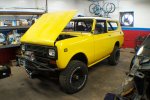
I thought someone might want to see what replaced this 392 in the '80 Scout. I was told that it was an ls7 racing engine from the track at daytona. The guys at the garage there had done it all. A lot of custom work had gone into pulling this off, I can't claim to know if it was the best work or not, but I can Tell you that it sounded bad-a@$... Not at all like an International mind you, but bad-a$# nonetheless. It's not something that I would ever want to do, but I always find it fun to see what other people wind up doing to their scouts.
attachment.php

attachment.php


Oh and let me know what you think I should do with this 'broken' intake manifold... I don't have a need for it as far as I know. Anybody have a need for it? I do not have the little missing piece fyi, it came to me that way, and I believe it was broken in the shop after it was out of the '80 Scout, because the seller had posted a photo of it out of the truck and it didn't appear to be broken in the photo.

Thank you again,
-matthew
 

Attachments

  • donor1.jpg
    donor1.jpg
    93 KB · Views: 1,933
  • donor2.jpg
    donor2.jpg
    97.2 KB · Views: 1,910
Last edited:
Thanks for posting the pics of the ls7! I've seen one more very similar install! And we have some really nice swaperoos up here also, most commonly involving small block chrysler stuff since it's so easy to put the Scout II tranny guts in the chrysler 727. It's almost a direct bolt-in swap!

As for your damaged manifold, that sukker weighs about 53 lbs.! And shipping that around by any method is costly. But please...don't scrap it! 4v manifolds are in demand and as I said, that one can be repaired! Hold onto it until someone needs one and is willing to pay shipping and have it repaired!

One more thing I noticed about the egr valve on one of the manifolds...it's badly bent (or so it appears)! That unit May have been dropped, or it was damaged when the motor was pulled out. Chances are it's gonna be a leaker...we have no way of obtaining new egr valves right now, though we do have a some good used ones. Those valves were kinda "selective fit" on the engine when it went through the emissions lab at the end of the assembly line, we know there were at least five different part numbers for egr, each id'd with a color coded "dot" on the diaphragm housing.

Since none of this engine is now "emissions legal", I'd simpy toss the egr and block the port with an rpt blockoff plate kit:

egr block off plate for IH engine - International Scout parts
 
That is awesome! I've been thinking about that egr and what my options are. You're starting to freak me out man.

I think that whatever broke the manifold, also bent the egr as both were like that when I picked up the engine in florida, and there was no other visible damage on the valve covers for example, so I don't think the whole engine 'rolled' or anything. Dunno. Something in the shop I'd guess. Anyway, thank you for the heads up on that block out plate. I'm in the process of making my latest list needed to get this thing on the road again, and that plate will be at the top! And another biting question is booted from my worry-box.
Thanks again,
-matthew
 
Back
Top