Great story here matthew, something I've never seen asked or addressed on any other IH-related forum!
First off, do not toss that original manifold that has the tstat housing ear broken off! If you have the broken piece, I can fix that one! If ya don't have the broken piece, I can still fix it, just takes more effort! And it ain't gonna be some redneck workaround, once it's repaired you will not be able to tell it was ever damaged.
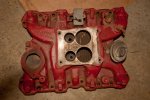
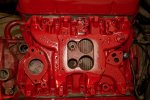
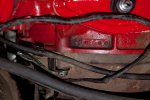
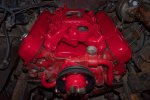
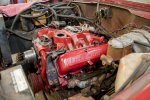
On to the differences...do you see the ihc part number cast into the runner for cylinder #7?. The numbers are the same except for the suffix...the early spreadbore manifold is a "c1", the later one is a "c2". The c2 unit is a supercession unit that is backwards compatible.
The spreadbore manifold with the carter thermoquad was first introduced for some IH 345/392 on the m/y '74 pickups and travelalls. That would be the c1 unit. There May be some oem Scout II produced in mid/late calendar year 1977 that also had that manifold.
At the time, the carter thermoquad was a fairly new design and did not have an extensive track record of performance and tuning quirks, most especially on IH applications. While it was an excellent mixer when properly set up, the major advantage it offered due to the tiny primary and the massive secondary throttle valves resulted in a kinda grossly "uneven" fuel distribution especially at idle and when operating in the "tip-in" mode. But based upon the emissions criteria at that point (both federal and kalifornia versions), it still passed muster.
Keep in mind, the secondaries only begin to actuate when manifold vacuum is low and the air mass above the secondary air valve is great enuff to open the flap against the balance spring. So when the secondaries do open, it's a massive dose of fuel/air that is intro'd to the plenums all at once, the secondary side if this carburetor has no idle or accelerator pump system to aid in that transition, that is a huge hurdle to overcome!!!
Prior to the '77 model year production (by then only the Scout II was still alive in the IH light line production arena), emissions specs tightened to another level for all manufacturers. Keep in mind, this was long before we had to smog this stuff in an active mode on a dyno or rollers, emissions testing was only done at idle. However, the emissions numbers were important throughout the operational range of the vehicle as far as the feds and the manufacturers were concerned, that is why we find that "deceleration module" mounted on the firewall of some of these vehicles!
Since the uneven air/fuel distribution characteristics of the spreadbore carb now really screwed up the smog numbers, a change had to be made that was the cheeepest possible solution, remember, IH was badly on the ropes at that point in time and every penney that had to be spent in achieving target emissions goals on the engineering/production side was reflected quadruply in the retail price of the vehicle!
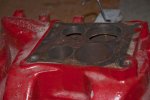
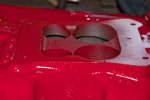
So...the existing manifold casting and blank was simply "undercut", a very cheep tooling change and handled on the machining line before the engine blocks hit the transfer line!
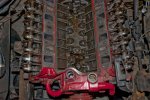
What that does is ties all four of the intake "plenums" together with a common crossover right at the top. That manifold is actually a very sophisticated design since it's a "medium-high rise" design with an "air gap"!!! That is the same design used in nearly all aftermarket performance manifolds that are considered "streetable"! The identical edelbrock design for other engines has no performance advantage over this stock intake,...other than weight!
It also enhances idle quality and tip-in significantly, while allowing an overall "leaning" of all the calibrated circuits in the matching carburetor. Therefore, idle emissions levels were able to be met with a very inexpensive engineering change. At the same time, the ignition system calibrations were also tweeked, all this can be easily seen when ya sort through all the specs in the service manual and the extensive "service letters" issued to dealers by ihc at that point in time explaining all this guapo so mechanics knew how to deal with it...and how their tuning/service methodology they had used for quite some time had to be upgraded as well!
In some motorcycle and other forms of high performance engine work that use multiple carburetion apps, we call that kinda stuff..."balance tubes", "crossovers", etc. It does the same thing on a four cylinder motorcycle engine with one carb per cylinder, it simplifies carb synchronization tremendously, and vastly improves the off-idle characteristics since back in the earlier days they had no accelerator pump circuit included like the carbs used today in full emissions motorcycle apps.
Because the 4v carburetor that IH had used for many years on these engines was the Holley modular (either 4150 or 4160) "square bore" design, this huge difference in primary-to-secondary throttle plate diameter did not exist, and fuel/air distribution was not an issue (except in trying to build a super-hi performance motor). However, the last generation 4v manifolds used on the square bore apps did have a balance circuit machined into the intake flange, but it was done in a different manner,...and the carburetor "pre-heat" path was also changed up. But the oem Holley 4v carbs also had a rudimentary "crossover" machined into the base of the throttle body, that was to allow a more functional vacuum signal for the power brake booster and also enhance the operation of the positive crankcase ventilation (pcv) system when they were changed over to the "closed"-type pcv system mandated by the feds.
All versions of the rpt manifolds are "flat" at the carb interface. That allows anyone to have custom machining done if desired, along with the port injection bosses to be final machined if needed for running port efi. The rpt manifolds also do not have the vacuum tap inserted into the rear of the plenum like an oem manifold does. So provisions for that must be made in some manner, and every user has a different approach to that. In fact, I'm gonna update that thread I referenced for ya to address that issue and what I've done about it just in the last few weeks.