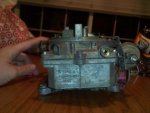
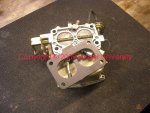
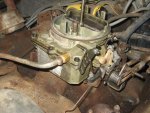
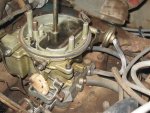
Holley 22XX Series Carb Stuff

Hello everybody. I am very new to this place in fact this is my first post. I just picked up a 77 royal monaco with a 360 (made up to look like the blues mobile from the blues brothers movie). It did not have a carb when I got it. I found that it needed a 2245. I picked 1 up from my local autozone. I put it on and it runs nicely. However the chock does not seem to cloase and I can not figure how the hell it should. There is no springs to close it no vacume line to close it... (I think) just have the chock unloader to open it. I also have no idea what all the vacume line go to. Any help would be awesome greg.
 
hello everybody. I am very new to this place in fact this is my first post. I just picked up a 77 royal monaco with a 360 (made up to look like the blues mobile from the blues brothers movie). It did not have a carb when I got it. I found that it needed a 2245. I picked 1 up from my local autozone. I put it on and it runs nicely. However the chock does not seem to cloase and I can not figure how the hell it should. There is no springs to close it no vacume line to close it... (I think) just have the chock unloader to open it. I also have no idea what all the vacume line go to. Any help would be awesome greg.

All Holley "22xx" series carbs were developed for the use only of a "divorced" choke arrangement.

A choke stove mechanism is mounted in the intake manifold above an exhaust crossover passage in the manifold. The choke stove connects to the choke lever on the carb through the use of a link rod, all mounted on the passenger side of the intake manifold.

With the exception of the fact that chrysler apps of these carbs use a small, rectangular mounting flange , vs. A larger pattern flange for ihc apps, the carbs are virtually identical.

These mixers were a "clean sheet" design as an emissions carburetor, and the divorced choke system was a major part of that package for all oem apps of that carb as that allowed a much m,ore sophisticated control of engine cold start scenario as demanded by the "smog" regulations in play at the time.

In some apps for both chrysler and ihc, the choke stove was also controlled by a thermostatic element that involved an electric heating element incorporated.

This system is not to be confused with either a "hot air" choke or the full electric choke systems.
 
I've got a 1971 dodge motorhome with a 360 and one of these carbs. It wouldn't pass emissions. I rebuilt the carb and noticed somebody had adjusted the float way down in an attempt to lean the carb. After a carb rebuild, it still wouldn't pass, and was worse, probably because I had corrected the float level.
I thought about the power valve, and how it seemed to have a lot of friction to move it up and down, and figured it was probably open all the time.

I know my next steps will sound like blasphemy, but I tried cutting the spring on the power valve actuator in an attempt to give the spring less force. That didn't work. So I bent the whole actuator off to the side, so it would not touch the power valve. After I did that, it passed emissions just fine.

But now I don't have extra fuel when I need it. So what should I do now?
 
I've got a 1971 dodge motorhome with a 360 and one of these carbs. It wouldn't pass emissions. I rebuilt the carb and noticed somebody had adjusted the float way down in an attempt to lean the carb. After a carb rebuild, it still wouldn't pass, and was worse, probably because I had corrected the float level.
I thought about the power valve, and how it seemed to have a lot of friction to move it up and down, and figured it was probably open all the time.

I know my next steps will sound like blasphemy, but I tried cutting the spring on the power valve actuator in an attempt to give the spring less force. That didn't work. So I bent the whole actuator off to the side, so it would not touch the power valve. After I did that, it passed emissions just fine.

But now I don't have extra fuel when I need it. So what should I do now?


How about...fix it right????

If you will post the list number off the carb body along with a nice picture of the carb showing the throttle linkage side and the top of the bowl cover (I need to see the vent config) we can most likely work ya through a repair situation.

Also, we happen to have n=2 new 2210 carbs for chrysler apps (360 and 400) which May be suitable. Those are at my shop in oregon and it will be oct. 21 before I'm back home to take a look at 'em and verify, I don't have the list numbers on those with me right now.

We most likely also have used parts you would need to allow proper power valve actuation.
 
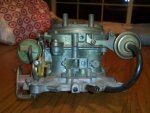
Ok, I'll have to post some pictures. As I remember, there was no id tag on the carb, but you said "list number off the body of the carb", which I can get. Did these carbs have an aluminum id tag? I'm sure you could identify it if I provide enough pictures. It does have a bowl vent. And it does have the 2 stage power valve. I can now appreciate the diaphragm power valves Holley uses on it's other carbs.

I'm teetering on abandoning the setup and going with a completely different carb. My local wrecking yard has a spread bore manifold for my engine for $30.

If you could pick a really good carb that is easy to work on, plentiful and cheap parts, which carb would you pick?
 
Last edited:
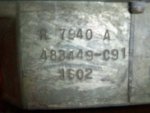
Holley carbs don't use id tags, the list number is stamped into the front of the bowl section of the main body. You should also see a chrysler part number stamped into the body adjacent Tom the list number.

There are several identification aids contained in this thread, way back in the beginning, including pics of the id numbers with location.

Spreadbore carbs are very difficult to deal with today, the oem carb on that chrysler manifold would have been a carter thermoquad. We do rebuild those on a custom basis, but the thermoplastic main bodies can be very difficult (and expensive) to deal with..

The spreadbore rochester quadrajet is equally difficult to deal with in a reman process. Edelbrock discontinued their clones quadra several years ago though some are still in the marketplace.

The edlebrock performer and thunder series carbs are not spread bore units, though they do incorporate two different primary/secondary throttle bore sizes. And the aftermarket edelbrock "performer" series manifolds are designed primarily for the use of the companion carbs, if you run a squarebore Holley, the adapter plate included with the manifold is required.
 
I am working on a really clean 2210c 6620 that seems to be the original carb. The pv actuator was never unstaked until I did it because I was concerned that it felt sticky.

I ran a test on the pv actuator circuit with a mightyvac and I wanted to share. Also a short video can be seen here:

pa230058.flv video by rusty_scout - photobucket

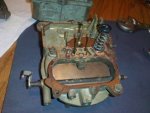
Here are some pics of the air horn inverted on the bench:
pa230050.jpg


pa230051.jpg


Using a mightyvac and pumping a few times to get 5-8 in. Of hg I am able to get the actuator to move down a little but it will not hold vacuum.

If I really pump the mightvac the valve bottoms out but does not stay down.

If I hold down the actuator all the way and then pump up to about 20 in/hg it will hold the actuator down (upside down air horn on the table) for about 5 seconds as it leaks down to about 10in/hg where it releases.

If I unhook the mightyvac and give that tube a long drag with my mouth at about 4in/hg the actuator seems to be working more smoothly but does not provide much of a seal.

The lead plug in this circuit on top of the airhorn seems tight.

It seems to check out but this is my first 2210c experience.

Side note: no evap system on my 1975 150 pickup and no evap on the carb
 
Much nicer looking carb than the other shots ya sent me steve!

I'd still go ahead and remove the pv actuator carefully, you will no doubt find some varnish and water-caused corrosion in the bore. Polish the actuator piston and same for the bore. Before re-assembly, I smear a very slight film of antisieze on the piston surface as an aid to operation over time.

These actuators will not hold a static vacuum such as produced by the mityvac. The clearance between the piston and the bore precludes that from happening and the rod is not "sealed" to the staked retainer.

That does not matter as long as the lead plug in the top is sealing...if in doubt, put a dab of jbweld over the plug but that is rarely needed unless someone has tried to remove the plug. That can be tested by holding the meat of a finger tightly on the plug while pumping the mityvac...if the actuator holds vacuum a bit longer...then the plug is leaking.

What does matter is that the actuator is held up when the engine is running and developing maximum manifold vacuum which is applied to the feed port for the actuator. So ya might think of that as a "metered" (calibrated for when the idle mixtures are adjusted) vacuum leak...that is a designed-in feature. And of course...it matters that when manifold vacuum drops, the power valve actuator opens the power valve!

Once it's re-assembled, then test with the mityvac again for proper operation.

I see that carb has been converted to a manual choke system! Do you plan to retain that workaround?? If not, I can prolly fix ya up with the proper used parts to put it back original if ya still have the choke stove installed on the intake...I don't have any of those parts left though Jeff does have a few at the shop in Loomis. And hopefully your nylon fast idle cam is still present and in good condition, I've got none of those left now except on complete core carbs for rebuilding.
 
Thanks for the reply on my 2210c test. Yeah I have a good feeling about this carb based on quality of the finish. This is only a last ditch $31(price of the carb kit) effort to make ol' pumpkin run a little better before I plunk down $400 on a new 2300 fully kitted out.

Luckily all the working choke parts were on the manifold and this carb was complete. Any reason not to switch back to the manual choke system the po had set up with that trick machinist scale?

olpumpkin.jpg
 
Howdy, moving on to the carb stuff.

Onna 1976 International 345 w/mallory unilight dist and mallory coil with t-19 trans.

Courtesy of the po I have a non-carb legal carb, Holley 0-4412 that gotsta go. Managed to scrounge up what was called a 2210 for chrysler 360 that should work.
#C266806230310#P450774240310#F8#.jpg
I have been following along with this handy guide and have noticed that this carb has some 2245 features as well as 2210c features. Lotsa pics to follow. Is this going to cause some sort of devastation at the smog station? I don't think so on accounta the vacuum lines will all hook up, but it is no doubt confusing.

Will the power valve cause a problem? It was stated that the body will only accept the proper valve, but I have the sqwat 2210 valve and the non-machined hic of the 2245.
Image1.jpg
#C266806230310#P740774240310#F8#.jpg
Also have the 2245 fast idle cam and air cleaner vac nipple
 

Attachments

  • #C266806230310#P750774240310#F8#.jpg
    #C266806230310#P750774240310#F8#.jpg
    30.3 KB · Views: 589
  • #C266806230310#P440774240310#F8#.jpg
    #C266806230310#P440774240310#F8#.jpg
    36.1 KB · Views: 552
  • #C266806230310#P140774240310#F8#.jpg
    #C266806230310#P140774240310#F8#.jpg
    35.2 KB · Views: 534
  • #C266806230310#P150774240310#F8#.jpg
    #C266806230310#P150774240310#F8#.jpg
    32.4 KB · Views: 560
  • #C266806230310#P130774240310#F8#.jpg
    #C266806230310#P130774240310#F8#.jpg
    34.1 KB · Views: 515
  • #C266806230310#P420774240310#F8#.jpg
    #C266806230310#P420774240310#F8#.jpg
    34.2 KB · Views: 526
Last edited:
howdy, moving on to the carb stuff.

Onna 1976 International 345 w/mallory unilight dist and mallory coil with t-19 trans.

Courtesy of the po I have a non-carb legal carb, Holley 0-4412 that gotsta go. Managed to scrounge up what was called a 2210 for chrysler 360 that should work. I have been following along with this handy guide and have noticed that this carb has some 2245 features as well as 2210c features. Lotsa pics to follow. Is this going to cause some sort of devastation at the smog station? I don't think so on accounta the vacuum lines will all hook up, but it is no doubt confusing.

Will the power valve cause a problem? It was stated that the body will only accept the proper valve, but I have the sqwat 2210 valve and the non-machined hic of the 2245. Also have the 2245 fast idle cam and air cleaner vac nipple

First off...your list 7940a Holley is not a chrysler app by any stretch of the imagination. The chrysler pattern throttle body is completely different and will not bolt to any IH sv 2v intake manifold. In fact, I currently have on hand two new holleys that are correct for a chrysler 360 or 400 app. And...the ihc part number is clearly visible in the bowl stamp!

What you do have (at least in the pics posted) is a 2210 application for a m/y '77 345 kalifornikate-emissions. So somehow you did end up with a possible winner after all!

Visually it should work out fine for the smognazi. Will it pass smog? Who knows! I'd definitely run the rig at a "test only station" and find out once it's operational. Not having an active hicd is of absolutely no consequence as far as idle test numbers are concerned.

And yes...the power valve itself must match the power valve actuator design, otherwise it won't work! If that carb has the "long" actuator that will actually contact the "short" power valve, then yes it should work just fine once rebuilt.
 
Thank you for the quick response :icon_biggrin:

that sounds like just what I needed to hear. The power valve/actuator combo does make good contact so that shouldn't be a problem. The thing has obviously been sitting for a looong time, but fortunately not outside and everything came apart easily and seems to function smoothly.

Just out of curiosity, is the main difference between the Holley 2210 and 2245 the single or multi unit power valve? I was under the impression the body was different, but this *looks like the 2245 body but the part number is 2210.
 
This is much confusion and mis-information out there regarding which Holley 22xx variation is which.

Only the list number stamped into the bowl is definitive in regards to what the carb "was" originally. Since these mixers have been botched-over and mix-and-matched repeatedly over time, what I see daily is carbs that are basically "unknown" with few exceptions. Much of that has been covered in this thread which I why I started it in the first place.

Then...we see the commercially-remanned carbs that have had the same parts mixed in order to create a "kinda" list number that is not representative of what is actually stamped on the bowl!!! When those are presented for rebuilding, they can be a real bitch to make operate in a satisfactory manner.

For instance...you cannot match a chrysler-pattern 22xx with a ihc-pattern throttle body as we've already detailed. But...right now...on my bench I have three ihc list carbs that all have the wrong throttle body insulator gasket, one of 'em is an actual reman from Holley in bowling green which according to the customer never worked properly right out of the box...but at that point he simply gave up and bought a new 7448 and then gave me the 22xx core. It's a very nice core and now that it's rebuilt correctly is nearly indistinguishable from new. And it is dedicated to that very rare individual who desires a perfect 22xx for a restoration project, not just a dd.

All of the ihc list main bodies for the most part are identical when they are cast. The difference will be in the bowl cover casting as far as which type power valve actuator is going to be incorporated for which list number. Also...which type vent is going to be used in the bowl cover determines what additional machining processes are used. The main body also must go through an additional set of machining steps if an active hicd is part of the list.

For the chrysler-pattern 22xx, the main body casting, the bowl cover casting, and the throttle body casting are completely different...though very similar in appearance.

The amc and Ford applications of the 22xx follow the same design as the ihc with the "four ear" throttle body, only the chrysler variation is different.

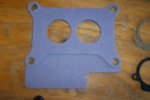
This pic is a Holley 2210, list r7024a. This is an aftermarket replacement for the oem carb, thus it is considered not an exact calibration for the original, though it will not impact smog numbers if the engine does not have other issues. Application is for any 1973 chrysler 360 or 400 engine, any transmission. And...a chrysler 360 is a completely different engine series for the "b" block 400 series.

Notice the much smaller throttle body bolt pattern as compared to the ihc version, along with the companion base gasket/heat insulator. And the main body on this carb cannot be installed on the throttle body of the ihc version and expect correct performance.

The only way to determine which parts are original to which list number is to first determine what the application for the list number is. Then using that list, you look up the original specifications/bill of material in the various Holley reference guides. This information is not in a typical ihc parts list since those drawings and even the part number id is not considered definitive. And yes...even the Holley "factory" references are sometimes inaccurate!

Once you have the bom identified, then you go through the carb piece-by-piece and determine what you have (part number-wise) to work with. This is not a simple, quick thing to do and sometimes I spend more than an hour doing an analysis, especially on the 22xx carbs since po virus has scruud nearly all of those that cross my bench.

And...in some cases I have to use the parts from two completely different carb kits to come up with all the correct parts needed to build one mixer. That is because all the "correct" service kits were discontinued years ago!
 

Attachments

  • Holley 7024A 002.jpg
    Holley 7024A 002.jpg
    129.4 KB · Views: 1,426
Thank you for the wealth of knowledge on the various issues of these carbs.

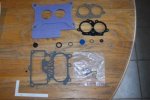
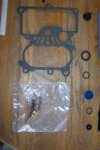
Figured I'd post up some shots of the rebuild kit I picked up for this thing. It did not come with any replacement power valves, fortunately the one I got moves very nicely so it should work, will find out later if I need to tear into it again. This kit also has the correct base gasket, it did include the proper dam(n) gasket.
100_1240.JPG
100_1241.JPG
Win some, lose some. Now back to cleaning...
 

Attachments

  • 100_1243.JPG
    100_1243.JPG
    31.7 KB · Views: 500
  • 100_1249.JPG
    100_1249.JPG
    26.4 KB · Views: 506
  • 100_1246.JPG
    100_1246.JPG
    34.5 KB · Views: 569
  • 100_1244.JPG
    100_1244.JPG
    24.1 KB · Views: 506
Last edited:
In your pic, the heat dam/base gasket is not turned correctly in order to mount.

The item "should" be marked "front" on the overhanging portion...that goes towards the front of the engine with the stamping visible from the top.
 
in your pic, the heat dam/base gasket is not turned correctly in order to mount.

The item "should" be marked "front" on the overhanging portion...that goes towards the front of the engine with the stamping visible from the top.

It is reasons like this why I am not surprised that I got laid off a couple weeks ago :frown2:

once again, thank you! I was probably just gunna re-use the old one
 
Hello mr. Mayben,
I am in the process of rebuilding my 2210 Holley carb. Might be a dumb question but here it goes.....what is the spec weight of the carb float? My foat is not metal and I suspect it has retained weight over the years. Thanks
 
hello mr. Mayben,
I am in the process of rebuilding my 2210 Holley carb. Might be a dumb question but here it goes.....what is the spec weight of the carb float? My foat is not metal and I suspect it has retained weight over the years. Thanks

I am not sure how it could have gained enough weight so as to not function properly, but who knows :crazy: have you tried assembling the float in just the bowl with the top off and then filling the bowl with solvent to verify that your current float still floats? It shouldn't take much to get the float to act on the needle.

My .02 and I could be out in left field.
 
hello mr. Mayben,
I am in the process of rebuilding my 2210 Holley carb. Might be a dumb question but here it goes.....what is the spec weight of the carb float? My foat is not metal and I suspect it has retained weight over the years. Thanks

I've looked for years for the callout for the float weight for those carbs and never found it!

But... Nearly every 22xx I do gets a new float.

The oem (and replacement) floats are a very dense, closed cell foam known as "nitrophyl". A very durable material but they are attacked by this shit e10 fuel we're forced to use today. The oem floats are a reddish-brown color, the replacement is normally black.

If you compare a used float with a new one juggling in both hands, you can tell the difference in weight! However, it' won't show up when ya "float" 'em in gasoline (not solvent or water). The difference shows in performance simply by the sunk float not sitting high enough to maintain a stable fuel level. If you set the fuel level "low" enough to not overflow the vents, then once the motor is at speed, the bowl will run dry enough (major surging) that you think you are running out of gas...in actuality...you are! And...across rough terrain, the "heavy" float will bounce terribly and also cause an erratic fuel bowl level.

I have a collection of more than 20 "sunk" nitrophyl floats onna daisy chain right now, I just replaced one on my own carb (Holley 4160) two days ago! They May go on the xmas tree!

Always replace the nitrophyl floats when doing surgery on any mixer nowadays, the replacement ya need is a standard hygrade fl9...though I "think" an fl 12 will also work just fine.
 
I have a 75' dodge w100 4x4 w/ 360 engine...2bbl 2010 Holley carb. I have had this issue for a few years now...the truck is used for moving snow at my house only, so probably sees maybe 30 miles a year...which at first is hard on them on know.
The engine it self has appromiately 85000 miles on it with main bearings doine and a rv cam. I have replaced plugs, wires, cap, rotor, run grounding strap to all fender and firewall mounted electronics, cleaned all electrical connections to firewall, and all in engine, carb kit, and just a few days ago replaced accel pump, new master cylinder, new vaccum hoses from carb and to distribuiterk, fuel pump new a year or two ago

the problem I am having is a couple first when I put the peddle to the wood, the truck falls on its face and then comes back to life. Many said replace the accel pump...which I just did last year when carb was rebuilt but did again a couple days ago, still falls on its face. So kinda stuck on this one

also when I apply the brakes, I have to push them almost to the floor...kinda acts likes it has no power brakes??

Thanks for any help you guys can give me.
 
Back
Top