Carter Thermoquad "Spreadbore" Stuff

Michael Mayben

IHPA Tech Moderator - Retired & No Longer Online
Beginning with some possibly later m/y 1977 Scout II rigs with a 345 and on through eop, the carter "thermoquad" 4v carb was standard issue.

The same carburetor series was also used on some fullsize rigs equipped with the 392 motor for m/y 1974 and 1975 production.

These units are generically refered to as a "spread bore" throttle body design, a description of the design which incorporates relatively small diameter primary throttle bores, with much larger secondary throttle bores.

The mounting fastener configuration for this carb series is also not interchangeable with the Holley modular carbs we refer to as "square bore" throttle bodies.

It is possible in many cases to use a suitable adapter to convert one manifold design to another so that these various carbs can be interchanged. But performance-wise, an adapter is not considered to be the best solution, and it also adds to the induction system height which May create a hood interference issue on many vehicles.

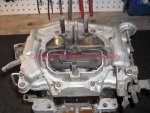
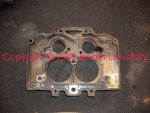
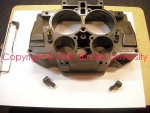
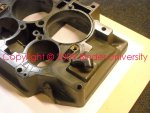
This shot shows the intake manifold side of the cast aluminum (not cast zinc) throttle body used on the thermoquad.
 

Attachments

  • TQ Spreadbore Throttle Body.jpg
    TQ Spreadbore Throttle Body.jpg
    97.6 KB · Views: 13,024
The "tq" was a very advanced, high-tek carburetor engineered to provide both adequate performance for larger displacement v8 engines popular in the 1970's and into the 1980's, with an overall much tighter calibration needed to meet both 49 state and CA-only emissions requirements which came into being with the advent of m/y 1973 light duty vehicles in general.

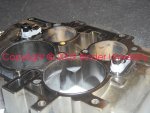
The most unique component of the tq design is the use of a molded thermoplastic resin main body/fuel bowl. The bowl was capped top and bottom with a cast aluminum airhorn and throttle body.

Many manufacturers (most notably chrysler), used significantly increased engine operating temperature specs as part of their emissions schemes as compared to previous versions of some engine families. This of course resulted in much higher underhood temps as well, so the problem of "fuel percolation" within the carb when a hot engine was shut down for a period of time, became much more significant. And percolation just added to the "load" that the evaporative emissions control system had to deal with under the same "shut down" conditions.

As compared to previous carter "afb" designs, as well as the Holley modular carb series used for many years by ihc, the tq was consider to be much more complex to deal with, and that was pointed to regarding the difficulty mechanics had in calibrating/adjusting these mixers to stay within emissions limitations, yet trying to enhance drivability complaints which flooded dealerships back in the day. Same type of "technology overload" that was experienced again just a few years later with the advent of rudimentary electronic engine management systems such as the chrysler "lean burn" concept which used an "electronic" version of the tq. These were not good times in the automotive service industry! The IH dealer mechanics also faced their fair share of difficulty in dealing with the same while also learning how to service electronic-trigger ignition systems.

Then add in the later variations of these mixers which incorporated a electrically-controlled rudimentary "altitude compensation" circuit and it's no wonder most special interest vehicle enthusiasts shy away from these mixers!
 

Attachments

  • TQ Airhorn.jpg
    TQ Airhorn.jpg
    92.4 KB · Views: 8,837
Last edited:
One aspect of the carter 4v carb family has always been the use of some type of "air valve" to assist in modulating air flow through the carb secondary venturis as the throttle plate angle increased. The increased air flow (and the corresponding increase in fuel volume) must be controlled in some "progressive" fashion when the throttle is suddenly pushed to the floor, otherwise the engine simply cannot deal with a sudden overabundance of mixture instantaneously (we're talking the average "street" engine/vehicle here, not a high performance/race application).

Holley accomplishes this by using a design which incorporates a vacuum motor to actuate the secondaries on their oem/aftermarket "street" carbs. Thus it's not possible to "over-carburate" an engine (within reason) if all the tuning parameters are correct.

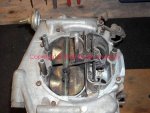
Carter uses the "air valve" to accomplish the same thing. The secondaries are connected to the primary throttle control using a "progressive" linkage arrangement that is very simple in design. The air valve in the secondary side (the large rectangular "plate" seen on the left side of this pic) is spring-loaded to a closed position in a balanced fashion. Once air flow through the secondary throttle bores/venturis is sufficient, air flow overcomes the spring tension and the air valve gradually opens to allow an increase in air/fuel mix to be drawn through the intake manifold and distributed to the cylinders.

A rochester quadrajet carb was GM's answer to this same design...but a quadrajet was never oem for any ihc application so we aren't interested in including those in this discussion.

The true "secret" to proper operation of either the tq or a quadrajet is a correctly-operating "choke pulloff" (either one or two depending upon model variations). These devices "lock out" the operation of the secondary throttle system until the engine is both up to operating temperature and the manifold vacuum signal is correct for secondary throttle bore engagement in a progressive fashion. Without correct choke pulloff functionality, neither of the two spreadbore carb designs will operate at all as they are supposed to.

Likewise, Holley also developed a "spread bore" version of their modular series but those never enjoyed any popularity as an oem emissions solution. They are available in the marketplace as a replacement for a tq but won't be "emissions legal".
 

Attachments

  • TQ Secondary Air Valve.jpg
    TQ Secondary Air Valve.jpg
    80.5 KB · Views: 8,808
Last edited:
Mm:
good initial write-up on the carter thermoclog ...I mean, thermobog... ...uh, yeah...

Anyways: my main experience has been assisting my friend with his tq on a '79 Scout II 345. His unit has worked quite well in the 15 years he's had it.

I also have experience with the carter avs and afb carbs, from my mopar muscle car days.

Along the way in this topic, I'll try to put in my three-cents-worth, if needed...
 
The tq is a fine mixer if it's dialed in and maintained! No different than any other carb! Maybe even superior in some respects. But due to the "cost" of maintaining one and the difficulty in obtaining tuning parts in some cases, they have pretty much dropped from the scene except for folks that do resto work, or must have one for "smog" purposes.

They got a bad rep back in the old days since they could not be treated inna typical ham-fisted manner by junkyard dawg "mechanics"! And due to their primary reason to be..."emissions"...they were considered throwaways, just like the Holley 22xx stuff since warranty service would not allow repair of the carb, only replacement.

Let's take this spread bore deal a bit further here and hopefully we won't confuse anyone.

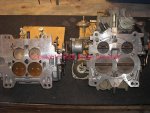
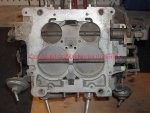
This pic shows two alternatives to a spread bore carb solution as provided by a tq. But only one of 'em is a true spread bore design, the other is a wannabe crossover.

The carb on the left is an edelbrock "thunder" series mixer, those are a clone of the original carter "avs" carb series, an excellent carb in it's own right. As can be seen, this throttle body is not a true spread bore, it even carries a mounting hardware pattern for multiple manifolds. Those units incorporate an "evolved" version of an air valve for the secondary system, quite different in execution when compared to the more common carter "afb" and it's clone family...the edelbrock "performer" series. The avs/thunder mixers could be used on IH square bore manifold applications if much port matching was performed on the oem intake manifold. Same for port matching onna spread bore IH manifold. An intermediate adapter or spacer would be of use in making the port transition...I've not attempted that myself at this point.

On the right in this pic is a true "spread bore" replacement carb for the tq, a Holley modular in the 4165/4175 design series. Virtually identical in most all regards to the traditional Holley square bore mixer, but incorporates a completely different main body and throttle body. This one is a "replacement" carb for a quadrajet used on a chev app, notice the fuel inlet fitting which point to the passenger side. Bop (buick/olds/pontiac) replacements for the quadrajet have a front-facing fuel inlet fitting.

In order to use these 4165/4175 carbs on an IH sv app, most likely the primary fuel bowl assembly would have to be replaced with a different version, otherwise tstat housing interference would be encountered.

The edelbrock carbs are currently manufactured under license from carter by marelli in north carolina iirc. Marelli is also the source of the "weber" product in the u.s. Market currently, you will sometimes encounter a weber version of the afb or avs that will have neither the carter nor the edelbrock brand identified on it, only the weber tradename.
 

Attachments

  • Holley vs Edelbrock spreadbore compare.jpg
    Holley vs Edelbrock spreadbore compare.jpg
    99.4 KB · Views: 19,139
Last edited:
Must be alotta folks bringing their projects outta hibernation this past week. I've had several contacts regarding dealing with thermoquad carbs that have been sitting with fuel in the bowl and have now deteriorated to the point they need some attention.

And comparing a freshen of a Holley modular carb with a tq, is a real eye-opener. The tq is far more complex with it's myriad links, interconnects, dual vacuum pulloffs, and composite materials construction. But I've finally sourced the "right" kit for dealing in an IH app tq, so let's take a look.

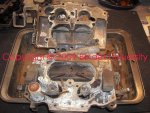
Here's the first one I pulled put of the core pile that looked decent on the outside. Man was I mistaken! This is about as rotten a carb as I've ever seen!!! Been full of water for years, and obviously was involved in an engine fire and the fire extinguisher chemical had it's way with the body. So this one goes in the parts donor box.
 

Attachments

  • IHC App TQ 001.jpg
    IHC App TQ 001.jpg
    131.7 KB · Views: 9,980
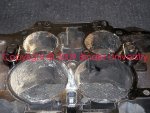
This is the interior of the thermoplastic resin main body after I dumped a cupful of corrosion and garbage out! Even had a screw left inside the bowl that is nothing like the fasteners used on the carb!

Folks talk about these plastic bodies "warping" like that was something that happens all the time. In actuality, I've seen very few of the bowls with that issue. And if they are, it's easily delt with by carefully using a wide plate belt grinder with an alox belt to correct the "flatness".

Then, looking down into the primary nozzle wells, ya see the second one of the two principal problem areas regarding these carbs. Fuel leakage /drool from the nozzle wells and fuel bowl continuously. Starts out with the bowls leaking down slowly over a period of days when the carb sits unrun. That progresses to fuel appearing to drool from the throttle shaft, causing folks to think the carb is now toast because the throttle shafts and bores are scruud...not true!

When the nozzle wells begin to leak, the fuel runs right onto the throttle shafts and to the outside. When the engine starts, we have a major over-Rich condition that is masked by the choke action. As the engine warms up, the liquid drool is so small, the motor seems to run just fine, though fuel economy begins to suffer.

As the issue becomes worse, the odor of gasoline (or today, that alkeegazz shot known as e10) is noticed when the rig sits for a few minutes. Especially if parked in an enclosed space.

Finally, engine performance deteriorates to the point the motor is a real pita to start and then run. So we blame it on a "crappy carb", "bad gasoline", Friday the 13th, whatever. Only problem is the carb is tired after 30+ years of neglect!

As shitty as this bowl looks, it will be brought back to life. These bowls are priceless and not available new unless ya find a stash somewheres that has been hidden since the 70's when they were popular!

This bowl is flat. It's only issue besides being badly grunged, is that the nozzle wells both leak. I test those by drying the inside of the bowl and then carefully pouring rubbing alcohol into the nozzle wells and filling the bowls up with about 1/2" of liquid. Then I carefully elevate the bowl and watch for the "stain" to appear around the joint where the nozzle wells are epoxied to the main body. And unless the bowl has been previously repaired, they all will leak after 30 years of service!!!
 

Attachments

  • IHC App TQ 005.jpg
    IHC App TQ 005.jpg
    138.1 KB · Views: 8,172
This is the main body turned upside down so ya can see the nozzle wells and the epoxy joint where the small portion is joined to the larger casting. There is a primary nozzle well for each primary venturi of the carb. The white parting line is the rotted epoxy sealant.

Later on, we're gonna sterilize this bowl, prep the nozzle wells for re-seal, and then use some proprietary epoxy to make the repair.

By the way...all rochester quadrajet spreadbore carbs have this same issue...only more so! Even though they don't employ a thermo-plastic fuel bowl, they are "sealed" at the point of manufacture and that sealer does break down over time resulting in exactly the same condition as afflicts the tq series carbs.

Only a Holley spreadbore replacement will not have this leakdown issue due to it's entirely different method of construction.
 

Attachments

  • IHC App TQ 009.jpg
    IHC App TQ 009.jpg
    149.5 KB · Views: 8,128
So after tearing down four different tq carbs all of which are for sii/345 apps, I finally got one that is a candidate for a reconditioning operation that I guarantee success when completed and will look fairly decent.

It takes me at least three times as long to fully build a tq (cleanup is a super-pita!) as it does the worst Holley modular or carter afb/edelbrock clone. And the service kit is much more dinero also compared to the Holley.

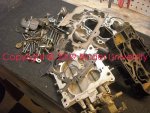
So this is a "before" shot. The choke pulloffs shown here are crapped as usual, so this carb will get a pair of fresh reconditioned pulloffs that are on the shelf at ihon.
 

Attachments

  • IHC App TQ 017.jpg
    IHC App TQ 017.jpg
    139.4 KB · Views: 8,075
Mm,

from someone that has a thermoquad with all these problems
I am glad to know I don't have to junk the carb. Your photos and knowledge of the issues is refreshing considering the popular opinion is to just trash em. I have one in need of a
rebuild.
 
Our email exchange inspired me kurt!

And you were one of many who brought up the tq subject last week. Was that a setup kinda deal???

I constantly need my ass kicked to keep this stuff in progress!!
 
In posts #6, 7, and 8 in this thread, ya saw the guts of a damnastee tq.

Here's what the bowl looks like now after a preliminary cleaning.

When I checked the glued-on primary wells for integrity, they fell right off on the bench!

So this is a good opportunity to show the fix.

First all traces of the oem sealer was removed (remember that white line?) from both the bowl and each primary well. I use an exacto knife, a small pick, and a cut-down/sharpened scraper to do that. No trace of the original adhesive can be left to contaminate the repaired joint.
 

Attachments

  • Primary Well Prep.jpg
    Primary Well Prep.jpg
    83 KB · Views: 10,231
This is a closeup of one primary well and it's mounting point on the plastic bowl. The inside of the primary well and the bowl where the pieces join must be sterile so that the epoxy will adhere.
 

Attachments

  • Epoxy Ready.jpg
    Epoxy Ready.jpg
    83.1 KB · Views: 9,336
This shot shows the primary wells re-attached using jbweld.

A toothpick is used to butter a thin layer of jb on the parting line of the bowl, then the primary well is pressed into position .

A thin layer of jb is then spread around the parting line for reinforcement.

Jbweld works just fine for this application. There are some other proprietary epoxy treatments that could be used also, but are not generally available except in larger quantities (there is a shelflife to the stuff) and much more expensive. I use the jb for doing the same thing on a rochester quadrajet. They have a similar arrangement only they use pressed-in plugs to seal the access passage for the rifle-drilling. All quadrajets leak fuel out of the bowl unless they are also sealed, same issue as the tq! The bowls must be leak-checked and sealed when they are rebuilt.
 

Attachments

  • Epoxy Applied.jpg
    Epoxy Applied.jpg
    90.9 KB · Views: 8,333
Michael,
when you rebuilt this carb did you happen to measure the diameters of the metering rods?

I know they are three step rods as opposed to the two step rods used in an afb or avs carb. According to the service manual the primary jets supplied with the stock tq were 101's, secondaries were 98's but it makes no mention of rod size. I'm not sure if the rods might have changed form year to year or by "as equipped" or "where sold" or even model.

I have been thinking of trying to match the jetting of the stock tq, as close as I can, in the afb I'm currently running, just as a knowledge starting point. I'm wanting to make a comparison between stock jetting from the factory and current jetting required based on the particulars of this new engine.

I realize that I will likely need to run this new motor a little richer than stock if only due to the headers and I'm also planning on a fresh air intake system that will likely lean the mixture further away from stock. I just like looking at the real world numbers for the sake of comparison.
 
News flash!!!

All my previous regurgitation regarding the use of jbweld is wrong! That shit won't hold up to today's so-called gasoline!

The carb I did for one of our members works ok when cold...but after it hot-soaks it will leak down just like the original rotten tq bowls did. Jb weld is a wonderful product for many uses...but not onna tq carb bowl repair!!!

So I've now completed a "long-term" test of using a different product for reclaiming these tq bowls. I've had two of 'em soaking immersed in e10 now for three weeks, and the current epoxy I'm testing has held up just fine.

Our good buddy (and business associate) dave the gear man suggested using the stuff that was originally used on these bowls when manufactured. He actually had some in his stash that he used in doing cylinder head porting "mockups" on nascar motors in development from the time he spent as chief engine designer for dei. It's still available as a very specialized product from a boutique blender of industrial adhesives.

So...from now on, that is the product I'll be using in reconditioning the tq fuel bowls (and also making the very similar repairs on quadrajets).

I have a second carb in process now for ihon member kurt that we'll swap out for the faulty unit I sent him.
 
michael,
when you rebuilt this carb did you happen to measure the diameters of the metering rods?

I know they are three step rods as opposed to the two step rods used in an afb or avs carb. According to the service manual the primary jets supplied with the stock tq were 101's, secondaries were 98's but it makes no mention of rod size. I'm not sure if the rods might have changed form year to year or by "as equipped" or "where sold" or even model.

I have been thinking of trying to match the jetting of the stock tq, as close as I can, in the afb I'm currently running, just as a knowledge starting point. I'm wanting to make a comparison between stock jetting from the factory and current jetting required based on the particulars of this new engine.

I realize that I will likely need to run this new motor a little richer than stock if only due to the headers and I'm also planning on a fresh air intake system that will likely lean the mixture further away from stock. I just like looking at the real world numbers for the sake of comparison.

Sorry I overlooked your post tim!

By far, the most complete analysis regarding the tq I've ever seen is here:

a carter thermo-quad guide

Chew that up and see if it helps. You will soon realize that the "thermoquad issue" is not near as simple as dealing with Holley modulars!

I have some more tq carbs in process now...I'll have to look over the metering rod/jet issue and see if there is any consistency to it.

I also have the master reference used for mechanic training by chrysler when the tq was introduced...but those were somewhat different in design compared to the tq used by IH on the "late" sv motor apps in the sii platform.
 
Ok, time for a tq update...

This shot shows the second carb that is in transit to kurt right now.

This core is a correct IH core for his application, not a botched and modded, "converted" commercial reman like the first one.

After extensive testing of the repaired tq resin bowls using the "other" epoxy", I built a fresh core from the pile. And this one had a functional choke pulloff (single) that "releases" in a correct fashion (big problem with these items!).

The carb was then run on the mule for about two hours at both idle and 2000rpm (throttle propped). Manifold vacuum was continuously monitored along with idle quality.

Then the motor was shut down and with the hood closed and allowed to heatsoak which creates the percolation conditions in any carburetor. At various times throughout the day, I cranked the engine to determine if the mixer was leaking down creating the classic "over-Rich" condition that plagues both the tq and it's rochester quadrajet cousin...this one passed the tests just fine! That tells me that the latest epoxy repair application works just as it did in the fuel-soak tests.

It's now run on about five gallons of fuel through it under various scenarios, so now we'll try again regading kurt's project launch.

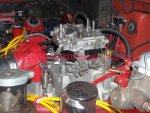
In this pic, the carb is installed onna homebrew adapter to mate with the rpt squarebore manifold. This is not the correct way to use one of these carbs in the long term, but it allows me to test run virtually any carb on a live motor. Setting up an adapter like this is a bitch, the few commercial adapters out here for doing this really don't mate properly on stock IH-pattern egr manifold. Because the rpt manifold flange is not relieved and cutaway (and has no separate pcv vacuum connection into the plenum), with a lot of careful mods, an adapter can be used...but probably not on a Scout II application unless it has a 2" body lift and/or a hood scoop! But with the adapter, actual cylinder charge/distribution through the manifold is going to be really scruud up.
 

Attachments

  • KK TQ #2.jpg
    KK TQ #2.jpg
    106.1 KB · Views: 4,497
Last edited:
Back
Top