cam bearing questions

flatbed200

New member
Hello all!

I have a few questions about the cam bearings in these trucks. First off, what causes these bearings to fail? I have seen/heard of several engines with very low miles that have had cam bearing failures.
Next, are there any bearings out there that are tougher than the original ones and that will not fail as easily.

My '74 200 w/a 392 only has 18,000 miles on it (it was a fire truck), and I think that one of my cam bearings has taken a dump and I am looking for alternatives.

Thanks,
jim
 
The failures we all see were a manufacturing related delamination. This is a result of a poor or compromised by time, lead/babbitt to copper bond. All of the new sv cam bearings are fine whether it is durabond, federalmougal etc.

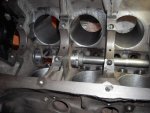
Alignment is always going to be critical and you can't simply drive them in like a GM. The rear is a problem child and must be seated a certain distance from the rear of the block to ensure proper lifter gallery oil supply...

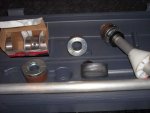
Some pictures of the rear bearing in close to its proper position. In reality it could have been about .030 1/32 further forward into the block to be perfect but I consider this the farthest aft the bearing should be placed and still function properly.

8282d1263052871-cam-valvetrain-issues-p1010241after-large-.jpg


8283d1263052871-cam-valvetrain-issues-p1010243after-large-.jpg
 
I disagree with Robert regarding the cam bearing issue being related to the oem bearing quality. Tens of thousands of these engines were in service with 150k+ miles on 'em that never failed cam bearings.

And a friend who worked in an IH factory branch doing fleet engine rebuilds up through 1984 confirmed that in many cases, the cam bearings in 150k mile sv motors were not replaced if no measurable wear was noted, these engines were normally rebuilt for fleets in sets of 10 units at a time.

The issue is long-term non-rotation of the camshaft which creates a situation I refer to as "stiction". And this is most common in engines that are not run on a regular basis long enough to allow the oil to get to full operating temperature (at least 30 minutes at fast idle). And this condition involves the oem engine/bearing system which does not suffer from the possibility of bearing mis-alignment which May occur during a rebuild.

Add to the above, most of us deal with engines that have not rotated in many years when we try and bring these rigs to life, the first thing most folks think about is "does it rotate or are the pistons stuck?". Screw the pistons, ya gotta make the oil film between the crank and cam bearings and journals come to life before rotation of the crankshaft. This is an issue that while not only exclusive to IH motors, because of the design of the engine lubrication system, it is more critical when dealing with IH motors.

The oil film between the cam journals and the bearing babbit surface simply disappears when non-rotated. On engines that have been neglected regarding oil exchange, the added problem of moisture/acids that is left behind in the oil film begins to etch the bearing layer/journal, when the engine is rotated, it's a dry start...the cam journal then wipes the babbit layer away which is extremely thin and the failure mode is entered which occurs over time once the babbitt layer is compromised. One can literally watch cam bearing failure occur on an engine afflicted with this problem, the oil turns "gray" before your eyes while watching the rocker assembly "oil".

This issue is not related to the "finger-joint" cam bearings which were oem, there was a point in time when I thought that was the case, but I've seen the same thing occur with both durabond (one-piece bearing shell) and other brand cam bearings that are identical in construction to the durabond items.

All of this research into "cam bearing failure" over the years is what led me to develop the "dry-start" process described in this stickee:

http://www.forums.IHPartsAmerica.co...I-4-sv-engine-non-oiling-rocker-assembly.html

A 18k mile/'74 fire wagon support vehicle spent long periods of time non-rotated! And if/when it was started on a regular basis in accordance with fire department practices, no doubt it was not run long enough to get the oil temp up and cook the moisture out of the oil!

I have a 196 that sat for 14 years non-rotated. I used it for developing the process I've outlined. Four years later the motor is run almost daily as a test mule, oil pressure is outstanding across the board. My '73 392 has never had the heads off and is closing in on 215k miles. It also had been neglected for many years when I found it, but at least it had been rotated (usually without starting though!), at the time I bought it I knew nothing about this whole cam bearing/valve train noise issue that is more common on IH stuff, that was nearly 12 years ago and it also has excellent oil pressure still, and no IH motor has been more abused in vocational and towing service than that one!

Rebuild the engine and do it right, run the engine normally and take care of it maintenance-wise. 200k miles is not an unusual goal for these motors used in daily service.

It is not "use" that kills these motors...it is non-use over time!

 
Last edited:
Not doubting the effect of the weak bond but the loss of the layer at the exact copper to babbitt interface indicates a weakness. Deal with laminated metals on a regular basis and the way the failure manifests it self shows to be the bond failure. Not saying the bond is not affected in some way by usage, it very well could be but the interlayer failure is very suspicious.

The babbit under poor lubrication/stiction should simply wipe away if the bond is good much like a dry started main or rod bearing.


But hey good food for thought.
 
Found a good bearing failure analasys guide that would be a valuble referance foe any bearing failure. http://www.engineparts.com/publications/cl77-3-402.pdf

See page 16, kinda shows what you would expect to see when oil film becomes weak and the babbitt over heats and delaminates.

Now I wonder if the ultimate cause May be weak bond and ultimatly fails due to like you say the dry start. I have not seen the bearings exibit a blackened state on the sv cam bearings.
 
Robert and I have divergent opinions many times regarding root cause analysis! That comes with experience regarding doing this shit for many years on many engines by both of us, not just IH schnizz!

And the extensive section in all IH service manuals regarding "bearing analysis" is simply stuff regurgitated and doctored by IH based upon standard industrial analysis provided by the bearing and engine component suppliers themselves, just like the "spark plug" information was not developed by IH but by champion back in the day!

The root bearing analysis info Robert linked is exactly what I'm saying, that comes from the folks that do root cause analysis for a living and make the parts, it's not massaged information from the marketing smokeblowers!

Is this bearing failure issue rampant?? I think not...but what is happening is that more and more folks are now getting involved with IH junkiron as it becomes more widely known the stuff is affordable for the average person to play with (for the time being). And no doubt, much of this interest has been generated by the Scout 800 build on extreme 4x4.

I deal now with an average of three of these "back from the dead" engines (same old non-oiler scenario) a week through phone calls and email, these are folks who will not post about this stuff in the forum, though they do lurk and read what we have posted regarding factual information. Usually all are in denial about "their" engine...until they finally admit to stuck valves/loss of compression/bent or broken pushrods after pissin' sea foam or atf down the carburetor!

I've got a 304 out back inna 1300c flatbed that is soon gonna come to the parking lot for parting out. I'm gonna use that one to illustrate what I'm tossin' out here, it's been non-rotated for at least seven years that I can verify. Maybe it'll come to life, maybe it won't!
 
Thanks for the replies guys!

As soon as I get my other IH leak proof and put back together, I will tear this dude apart and get some new cam bearings in it. Is there a brand of cam bearing that you guys prefer?

Thanks,
jim
 
I have no preference for replacement cam bearings. What is critical is proper installation and verification of oil hole alignment (and adjustment if needed) during and after installation.

The durabond-design bearings are fabricated from a tubing shell. The clevite and other brand bearings are fabricated with strip material and finger-jointed.

One brand of bearing that has become common in the u.s. Market amongst engine remanners who buy 'em in bulk paks is the "enginetech" label, these are made in columbia and identical to durabond in manufacturing style. Same for acl bearings which are used extensively in the oem market and are produced in australia.

Clevite is still a "brand". All the other long-time "brands" we have used over the years have become bastardized to the point we have no idea who the root manufacturer is. Brand names are kicked around on everything now depending upon which holding company owns the brand at what point in time. The transportation oem and replacement parts business worldwide has been bankrupt now for nearly four years because of the economic situation in the us and other countries due to trickledown, so the parts business has now evolved into a game of smoke and mirrors.

The engine kits we have here at ihon will contain durabond cam bearings.
 
Thanks for the replies,
I have a another question. Is there anything else that causes cam bearings to fail such as over revving? I know a guy who had a cam bearing failure in his Scout and the bearing pieces that were in the pan didn't look like they had stuck or been run dry. The babbits wear surface was in good condition, the bearing had just broken into several pieces like it was stressed.

Also, can a cam bearing fail but the truck still have good oil pressure? When the engine is hot and running down the road, the pressure is about 50psi. Idling hot is about 15 or 20.

Thanks,
jim
 
thanks for the replies,
I have a another question. Is there anything else that causes cam bearings to fail such as over revving? I know a guy who had a cam bearing failure in his Scout and the bearing pieces that were in the pan didn't look like they had stuck or been run dry. The babbits wear surface was in good condition, the bearing had just broken into several pieces like it was stressed.

Also, can a cam bearing fail but the truck still have good oil pressure? When the engine is hot and running down the road, the pressure is about 50psi. Idling hot is about 15 or 20.

Thanks,
jim

First question... There can be many root causes of cam bearing failure, but regarding an IH engine over-revving is not one of 'em! These motors are basically self-regulating in the rpm department since they are extremely asthmatic based upon the cylinder head (mainly the intake valve angle) design.

The lubrication routing on these engines is somewhat unique, it is a design used in moderate rpm engines used under heavy/constant load...can we say truck engine?? Ihc was a truck and agricultural product manufacturer, they never built passenger vehicles for the masses, the engines are purpose-design for their intended market. And as far as a gasoline powered engine they are capable of diesel-like life expectancy if properly maintained.

When the cam bearings fail, it can happen result in many observable manners. Sometimes the babbit peels up like aluminum foil and is found in thin ribbons. Other times the babbit layer explodes into chinks and chunks. On some occasions, the babbitt simply disintegrates into what looks like gray powder mixed with the oil and you can watch it flow around the rocker arm bushings and return to the oil sump. I have several sets of resulting "failed" bearings and residue I use for demonstration of this stuff.

If the #1 cam bearing goes away, then the cam/crank/distributor gears won't oil, that make take some time but eventually the "nose" will probably break off the cam, taking the gear with it. In that case, oil pressure will not be affected.

If the #3 cam bearings takes a hike, then likewise oil pressure will not show an anomaly.

Bearings #2 and #4 feed the rocker shafts, so when they shit the result is lack of lubrication to the valve train and a low oil pressure reading when hot. If #5 goes away, the the lifter galleries are affected and all lifters will have a tendency to "collapse" randomly.

By the way, Ford fe motors (331/352/360/390/428) have a near identical form of rocker assembly lubrication with their own set of unique problems such as starving for lube. But those motors can turn significantly higher rpm than the IH sv stuff. And...they use a much higher pressure oil delivery/lubrication system (80 psi). They also shit cam bearings on a regular basis when run hard and put away wet!

It seems like we deal with this cam bearing stuff alot. But that is just because folks now know how and why what takes place when this old junk is brought back to life after years of neglect and talk about it. But there are many motors out there in daily commercial service (buses, delivery trucks, dump trucks, combines, forklifts, aircraft tugs, etc. That have never had cam bearing problems. The difference?...preventative maintenance/regular oil changes!! Keep in mind the last ihc-produced gasoline engine came of the line sometime in 1984!!! That was more than 25 years ago!
 
Sorry to keep draging this thread out, but I have a few more questions.
How long does an engine have to sit before it becomes necessary to "pre lube" the cam bearings before startup?
Also, lets assume that an IH engine was started up after sitting for several years without "pre lubing" the cam bearings, but it still had good oil pressure. How long can a cam bearing that has been damaged or stressed like that run before completely failing?

Thanks for the replies,
jim
 
In my world, any time the "length of time since last run" is unknown regarding one of these engines, it's gonna get the pre-lube treatment. Why risk any damage?

As for your second question, that's just not possible to have an answer! And it's entirely possible for an engine to have correct oil pressure, but still not be lubricating the valve train!

This thread is a perfect example of that, a freshly built motor by pros that didn't oil the top end:

http://www.forums.IHPartsAmerica.co...6-waynes-non-oiler-392-a.html?highlight=wayne
 
Michael will have to talk to how long an IH engine can "sit"...

But, basically, I do not think there is a "one size fits all" to this problem -- cam bearing failure

as far as "how long / how far" -- that is a case by case issue, also.

It depends on the "size" / "scope" of the failure.

If the oil holes in the cam bearing are not aligned with the block, I would think there would be a rapid deterioration (and valve train noise). Otherwise, the engine May last quite a while.

The only way to really tell if a cam bearing is gone is pull the pan and look for debris.

The 392 in my 73 t/a is being rebuilt at ihon at this time -- because of a cam bearing failure (at approx 200,000 miles).

The engine ran fine, but the oil pressure was not "good". The needle would drop down to just above the 1/4 Mark after a few miles on the freeway. But, I did drive it the 60 - 70 miles to ihon -- and, I probably put a couple thousand miles on the engine with the bad cam bearing.
 
hope Jeff and Darren have saved the removed cam bearings Robert! I'd certainly like to see some 200k bearings for comparison with all the others in my collection! I posted pics of the bearings removed from my stroker motor candidate yesterday in this thread:

Just called ihon and spoke to Darren -- the cam bearings are already "gone"...

Jeff said he took pictures of the bearing bits in the oil pan, but I do not know (doubt?) that he has taken any more pictures of the engine being taken apart.
 
just called ihon and spoke to Darren -- the cam bearings are already "gone"...

Jeff said he took pictures of the bearing bits in the oil pan, but I do not know (doubt?) that he has taken any more pictures of the engine being taken apart.

That's ok, I'll talk to them both regarding what they saw in a visual inspection, they are on the clock to git this done, I'm not!
 
Michael,

how long do you have to run the drill while pre lubing the cam bearings in order to get the oil to the cam bearings? Also, does the position that the crankshaft is in affect whether the oil gets to the cam bearings or not? This is on an engine that has been sitting for about one month and a half while I have been doing a seal job.

I ran the drill for five minutes or so just to try out the driver tool I made for the oil pump. The oil pressure showed about 55psi a couple of seconds after I started running the drill. This is on 10w40 oil.

Thanks,
jim
 
Go here and look at post #53 and newer, we just delt with this same issue yesterday!:

http://www.forums.IHPartsAmerica.co...4-sv-engine-non-oiling-rocker-assembly-2.html

Oil pressure will normally come up nearly instantly when running off the drill if the oil temp is 50* and greater.

There is a very tiny window at which point the oil spit holes on the #2 and #4 cam journals line up with their respective ports in the cam bearings to allow oil flow to the rocker assembly(s). About 5* of crankshaft rotation! Go sloooooow when rotating the crank to find the spot, and that will be for only one side of an sv...ya gotta keep going around to catch the other side, they do not "squirt" simultaneously.

Here's another thread regarding this same question:

http://www.forums.IHPartsAmerica.com/gas-engine-tech/2694-no-oil-driverside-head.html
 
Does anyone know a source for the sv cam bearing driver - meaning I have an installation tool but need the correct sized disc. If need be I could have one made up but am always looking for the cheapest alternative -thanks
 
Back
Top