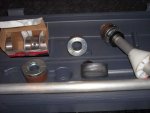
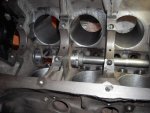
I disagree with Robert regarding the cam bearing issue being related to the oem bearing quality. Tens of thousands of these engines were in service with 150k+ miles on 'em that never failed cam bearings.
And a friend who worked in an IH factory branch doing fleet engine rebuilds up through 1984 confirmed that in many cases, the cam bearings in 150k mile sv motors were not replaced if no measurable wear was noted, these engines were normally rebuilt for fleets in sets of 10 units at a time.
The issue is long-term non-rotation of the camshaft which creates a situation I refer to as "stiction". And this is most common in engines that are not run on a regular basis long enough to allow the oil to get to full operating temperature (at least 30 minutes at fast idle). And this condition involves the oem engine/bearing system which does not suffer from the possibility of bearing mis-alignment which May occur during a rebuild.
Add to the above, most of us deal with engines that have not rotated in many years when we try and bring these rigs to life, the first thing most folks think about is "does it rotate or are the pistons stuck?". Screw the pistons, ya gotta make the oil film between the crank and cam bearings and journals come to life before rotation of the crankshaft. This is an issue that while not only exclusive to IH motors, because of the design of the engine lubrication system, it is more critical when dealing with IH motors.
The oil film between the cam journals and the bearing babbit surface simply disappears when non-rotated. On engines that have been neglected regarding oil exchange, the added problem of moisture/acids that is left behind in the oil film begins to etch the bearing layer/journal, when the engine is rotated, it's a dry start...the cam journal then wipes the babbit layer away which is extremely thin and the failure mode is entered which occurs over time once the babbitt layer is compromised. One can literally watch cam bearing failure occur on an engine afflicted with this problem, the oil turns "gray" before your eyes while watching the rocker assembly "oil".
This issue is not related to the "finger-joint" cam bearings which were oem, there was a point in time when I thought that was the case, but I've seen the same thing occur with both durabond (one-piece bearing shell) and other brand cam bearings that are identical in construction to the durabond items.
All of this research into "cam bearing failure" over the years is what led me to develop the "dry-start" process described in this stickee:
http://www.forums.IHPartsAmerica.co...I-4-sv-engine-non-oiling-rocker-assembly.html
A 18k mile/'74 fire wagon support vehicle spent long periods of time non-rotated! And if/when it was started on a regular basis in accordance with fire department practices, no doubt it was not run long enough to get the oil temp up and cook the moisture out of the oil!
I have a 196 that sat for 14 years non-rotated. I used it for developing the process I've outlined. Four years later the motor is run almost daily as a test mule, oil pressure is outstanding across the board. My '73 392 has never had the heads off and is closing in on 215k miles. It also had been neglected for many years when I found it, but at least it had been rotated (usually without starting though!), at the time I bought it I knew nothing about this whole cam bearing/valve train noise issue that is more common on IH stuff, that was nearly 12 years ago and it also has excellent oil pressure still, and no IH motor has been more abused in vocational and towing service than that one!
Rebuild the engine and do it right, run the engine normally and take care of it maintenance-wise. 200k miles is not an unusual goal for these motors used in daily service.
It is not "use" that kills these motors...it is non-use over time!