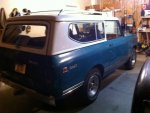
Brake trouble

I recently aquired a 1972 1210 camper special. This truck was converted to four wheel drive. The rear end is a Dana 60. The front is a Dana 60 out of a 1 ton dodge 4x4, the p.o. Swapped it in from a military truck. Non ic 392. Disc brakes in the front, drum in the rear. When I got the truck, he was saying its going to need a bigger master cylinder, because you have to pump the brakes to slow it down. It felt like to me master cylinder was shot, it would pump up, then go to the floor. The master cylinder did not look oem, I removed it and went to napa, the part number is for a 1 ton dodge truck. I bought a new master like the part that was on it, bench bled it, installed it on the truck, adjusted the rod length during that process, bled the brakes, it was still doing the same thing. I returned that master cylinder, wasn't squirting brake fluid out the front brakes anymore. I made certain I did not push the spool inside the cylinder past 1''. I got another master cylinder, for a 200 series truck. It's doing the same thing, but its squirting fluid out like it should. There were no air bubbles to be seen. Do I need a bigger master cylinder?? The front brakes are bendix, huge calipers. I would really like the get this truck up and going. No pressure build up on the brakes period.
Thank you for the help.
 
Last edited:
Good detail steve!

The "no output" of the first replacement mc is a very common issue regarding remanufactured masters, that is exactly why we don't use 'em around here! If it was a new mc though, that would be very rare. So what yo have going on is two things...a functional master cylinder and a functional master cylinder that is correct capacity for the dodge disc brake system.

The correct disc brake mc for either the oem dodge setup or the disc brake version of the d60 used in later IH pickups (74>75) is a 1-1/8" bore. Normally, a "disc brake" mc simply has a greater reservoir volume as compared to a drum brake master, that is accomplished by making the body casting "taller". The bore is the bore, there is no difference in disc and drum bores as long as they are properly matched to the hydraulic system, in this case your 1-1/8" mc bore is correct.

Also, if included with the replacement master cylinder, the residual pressure valve for the disc brake output will be a nominal 2psi unit and the drum brake side will be a nominal 8>10psi. A drum/drum mc will have residual valves on both side of 8>10psi.

Have you tested for output of both circuits right at the master cylinder connections? If that is ok, then test for output at the proportioning valve connection.

And regarding the proportioning valve...the oem setup on a '72 1210 with drum/drum would have been a combination valve, not a proportioning valve. So for adding front disc brakes, that unit must be changed out. Those two components are entirely different and do not perform the same function. A combination valve provides absolutely no "proportioning" function, it only serves as an operational point for the dual channel brake warning light switch.

The easiest way to eliminate the combo (or proportioning) valve now to eliminate one potential trouble spot is simply use two unions in the plumbing and eliminate the valve completely. Then if that gives you proper actuation, add an adjustable proportioning valve to the rear brake circuit only, set it after test drives, and lock it down.

All oem proportioning valves are calibrated and biased for only the vehicle/brake system for which the part number is intended. This is due to the varying vehicle weight bias (front-to-rear) of each vehicle and the capacity of the brake sets installed on the vehicle, along with vehicle gvwr.
 
The po or the po prior install the proportioning valve from a disc brake truck, its looks like same valve I put on my t'all for disc brakes. Another thing I noticed I should've typed in when starting this thread, theres a ''lock'' under the dash, plumbed into the line going to the rear brakes. There is flow coming out of the master cylinder, out of both circuits. Im going to recheck it again, and I will get some unions and connect directly to the master to eliminate the proportioning valve. I will come up with something also to test the pressures of both circuits, all of my pressure guages are at work. I repair heavy equipment at a gold mine here in co, so the majority of my good tools are there. Thank you for your help Mike.
 
the po or the po prior install the proportioning valve from a disc brake truck, its looks like same valve I put on my t'all for disc brakes. Another thing I noticed I should've typed in when starting this thread, theres a ''lock'' under the dash, plumbed into the line going to the rear brakes. There is flow coming out of the master cylinder, out of both circuits. Im going to recheck it again, and I will get some unions and connect directly to the master to eliminate the proportioning valve. I will come up with something also to test the pressures of both circuits, all of my pressure guages are at work. I repair heavy equipment at a gold mine here in co, so the majority of my good tools are there. Thank you for your help Mike.

Ok steve! The "lock" you refer to is a "mico"-type brake lock:

design and manuafacturing of hydraulic components, controls, and brake systems worldwide | mico, inc.

There are other manufacturers of similar devices also. Since you work with offroad/vocational vehicles maybe you have more of those in the fleet? Ya might also bypass that device just for eliminating any potential problem areas.

A "guess" (I've never had to actually test mc pressure generation) as to typical pressures generated in that system before the proportioning valve would be in the range of 1200>1600psi.
 
The mico lock is going to be bypassed for sure. None of our trucks have that device on them. I did for the fun of it recheck the flow coming out of the master cylinder for both circuits, found no problems there. I just hope I can find unions that will work for this. I removed fitting and both lines, and capped off what was open to the atmosphere, so I can match up some stuff at work tonight. I really would like to start driving this truck. I had a welding class a couple of weeks ago, just to get so ot in, and the instructor offered me the truck. Really good shape. 392, 5 speed direct, 4.10 gears. He installed a 2 barrel manifold on it, I'm curious how a 392 runs with that, since all the 392's I've owned were all 4 barrels. I'll try to post a pic of it on here soon.
 
A two barrel carb was available on some 392 motors used in medium duty trucks, both governed and non-governed.

I've run a Holley 4412 2v mixer several times on my 392 for testing when rebuilding 'em. Seems to work nicely but that is on an adapter which is not the best way to go!

I've not tried to actually dial one in as far as power valve and main jets on my rig, but I have a fresh one right now that I am planning to try on the "built" 392 described in this thread:

http://www.forums.IHPartsAmerica.com/readers-rides/4072-dd-known-chunk.html

Since the oem carb that is installed now is total shit with the built motor. We'll never know if we don't try this kinda weird, this stuff costs me nothing but time!

A five speed direct and 4.10 axle should be perfect for a trailer dragger (if ya can make it stop)!

One last idear...have you put a vacuum gauge on the manifold to verify your vacuum level also? You have already id'd that mc "output" May be the issue, but double check the booster operation also. At your resident altitude, a well-tuned motor should make about 15"hg, any greater is outstanding. It takes a minimum of 15"hg for a vacuum booster to work well, they will work at a manifold vacuum less than 15 but will require a bit of extra leg pressure, especially on those big disc stoppers ya have now.
 
I'm definetly going to check the vacuum. The po said the engine was overhauled 5000 miles ago. I some things of his I want to give back to him that was left in the truck, I wouldn't mind getting the receipts for the truck. The engine runs fantastic, I'm to go through it hopefully this weekend. I got all the parts to bypass the porportioning valve, I got off of work at 6 this morning, when I wake up this afternoon I'm going to screw with the brakes. Thats a nice t'all you have. I'm thinking of selling the one I have now, I really don't want to, but three vehicles, two people.....all of them are IH.
 
Ok Mike....I bypassed the p-valve, and the brake lock. Bled the the brakes. The pedal still goes to the floor. Just to let you know, I adjusted the brakes on the rear with slight drag. I'm going to remove the front wheels and look to see if there is anything wrong there, I put a light and a mirror behind the wheel, pads looked good. I don't know where else to go with this.
Steve.
 
So...now you have no resistance at the pedal/mc when pumping the brakes? Did you have good fluid flow from the front calipers when bleeding again?

You are spot on about the rear brakes and "slight drag" for bleeding purposes, that way the cylinders have to make a "minimum" travel in order to bleed. When rigs sit along time, sometimes the auto-adjuster freezes up and can't self-adjust until freed up. And I'm assuming no sign of rear cylinder leakage such as fluid leaking out of the bottom of the backing plate(s) and running down the tire(s)?

Where you able to rig up a test gauge for taking a pressure reading at one front caliper port and one rear slave port? I know that is alotta trouble to rig some adapters.

You can pull the front calipers and then "hang" 'em from wire. Then insert a wood shim/wedge to replicate the rotor thickness and watch the action while having someone press the pedal and see if any pressure is being generated.

However...your description of the pedal now going to the floor (fairly easily??) tells me that the new master cylinder is also bypassing!

I've chased my tail like this countless times, and every time it came back to both reman and new master cylinders being no good! And at $125 a pop for a new one each time and the hassle of making the return, it makes ya wanna trade in for a horse and wagon with block brakes.
 
Yes sir it goes to the floor real easy. No leakage the the rear brake cylinders. What I thought was good flow going to the front wasn't. I never got any resistance out of the master cylinder from the beginning. I need to get my guages from work, I got to test ports I'm going to rig up so I can figure out what the pressures are. I have to agree, the master cylinder is bypassing, because when I removed it from the truck, for the fun of it I left the fluid in it, moved the piston or spool, the front didn't squirt much oil at all, the rear circuit squirted fine. I'm returning it for another master cylinder. I'll keep you posted, I appreciate your help. Its good to pick another mechanic's brain on the matter!
 
yes sir it goes to the floor real easy. No leakage the the rear brake cylinders. What I thought was good flow going to the front wasn't. I never got any resistance out of the master cylinder from the beginning. I need to get my guages from work, I got to test ports I'm going to rig up so I can figure out what the pressures are. I have to agree, the master cylinder is bypassing, because when I removed it from the truck, for the fun of it I left the fluid in it, moved the piston or spool, the front didn't squirt much oil at all, the rear circuit squirted fine. I'm returning it for another master cylinder. I'll keep you posted, I appreciate your help. Its good to pick another mechanic's brain on the matter!

I'm tellin' ya..getting a good master cylinder these days is a crap shoot!

I had this same discussion two weeks ago with the wholesale parts distributor I use here for this kinda stuff. They are bigtime regional folks who don't sell at retail. Two years ago they changed their entire parts line for hydraulics over to the "centric" which is a kinda "new" re-hash of some very old name brands they have acquired and have become the dominant brakes parts supplier in the north American market. Normally when they do that, they "purge" their inventory of all brands that are not the "new" one and the stuff goes into a rollback that heads straight to the scrap yard for crushing/bailing. But in this case centric would not front that deal so they continued to market the other stuff with it's problematic quality.

It's taken time for the centric line to be fully absorbed into their inventory but they tell me their warranty returns for the shops they sell to in the region have gone way down! They quit selling any reman brake-related products several years ago because of major quality issue, even amongst the "name brands".

I'm not pushing centric, I'm just saying the responsible wholesalers have the same issue that we have in sourcing decent brake stuff. They don't wanna sell stuff at a "price point" if they are going to have to eat many of the sales...and the professional installers dam shore don't wanna have comebacks (or even worse...can't fix the vehicle the first time!).

I had to pay dearly (nearly twice what I used to pay) for a new replacement mc for the t'all I'm dealing with now. And... It worked properly out of the box, that was a surprise as I'm kinda used to having to return at least 50% of the masters I replace around here!

I'm tellin' ya, when dealing with brakes today on this older stuff, it's a crap shoot if it works the first time! This same thing happens in the rip-joints like midas...but the customer just never knows it...they keep throwing parts at customer repairs until something sticks! And the liability exposure on this stuff is huge for a commercial shop.
 
Excuse me for high jacking, but does anyone rebuild mc's anymore?? A long time ago I used to buy seal/oring kits and rebuild them myself.

Ron
 
excuse me for high jacking, but does anyone rebuild mc's anymore?? A long time ago I used to buy seal/oring kits and rebuild them myself.

Ron

Good question ron!

Most commercial shops will not do master cylinder rebuilds today due to the liability of doing so! They also are interested in only "r&r" and not actually repairing any components.

I do rebuild some masters, especially the single channel stuff used on Scout 80 and others because it's "simple" and that is only if the bore is in perfect condition and I can get the proper parts kit. I also do the "step-bore" mc used on some Scout 800 dual channel stuff but again, the parts can sometimes be difficult to source and they are also very difficult to prep the bore if they are good.

But I won't touch any other dual channel mc, basically because it's simply not worth my time to do so and dealing with the reassembly is tedious and prone to failure.

I have had some unobtainium masters done professionally by folks such as white post that know how to sleeve the units, are "wet tested", and will guarantee functionality when returned...but that is very pricey and is done only when I've exhausted sourcing a new replacement or a workaround that requires major mods.

Don't get me wrong...there are quality remanned components out there ya just gotta find 'em! But when you open up a by-passing "reman" master cylinder like steve is dealing with, and find it full of glass bead media, rust, and a bore that is useless, it makes ya sick to see what these suppliers are providing to the market place. The "name" on the parts don't mean shit anymore, the name brands are just as bad as the no-names, they all come out of the same sweat shops and many of those sweat shops are inside the borders of the u.s.!
 
Ok Mike, it's alive. I exchanged the master cylinder, installed it on the truck, I decided to reconnected the p-valve, and the brake lock. I decided to buy a vacuum bleeder, got it from harbor freight. Got everything hooked up, bled the brakes, and they work great. But I'm going to keep an eye on this master cyinder.
I wanted to check the pressure of the brakes, but the fittings I found to make it work were inverted flare to pipe, I'm not really keen on having pipe thread in the brake system. But they are firm, the way I like 'em. Thank you for helping me troubleshoot my brakes.
Steve.
 
Last edited:
Another success story!

I've got a write-up in process now regarding that harbor freight pneumatic brake bleeder! I hope to use it in it's "modded" form this afternoon and complete the write-up and post. What do you think of it??? Beats pumpin' a mityvac by hand???
 
I like the pump from harbor freight. I put teflon tape on the bleeder threads, because at first the vacuum wasn't holding. Glad I have it. Bought a double flaring kit for the heck of it too.
Drove the truck down to Colorado springs yesterday. I'll have to start a post on the carb. This thing drinks fuel bad.
Steve.
 
So I replaced my mc yesterday, bled it out properly, etc on my '73 (I think) Scout II, disk front/drum rear (oem). Now the pedal travel is almost to the floor, with marginal braking at that. After a little review of the service manual it sounds like I'm activating the secondary system only. Low flow from the front bleeders confirms this theory, but I could be wrong. Aside from a faulty mc, is there anything else that could lead to such a condition? I know the rears are supposed to be self-adjusting and that self-adjusters rarely work, should I bust open the rears and do some adjusting? Fairly green mechanic here, experience in basic component swaps mostly. Picture of the old girl in her stable included. Thanks guys.

--edit-- it has come to my attention that the mc for '73 and '74 models were different, that might be my problem. Was sold to me as a '74 with lost title, deemed it to be a '73 somewhere years ago when applying for the paperwork but could be mistaken. Just fyi, does anyone see that making a difference? http://www.superscoutspecialists.com/store/p-427-brake-master-cylinder-Scout-II.aspx (I know, bad-guys, for reference only ;) thanks again all.
Dave
 

Attachments

  • IMG_1666.jpg
    IMG_1666.jpg
    54.8 KB · Views: 386
Last edited:
The self-adjusting feature on drum brakes work perfectly as long as regular maintenance is performed!

The first thing I'd do is make a simple test of master cylinder output by removing each fitting in turn and pressing the pedal. This is a crude setup but it will tell you if each circuit is attempting to pressurize.

If the simple test works, then remove each pipe from the proportioning valve and determine if each system is also pressurizing.

It's far more common for the proportioning valve to fail internally (blocking one side of the system), and the centering valve must always be confirmed to have actually "re-centered" when working with this stuff. That usually does not happen and ya end up having to make the re-center by hand.

The difference between the drum/drum master and a drum/disc master is the volume of the fluid reservoirs and sometimes the diameters of each piston (which must match the respective front or rear brake cylinder/piston diameters). However, as long as the plumbing connections are the same, having an inappropriate mc is not the issue here as the brakes would still work as they should.

Also, the drum/drum system used a combination valve which is only used to operate a loss of fluid pressure warning light and does nothing as far as proportioning the actual entire brake system. The disc/drum valve is a true "proportioning" valve...big difference!
 
Thanks sir!
I had good pressure at the mc fittings, but didn't crack the lines at the proportioning valve. I imagine I'd need to crack them downstream of the valve? How does a fella re-center it by hand? Would rather not buy a $140 3" valve if I don't need to. I have confirmed I do have the correct mc. Another gentleman suggested cracking the lines at the brake cylinders themselves, or removing the bleeders entirely to make sure they aren't just clogged up, giving the impression of poor pressure as well as removing air that might be trapped in the caliper. Any thoughts? Thanks again.
 
The idea here is do a diagnostic in sequence. Starting at the master cylinder outlets and then following the entire directional flow of fluid through the entire system.

As you work through the systems (n=2), you will confirm presence (or lack of) brake fluid under pressure at each point.

Removing a bleeder nipple completely won't prove anything, simply loosening the nipple and observing flow under pressure will tell you immediately if system pressure is available or not without any hassle, that means about one turn of the nipple. If no liquid emerges, then you don't have fluid available to that point. We're not trying to bleed the system here, we are just checking for fluid presence and flow when pressurized by the foot pedal.

If you are certain you do have the proper proportioning valve, then I'd perform the flow tests by pressing in on the extended nipple on the proportioning valve with a force of about 10psi (with your hand only). If the valve is functional, that will allow it to self-center itself and become functional once again. However, many of these valves will not re-center due to internal corrosion after all these years.

Don't know where your "other" information is coming from, but here at ihon we do this in sequence and determine what the primary issue is before simply bouncing around on this. In fact, the service manual has an excellent description of how all these parts operate and what the correct service sequence is.

There are several ways to actually "bleed" the entire system. But you simply can't do a bleeding unless all circuits are operational as designed. And those circuits must be verified in proper sequence, not by bouncing all over the system.

If in fact you end up having a non-func proportioning valve, an option is to simply install an aftermarket adjustable valve (such as obtained from ihon) for much less money that on oem-type valve. Doing so however, you will loose the "warning lamp" functionality.
 
Well, I have pressure at each brake, though the front bleeders just dribble, I'm wondering if that's a pressure issue or if the bleeders are clogged/rusted up. I only assumed it's the proper proportioning valve, but it doesn't have any extended nipple to depress anywhere, and doesn't look exactly like this.. brake proportioning valve for power brakes - International Scout parts. Think I might just end up putting a generic valve in and adjusting from there. The thing does stop pretty well if I give it two quick pumps, but if it's just the first brake application it pretty much sinks almost to the stops and then feels like old style manual brakes (secondary system?). Thanks michael.
 
If the front calipers simply "dribble" fluid, then you have issues with them being plugged internally. Remove the entire bleeder nipple and see if the posts then allow full fluid flow. If a nipple is partially/fully clogged, simply install a new one from the parts house.

These parts are nothing complicated at all, simply a tapered sealing tip that matches the receptacle in the caliper body. However, any old caliper or wheel cylinder will certainly fail/corrode internally over time, that is why we replace 'em when they don't work as spec'd.

Your parts description tells me this system is botched from years ago. Most likely started off as a drum/drum system and and was partially converted but does not have the correct proportioning valve. A disc/drum system must have a properly operational proportioning valve or have an aftermarket single circuit valve installed in the rear system and then adjusted for proper four wheel braking action.

Having to double-pump the brakes also tells me there is probably no residual pressure valve set installed in the master. A drum system requires an rpv of approximately 10psi, the disc side requires an rpv of approximately 2psi.

Anytime the brake vacuum booster is changed out,the connecting rod that mates the booster piston to the master cylinder input must also be adjusted in order to have a proper relationship.
 
Back
Top