Engine Cooling Systems and Components

Lots and lots of good stuff here. Greg I've been reading all about pumps the last few days and causes of cavitation.
What I need is for somebody to warm it up until the t-stat is opens. Release the pressure under the cap via the little red handle and then remove the radiator cap. Then reach over and give the engine some gas. Does the pump lower the coolant level in the radiator a few inches. The az rebuilder told me on the pickups the pump would push the coolant out the top of the radiator if you gave it gas, the same should be true for scouts, but instead the level would go down, since the cap is on the return side. {mine goes down a few inches now}

lou, no need to weld on the fins. I looked at doing that with my cast one I had, as I do have a tig welder. But swapped it out for a new pump. Then I just rotated the blade a few degrees which raises the blade. I then check the pump with the gasket for running clearance. The problem is "play-dough" does not work at 1/32" I did the best I could and it looked about 1/32" but you need plastic gauge at that point. Or real modeling clay

michael mayben, square body truck,as in 1974 100? You bring up some really good points. 20% less in the Scout to start and then the "normal" other condition that existed on my Scout to start with. I have found that each and every little thing I do helps.

( update, I changed my timing back to 8 degrees last night, had it set to 4 btdc, that was bad:mad5: info I got else where.) runs a whole lot better for one thing. (fyi I'm fuel injected too.) looked like it shaved a few degrees off. I have a great big winch which blocks air flow big time. Might remove it, or add air dam to help with air flow. Weather is going to be a lot cooler today, and the first big hill is 15 miles away:(
 
I will post some "info" I have - May "help" / maybe not.

And, I have a 73 1210 t/a 392 -- not a Scout.

I bought a spare water pump about two years ago.

The box is federated auto parts (manufactured by gmb north america / made in usa)

it has a stamped pulley -- the shaft measures 11/16" ("eyeball" with a ruler).

The federated number is 138-4126 (fan clutch / "big nut").

The federated number for the "regular" pump is 138-1010 (I ordered the wrong one.)

re michael's statements about fan clutch:

the fan clutch on my 392 was replaced in 2001 and the original was not available.

My mechanic found a replacement -- it has a "big" plastic fan. I went thru my records and found that it is an IH part. I assume that it is / was for a medium duty IH truck.

It seems to work ok -- does not engage exactly when I think it should. But, the engine is running a 160 thermostat (installed "earlier" by the mechanic).

It does make a "lot of noise" when it engages -- can hear it at street / city speeds (25 - 30 mph).

The part number from my invoice is 1693176c91.

This is defintely not a cheap part.

Also, my mechanic had to find a new water pump since I had the wrong one -- the number from the invoice is 51-1591, but I do not know the "brand". His shop mostly works on medium duty trucks -- I was referred to him / his shop when IH got out of servicing "light line" -- as least the san leandro, CA dealer, anyway.
 
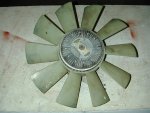
This tha fan yore talkin' Robert?

Oem app on loadstar platform witha 392.

Supplied by schwitzer, the nylon fan is matched to each clutch at the point of manufacture and should never be dismounted or it can't be re-centered on it's hub.

Direct replacement for the light line stuff big nut clutch, fan diameter is the same. However, it is approximately 2" deeper which works ok onna 2 core radiator, witha 3 core the radiator must be spaced forward in some manner (not an easy thing to do onna squarebody fullsize or sii without some fab work).

This bustard prolly moves one-third more air than the stocker big nut fan. "lockup" should begin at around 150f +/- and be fully locked at about 170f. Lockup is fairly rapid, but not as harsh/sudden as an air-operated clutch.

Still available new last I checked two years ago, price then was around $450.

The water pump this one was mounted on has the stamped impeller which carried an IH p/n in the casting. Iirc, this is the pump I now have on my motor (and have had in place for maybe 35k miles?).
 

Attachments

  • Loadstar Fan Clutch.jpg
    Loadstar Fan Clutch.jpg
    418.6 KB · Views: 912
Mike, going back to your comment that the clutch isn't a major issue and a fixed fan will do the job, is there a fixed fan out there that looks like the one you posted? It seems there should be a very aggressive fixed fan in steel or nylon out that that doesn't cost too much and will just suck this truck down the road.
 
Don't know of a similar fan with the proper bolt pattern lou. But a "hd" fan (used with the big nut clutch) ain't no slouch in the air movin' department!

Unfortunately that fan only matches the bolt pattern on the big nut clutch and won't match either bolt pattern onna "8 hole" water pump hub for sii. But hayden/imperial might have a oem-style steel fan that is nearly identical that will match one of those patterns. I'm not talkin' a hayden "flex" fan, I won't allow those bastards on the premises! I know you heard my story about that dude in the chev dealership who gave himself a frontal lobotomy with a flex fan onna 'vette that tossed a blade and it came out the top of his haid?

Lemme do some checkin' on this...I need to prepare for a similar deal anyway for my own use when this big nut clutch goes away.

I have used 4 hole and 8 hole water pumps here now for comparison (one of each impeller design). Just this last week I've given away two "renew" IH pumps from a school bus fleet parts dept. That were gifted to me, one 4 holer to monte, and an 8 holer to Todd Wednesday nite. I'll be wishin' I had that 8 holer back soon!
 
Michael,

yep, that's the fan on my 392.

I managed to leave enough room from the back wall this time, so I could open the hood.

I do not know what "core" radiator I have. I originally ordered the "increased cooling", but no a/c. When the original radiator "went away" (I did not change coolant frequently enough!), the replacement only had half the "fin depth" of the original. I mentioned it to my mechanic one time and when he replaced the radiator (2004), I noticed that the "fins" were back to "double thickness".

But, since you mentioned "clearance", I checked and there is about 1 inch (or a little less) between the fan and the fins / radiator (had not paid attention before) -- small :yikes:
 
Craig: in my '71 1210/345 and a crossflow radiator, the level does go down When accelerating the engine. It doesn't take much, maybe at 1500 rpm or so; and it drops about an 1" or 1 1/4" and stays down. I've definetly got flow.

Mike: I'm tending to see a pattern you're describing in "marginal" cooling capacity by a number of tsb's I have regarding "increased cooling" packages and a number of larger capacity fans. They go hand in hand with options like a/c, automatic transmissions, larger engines. In '69 an aggressive 6 bladed/40 degree pitch fan was offered for fullsize rigs with a/c. Also one describes a temperature activated vacuum switch to allow an advanced timing to kick in when the engine temp rises from prolonged idling. It wasn't just scouts and fullsize stuff, large trucks had occasional issues too. One tsb described better airflow by replacing the bumper with a louvered one and a cross member change for co loadstars. The theme to most of them was airflow as I see a challange was fitt'in horsepower in a small "footprint".
 
Last edited:
Quick update. I added a sheet metal air dam between the leaf springs. Then used my kids pool noodle ( don't tell on me) to block off some big holes to force the air through the rad. At speeds. I drove around the neighborhood and the it ran cool 180-190 I then drove it on the freeway and it started to warm up to about 210-220. (oh I switched back the electric as it cools better when not on the freeway) I went wheeling at the local 4x4park and it never got hot. That's with the fan on low too. :gringrin: I can drive to the trail in the morning or at night as the temp would stay lo then too. Today is was only like 85-90 outside.

The viper fan pulls more air over the radiator, but to get the fan to fit, I cut off one side of the rubber flaps openings let air past through.


Fyi if you can't get more blades, then get a larger fan and make a shroud.

I guess I could use this
ebay motors: radiator fan blade dodge dakota 97-99 cooling truck 98 (item 230280709318 end time aug-19-08 06:22:14 pdt)


28385616.jpg
 
Last edited:
Craig: in my '71 1210/345 and a crossflow radiator, the level does go down When accelerating the engine. It doesn't take much, maybe at 1500 rpm or so; and it drops about an 1" or 1 1/4" and stays down. I've definetly got flow.

Mike: I'm tending to see a pattern you're describing in "marginal" cooling capacity by a number of tsb's I have regarding "increased cooling" packages and a number of larger capacity fans. They go hand in hand with options like a/c, automatic transmissions, larger engines. In '69 an aggressive 6 bladed/40 degree pitch fan was offered for fullsize rigs with a/c. Also one describes a temperature activated vacuum switch to allow an advanced timing to kick in when the engine temp rises from prolonged idling. It wasn't just scouts and fullsize stuff, large trucks had occasional issues too. One tsb described better airflow by replacing the bumper with a louvered one and a cross member change for co loadstars. The theme to most of them was airflow as I see a challange was fitt'in horsepower in a small "footprint".


Thanks for checking. I was just looking for a low tech way to check for flow. This would only work if you know your radiator is up to par. But then again you would have to know the rpms and the measure the drop to compare.
Way back when, 2 years ago I was "hoping" for quick fix, but it looks like you need to check and fix all the cooling system items. It's been an evolution process for me. Changing/fixing the missing/broken items. Compounding the issue is my Scout is lifted and running huge tires, with a big fat winch blocking all the airflow into the radiator. Plus a fresh rebuilt FI engine.

I was very diligent in taping the shroud to prevent air leaks. I use the rubber/foil tape and it stays put. You can spray paint it black if silver is not your color. It works for me for right now.

My next mod will be a cold air intake, as that is a proven idea for diesels to not only make more power, but run cooler. Finding a location to pull air from is the issue as down low in front won't work very good for an off roading Scout.

edit... One more update on checking flow. Before I had 30 to 50 degree temp drop across my radiator, I was thinking man I got a great fan shroud. When I really had no flow. Now I have about 10-15 dregree drop.
 
Last edited:
I think I'll do the noodle seal too, that's more my shadetree enkineering style:gringrin:

the 10-15 degree t/d(temp diff) yore seeing is closer to design, that's the max spec'd with full flow on air and water or a variation of that depending on power and heat balance. If the pump is grabb'in more water you'll also see a t/d from the pump's discharge to the heads vs the water returning from the manifold at the t'stat outlet.
 
Just two examples of how critical simple "air dams" or "air seals" can be regarding air flow management:

a Scout 80 don't even qualify for the statement "engineered"! But look at the hood underneath. A long strip of what looks like an innertube split open and stapled to the stiffener under the sheetmetal! And that "seals" to the radiator core support. Real IH quality at play...but it works! And having the sheetmetal radiator shroud in place on those crapballs is imperative for engine temp management. Keep in mind that platform has more in common with manure spreaders than a motor vehicle.

The other extreme...the Nissan 300zx platform from m/y '90>thru eop ('95). Twin turbo variation, one of the most sophisticated and finest motor vehicles ever to hit the street imho.

Those are bottom breathers with an engine-driven fan nearly identical to the loadstar fan in the pic I posted...they'll suk the stripes off the interstate at 100mph until the air intakes in the lower valance (charge air coolers on either side of main air intake) clog with wallyworld bags, small children, and snow/ice. Then the pooter puts 'em into "limp mode" until engine temp goes way back down!

The "secret ingredient" to engine temp management on those rides? A $1.00 strip of foam weatherstrip simply stuck between the top of the radiator and the core support that seals the entire bottom-sukkability and makes all this schnizz work! Typical crap-quality gray expanded foam just like ya get at true value for wedgin' between the sashes of oldskool doublehung wood windows in that rent house!

If ya ever powerwash the engine bay on those rides to keep 'em purty, that foam disappears to shreds. That's when all hail starts breakin' loose, especially when the pimps that liked them rides start cruisin' the hellvegas strip in August with the a/c blowin'. 2pm can give a street temp at air intake level of around 170f and traffic "might" move at 5mph. Those are conditions which no manufacturer engineers for (or can afford to), that is why vehicle "testing" is done there.

Iirc, that's how Jeff and I first met way back when...talkin' about Nissan "stuff"???? And how to make retrofitted Nissan peekups actually cool with r-134a.
 
I think I'll do the noodle seal too, that's more my shadetree enkineering style:gringrin: lol

The 10-15 degree t/d(temp diff) yore seeing is closer to design, that's the max spec'd with full flow on air and water or a variation of that depending on power and heat balance. If the pump is grabb'in more water you'll also see a t/d from the pump's discharge to the heads vs the water returning from the manifold at the t'stat outlet.


I will post the new numbers when I get home.
Here some good reading too. It's what you have been saying all along.
http://www.arrowheadradiator.com/14...apability_in_high-performance_automobiles.htm
 
I have not been able to do much since the weekend, but more testing and data recording is needed for me to fully understand whats going on.

These numbers are mostly the engine warming up, and getting off the freeway after several miles. I will do more recording while driving around surface streets.

edit.. I hate posting raw data without proving a point, or explaining something. But I do see the water is flowing around the system better as the temp are more even. I suspect the TBI/water heater temp is affected by the heater hose in the closed position too. Anybody got a pictures of the water passages or flow direction?

Edit2... Greg r Ever use a magnehelic to measure under hood pressures?
 

Attachments

  • T-stat IR temp2.jpg
    T-stat IR temp2.jpg
    73.2 KB · Views: 759
Last edited:
Craig: no, I've never even thought of using a static pressure gauge or magnehelic. Propeller( or prop ) fans don't deliver much in the way of static pressure, but they do deliver a high volume in a small package. That's why radiator thickness vs. Fin count is so important. It doesn't take much to develop a pressure drop across a radiator while trying to draw or blow a lot of air volume. Even a 1/10 of an inch water column in air pressure drop can have a drastic reduction in air volume when using a prop fan. Ram air at road speed of 20-25 mph or greater can create enough pressure that you'll have more than you need for an oem radiator with oem horsepower. However, as Mike expertly pointed out, restrictions or obstructions behind the radiator can create reversions or turbulance that'll restrict air flow. I have some charts that show air flow patterns behind and in front of radiators that show high flow spots, and some "dead" zones from obstructions depending on the engine bay layout. It's quite an eye opener that flow across any given radiator is not Uniform, and even with that they can still exhange enough heat to keep the engine in limits. Shrouds, and even fan offsets really keep a radiator's performance up to snuff.

I'm curious about your radiator's t/d, it's almost not there. You definetly got water flow. To be honest, I didn't like the idea of bending impellers, but you've proved that close to spec works; that is the final nail in the "cast vs. Stamped" debate's coffin.

Remember that a thermostat only sets the minimum Operating temperature. It is common on any given day that my truck or Scout will run in the 200 to 215 range, and that's only about 1/2 way or a little past on the temp gauge. Mike has showed me that the gauge's bar is the range That is safe for the engine to run in. Let them idle long enough, and they'll go back to regulating 185 or 195 degree coolant back to the radiator. I have a 185 stat in the Scout, and a 195 in the 1210.
I've done an I/r thermometer scan of the engines after various workouts on different degree days and readings on the blocks around the core plugs show an average of 205 to 210, the oil pans were around 215 to 220, water to the radiator was on the average 205/210 with an outlet of 196 to 200. After about a 20 minute idle the radiator inlets were the thermostat's setting and the outlet could be 15 to 20 degrees less. The pump's discharge to the heads were a mix with an average of 190 to 200. This scenerio won't be true for all engines, timing can affect idling temperatures. One IH bulletin shows a temp switch for cutting in an advanced timing when the engine exceeds a certain temperature from prolonged idling, that was around the time emission stuff was kick'in in.
 
I could not figure out why the radiator had no t/d either, but I just got off the freeway and found a parking lot and pulled in, maybe 2-3 minutes after getting off the freeway. That's why did not post before as I did not understand why. More test runs with other types of driving will be needed. ( I forgot the ir gun when I went to the 4x4 park.)
I want to understand air flow under the hood as you pointed out these fans don't make much pressure. I'm going to install some hood vents to help draw air out at speed too. I did cut out my inner fenders (trail Scout) and will be installing some expanded sheet metal, like on iho chads Scout.
 
I did some reading up on the type of pump IH used on these trucks and came up with the following notes.
1. A typical volute or back plate clearance for a semi open impeller would be 0.015 to 0.020 inches. For each 0.002 inches you increase this clearance, the pump will lose about 1% of its capacity.
With this the .188 clearance shown at the beginning would be almost a 9% reduction in efficiency compared to the .015 spec.
2. Balance holes are used to reduce axial thrust by relieving pressure on the back side of the impeller back to the impeller eye.
This would explain the two holes in some of the cast impellers I've seen.

And a final observation: when I hold my hand behind the fan of my Scout the air comes back from the fan perimeter at a 45deg angle, not much at all directly behind the fan. When I put my hand behind the shrouded/clutched fan on my 65 malibu I get a tornado directly behind the fan. Reason tells me I should get the same from my Scout. Thoughts?
 
That chev shrouded radiator has a real deep shroud right?? I "think" I can remember back that far! About 12" front -to-rear??

And the fan sits just completely inside the shroud, with no "stickout" past the trailing edge? And in addition to movin' muy mucho airo...it's dam noisy too? But us old farts that can't hear don't givva shit about noise anyway...right?

But them mouse motors sit down and way back in the front clip, with plenty room to mount all kindsa schnizz under the hood, in fact ya can climb in and stand beside the motor which feels good onna cold day.

So the malibu moves bunches of air volume 'cause of the tunnel effect. The sii envelope simply does not allow that kind of room under the hood. I mean, there is nearly three feet of nothin' except airspace and chrome bumper between the exterior grille nose and say the face of the chev water pump.

Also compare the "pitch" of the two fans just to see what ya can see! Is the chev fan clutched? If so, is it just a viscous drive, or thermo-control clutch? Are both fans in lockup when ya checked 'em? To make 'em lock up real quick, stuff an old bath towel over the face of each radiator, that will raise temps real quick and cause fan lockup, you will hear that happen...then check for air flow using the "back of the hand" method. If the clutch fan (thermo-control) does not lockup, then it's faulty, a very common issue.

The whole front clip of the sii was not designed to optimize the engine cooling/hvac package. Today we call that whole shebang the "cooling module" and is supplied to the assembly line as an engineered package which is completely assembled outside by a supplier and simply hung in place on the platform.
 
and a final observation: when I hold my hand behind the fan of my Scout the air comes back from the fan perimeter at a 45deg angle, not much at all directly behind the fan. When I put my hand behind the shrouded/clutched fan on my 65 malibu I get a tornado directly behind the fan. Reason tells me I should get the same from my Scout. Thoughts?
__________________
I've seen the same effect in refrigeration and a/c equipment that use prop fans. I've seen on some outdoor condensing equipment that some of the air is drawn back in around the center of the fan but the net effect is a large volume discharge. I can get a hot wire anemometer. Maybe a day at binder u can show air velocity or flow patterns around a Scout II and an 800's radiator.
 
I did some reading up on the type of pump IH used on these trucks and came up with the following notes.
1. A typical volute or back plate clearance for a semi open impeller would be 0.015 to 0.020 inches. For each 0.002 inches you increase this clearance, the pump will lose about 1% of its capacity.
With this the .188 clearance shown at the beginning would be almost a 9% reduction in efficiency compared to the .015 spec.
2. Balance holes are used to reduce axial thrust by relieving pressure on the back side of the impeller back to the impeller eye.
This would explain the two holes in some of the cast impellers I've seen.

And a final observation: when I hold my hand behind the fan of my Scout the air comes back from the fan perimeter at a 45deg angle, not much at all directly behind the fan. When I put my hand behind the shrouded/clutched fan on my 65 malibu I get a tornado directly behind the fan. Reason tells me I should get the same from my Scout. Thoughts?

Lou as for the fan, you don't want the air to come straight back. I was talking with a tech rep at derale and he compare it to a water nozzle. You want the air to go around the motor, not straight into it. So by having some fan stick out from the shroud the air can go around the motor and not straight into to it. Sort of like a water spray nozzle, make since?

"for each 0.002 inches you increase this clearance, the pump will lose about 1% of its capacity."
nobody every said I was the sharpest tool in the box, but I was always good in math. .188 minus the spec of .020= .168
divide .002 into .168 = 84 that would be 84% less. Either you drop a decimal place or you meant 0.020 :icon_mrgreen:

I did some more testing, but just in town (no freeway) and the Scout never got hot. It ran at 185 the whole time. Yes it was cool last night under 80 for sure. We should have some hot days again here soon. :icon_eek:
 
So it's 96deg here today and I'm sitting with a 12" fan blowing on me. The air blows from that in a column. That's what I expect from a fan but I will put some effort into getting a grip on the water nozzle idea. I've attached a photo of the malibu fan and it's as simple as they come. The distance between pump and radiator isn't that much different than on the Scout. I could beat myself silly over this but I need to find an IH factory fixed fan and do away all the clutch variables. Like Mike says I'm deaf from being a gunner’s mate in the navy and tinnitus is my favorite band. Where do find a factory or good aftermarket fixed fan that will move a ton of air and I don't care about the noise.

Craig, your math is correct, I have no idea how I came up with 9% loss of efficiency. On the other hand if the pump in the photo here has lost 84% then I have to believe that getting the volute/impeller clearance is not only critical but is very probably the solution to the problems I've seen with my temps. Gotta find volute housing.

Malibu photo is too big. I'll post it later when I figure out how to reduce the size.
 
Back
Top