69 Charger - Torqueflite trouble

well - sounds like this is above and beyond my range of mechanics. Should I just look to have someone go thru and overhaul it?

Sounds like you know when to fish and when to cut bait!

Given the value of that vehicle, I'd suggest having the unit done correctly by a pro who knows the 727, knows how to perform normal performance unit upgrades, and has access to the correct service parts.

With the level of debris I see, there is something badly damaged internally, this is not something that can be "fixed" at this point.

We are in the final process of producing a 727 rebuild video that will be available to ihon members soon. Nothing fancy, but the kind of stuff that can be done in a diy shop with limited special tools and with a definite redneck attitude.
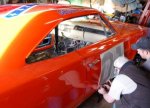
 
I know things vary nationwide...shop to shop... But about what should I expect a tranny drop/overhaul and re-install to run on this car/tranny?
 

Attachments

  • KSL.jpg
    KSL.jpg
    24.1 KB · Views: 805
At the present time, we're doing "normal" super-duty (rv service spec) 727 trannys for $995 exchange. Exchange means...an IH core for either a Scout II or a pickall since we have those cores in the inventory right now.

The price for building the customers core (either an IH core, a chrysler core, or an amc core) is the same.

These units are built using B&M internals, including their shift reprogramming systems and are identical internally to the 727 units B&M used to market.

That price does not include a torque converter, or a repair kit for the overrunning clutch (bolt-in sprag), that runs an additional $125 installed.

One-way shipping by ups ground runs an average of $165
nationwide.

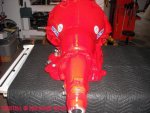
Pic attached is a unit we did for a customer just last week, I installed a dodge motorhome tailshaft and housing into a IH 1310 727 core. Reason being the customer is installing a gearvendors under/overdrive unit on it and those are only available now for the dodge tailhousing pattern.
 

Attachments

  • IHON CPT 727.jpg
    IHON CPT 727.jpg
    82 KB · Views: 725
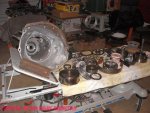
This pic shows the red 727 after cleaning and mounting on the surgery table. All the guts are laid out.

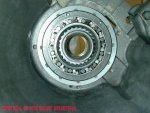
If you look inside the case at that dark ring, that is the outer race for the overrunning clutch. The oem part has a very fine spline cut into it's periphery, then it's pressed into the housing and has an "insurance" set screw locked into a indentation.

The repair race is exactly the same except it has three holes drilled into it. Those holes have to align with three of the holes that retain the output shaft support and three special fasteners are used to retain. Thus the race is locked into the case and we're able to save a case that has had the race bore ripped out.
 

Attachments

  • 727 Surgery.jpg
    727 Surgery.jpg
    82.3 KB · Views: 755
This pic shows a typical bolt-in sprag race after the installation is completed and the inner race, springs and rollers have been installed.
 

Attachments

  • Bolt in Sprag Complete.jpg
    Bolt in Sprag Complete.jpg
    70.6 KB · Views: 710
My Dad just called... His friend has an old dodge motorhome with a 440 in it and an auto-tranny. His friend told me I could have the motor and tranny! Just have to go pull 'em.

Would this tranny bolt up to my 383?
 
my Dad just called... His friend has an old dodge motorhome with a 440 in it and an auto-tranny. His friend told me I could have the motor and tranny! Just have to go pull 'em.

Would this tranny bolt up to my 383?

Yes...the transmission will bolt right up to your engine in the charger.

But...the entire tailshaft/housing on the dodge motorhome transmission is completely different! It would be exactly like the one shown in my pic of the red transmission.

The motorhome units use a very "hd" tailhousing, some have the parking brake mounted on the extension, some don't. And all have a large ball bearing to support the output yoke which is retained with a nut and is most likely a "1350" u-joint size.

Your passenger car version of the tf727 has a completely different long tailhousing with only a bushing to support the output shaft. And...it uses a "slip yoke" on the output shaft spline.

The motorhome tranny would be an excellent core to rebuild into a super-strong slushbox for the charger, but it would need the output shaft and tailhousing from the charger trans installed during rebuild. The motorhome unit uses a four pinion planetary system which is a bit stronger and should have one additional clutch plate in both clutches.

Bottom line, this is not a "bolt-in" swap!

There are quite a few variations of output shaft configs used across the entire spectrum of the tf 727 transmission spread amongst all the oem apps. Here is a stickee that is used for id and discussions of the transmission variations, including the dodge (and ihc) motorhome units:

http://www.forums.IHPartsAmerica.co...t-407-tf727-variations-parts-differences.html
 
Aargh! So the motorhome tranny is going to be too long?

The motorhome tranny is in good shape. How difficult is it to change the output shaft and tailhousing?
 
No, the motorhome trans tailshaft assembly is completely different!

In order to make this work, you must completely teardown the long tailshaft/slip yoke charger trans and remove the output shaft assembly which includes the planetary units. That is the last component that comes out of the case during teardown.

Then do the same with the motorhome trans.

That's the short version, in reality it's a bit more complex than that since during rebuild the planetaries are disassembled to a degree for cleaning and inspection. And depending upon the diameter of the output shaft spline where it engages the planetary carriers, you May be able to swap just the shafts.

So since the motorhome unit is completely wrong regarding it's tailshaft assembly as far as using in a passenger car (your charger), there is no reason to use it. Just have the charger trans rebuilt correctly and in the process repair the damaged components.

Does your charger trans carry a vin/serial number stamped into the pan rail that matches the vin/serial for the car?? If so, the "numbers match" game rears it's head as pertains to a special interest vehicle project like this. Chrysler did this sort of thing, ihc did not and used only the trans assembly part number stamped into the rail, no "number match" of the vin/serial number.
 
What years of a-727 tranny's would I be able to use in my '69 charger?
Any other auto tranny's that would work?
I'm asking, because I've found quite a few in the local classifieds.
 
Any non-pushbutton controlled tf 727 post '67 that is from a chrysler product (dodge/plymouth/chrysler passenger car will work. It must be a 727, not it's baby sister tf 904/tf6 used in the compacts.

The unit must have the "long" tailshaft and use a sliding yoke to connect the driveshaft. The best units would be something from a 413/426/440 wedge-powered whatever, though the 383-powered musclecar versions are equally as desirable.

The kicker here is the tailshaft design, no "short" versions as used in some trucks, no "bolt-on yoke" versions used in some trucks and the motorhomes.
 
Found someone to go thru the tranny. He said it looked like it had been run with little or no fluid, and the reverse (plates?) had fused together. He replaced them.
We put the tranny back in, and everything worked great...

until - the tranny warmed up. Then, while driving and in the high gear - it would feel as though you were "riding" the clutch as in a manual tranny.

The next day, again - everything was great, until the tranny warmed up. Same thing happened. 1st, 2nd and reverse all work fine. It's just when it's in drive that it feels like your "riding" the clutch.

The guy that did the tranny replaced the accumulator piston with one that had steel rings. The one he pulled out had a different type of rings on it. He thinks maybe the rings expand when the tranny warms up and prevents the piston from moving.

Does this sound right?

He wants to drop the pan and valve body and replace the sealing rings.
 
After the trans shifts into direct (3rd), both clutches are applied (locked up).

Your description regarding this being related to the internal temp of the trans becoming "normal" and stable tells me one or both clutches are not locking up fully. Possibly the clutches are not assembled correctly as to the number of steels and frictions, the steels are warped, or the clutch pack clearance (selective fit snap-rings) is not correct.

The accumulator rings that May have been present originally sounds from your description to be teflon. Those have come into being over the last ten years and I've never encountered a problem in using 'em. In fact the B&M transmission kits I'm installing in customer units right now use those same rings. The teflon rings and the iron rings are interchangeable on the pistons with no performance/operational differences.

The accumulator serves as a hydraulic "cushion" to soften the 1>2 shift and the 2>3 shift so granma doesn't have her neck popped doing a wot launch at the red light! That is why we discard the accumulator spring when installing an aftermarket shift improver/re-programmer system, we do not want the shifts to be "cushioned" as that is not conducive to transmission service life.

This transmission should be road tested with pressure gauges installed and the operating characteristics/pressures observed both cold and hot.

At the very least, the valve body needs to come down again and the clutches air pressure tested for operation.
 
Call Jeff at 530-268-0864 and order up a B&M p/n 10229.

That kit contains all components needed to build a super-duty 727 including all frictions and both bands. The output shaft seal will be correct for the version of the 727 you have.

These kits contain all the components needed to install the re-programming kit for the valve body, along with the additional parts installed in the trans to complete the build. Using this kit you will have a 727 built exactly to the same level that B&M provided when they supplied complete 727 units.

The price is outstanding for the level of quality and the grade of components in that kit, you can't do any better.
 
Last edited by a moderator:
Me again...
We're going to pull that 727 out of the motorhome, to use the case - and rebuild using the tailshaft from the general lee tranny.
Gonna pull both of them later this afternoon - and get to work.
I'll keep you posted, and thank you for all your help.

It's very nice of you to share your advice and knowledge. Extremely helpful.
 
me again...
We're going to pull that 727 out of the motorhome, to use the case - and rebuild using the tailshaft from the general lee tranny.
Gonna pull both of them later this afternoon - and get to work.
I'll keep you posted, and thank you for all your help.

It's very nice of you to share your advice and knowledge. Extremely helpful.

This is an excellent plan man!

Keep us in the loop as ya go through the process!

Make sure ya keep the planetary system and output shaft assembly together for each trans separate. There could be a slight difference in planetary carrier spline diameters vs. Output shaft spline diameters so ya don't wanna mix up those parts. The exact date/part number/vin/etc. That chrysler made this change is unclear and everyone has an "opinion" of what is definitive. The only thing that is definitive is actual measurement of the involved components! Scoutboy74 and I went through this same thing about six weeks ago and it created some major trickledown during the video shoot at one point! See this thread for what we're calling the "parts differences" spread over all the versions of these trannys, this info is not just IH-related as it affects all versions of the 727 across the board:

http://www.forums.IHPartsAmerica.co...t-407-tf727-variations-parts-differences.html

That's a great project ya got going. I was working as a mechanic inna chrysler/dodge/plymouth dealership while in college dealing with those cars new! I did many pdi operations on 'em right off the transporters, I ran a '68 road runner in drag racing sponsored by the dealer principal.

As an aside...if the engine in that motorhome donor is truly a motorhome application originally, it is a very hd motor and is considered part of the industrial/marine line, the block is much beefier (by nearly 100lbs.!!) the area around the motor mounts is somewhat different in casting dimension as compared to the passenger car version, though they do interchange. Lots of detail parts difference as to beef and materials internally also. I call that kinda stuff..."treasure" in the world of gearheads!
 
Ok -
we took the 2 tranny's, and made one. Used the case from the motorhome, and the tail piece from the charger.

Today we're putting it back in the car.

What fluid would you recommend?
 
Went with the "type f". Transmission working great - except the kickdown. Need to do some adjusting on it - as it wasn't "kicking down" at all.
 
Don't know if your charger project is a "period correct" deal or what. But if you are missing some of the original chrysler kickdown linkage components and aren't concerned with "original", then you simply can't beat the lokar-sourced cable kickdown stuff! Many of our IH folks have used those with great success and they truly are universal in nature as far as installation.

The oem kickdown setup on the '74/'75 IH picks-ups and travelalls are the worst conglomerations of crap ever designed, the lokar conversion corrects everything about those! If they had existed in 1968, we would put 'em on any 727-equipped chrysler performance product then in warranty as a definite upgrade!!
 
Nah - I'm not concerned with kepping everything stock or "period correct"
the lokar cable is definitely something I'm interested in - but for now, I'll use the 3 piece linkage that is on the car.

I did have a question though:

I used the original kickdown lever on the outside of the case. The one on the motorhome tranny was about 1/2 inch longer.
The motorhome tranny had also been recently rebuilt and has a shift kit.

----if I can't get the kickdon to engage by adjustment - would it be possible that I need switch to the longer kickdown lever?
 
nah - I'm not concerned with kepping everything stock or "period correct"
the lokar cable is definitely something I'm interested in - but for now, I'll use the 3 piece linkage that is on the car.

I did have a question though:

I used the original kickdown lever on the outside of the case. The one on the motorhome tranny was about 1/2 inch longer.
The motorhome tranny had also been recently rebuilt and has a shift kit.

----if I can't get the kickdon to engage by adjustment - would it be possible that I need switch to the longer kickdown lever?

I haven't found variations in the kickdown lever on the shift tower...but that certainly doesn't mean I've seen 'em all! There are many variations of the "shift" lever though, that is to accommodate the myriad versions of shifter controls used with all these trannys, the lever for a Scout II floor shift is cable controlled and the strangest of all!.. The dodge motorhome shifter is also a dash-mounted shifter that used a cable instead of the "johnson rod" linkage used on most of the chrysler floor shifters, the column shifters were yet another variation.

In the case of your setup...the kickdown control system that is engine-mounted must match the lever length on the trans! Even just 1/4" difference in the leverage ratio is huge! So I'd use either all the parts from the motorhome or all the parts from the charger. Then adjust the system so that as soon as the throttle linkage moves off idle, the throttle pressure lever begins to move also. When the throttle is wot mechanically, the throttle pressure control lever must be all the way back and lightly against it's internal stop on the valve body.

Throttle lever actuation and throttle pressure activation should be a "coordinated movement" in a one-to-one ratio (within reason!).

If a shift kit was installed, there is a one-time adjustment for the pressure regulation system outside the valve body. Each type of shift kit is different in that respect, so I'd have to know exactly whose shift kit was installed and which version, in the case of transgo, there are three different kits currently and in earlier days there were two "different" kits they supplied!

Congrats on the rebuild, yawl have made real progress in a relatively short period of time for hobbyists with limited time to do this stuff!
 
Back
Top