

You are using an out of date browser. It may not display this or other websites correctly.
You should upgrade or use an alternative browser.
You should upgrade or use an alternative browser.
Vintage Ray Jay Turbo ???
- Thread starter JohnnyC
- Start date

Robert Kenney
Super Moderator
Ray jay is a very common name in aviation oem and retrofits especialy lycomings in mooneys and the like, and so far as I know still in buisiness. May have been resold but parts are availible.
rajay® parts, llc. - rajay turbocharger system parts for aircraft
Are you buying a rajay unit or just in the market for a turbo?
rajay® parts, llc. - rajay turbocharger system parts for aircraft
Are you buying a rajay unit or just in the market for a turbo?
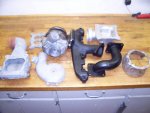
Robert Kenney
Super Moderator
Very nice!! 
looks like a single turbo v8 kit due to the 3 bolt crossover flange. What do they use for the other manifold the oem one?
looks like a single turbo v8 kit due to the 3 bolt crossover flange. What do they use for the other manifold the oem one?
Robert Kenney
Super Moderator
Oops,
guess I didn't look close enough.
guess I didn't look close enough.
Mark Pietz
Member
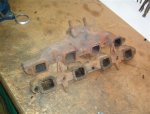
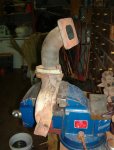
Mark Pietz
Member
Fair question. I know that in the corvair community I had recently left (I had a turbo coupe), this "controversy" had received a fair hearing. Forged are obviously the best choice (if you can afford it), but it is claimed that as most modern autos that have turbos are using hypereutectic pistons as oem, the manufacturers must have a high level of confidence in that technology.
Another question to ask would be the track record of those who had (and really thrashed) those old 152t engines. If those engines didn't have piston failures (maybe other problems, but not that), then that May be an answer. However, I don't believe the pistons we buy today as replacements are the same as the oem IH pistons of the mid-60s.
Hopefully the knowledgeable moderators will chime in here, I, too, would like to get their take on this important topic.
My 196 goes up on blocks this weekend to begin its own turbo conversion. It's stock and will hopefully live with a target boost of ngt 8-9 lbs.
Another question to ask would be the track record of those who had (and really thrashed) those old 152t engines. If those engines didn't have piston failures (maybe other problems, but not that), then that May be an answer. However, I don't believe the pistons we buy today as replacements are the same as the oem IH pistons of the mid-60s.
Hopefully the knowledgeable moderators will chime in here, I, too, would like to get their take on this important topic.
My 196 goes up on blocks this weekend to begin its own turbo conversion. It's stock and will hopefully live with a target boost of ngt 8-9 lbs.
Mark Pietz
Member
My engine is stock and appears to be sound, and is quiet (for an IH). Because of that, I am going to just go ahead and turbocharge it using the original 152t manifolding (pics posted above), plus the original style trw turbocharger (rayjay bought the rights to this unit, so in a manner of speaking, they are one and the same. I'd be curious to know what is on the I.d. Tag on your turbo). The early corvair turbo was a "b" flow, the later '65-66s were "f" flows (greater flow). You would need to see what yours is in terms of "flow" and see if it is suitable for a 304/345. The 152t trw unit was a "b" flow. I have the parts and can build either a "b", "f", or combo (f compressor, b turbine, to spool up faster). There is also a very aggressive "e" flow compressor, but that wouldn't be suitable for my needs. The 152t's would put out around 7 lbs. Boost and live, so I am confident mine (or yours) would do likewise with stock pistons. If/when I ever rebuild my engine, then I'll upgrade the pistsons, but don't know which way yet.
I'm including some shots here, one of which how this looks roughly fit up in a Scout II compartment. For now, I am going carter yh sidedraft. Maybe f.I. In the future, who knows.
I'm including some shots here, one of which how this looks roughly fit up in a Scout II compartment. For now, I am going carter yh sidedraft. Maybe f.I. In the future, who knows.
Attachments
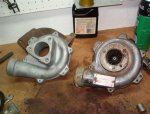
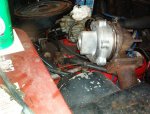
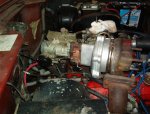
there is no I.d. Tag on my turbo. Must of been removed by previous owner/s or not put on by ray jay (they were known to do that sorta thing). I'm just wondering if hypereutectic pisons will be fine for my build. Also wondering if ihon has them?
As far as I know, the only pistons "commercially" available for IH engine are cast (stock was forged).
Of course, you can have pistons custom made.
Two recommendations:
figure out which "size" turbo you have before you put it on the engine.
If you do not already have it, you should buy hugh macinnes book on turbochargers...
Corvairs came stock with cast pistons -- most people building a strong corvair engine opted for forged pistons.
The only problem with cast pistons is longevity -- if you run it hard or you run it too lean.
The carter yh on a corvair turbo engine was a basic "limiting factor" - can only flow so much air thru it.
Mark Pietz
Member
Stock were forged? I'm skeptical.
True about the yh being somewhat restrictive, but that was for an engine of 164 c.I. Turning up to 5,500 rpm. Exhaust was restrictive as well. The IH turns 4,000 max (I doubt I'll flog it anywhere near that), and I've run some of the numbers using mcinnes' book (it's old, but still very good). So for my needs, the yh will do. Thing to keep in mind is: exactly what is it one expects. I'm not building a racer, but an engine that will have extra power at higher altitudes, like in the mountains (where I live) while pulling grades, etc. That's all. Personally, I think anything else sort of defeats the characteristics desired of these heavy off-road vehicles, but that's only my opinion.
True about the yh being somewhat restrictive, but that was for an engine of 164 c.I. Turning up to 5,500 rpm. Exhaust was restrictive as well. The IH turns 4,000 max (I doubt I'll flog it anywhere near that), and I've run some of the numbers using mcinnes' book (it's old, but still very good). So for my needs, the yh will do. Thing to keep in mind is: exactly what is it one expects. I'm not building a racer, but an engine that will have extra power at higher altitudes, like in the mountains (where I live) while pulling grades, etc. That's all. Personally, I think anything else sort of defeats the characteristics desired of these heavy off-road vehicles, but that's only my opinion.
stock were forged? I'm skeptical..
Which manufacturer's pistons are you referring to? Corvair's were cast... From what I have been told IH were forged -- and given the design use I would think (hope) so.
so for my needs, the yh will do.
True - if you can get new jets and "rods" so the carb works correctly.
thing to keep in mind is: exactly what is it one expects.
True -- but, if you have never "done" it (put a turbo on a vehicle) before, you May be expecting too much.
And, if you do not "spec" it correctly, you May be disappointed...
Mark Pietz
Member
I had read - maybe on this forum - that the original IH pistons had iron/steel "lands" for the compression rings. If true, that feature would make the oem pistons very durable, and resistant to collapse due to detonation (gee, like you'd see with a turbo). The original corvair pistons were cast, regardless of application. Now there are options, but then there weren't, and the pistons lived if you didn't get into detonation.
For the yh, fortunately, there are new rod/jet combinations available, so that base is covered (blackhawk engineering).
For sizing a turbo for these things, I'm confident the original trw turbo will not have a problem being installed on a 196. The "f" flow turbine gives me some flexibility here. Gearing (loading) and the ignition curve also play extremely important roles in when boost comes on, etc. If I were putting it on a 304/345, the issue requires more research and consideration. Then you get into the "one big turbo or two smaller ones" problem. My application is actually fairly straight forward and shouldn't really pose problems.
I'd also mention another thing. Probably not an issue with your particular turbo (which looks like the trw), is that there are no longer original carbon seals available. I have been fortunate in reusing old ones if they don't have cracks or chinks that create a path for leakage (I.e., you burn oil and create lots of smoke!). Since the '60s, this design has been upgraded by rayjay and more modern carbon seals can be retrofitted by machining the aluminum "dish" to accept them. Also, there was a butt-style piston ring used on the turbine, but that has been upgraded with an overlapping style ring. These parts are still available if you know where to look. No biggie.
For the yh, fortunately, there are new rod/jet combinations available, so that base is covered (blackhawk engineering).
For sizing a turbo for these things, I'm confident the original trw turbo will not have a problem being installed on a 196. The "f" flow turbine gives me some flexibility here. Gearing (loading) and the ignition curve also play extremely important roles in when boost comes on, etc. If I were putting it on a 304/345, the issue requires more research and consideration. Then you get into the "one big turbo or two smaller ones" problem. My application is actually fairly straight forward and shouldn't really pose problems.
I'd also mention another thing. Probably not an issue with your particular turbo (which looks like the trw), is that there are no longer original carbon seals available. I have been fortunate in reusing old ones if they don't have cracks or chinks that create a path for leakage (I.e., you burn oil and create lots of smoke!). Since the '60s, this design has been upgraded by rayjay and more modern carbon seals can be retrofitted by machining the aluminum "dish" to accept them. Also, there was a butt-style piston ring used on the turbine, but that has been upgraded with an overlapping style ring. These parts are still available if you know where to look. No biggie.
Robert Kenney
Super Moderator
so I did a search and I cant find any info on forged pistons.
Heres the question: I am rebuilding and turbo charging my 304 and I was told that I need to buy forged pistons instead of having cast or hypereutectic. Is this true or is my machinest pulling my leg?
No sv ever used forged pistons period so we can drop that. Some makers are marketing hypereutectic pistons for our sv's. Not sure I can believe that till I see the lab data for the alloy. The sv piston is very well built. Thick skirts and a looooong bearing surface. Doubt you will ever break one. If you were buildign a sbc you would want to go forged without a doubt.
7-10 pounds max, 4500 rpm and cast pistons in a peak operating regime will be fine in an IH sv that is in a proper state of tune. This also assumes a properly built and set up engine.
Now take this a step further any engine with the best of the best will only last moments if subject to detonation brought on by either being to lean using poor and inadequate fuel quality for the given cylinder pressures or to much timing.
Keep everything with in the proper operating limits.
Compression ratios for you should be 7.5-1 - 8.0-1 max and the best in the 7 range.
Abide by recommended quench distances .040-.045 when decking or choosing a piston. That equates to a zero deck condition with the availible composit head gaskets and a piston with a dished top. Roughly 20-25cc
oil temp must be measured and kept between 160 and 210f max period. Oil is what keeps piston temps in check. A thermostatically controlled oil cooler is the key.
Afrs read using a wide band lambda sensor as close to the head on the collector pipe as possible. Be no higher that 13-13.5 but prefer 12.0-12.5 when manifold pressures are above 14.7 pounds absolute. Leaner will make more power but you will have very little wiggle room for error so stay clear of it. During cruise feel free to lean to 14 afr but ramp richer above 12 pounds map. But if in doubt run a point richer under boosted conditions (11.5-12)
for a draw through system like I think you are building you can get away with not cooling the air charge up to 8-10# boost but it can be touchy because of high air charge temps.
Blow through systems will need air charge cooling above 6# boost to be safe and reliable. Heat is your enemy.
Monitor tit's (turbine inlet temperatures) 1400f max peak and 1350f continuous. This temps correlate to afr's. Richer is cooler.
There are more conditions to keep in mind but this will get you going.
Last edited:

JohnnyC
Member
Mr. Kenney,
I was told to use flat-top pistons and not dished, there are so many different opinions/ideas. Just to make sure I read you right, I need to have dished pistons correct. Is that just to lower my compression. I was taught the only way to change compression ratios is by changing the stroke.
I was told to use flat-top pistons and not dished, there are so many different opinions/ideas. Just to make sure I read you right, I need to have dished pistons correct. Is that just to lower my compression. I was taught the only way to change compression ratios is by changing the stroke.
Robert Kenney
Super Moderator
Just to clarify what I post. They are not opinions backed by bull shit but backed by experience building engines of all calibers. I see each engine through from womb to tomb so to speak. The machine shop does only what I tell him/her.
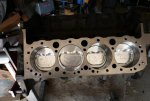
The dish in only in the center. The outer edge is still perfectly flush with the deck surface at tdc so the quench/squish band is .042 in the case shown in the photo. Quench= distance between the head and the outer edge of the piston at tdc
stroke only changes the total cylinder volume.
Compression ratio is calculated as follows
cylinder displacement
+
combustion chamber volume
+
head gasket volume
+
piston dome volume including valve reliefs.(a dome is a negative value and dish is a positive value)
+
distance the piston is down in the hole at tdc in a volume value.
________________________________________
total of above values
divided by
cylinder displacement
in any case here is a photo of a blown sbc I build recently that is @ 8.4-1 and 15 pounds of blower. It needs 105 octane racing fuel per the owners choice. Notice the d shapped dish in the piston. They are 22 cc + 3 cc for the valve reliefs.
This is an effective compression ratio calculator for you to plug your intended static compression ratio and boost levels in to. I have my own but this makes it easy.
effective compression ratio calculator
The dish in only in the center. The outer edge is still perfectly flush with the deck surface at tdc so the quench/squish band is .042 in the case shown in the photo. Quench= distance between the head and the outer edge of the piston at tdc
stroke only changes the total cylinder volume.
Compression ratio is calculated as follows
cylinder displacement
+
combustion chamber volume
+
head gasket volume
+
piston dome volume including valve reliefs.(a dome is a negative value and dish is a positive value)
+
distance the piston is down in the hole at tdc in a volume value.
________________________________________
total of above values
divided by
cylinder displacement
in any case here is a photo of a blown sbc I build recently that is @ 8.4-1 and 15 pounds of blower. It needs 105 octane racing fuel per the owners choice. Notice the d shapped dish in the piston. They are 22 cc + 3 cc for the valve reliefs.
This is an effective compression ratio calculator for you to plug your intended static compression ratio and boost levels in to. I have my own but this makes it easy.
effective compression ratio calculator
Attachments
Last edited:
JohnnyC
Member
Sweet I appreciate your help kenney. Now I'm struggling to find some pistons that will give me the correct cr. Your skeptism about hypereutectic pistons is beginning to make me doubt about buying them. To clarify, dished cast pistons by silvolite will do well in my turbocharged 304?
Robert Kenney
Super Moderator
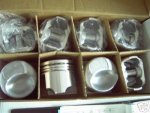
Not much availible for the IH stuff that is anything but stock. Start by getting it pulled apart and cc the heads for combustion chamber. I presume your existing engine has flat top pistons and d shapped chambers. If so the stock pistons by silvolite cam de machined to creat the required dish. Just maintain a crown thickness of .200 minimum.

Robert Kenney
Super Moderator
If your engine serial number has an e in it you need the flat top pistons. Also look at the combustion chamber shape. If you see a general "d" shape where the deck overhangs the bore along one portion, you definitely need flat tops.
If it is basically round you need domed ones like you have.
If it is basically round you need domed ones like you have.