

You are using an out of date browser. It may not display this or other websites correctly.
You should upgrade or use an alternative browser.
You should upgrade or use an alternative browser.
vin #
- Thread starter Rico
- Start date
it depends on what IH you have... You need to tell people the vehicle...
Most of the 70's IH Scout iis, t/a, pickups, it is stamped on the outside frame rail up by the steering box.
For 50's, 60's or older IH vehicles, I have no idea where it is located.
I'm sorry I think it's a 80
Last edited:

Michael Mayben
IHPA Tech Moderator - Retired & No Longer Online
where can I find a vin # be sides the fire wall?
I"m missing the plate that goes on the fire wall.
Thanks for looking...
No way to help you since you didn't tell us "what" IH vehicle/platform you are asking about!!
IH vehicles manufactured prior to m/y 1974 (actually m/y 1966>1973) do not use a true "vin" as you know it. The uniform seventeen digit was a federal regulation implemented with the sop of 1974 vehicles by most oem manufacturers (but not all).
Prior to that ('66>'73), IH vehicles used a thirteen digit serial number that was sometimes referred to as a vin. Information regarding how to decode that style number is contained in the parts list for each platform.
And prior to the m/y '66 production, a serial number was used.
In any case, the frame or "chassis" number is stamped on the passenger-side frame rail, somewhere between the front of the rail and the first cab support. It can be a very small stamping and extremely difficult to locate. You will most likely need to wire brush the entire outside section of the frame rail in order to find it. The last seven digits of that frame number are the vehicle "serial" number and would match the corresponding place holders in the number stamped on the data plate.
The "standard" location for this chassis number is in an area directly above the front axle...but that is certainly not always true!
The mylar printed vin label (in addition to the data plate) was phased in around 1971, but since it's a sticker adhered to the driver side door, door jamb, etc. They are sometimes not able to be read, have been painted over, or have been removed.
The IH parts lists are always coded by "chassis number" as far as cut-off points for service parts lookup.
no way to help you since you didn't tell us "what" IH vehicle/platform you are asking about!!
IH vehicles manufactured prior to m/y 1974 (actually m/y 1966>1973) do not use a true "vin" as you know it. The uniform seventeen digit was a federal regulation implemented with the sop of 1974 vehicles by most oem manufacturers (but not all).
Prior to that ('66>'73), IH vehicles used a thirteen digit serial number that was sometimes referred to as a vin. Information regarding how to decode that style number is contained in the parts list for each platform.
And prior to the m/y '66 production, a serial number was used.
In any case, the frame or "chassis" number is stamped on the passenger-side frame rail, somewhere between the front of the rail and the first cab support. It can be a very small stamping and extremely difficult to locate. You will most likely need to wire brush the entire outside section of the frame rail in order to find it. The last seven digits of that frame number are the vehicle "serial" number and would match the corresponding place holders in the number stamped on the data plate.
The "standard" location for this chassis number is in an area directly above the front axle...but that is certainly not always true!
The mylar printed vin label (in addition to the data plate) was phased in around 1971, but since it's a sticker adhered to the driver side door, door jamb, etc. They are sometimes not able to be read, have been painted over, or have been removed.
The IH parts lists are always coded by "chassis number" as far as cut-off points for service parts lookup.
I think its a 80 no paper work I cant find a vin


Michael Mayben
IHPA Tech Moderator - Retired & No Longer Online
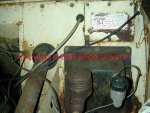
yes, that's a Scout 80 with roll-up windows.
Yes it has roll up windows mine does not have that plate and I didn't see any thing on the door... But I'll look at the frame tomarrow thank you for your help
Michael Mayben
IHPA Tech Moderator - Retired & No Longer Online
yes, that's a Scout 80 with roll-up windows.
Yes it has roll up windows mine does not have that plate and I didn't see any thing on the door... But I'll look at the frame tomarrow thank you for your help
There won't be any type of id on the door or door jamb regarding an s80, placement of an id plate in those positions came much later in production regarding IH-produced vehicles.
Regarding any vehicle (not just IH) which May have had a "salvage title" or a "rebuilt vehicle" title, or a "home built vehicle" title...individual states (this varies tremendously!) issue a so-called vin which is either a metal plate or a one-use mylar tag that must be adhered in a specified location on the body such as the door jamb, firewall, inner a pillar, etc.


IH did not put paint codes on the "data plate" like other manufacturers...
You need to get the line setting ticket for your Scout.
I think the LST can be orderd thru ihon...
The line setting ticket will tell you how the Scout was built at the factory. Of course, that does not mean that it is in the same "configuration" 40 years later.
The paint code for the original color will be on the LST.
To get an idea of the original paint colors available, you can go to tcpglobal website (online paint company) which has an online paint library where you can enter the vehicle and year and see "paint chips" of the various colors...
You need to get the line setting ticket for your Scout.
I think the LST can be orderd thru ihon...
The line setting ticket will tell you how the Scout was built at the factory. Of course, that does not mean that it is in the same "configuration" 40 years later.
The paint code for the original color will be on the LST.
To get an idea of the original paint colors available, you can go to tcpglobal website (online paint company) which has an online paint library where you can enter the vehicle and year and see "paint chips" of the various colors...
IH did not put paint codes on the "data plate" like other manufacturers...
You need to get the line setting ticket for your Scout.
I think the LST can be orderd thru ihon...
The line setting ticket will tell you how the Scout was built at the factory. Of course, that does not mean that it is in the same "configuration" 40 years later.
The paint code for the original color will be on the LST.
To get an idea of the original paint colors available, you can go to tcpglobal website (online paint company) which has an online paint library where you can enter the vehicle and year and see "paint chips" of the various colors...
Thank you for the info.
What does this plate tell u then?
Me, not a whole lot since I am not familiar with Scout 80's --
michael mayben has one and can probably provide more coherent / correct info
"top line"
Scout 80 4x4 fc74949a (is serial number / vin number used on registration / title)
guesses:
86 / 93.4 is probably net / gross hp
4400 is probably gvw
based on a 80 / 800 serial number compilation on another board, your Scout 80 was probably built in the summer of 1963.
It was probably originally titled as a 63, but it could have been titled as a 64.
In those years, IH titled vehicles based on the year they sold; not the year they were built. So, if yours sat on the lot for a few months, it could have been titled as a 64.
The serial number fc74949 is used to get your line setting ticket.
michael mayben has one and can probably provide more coherent / correct info
"top line"
Scout 80 4x4 fc74949a (is serial number / vin number used on registration / title)
guesses:
86 / 93.4 is probably net / gross hp
4400 is probably gvw
based on a 80 / 800 serial number compilation on another board, your Scout 80 was probably built in the summer of 1963.
It was probably originally titled as a 63, but it could have been titled as a 64.
In those years, IH titled vehicles based on the year they sold; not the year they were built. So, if yours sat on the lot for a few months, it could have been titled as a 64.
The serial number fc74949 is used to get your line setting ticket.
Last edited:
Michael Mayben
IHPA Tech Moderator - Retired & No Longer Online
me, not a whole lot since I am not familiar with Scout 80's --
michael mayben has one and can probably provide more coherent / correct info
"top line"
Scout 80 4x4 fc74949a (is serial number / vin number used on registration / title)
guesses:
86 / 93.4 is probably net / gross hp
4400 is probably gvw
based on a 80 / 800 serial number compilation on another board, your Scout 80 was probably built in the summer of 1963.
It was probably originally titled as a 63, but it could have been titled as a 64.
In those years, IH titled vehicles based on the year they sold; not the year they were built. So, if yours sat on the lot for a few months, it could have been titled as a 64.
The serial number fc74949 is used to get your line setting ticket.
IH did not "title" vehicles or determine "year model" back in those days. In fact no manufacturer "titles" vehicles, only the state in which the vehicle was delivered to the end user titles and/or registers motor vehicles. And at that point in time, just like there was no industry-standard vin (the vin "system" was developed by the sae and adopted by the feds at a much later point), each state had their own methodology for determining "model year"...and many states had no "title" law...only a registration and possibly a "safety inspection" routine. Even with the uniform title regulations forced through by the feds in the 80's, some states still do not title "veteran" vehicles that were manufactured prior to an arbitrary cut-off date. Georgia is the most recent state I've delt with in that regard.
You simply have to realize this stuff was current at the point in time in which the vehicle was manufactured, you can't apply whatever any state (or the feds) have on the books regarding these issues today...or even ten years ago!
Every "new" vehicle manufactured for use on public roadways and sold in north america has/had a manufacturer's statement of origin (a uniform code commercial document) issued to the selling dealer at the time the vehicle is invoiced and paid for during the wholesale transaction. That document in turn is surrendered to the titling/registration authority in each state and is/was processed for title according the practices on the books in that state. An mso is considered to be the vehicle's "birth certificate"...there is/was only one generated for each vehicle and those were printed at the same time that the vehicle data plate (or vin plate) was generated. And an mso is considered a "negotiable instrument" in the motor vehicle business and May be held for security/collateral when new/used vehicles are financed under a dealer's floor plan arrangement.
There was a point in time that one could purchase a motor vehicle for say "farm use" or "off-highway" use and depending upon the state in which the selling dealer delivered the vehicle, if the purchaser desired to not title the vehicle, not pay a motor vehicle sales tax, not pay a general sales tax, not pay a "personal property" tax, etc., nor desire to "register" the vehicle (obtain a license plate set), then the selling dealer could transfer the mso to the buyer or to the lending institution if the vehicle purchased was financed. Thus...we still find today, vehicles such as Scout 80 that never were titled (because they were purchased for vocational use only), nor registered. A perfectly legal tax avoidance method as long as the vehicle was never operated on public rights-of-way. Kalifornikate killed that workaround in 1972 iirc with the implementation of the infamous "green stickie" legislation so that they could collect tax any way they could. But in many other states today, that is still a perfectly legitimate method for purchasing a new vehicle.
The only important number on that data plate is the serial number...and if this vehicle was in fact titled originally, in some state, then a title trace can be done by whatever agency handles this in whatever state the vehicle is located. If in fact a title trace shows a positive hit, then it's possible to apply for a "lost title" under many pretenses. If no positive hit is found, then each state has a method by which a title May be issued (along with an agency-generated "vin" sticker/plate), in many states that's a very simple process, in some states it's near impossible to jump through all the required hoops. Assuming that both you and the vehicle are located in kalifornikate, then you get to deal with that wonderful public agency...the infamous dmv.
So what that plate shows is a typical Scout 80 4x4, witha unique serial number progression, and was equipped with the standard 152 I-4 engine, and has a gvwr of 4400lbs., and a "net" weight of 3900lbs. (thus the payload capacity is 500lbs.) most states determine registration fees based upon weight classifications and "type" (such as 4x4 which in some states is a truck, some states is a car, and in some states is a utility vehicle), so the weight for registration purposes is 3900lbs.
Last edited:

IH did not "title" vehicles or determine "year model" back in those days. In fact no manufacturer "titles" vehicles, only the state in which the vehicle was delivered to the end user titles and/or registers motor vehicles. And at that point in time, just like there was no industry-standard vin (the vin "system" was developed by the sae and adopted by the feds at a much later point), each state had their own methodology for determining "model year"...and many states had no "title" law...only a registration and possibly a "safety inspection" routine. Even with the uniform title regulations forced through by the feds in the 80's, some states still do not title "veteran" vehicles that were manufactured prior to an arbitrary cut-off date. Georgia is the most recent state I've delt with in that regard.
You simply have to realize this stuff was current at the point in time in which the vehicle was manufactured, you can't apply whatever any state (or the feds) have on the books regarding these issues today...or even ten years ago!
Every "new" vehicle manufactured for use on public roadways and sold in north america has/had a manufacturer's statement of origin (a uniform code commercial document) issued to the selling dealer at the time the vehicle is invoiced and paid for during the wholesale transaction. That document in turn is surrendered to the titling/registration authority in each state and is/was processed for title according the practices on the books in that state. An mso is considered to be the vehicle's "birth certificate"...there is/was only one generated for each vehicle and those were printed at the same time that the vehicle data plate (or vin plate) was generated. And an mso is considered a "negotiable instrument" in the motor vehicle business and May be held for security/collateral when new/used vehicles are financed under a dealer's floor plan arrangement.
There was a point in time that one could purchase a motor vehicle for say "farm use" or "off-highway" use and depending upon the state in which the selling dealer delivered the vehicle, if the purchaser desired to not title the vehicle, not pay a motor vehicle sales tax, not pay a general sales tax, not pay a "personal property" tax, etc., nor desire to "register" the vehicle (obtain a license plate set), then the selling dealer could transfer the mso to the buyer or to the lending institution if the vehicle purchased was financed. Thus...we still find today, vehicles such as Scout 80 that never were titled (because they were purchased for vocational use only), nor registered. A perfectly legal tax avoidance method as long as the vehicle was never operated on public rights-of-way. Kalifornikate killed that workaround in 1972 iirc with the implementation of the infamous "green stickie" legislation so that they could collect tax any way they could. But in many other states today, that is still a perfectly legitimate method for purchasing a new vehicle.
The only important number on that data plate is the serial number...and if this vehicle was in fact titled originally, in some state, then a title trace can be done by whatever agency handles this in whatever state the vehicle is located. If in fact a title trace shows a positive hit, then it's possible to apply for a "lost title" under many pretenses. If no positive hit is found, then each state has a method by which a title May be issued (along with an agency-generated "vin" sticker/plate), in many states that's a very simple process, in some states it's near impossible to jump through all the required hoops. Assuming that both you and the vehicle are located in kalifornikate, then you get to deal with that wonderful public agency...the infamous dmv.
So what that plate shows is a typical Scout 80 4x4, witha unique serial number progression, and was equipped with the standard 152 I-4 engine, and has a gvwr of 4400lbs., and a "net" weight of 3900lbs. (thus the payload capacity is 500lbs.) most states determine registration fees based upon weight classifications and "type" (such as 4x4 which in some states is a truck, some states is a car, and in some states is a utility vehicle), so the weight for registration purposes is 3900lbs.
That's a lot of knowledge thank you for sharing it with us how do u know so much?

Erik VanRenselaar
Member
that's a lot of knowledge thank you for sharing it with us how do u know so much?
'cause he spends too much time messin' with old IH iron...
Michael Mayben
IHPA Tech Moderator - Retired & No Longer Online
And...I'm closin' in on 63 years, been workin' on shit since I was eight, and was a motor vehicle dealer principal in texas for many years and sold vehicles (new and used) all over the world!
And since I was "there when it happened" during the late 50's>80's when all this uniform title stuff/vin stuff/legalbeagle stuff was going through the state of turmoil that the federal government normally promulgates just like fema in nawlins', I hadda ringside seat! Spent fourteen years as a department chair/instructor in a community college automotive/industrial engine technology training program also.
In later years I was a field service engineer for a major world-class motor vehicle component supplier and worked in assembly plants, sae sub-committees (remember the world-wide conversion from r-12 to r-134a as a mobile hvac refrigerant??), and delt with vehicles coming into the u.s. Market from all over the planet including dealing with "partial build" (incomplete mso/vin assignment) new cars and trucks and overseeing final assembly in ports-of-entry in the u.s.
My only interest in dealing with this old crap is to pass on the information (good or bad!) that I have in my head before the government completely bans the possession and operation of old iron! I can remember stuff from 1959 really well now, but remembering where I was eight hours ago (or ten minutes) is a real stretch!
And since I was "there when it happened" during the late 50's>80's when all this uniform title stuff/vin stuff/legalbeagle stuff was going through the state of turmoil that the federal government normally promulgates just like fema in nawlins', I hadda ringside seat! Spent fourteen years as a department chair/instructor in a community college automotive/industrial engine technology training program also.
In later years I was a field service engineer for a major world-class motor vehicle component supplier and worked in assembly plants, sae sub-committees (remember the world-wide conversion from r-12 to r-134a as a mobile hvac refrigerant??), and delt with vehicles coming into the u.s. Market from all over the planet including dealing with "partial build" (incomplete mso/vin assignment) new cars and trucks and overseeing final assembly in ports-of-entry in the u.s.
My only interest in dealing with this old crap is to pass on the information (good or bad!) that I have in my head before the government completely bans the possession and operation of old iron! I can remember stuff from 1959 really well now, but remembering where I was eight hours ago (or ten minutes) is a real stretch!
Eric VanBuren
Member
As noted in the introductory "meet the Scout" brochure, 4400 is the rpm at which the engine produced the certified net hp (86) and certified gross hp (93.4). 3900lb is the gvw of 4x4 version.