Using a fuel pressure regulator

gotscout73

New member
I have a '73 Scout with a 2bbl carb, 345v8. I have had the float lowered and it runs well below 7,000 ft elev and up hills. However, at around 8,000 ft elev I tend to get a little flooding. People I run with that have Bronco's and Jeep all run fuel pressure regulators and crank them down to about 1 psi when they get up in the mountains. I would like to hear peoples thoughts on this and suggestions for regulators and how to set it up if anyone uses one. Thx
 
Sorry got!

I missed this post!

See your other thread for my "fuel pressure" response.

I run a permanent inline fuel pressure gauge on all my installs so I can monitor any fuel delivery glitches. Doesn't have to be anything fancy.

One psi on a fuel delivery system???? No freakin' way!

Fuel pressure regulators have been on the market ever since car/truck manufacturers went away from gravity feed fuel delivery systems. Most call 'em "economy enhancers" which is total snakeoil marketing bs!

At your "magic" elevation point, you are experiencing a supermega Rich condition....not flooding! See the thread where you posted about your carb issue, post #52 for some "data" which is rule of thumb kinda elevation stuff for any non-forced induction motor.

There is a need for such items in some cases, I work with an old IH backcountry firefighting rig that runs a pto to the main pump and uses the oem fuel pump (304) to also feed an auxilary twin cylinder wisconsin donkey motor for a separate pump, sometimes used to fill the main water tanks from a lake or creek while the engine is running to fight with the main discharge. In that case, the carb on the wisconsin is not rated for 5.5psi, as it's originally a gravity feed carb. That regulator drops the inlet pressure for the donkey to about 2psi which it likes, and the walbro carb needle/seat/float can handle that inlet pressure, even at altitude.

Just an example of how a regulator might be used correctly.

Also, if you are running an auxilary/aftermarket electric pump of the incorrect output pressure (the two common pump systems are 4psi>7psi, and 7psi>13psi nominal), the regulator can be used to dial it back so that it's suitable for the carb being used.

Every engine/carb package has unique fuel delivery requirements, ya can't judge one "type" setup by another! And for nearly all domestic/oem-style carbs, the standard inlet pressure is a nominal 5psi.
 
Last edited:
As referenced in this thread:

http://www.forums.IHPartsAmerica.com/carb-tech/1281-alternative-I-4-engine-carburetion.html

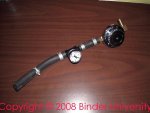
I rigged up a fuel pressure regulator and gauge to use for playing with these weber/Holley 5200 mixers since they require a much lower fuel supply pressure than other "normal" carbs! Max of 3.5psi as opposed to 5>6psi for a real Holley!

This is just a plain old cheepazz adjustable regulator sold under several different private labels, at prices from $20 to well over $50 for the same thang! This one was inna empi blister pack at $22. Likewise for the spectre fuel pressure gauge, I've installed many of those underhood and they hold up just fine to underhood temps and conditions, they are not rated for use in any form of fuel injection service though!

This one is just a test unit for use when I wet test carbs under load on any engine. It's not set up for permanent installation. This regulator is rated in 1/2psi increments from 0.5psi through 5.5psi. This is a solution when converting to an electric fuel pump which is rated for a much higher delivery pressure and ya need to throttle it back!

The regulator body is ported for 1/8" npt, just screw in the appropriate hose or flare fittings for the application. This one is set-up for 3/8" fuel delivery plumbing and I use various step-down adapters when needed for testing purposes.
 

Attachments

  • Fuel Pressure Regulator 004.jpg
    Fuel Pressure Regulator 004.jpg
    58 KB · Views: 3,716
I asked a question about pressure regulators on the bb just before it grenaded. I've had a "purolator" version under my hood for a number of years. Recently my friend's regulator (same brand) sprung a leak, so he's been looking for a replacement. It's good to see that they're still available.

Somebody on the bb pointed me toward the Holley non-FI pressure regulators, which look decent. A little different design, being somewhat rectangular in shape rather than round. One thing interesting about theirs is some models have two outlet ports, making it easy to include a gauge if you wanted one.

The only weird thing about the holleys is that they come in two pressure ranges, like 1-4psi and 4.5-9psi. I wouldn't be sure which one to buy if I were replacing mine with a Holley. My Holley carbs (I run a 7448/"2300" most of the time and a 2210 during smog-inspection season) have always seemed content with ~4.5psi, which I set when I first installed the regulator. With a Holley it would be tough to play with this pressure up or down a little.
 
Patrick,
I have a holly 1-4 # regulator on my Scout and I can get close to 6 out of it and down to 1/2. Seems to regulate fine across the entire range. I use the lower settings at high altitude to lean a bit. I use 1 1/2 - 2 # and it also helps Rich conditions on steep climbs.
 
No doubt the Holley-supply regulators are prolly somewhat more robust internally. I've never dissected one. And the cost is somewhat greater than the off-shore supply stuff like the one shown in the pic.

Those "purolator" regulators, like the purolator electric bellows fuel pumps of yore were actually sourced from walbro under a private label deal.

We're gonna see much more evidence of oldskool fuel-related components as their internal exposure to e10 is increasing.

I have three of the electric bellows pumps, two are many years old and worked fine until this past September, those were used for "utility" fuel transfer pumps for many years (one ran as a primary pump on a vehicle also) and set with fuel inside for months without being used. The third one was new (purolator private label), that one quit pumping while in use the very first time. When all three were dissected...same condition...the bellows pumping component had turned to a liquid state resembling black weatherstrip cement.

The Holley electric pumps should not be affected by this e10 fiasco, completely different design internally but much more dinero also!!

I have one facet low pressure "electronic" pump now that has been used once in transfer mode. When I was finished with it, it got sukked full of sta-bil for storage. So this is a science experiment to see what happens. That pump did not work when I removed from it's packaging the first time. Those have a checkvalve that can be seen through a port...that valve was "stuck". Once I probed it to un-stick...the pump started working.

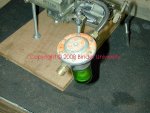
Just as a piece of IH "history", here's a shot of a "filto-reg" add-on piece that was heavily marketed back in the 60's/70's for a fuel economy enhancer. These were also sold under an IH accessory p/n as a "dealer-install" item, but I can't find the catalog page that shows that right now.

This one is installed on a Holley 2300g carb (governor model) on Mike roth's backcountry fire fighting rig (model bc160???). A second unit was also installed to feed the two-cylinder wisconsin-powered donkey pump since those carbs were designed to be "gravity" fed and must have the fuel inlet pressure reduced to under 2psi or the crankcase will fill with gasoline as it's forced past the float needle/seat when the donkey motor is not running.

No tellin' when or who installed these devices way back when, this rig is remarkably complete and functional in all respects.
 

Attachments

  • Filtoreg.jpg
    Filtoreg.jpg
    108 KB · Views: 2,001
patrick,
I have a holly 1-4 # regulator on my Scout and I can get close to 6 out of it and down to 1/2. Seems to regulate fine across the entire range. I use the lower settings at high altitude to lean a bit. I use 1 1/2 - 2 # and it also helps Rich conditions on steep climbs.

Robert's observations regarding "actual" output fuel pressure are the same as mine.

The "click stop" detents on the regulator in the pic I posted are references, not accurate settings. That's why ya wanna always use this stuff with a pressure gauge for monitor.

That regulator is "off" by one detent according to the pressure gauge with the engine running at idle.

All Holley "streetable" carbs (oem and aftermarket apps) with the exception of the 4500/dominator stuff uses a "standard" inlet pressure of 5.5psi, that is what their wet test process calls for. They work just fine between 3psi and 6psi or so. You can also verify this data when reading though the specifications data in the ihc-produced service references.
 
Robert's observations regarding "actual" output fuel pressure are the same as mine.

The "click stop" detents on the regulator in the pic I posted are references, not accurate settings. That's why ya wanna always use this stuff with a pressure gauge for monitor.

That regulator is "off" by one detent according to the pressure gauge with the engine running at idle.

All Holley "streetable" carbs (oem and aftermarket apps) with the exception of the 4500/dominator stuff uses a "standard" inlet pressure of 5.5psi, that is what their wet test process calls for. They work just fine between 3psi and 6psi or so. You can also verify this data when reading though the specifications data in the ihc-produced service references.
My purolator regulator looks just like the on in your picture, except for a sticker on the face of the knob. But it's hard to say if it's the same w/o comparing them side by side.

And yeah, I noticed with mine also that the number indicators on the "dial" didn't correspond to psi. I used a pressure gauge when installing mine. I forget by what percentage and in which direction, but I just looked at the gauge and stopped messing with the dial when I was seeing a consistent 4-1/2psi or so.
 
my purolator regulator looks just like the on in your picture, except for a sticker on the face of the knob. But it's hard to say if it's the same w/o comparing them side by side.

And yeah, I noticed with mine also that the number indicators on the "dial" didn't correspond to psi. I used a pressure gauge when installing mine. I forget by what percentage and in which direction, but I just looked at the gauge and stopped messing with the dial when I was seeing a consistent 4-1/2psi or so.

So we're on the same page here!

Because you are able to monitor your fuel pressure under operating conditions, you can play with increase/decrease and see how it affects overall performance if at all.

But each time you adjust fuel pressure up or down (I'd use only 1/2lb. Increments), then you should also touch up the idle mixture adjustments, fuel pressure (as well as fuel level in the bowl) will change somewhat also. Once you've spent some time playing with that, you will fully understand the relationship.

For instance, set the fuel pressure to 2psi, then adjust the idle setup and let it stabilize. Then start increasing the fuel pressure in 1/2lb. Increments and stabilize. At around 4psi, it will change significantly, at 6psi, idle quality will really go to hell!

I got the perfect demo for this. I have one of the best Holley 1904 carbs I've ever done on my 196 right now, includes one of the reconditioned main well assemblies Robert is doing for us. And it has one of Robert's custom "sight glass" fuel bowls on it. I can tune the carb at 1.5psi for outstanding idle quality, with a perfect fuel level in the bowl, of course, that is way too low for normal vehicle operation.

Then...I start gradually increasing fuel pressure off the regulator. The ability of the float and needle assembly to regulate fuel level at idle starts getting real erratic at 5psi...at 7psi (max) it starts pukkin' fuel through the vent as the float and needle can't handle that. Keep in mind, the fresh oem (mechanical) fuel pump provides a constant 7psi on this unit which is above the spec of 5.0>5.5psi. That is why I always have to set the float level way lower than spec on carbs that are tested on this engine! Until just recently, I've never considered that!

On your 2300 Holley, you can do the same, just pop the sight plug out and watch the fuel level go up and down as ya tweek the dial.

 
Last edited:
so we're on the same page here!

Because you are able to monitor your fuel pressure under operating conditions, you can play with increase/decrease and see how it affects overall performance if at all.
Well... Sorta. I only had the gauge on there for the installation. It was a temporary rig that I tee'd onto the fuel line downstream of the regulator... One of those sunpro "tune-up" combo vacuum and pressure gauges.

But this inspires me to add a permanent gauge. I like that you can do things like improve idle by playing with the pressure.

Btw, I've also have a nice analog air/fuel gauge and 4-wire o2 sensor sitting in a box, just waiting for me to get inspired to hook it all up. That'll be a great tool too I think. But it's a topic for another thread
 
I have a mr gasket fuel pressure regulator on my Scout, 345 mechanical pump and an edlebrock carb. With out it the carb will hardly take a side hill 4 wheeling. With the regulator adjusted to the # 3 it runs pretty good at angles. I think they are good for temporarily lowering the float bowl level. Once fuel is in the float bowl, it is up to the jets and accl pump to determine if the mixture is lean or Rich. I don’t see how a regulator cold “lean up” a motor for altitude, unless it regulated the fuel flow down to almost nothing. Or do I have my facts all out of wack? I live in denver and I run a little Rich as it is. Any one ever have a problem with vapor locking? At about 12,000 feet it seem to get me a lot in the summer on the trails.
 
Once fuel is in the float bowl, it is up to the jets and accl pump to determine if the mixture is lean or Rich. I don’t see how a regulator cold “lean up” a motor for altitude, unless it regulated the fuel flow down to almost nothing. Or do I have my facts all out of wack? I live in denver and I run a little Rich as it is. Any one ever have a problem with vapor locking? Quote]

The flow of fuel is dependent on 3 things,

1) jet size (fuel orifice cross sectional area)
2) fuel signal(venturi suction) proportional to velocity of the air flowing through the venturi.
3) fuel head pressure( distance the fuel is above the jet orifice)
this also increases how far the fuel needs to be lifted before it exits the main nozzle.

As you stated the regulator will allow you to lower the fuel level this reduces the fuel head pressure.

You can set the float level base setting about 1/8 inch lower than spec. And bump the fuel pressure 1 - 1 1/2 psi to compensate at sea level. That gives you a broader adjustable band of leaning. This works particularly well on center hung float Holley carbs. Set the fuel pressure at 1 lb above max (8 1/2 psi) then adjust fuel level to 1/16 below the witness hole. This is a common way to dial in to air density altitude at a track by lowering the fuel pressure.
 
And I might add Robert...we've been discussing Holley carbs throughout this thread. They react very significantly to tweeks, even the basic 1904 which is only one step removed from a soda straw technology-wise but is a remarkable mixer even today.

Each carburetor design series by "brand name" reacts differently, the internal design of a carter afb/avs (which the edelbrock is a clone of) cannot be compared to a Holley, just like it can't be compared to a rochester.

Simply compare the "fuel reservoir volume" of the major carb designs and there is tremendous variation, and same for the "control" side of the float/needle/seat combo. Looking at the internals of a rochester quadrajet makes ya wonder how tha dam thangs can even light off at idle...but when ya study the evolution of the wet-side of the quadra over time, ya can see it was a long road to go down before they got it "right" for all the various apps!
 
Back
Top