exhaust tech

traveler

Member
I was wondering if there are any threads dealing with manifold issues on 304 and 345s

my engine runs sweet...but last night I viewed her at dark and see light (exhaust flame)...visible between the exhaust manifold and the head.

Then I noticed about 1/2 of the gasket has been pushed out exposing the exhaust to cold air.

So am worried about this....
After about 10 minutes the "puffing" sound goes away...and I attribute that to manifold heating and expanding...and self-sealing...at hot.

But it leaks...bottom line....and so I though...ok..now im pulling the exhaust and putting a new gasket. Looking at her...5 bolts...I wonder if those bolts are "heat fatigued" and will break when I pull them...oh boy!! Fun stuff!!

Any suggestions? I could let it go...but will I "pay" for the neglect?

Bigger question..how to remove those bolts without breaking...or lessing the chance of breakage

after ...which bolts to put back...that will last...and any sealers to use with new gaskets?
Thanks fellas
 
Sarcasm? Or did I miss the helpful response? I've seen other threads on this topic and have the same and similar questions. My 304's leaking, likely both at the block-to-manifold junction and at the manifold-to-tailpipe flange. Pulled everything off last weekend - dammit those bolts were stubborn, but the manifolds look solid (no cracks) and the tailpipe flanges weren't rusted much at all. The only significant problem was that the metal gasket/heat shield was rusted and needs replacement.

Questions: (1) is the metal gasket/heat shield alone sufficient for the block-to-manifold junction, or should I also/instead use a soft gasket for a better seal? And if the soft gasket is appropriate with the metal gasket, which should be against the block? (2) my local auto parts stores had both a solid metal and a crushable aluminum/composite donut available for the manifold-to-tailpipe flange - which is better/preferred? (3) any other advice?

Thanks.
 
I figure this is a good spot to land a photo of my exhaust manifold gasket. I had previously replaced the bad gasket between the manifold and heat riser valve. I could never see/feel any apparent leaks, but this photo shows the leaks were underneath the heat shield where they were hard to detect other than the annoying sound.

This was on the passenger side. I have new gaskets on the way from Jeff.

Hope this helps other folks who May be trying to track down such issues.
 

Attachments

  • Exhaust Gasket.jpg
    Exhaust Gasket.jpg
    64.1 KB · Views: 850
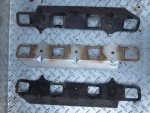
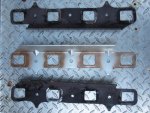
Here are my old exhaust manifold gaskets from the 392 I replaced recently due to exhaust leaks.
Every exhaust port was leaking.
Clean off the head and manifolds with a wire brush to ensure the surfaces are free of carbon, crud, etc.
I put two coats of permatex copper spray-a-gasket on each gasket port before installation. I prefer to apply this the day before, then add a fresh coat just prior to the installation.
Do not over-torque the bolts!!!!!!! Check the bolts after a few heat-n-cool cycles and re-torque them as necessary.

Installation tip: insert the end bolts (one at each end) and get the threads started by hand to hold the manifold in place. Drop the exhaust gasket down between the cylinder head and exhaust manifold. Now you can start the center three bolts.
Use some anti-sieze on the bolts/threads.

Fel-pro p/n ms9566 (one pair of exhaust manifold gaskets)
 

Attachments

  • 2012-10-24 17.11.51.jpg
    2012-10-24 17.11.51.jpg
    75.6 KB · Views: 365
  • 2012-10-24 17.11.30.jpg
    2012-10-24 17.11.30.jpg
    79.7 KB · Views: 366
Last edited:
Here are some answers that will help.

1. Metal or composite gaskets? I prefer the metal. If the surfaces are clean and flat, you usually just have to torque the bolts once. It pays to check them after a few heat and cool cycles. If the manifold port flanges show any corrosion pitting or erosion; it should be taken to a machine shop and have them ground/sanded to good metal and that way you know they are true end to end and all will seal evenly. The head ports also have to be as clean as possible, no bumps of stuck on gasket.

2. The oem style sintered donuts are kinda hard to seal if the manifold's flange is corroded and pitted.
These are the best to use: exhaust pipe to manifold donut gasket w/ inner sleeve - International Scout parts

3. The best advice is to clean all mating surfaces so they are flat and parallel to each other. Don't over torque the bolts, which is easy to do when you use anti-seize.

4. While it's not mandatory, chasing the bolt threads with a thread chaser ensures that the threads get the baked on crud out of them. That way you'll know that all the bolts will put an even crush on the manifold gasket across it's length when you evenly tighten them. Just like it sez in the above post, the end bolts go in first so you can get the longer ones and the hidden middle one in easier.

5. Neglect will be the worse fer sure, the manifold and head ports can erode away from the hot exhaust.

6. Kroil penetrating oil is absolutely the best out there for frozen rusty bolts. It's spendy, but you only need a little at a time, and on that, give it time to work. Patience is your friend.
 
Last edited:
Back
Top