PO botched carb?! Help Please

Hey man...too bad on the halibut, but it sounds like it was worth the trip. Now I'm gonna have to pick up some filets to grill tonight too!

I piston is retracting under vacuum and appears to be the right length for the smaller 2210c power valve...I really don't know anything about the production history of Holley, especially with IH vehicles, but it almost seems like they made a gradient type to go with the smaller valve...but again I have no real experience to base that off of

the one thing that I'm sure of is that I did not install the correct gaskets with the first rebuild

do you think its worth it to put it back on today and fire it up to see what happens?

I'm a pretty patient person, just worried about internal components now since its been sitting up a few weeks since the failed rebuild attempt

can't thank you enough for your time and help michael!
 
Appears there are two different lengths of power valve pistons which don't have the external spring, the "long" one like yours, and the "short" version like some others I have here. I did find a 2210 here that has had parts already robbed, but the bowl cover had not been removed. Very clean inside, has the "long" piston like yours.

The internal spring piston (like yours) can't be swapped in the bore for the "external spring" version.

The power valve in it is in perfect condition, and is a two-stage unit. So it will be in the mail to ya today. However, if ya wanna play with this now, then ya might install that other power valve that was in the rebuild when you did it and see what happens since ya now have the correct main body-to-throttle body gasket.

The gasket you used is correct for the carb body you have. The "other" gasket is used on the versions of that carb that had either a long air cleaner stud with an upset washer/flange made on it to add rigidity to the bowl cover/main body interface, or a set up that used a threaded "spacer" that went into the air cleaner stud hole for clamping force, and then a basic 1/4"x20tpi air cleaner stud was threaded into that.

The oem application of this list r8244a carb was for an IH mv404 engine used in a medium-duty truck app, for the California market only. This is a 2210 carb....not a 2210c or 2245! The "mv (medium v8)" engine series was the next step up in "block dimensions" from the sv engine you are dealing with. Much larger engine physically only used in medium duty IH truck and bus apps. That engine series used a multitude of different carbs, same as the sv series.

At this point, I think we are wasting time trying to figger what is going on completely here! There are too many variations of these dam throwaway smogerators to keep track of as they evolved! But at least now we know what to watch out for! And that pictures are a must when dealing with this kinda stuff!

And much of the information regarding these carbs was based upon chrysler apps anyway since no one ever really cared about the IH stuff before it disappeared and the actual market penetration of these carbs for IH was so very small as compared to all the chrysler variations! As the evolution of these mixers continued, IH was already dead in the water, the chrysler applications continued for several more years.

In some cases, IH did a decent job of documenting progressive, running changes in vehicle specs, but in the case of the Scout platform, it was always treated as an afterthought and not really serious as a "family member" to the IH medium/heavy truck, industrial, and ag product divisions. Many dealerships felt the same way regarding being forced to carry that line! And then...some dealer points only delt in the "light line" stuff!

So this is a great learning experience for us! And now it's forced me to analyze what the difference is in the bowl cover gaskets also! None of this kind of stuff is covered in the literature. And back in the day, the "carb" sections of the service manuals were proved as a "customer service" piece of the carb supply contract to ihc from Holley oem. So the manuals May not be correct for actual carb variations if IH spec'd running changes, again, "change information" was delt with by issuing various "service letters" aka "service/parts bulletins" by mail to the dealer base.

Let's try again!
 
Quick question...I'm mobile right now so I'll get some pics up in a little bit

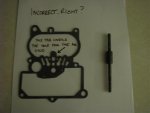
the bowl cover to main body gasket that is correct for my carb is the one without the "tab" covering the hold for the air cleaner stud?

You sent two...one covered that hole and the other did not cover that hole. The stud that I have is fairly long and in the middle of it there's a thick "collar" so to speak...but the stud is one continuous piece

when I did the first rebuild, the gasket I installed did cover that hole, and I couldn't thread the air cleaner stud into the main body, so I poked a hold just large enought to get the stud through

so when I saw the ones you sent it made sense to use the gasket that did not cover the air cleaner stud hole

is this correct

again, I'll get some pics up if needed soon
thanks
 

Attachments

  • gasket and stud 2.jpg
    gasket and stud 2.jpg
    31.8 KB · Views: 555
Last edited:
Ryan: in tweaking with IH-application 2210c carbs for the past 13+ years, I found that some versions thread the air filter stud only into the airhorn (top cover), and some pass through the airhorn and thread into the main body. On a list #6620 carb (threaded into top only) that I used for some time, the pulling of the stud warped the cover, exposing the area of the tops of the main wells to vacuum leaks. Carefully building a #7309 (threaded into main body) from the best of my 2210c parts pile resulted in a much better running carb.
 
The gasket I sent ya "with" the hole segment cut away is correct for that application.

But punching the hole in the other gasket is just fine also. The those carb numbers don't use any penetrations in that center area where the air cleaner stud passes through, though some other list numbers for chrysler do. That's the reason both gaskets are included in some carb kits, depends upon how many different list applications they are shooting for that single kit to work with. Remember the key word in car parts for the last few years has been "part number consolidation"!

The air cleaner stud you show is actually two pieces as I previously described. Sometimes the two parts are threaded together using chemical thread locker and appear as a single machined piece. There is a "third" type of air cleaner stud sometimes found, that one is about the same overall length as yours, but instead of being two piece, it's a single piece witha type of "washer" segment that is upset in the middle section to act as a "screw head" for an extra clamping point in the middle of the carb body.
 
Well, not so good

was able to get the off and on engine adjustments set to service manual specs...but noticed an irregular accelerator pump discharge

if I moved the accelerator linkage quickly, I'd get a healthy squirt...if moving the linkage more slow/regularly I'd get nothing

so when I put it on the road, it'd hesitate/bog down during initial acceleration but could get through it eventually

just picked up a vacuum gauge (yes I know I'm really showing my ignorance here...). Can you tell me which port/tee I need to plug up to to check vacuum correctly??

Ignition system and fuel pump are good. The only irregular thing I noticed was the accel pump discharge
 
Did you use that new accel pump element I sent ya?

Try this...disconnect the accel pump link completely from the completely from the actuator rod retained by the nut.

Block the choke wide open.

Pull up on the accel pump shaft and release. We are looking for two solid streams of liquid from the discharge ports. If you see that...then repeat the same test, only pull the accel pump rod up only half way and release. You should see the same volume of discharge but the duration of the discharge will be much less.

If either test is bogus, then something is "blocking" accel pump discharge.

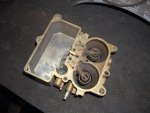
If you do get decent discharge under both conditions, then the accel pump "system" is ok. If discharge after the first shot is inadequate but present, then are ya sure you put the "accel pump discharge check valve in position? That carb uses what we call a "hanging weight" check valve and must be in it's seat in order for the accel pump to work correctly. I can "see" the top of the discharge check valve in two of your pics, just wanna make sure it's actually there...and the valve seats correctly when it's placed in it's bore.

If you are missing that valve, then I have one set aside and can send to you tomorrow with the other power valve. This pic shows what I'm referring to.

Also, with the carb on the bench, you can remove the bowl cover and then pull the accel pump back out of it. The with the check valve in place, fill the fuel bowl about two thirds full of naptha, kerosene, lamp oil, or gasoline (do not use alcohol!). Then insert the pump element and gently operate while watching the discharge action. Do this very slowly/gently and wear eye protection! I do this with the carb sitting inna aluminum pan so the liquid will be contained.

All IH vehicles are major pigs as you know. They must have a very healthy pump shot in order to "launch" and get over on tip-in to the main fuel delivery circuits.

Once you are certain the accel pump itself is functioning correctly, then completely disregard any "adjust spec" in any of the literature! You make it play nice. Ya do that by juggling the lever "slots" and bending the round connecting link/rod itself to give a shot sooner or later based upon how your rig launches...not anyone else's! Ya just don't want the accel pump to run out of adequate travel.

By the way...I have two "new" Holley 2210 carbs here in boxes, both chrysler apps. Those will be converted to IH apps by swapping throttle bodies and a few other parts. But both of those new carbs have non-functional accel pumps! They have been sitting for years wrapped in poly inside of boxes, but the pump rubber elements have dried out so that all they do is hang and will not "pump"!

One more thing...since your carb shows the small rectangular sheet metal cover retained with those two screws, that means it's equipped with the hic device (hot idle compensator). Remove the cover. Verify that the valve is closed with the carb at ambient temp and that the sealing element is in place for the bimetal valve element also, otherwise an overly lean condition will be present at idle and through the transition to the main jet circuits/cruise.
 

Attachments

  • 2210 accel pump check 1.jpg
    2210 accel pump check 1.jpg
    89.5 KB · Views: 578
Last edited:
Username patientlycrawling from the bb here, and I've had similar issues with my 2210. Per the bb FAQ, I acquired a rebuild kit for my 2210 (#7309) and got both 2245 and 2210 power valves. After reading FAQ, I had also determined my 2bbl as a 2245, based on the specific vac fitting size being 3/16".

After finding out that my actuator is the internal-spring, hollow 2245 style, I attempted to install a 2245 power valve. Had clearance issues of a little less than 3/8". Assembly goes just fine with 2210 pv, however. Does this mean that IH made a nongradient (2210) power valve piston in both internal and external spring design?

Mine's mostly a junk carb, and I say this because one of the throttle plate-to-bowl bolts has stripped out threads in the bowl, and will not make a good seal. But as of now it's all I have.

Also, just for notes, these two problems (mismatched bowl/bowl cover/throttle plate and probable vac leak between plate/bowl), carb has an issue of death during any cold startup, no matter how many times.

Also, hard hesitation and usually death during any hard accel, unless you go from hard accel to stumble, and immediately to wot. Usually picks back up if you just mash it to the floor, so I'm guessing it's lean. However, accel pump test mayben mentioned gives healthy squirt when dropped from any level, and choke/fast idle/ign timing/idle mix are/should be in spec.

I'll try to take some pictures to add to this thread... Since mine seems so similar, perhaps there's something to be learned from all of this. I'm definitely interested.
 
Yes sir, I did use the accel pump you sent

as soon as I can get away from this desk, I'll be back at it!

The check valve is in place but I did not test that...will do that too

I do have the hic and the valve is installed. Question: when "rebuilding" I placed a small gasket from the kit in between the hic valve and the main body...there was a machined area for a gasket to be placed

I then placed the valve in and screwed the plate over top..**the hic valve seemed to wiggle in the body..was I supposed to do something differently? Obviously its not rattling around in there but there was no way to make it "seal" to the main body and stay ridgid in place

hope that made sense..I'll get back to it after the daily grind
 
The hic element just "sits" in proper position and is retained by the sheet metal cover when mounted, but the valve itself must seal against the port in the casting through the use of that small self-stick composite cork seal. There are two projections or "legs" on the valve that should fit snugly in the casting when you insert the valve, that holds it in position while ya install the cover. The cover then pushes against those legs.
 
Welcome to the ihon forum kyle! Ya can see we do things a lot different around here as compared to the bb!

All the issues yawl have encountered with these throwaway smogerators is exactly why I call 'em "throwaways"!

And yes...they were evolutionary in nature as Holley worked with their customers in dealing with emerging emissions standards and ways of dealing with that for each market, the "CA only" thing was a major hurdle and really complicates "fixxin" stuff too. Just like when it was new! Hell, even the city of chicago mandated "CA emissions" crap for vehicles delivered to new customers within their jurisdiction!

There is little tech and information regarding these carbs since Holley oem ceased to exist after about 1987, and they were included in bankruptcy processes before that. The "carburetor" era was dead at that point! These units were designed to only "meet" the 50k mile federal emissions warranty program and were not really meant to be "serviced"...warranty process requirements called for "replacement" with new. So the manufacturers had to include service data in various publications, but did not "pay" to fix carbs, replace only! And not just carbs! As mechanics, we hated not being able to fix stuff, that was our job...but this was the beginning of the end (about 1967) of working on vehicles as we knew it, computers and FI was just around the corner and the feds changed everything because of emissions and the way all this add-on crap was incorporated.

And obviously there is much crossover between the 2210, 2210c, and the 2245. And that is just for the IH apps, when ya add in all the other variations for other oem products, then ya can see the problem!

I'd not say the the "vacuum port tube size" is anything definitive, but is only a component of one (or many?) individual list numbers. I only pointed that out as a "difference", not a defining element.

Your stripped thread issue can be repaired through the use of a helicoil, I do that as sop in carb rebuilds as needed.

But there is really no effective way to deal with that power valve piston rot inside the bore, rot in the cast-in internal passages caused by water contamination over the years, or the "gumming"/clogging/corrosion of the brass main well tubes and corresponding passages cast into the main body. And that is just the common issues!

By and large, anyone will be miles ahead in replacing the oem carbs if a "22xx" series mixer...with something that can be serviced over and over. But folks that want to keep it "original" or who have to play the smogcheck game really don't have a choice as there is no new carb which is "legal" for an emissions replacement and carries a carb exemption. The supply of decent core 22xx carbs is depleted as no shop kept throwaway stuff around...and there is no market for "rebuilt" 22xx carbs anyway. I have prolly 18 22xx cores right now, only three "might" be useable as a "rebuilt", ya just don't know until ya get into the meat and look at the big picture in detail to determine if it's worthwhile.

We'll keep working your "projects" as long as ya want to...but just keep in mind, we might come to the point where we declare "junk" and have to move on!

An example is the carb "kit" deal...it's just not possible to get the right kit with the right components needed for every list variation anymore! There is just no market for this stuff and it's service life is only effective if ya can get replacement parts inna timely and affordable manner!
 
the hic element just "sits" in proper position and is retained by the sheet metal cover when mounted, but the valve itself must seal against the port in the casting through the use of that small self-stick composite cork seal. There are two projections or "legs" on the valve that should fit snugly in the casting when you insert the valve, that holds it in position while ya install the cover. The cover then pushes against those legs.

This could be one issue then because the "gasket/seal" I used there was not a self-stic cork material...it was more ridgid

I felt like that wasn't correct...any alternate ideas on sealing that up?
 
If I'm remembering right, there was probably 1/32" of play on each side of the "legs" on the valve..it would stay in place but didn't go in there snug before the plate was screwed in

assuming I could just bend those legs out to get a better fit there, but still leaves me with the sealing issue of the valve itself
 
Ok. I'll throw an hic valve and new seal packing in the mailer along with the other power valve...keep going!

edit!

The hic packing/seal I have is not self-stick as described! But if the carb is on the bench when ya install it, just turn the body so it is "up" and position the seal, then push the hic into position. Once the cover is "clamped" into place, that will hold a tight seal. The normal position for the hic is closed and only activates if an underhood/carb body temp is reached, I don't know what the "critical" setpoint is. In other words, it creates a "metered" vacuum leak when the hic "opens" momentarily.

An alternative....

Because we're not dealing with an "emissions" deal in this case...the hic circuit could be eliminated. One way of doing that is simply carefully tap in a "split shot" lead fishing weight into the actual port inside the rectangular opening where the valve seals the port. Then do the same with the "vent" up on top of the air horn/bowl cover, that would not be a necessity, but rather a "finishing touch" to disabling the hic permanently.
 
Last edited:
Michael, you're part of disappearing breed man...a big thank you and hand shake from north carolina. I'll keep plugging away...no doubt ihonlynorth has a devoted customer and east coast spokesperson
 
also, with the carb on the bench, you can remove the bowl cover and then pull the accel pump back out of it. The with the check valve in place, fill the fuel bowl about two thirds full of naptha, kerosene, lamp oil, or gasoline (do not use alcohol!). Then insert the pump element and gently operate while watching the discharge action. .

Alright, after disconnecting the accel pump rod and manually testing the pump, I'm getting a very healthy shot both fully extended and half extended.

Also, pulled the bowl cover to test the check valve. If I hold the valve in place, the seal is good and there's no discharge...if I don't hold the valve down, its "flooding" fuel out of the passages

when pulling the cover, some of the gasket came with it of course so I'll carefully punch a hole in the extra one you sent for the air cleaner stud

noticed too that the base gasket has basically no "gasket crunch" on 2 of the 4 stud sleeves....I'll pick up a fel pro one and make sure its a good one
 
Now for a stupid question: when taking the carb off this time, noticed some shiny silver around the pcv nipple on the manifold...wiggled it a little and she came right out of the cover?!?

I understand the pcv's purpose for "freshening" crankcase gases...I guess sludge would build up faster if this is not present

is the "nipple" supposed to be part of the manifold or is it removable...you can obviously see where the IH red paint stops..a decent portion of the metal was showing so it wasn't in there good to begin with. What affect would a poor seal have???
 

Attachments

  • SCOUT 001.jpg
    SCOUT 001.jpg
    74 KB · Views: 392
That is a real scruuball "vacuum port" design on the part of IH engineering! That crap cost about half as much as installing a proper vacuum fitting! They used to use proper fittings...but cost reduction drove the ship for Scout II production and that was carried over to some other platforms also. That is one way they plumbed the pcv into the intake plenum on "some" manifolds". And what you have found is very common but it's a good thing you have now found that, that is a major vacuum leak point! The pcv is connected directly from the baffled, valley cover/chamber, to the manifold vacuum source, the internal design/calibration of the pcv valve itself "meters" proper crankcase ventilation to attempt to maintain a slight negative pressure in the crankcase when the engine is running.

All motor vehicle engines sold after about 1961 must have some form of pcv. And the carburetor itself is calibrated during engineering to take the pcv system into consideration, since that is an "engineered" vacuum leak, the idle mixture circuits on the carb are adjustable to compensate for the pcv "vacuum leak" if it's a metered leak. But what you see is an "un-metered" vacuum leak!

Ez fix...remove the tube from the hose. And most likely you could stand to replace the pcv hose anyway!

Then "lightly" tap a tapered punch/drift into the end where it engages the hole in the manifold. Ya wanna "very slightly" swell the end of the tube. Then push it back into the hole and tap the end carefully to drive it into a seated position. I drive 'em in dry, if it does not fit tightly with no movement, then I use locktite stud/bearing grade liquid on the fitting before driving back in.

Good thing I sent ya an extra gasket!

So the accel pump system is working as it should, but you will need to tweek it for max output early in the throttle plate rotation.

I'll go ahead and drop the parts to you tomorrow, I can't think of anything else I can send ya right now!

As for the heat dam insulator gasket. If the paper is not torn or damaged, then pop out all four of the "bushings". They are either delrin-type plastic (really nice quality stuff) or steel with an oxide finish. Then lightly sand/grind about 0.005">0.010" off one end of all four. Then re-install. That will insure proper gasket crush when the bolts are snugged down. I have to do that quite often on those gaskets when new due to manufacturing tolerances and poor qc on the part of fel-pro or their root manufacturing contractor.

All these little details you are finding/correcting will make a difference! These smogerators are ragged edge lean and that is why they are so tedious to try and restore to operation! They allow no margin of adjustability. Originally, there were "limit" caps on the mixture screws and only a dealer mechanic was supposed to mess with 'em! They have a very fine line between "work ok" and "pure crap" as far as drivability is concerned, right now you are trying to emerge from the pure crap stage!

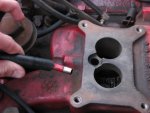
Once the engine is running again (even though not perfectly??), I want ya to do a redneck test on the egr valve. That is that flat can-looking device below your hand in your pic. With the engine idling the best it can, use a couple of fingers underneath the valve and you will feel some openings or slots. Be careful, the edges of those slots are sharp! Then push with your fingers up on the diaphragm of the egr valve, that is the fabric-appearing item underneath the cover. When you push up, the engine should start stumbling and the idle quality goes to hell. You just manually "opened" the egr passage. When ya release it, idle returns to ok (we hope!). Do that several times to cycle the valve. If idle quality comes and goes, then the valve is at least sealing when it should (at idle). If not, then the valve pintle needs to be cleaned, it will be clogged with carbon. It's "possible" that right now, the valve is clogged/stuck in the "open" or partially open position, that just creates one more vacuum leak point!

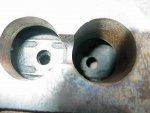
When you look straight down into the intake manifold on the floor of the plenums, you will see two holes about 1/4" in diameter. For the egr system to function properly, those holes need to be cleaned out, ya can poke the shit with a pick and then use a vacuum cleaner to suck the debris out. Then...plug the fuel line where it goes into the carb so it can't squirt fuel. Crank the engine over several times (pull the coil wire out first!) and you will see mt. St. Helens erupt from those two holes! Use vacuum again to pull any remaining particles outta the plenum, ya don't want that stuff going into the combustion chambers!

The pic shows the same thing I've just described. However, the manifold in the pic is on an amc 401 engine inna '73 Travelall. But that engine came originally with the same carb you are struggling with! See the carbon accumulation in the left hand plenum??

 

Attachments

  • EGR Ports.jpg
    EGR Ports.jpg
    201.4 KB · Views: 408
Last edited:
Alright! I'll test the egr when the mixer's back on

yeah....my plenum floor makes that amc's look spotless!! I'll definitely get that cleaned out

on the valley cover, the plastic retainer for the pcv valve is also loose...its in the opening but not "sealed" in anyway to the cover. The pcv valve is relatively new and seats well in the plastic retainer...does the retainer need to be sealed on there too? I was scared to fool with it thinking that plastic would probably break on me
 
Back
Top