Broken rocker!

Nelson

Member
1) vehicle model. 100 pickup
2) production date/or year model. 1974
3) two wheel drive or four wheel drive. 2wd
4) type of transmission (and transfer case if applicable). Not sure
5) if 4x4, which axles front and rear. N/a
6) which engine variation. 345
7) which ignition system variation. Not sure
8) which fuel system variation. 2210c
9) which brake system variation. Oem


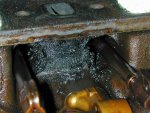
well, I finally was able to remove the valve cover today and this is what I found:

http://www.designhausinc.net/International/img_0149.mov

Hopefully the video shows up ok. So this was probably caused due to non-oiling also, I'm assuming, but the rocker seems to have actually broken from the bushing? Not even sure it was supposed to be attached from seeing just pictures on here, but I guess I'll find out what the deal is when I get the rocker assembly off and cleaned up. Mayben's right again!
 
Last edited:
And here was michael mayben's reply from another thread this was initially tacked onto:

"ain't it ez when ya know what to do?

Take this (previous) post and use it to start a new thread and we'll talk ya through the rest of the deal. We can also fix ya up with parts to repair this.

But...we still gotta figgr out what failed...did the rocker simply decide to take a hike? (doubtful), is that broken rocker not oiling? (most likely). If that single rocker quit oiling, then we gotta see if all the others are oiling or just that one has starved.

But all in all, this is not gonna be a big deal to fix and dam shore don't involve r&r of the head(s)!!

Go back and review this thread until you can see it all nite long in yore sleep:

I-4 and sv engine non-oiling rocker assembly

I'm not saying ya got a cam bearing issue, we just have to work through this one step at a time and determine what the root cause here is...yes, the rocker arm is trashed...but what caused it?? Simply replacing with another rocker is not gonna fix it, we gotta fix the root cause!

For instance...if the valve is stuck hard in it's guide...normally the pushrod will bend or break into pieces. But...it's certainly possible that the rocker arm broke instead. Either the pushrod or the rocker is the "fuse" for a hardstuck valve (that's my redneck terminology).

Currently, there is no pressure on the valve/spring combo since the rocker arm is doa...is the valve/spring all the way up or does it appear to be partially pushed down/in?? If it's down, then we gotta hardstuck!"
 
Ok, after taking it all apart, I found a few disturbing things. Only the #3 oiler hole wasn't plugged. All the rest were! Furthermore, they seemed to be plugged with what I can only describe as bearing pieces, much as I hate to say it. See photos below... And, the rocker rail looks to have been starved for oil for quite some time and is as good as a paperweight now with the scoring/seizing on it. I'm sure it'll be exactly the same way on the other head. So, how can I diagnose if this is cam bearing or rod/main bearing sediment? Would those even travel up this far? I know I can pull the pan to check the rod/main bearings and check for more pieces, but how would I check the cam bearings? I suppose the intake manifold and/or heads will need to come off? Oh, and I forgot to go back and see if the valve spring is all the way up or down. I'll check and let you know. But I did remove each pushrod and visually inspect it before replacing it in the divot on top of the lifter...they all looked straight and undamaged.

img_1116.jpg


img_1120.jpg


img_1123.jpg
 
That was quick!

Unfortunately, you are seeing the disease! Cam bearings have failed, most especially #2 and #4.

And that extreme wear on the rocker shafts is indicative of lack of maintenance over a long time (typical po abuse). The rocker shafts are plugged with gunk so they can't lube the rockers and valve stems. And they ran a long time with limited oil supply.

This is most likely why this rig was parked originally. You have brought it to life and the result is the weakest link failed.

This is not an engineering issue regarding the engine lubrication system...it's pure and simple a lack of maintenance issue that developed over time. Other engines shit their rod bearings, toss a rod, break a piston, etc. The motors simply loose the cam bearings.

So...what you are looking at is...either a major rebuild of this engine...or finding a replacement that is serviceable. And in my opinion, I'd much rather build this engine from scratch than screw with another unknown motor that hasn't run in years also but is "cheap" because of someonelse's failed project. Too many times I've seen these "good deal" engines that have set for years turn out to be just as bad as the one ya got now. Occasionally we'll luck out and get a decent runner, but unless you can hear a used motor running and look at oil pressure and rocker oiling, it's a crap shoot as to whether the same thing will happen with a donor.
 
I May have second-guessed myself. If they were bearing particles, I wouldn't be able to break them apart between my fingernails would I? They have the consistency of hard dirt-clods, but don't seem to be metallic. I can grind them up in my fingers to a thick powder. Regardless, it's obviously not the sign of a healthy engine and proper lubrication, but maybe it's not as bad as I thought?
 
Not sure how big those truck pans are, or how much is in their way, but you might want to figure on dropping it if you're still not convinced. I think you're likely to get a better feel for what's been going on as far as debris in the engine is concerned.
 
Thanks kyle, I think that's probably be a good idea. I think the chunks I found May have been hard carbon deposits that broke off and are flowing around the system (and probably also clogging the system in the process). I'm not sure how much will need to be moved to get to the pan...l seem to remember some suspension crossmember being in the way, but maybe the pan can be dropped without messing with too much else.

Still, if there are carbon deposits of this size shooting around the oil channels during engine operation, it's probably only a matter of time before the non-oiling issue presents itself yet again either in the same location or another...

But if I can get it running again well enough to feel comfortable driving it to a friend's garage where it will actually fit and can be worked on inside during the winter, I'd feel a lot better about doing an engine teardown, cleaning, and buildup.
 
That type of debris is likely from the rocker shafts. It can't get past a functioning oil filter so the bottom end May be ok.

Back when that engine was in its hay day leaded fuels were the norm and the burnt lead in the fuel makes it's way in to the oil and deposits as gray/brown sludge. Often when I hear about guys trying to cleanse the inside of their engine with a miracle solvent I picture what you are seeing. The sludge breaks loose and plugs all of the small passages.
 
Thanks Robert. That May be it also, as I didn't notice any of this debris until pulling the rocker stand bolts out of the stands, and it was all seemingly pulled from inside the shaft and rocker stands that had oil grooves (but were non-oilers). The one rocker stand that is an actual oiler was not plugged at all. Also, upon closer inspection the debris looks like it's formed along a smooth semi-circle on one side with a smallish diameter (inside of shaft?). That smooth semi-circular side is what made me think they were bearing pieces originally, but the other side is lumpy and the curvature looks to be too small of a diameter to be a bearing.

And I promise I didn't use any of the snakeoil solvent! I refuse to use any of that stuff. But it had recently had its first oil change since I owned it (a day or two before this all happened), and maybe newer oil has some of that detergent or carbon-fighting solvent in it?

Anyway, if I decide to try to get it running again as-is, will I need all new rockers to go with a new shaft? Or can I continue to use these rockers (with a new one to replace the broken one, of course) with a new unscored shaft?

Thanks guys!
 
The babbit layer of a cam bearing can break up in many ways. I've also found babbitt residue inside the shafts when cleaning (those shafts are worthless at this point, cleaning would be a waste). But normally, the cam bearing material does not make it's way to the rocker shaft except as particulate.

In one case, I watched a 152 literally disintegrate cam bearings before my eyes while running with the valve cover off. Oil turned from nasty black to pearlescent with micro-particulate while it emerged from the each rocker arm/shaft interface. The owner was still in complete denial about the cam bearings disintegrating after having replaced the same pushrod three times due to bending! So he finally was made a believer as he watched it take the big dump that rendered the motor a core.

The only way to "kinda" verify that the cam bearings "might" be ok without teardown is to run the oil pump from the drill motor while the rocker shaft is removed and watch the action at the oil delivery hole on the head surface. That is where I apply the oil pressure gauge so I can verify that the oil pressure at that point is the same (or nearly the same) as the oil pressure at the main gallery checkpoint.

Bearing babbit layer material has the consistency of lead foil. When you attempt to "crush" it, it simply spreads out and maintains it's matrix. Carbon/sludge chunks when crushed will break down into a powder-like material.

The large chunks of carbon form on the rocker side of the head due to the oil being overheated and "flashing". Most common right in the middle where the exhaust crossover is, you will find the pushrod holes at that point nearly completely clogged with burnt oil/carbon due to the extreme heat present at the crossover.

This pic shows my own engine with the extreme carbon accumulation at the area I've described, this is just one side. The carbon had actually partially eaten through the od of one of the pushrods due to it's extremely abrasive nature.

Those carbon chunks really aren't a problem as long as they stay adhered to the iron surface. When they break loose, they will have a tendency to clog/restrict oil return back to the sump through the return passage at the rear of each head. The crap that drains back to the sump simply lays in the "sump" where it's supposed to based upon design! But...much of it is picked up by the oil pump "float" and will completely clog the intake screen, thus starving the oil pump and the rest of the engine for oil on an intermittent basis.

Pull the pan off any engine that's been neglected over the years and you will see an amazing accumulation of all kinds of "stuff" in the sump, as long as it lays there, that is not an issue. Same thing is found inside axle housings and transmission housings. That is the function of the sump design.

Larger portions of babbit can go through the block/head oil hole and into the rocker shaft but they won't come out. Eventually the rocker shaft starves, which is what caused the extreme wear and damage.

With a rocker shaft that is in a totally destroyed condition like yours, the other side is gonna be the same. If you can satisfy yourself that the cam bearings are still serviceable, you are going to need a complete refreshing of the rocker assemblies. You can see from reading many other threads in this sub-forum this is a very common theme regarding neglected engines.

Those are the "welded" rockers as we refer to 'em, they have a bushing inserted that is nla. As far as reusing each rocker (there are an intake and exhaust rocker for each hole) you must inspect each for bushing serviceability, along with the "pad" (tip) that contacts the valve stem. Those rockers are simply not available except as good used parts, we still have a few, don't know if we can make up a complete usable rocker assembly right now or not.

We can supply a complete new rocker assembly using boat-style rockers with correct new rocker shafts, however, the pushrods used with those are becoming very hard to obtain new (we do have some used ones for 345/392) and in the future we will have to have the boat-style pushrods custom made.

Again, study several threads in this sub-forum to see what your options for rocker service are if it turns out the cam bearings are serviceable based upon running the oil delivery/pressure test. Otherwise you would be throwing cash down the rathole.
 

Attachments

  • Carbon at exhaust crossover.jpg
    Carbon at exhaust crossover.jpg
    96.9 KB · Views: 755
Last edited:
Hello again michael. Well, I've got a new issue. I ordered a new rocker shaft and a replacement rocker for the broken one through ihon. I finally had some time set aside to fix it today, so I was sitting down to assemble it all this morning, and I'm finding that the rocker stands won't fit on the new shaft. The new rocker and old rockers slide on just fine, but the shaft is too large of a diameter (by just micrometers I'm sure) for the stands to slide on. I tried a few different stands and tried putting them on from both sides of the shaft. With assembly lube and without. Tried tapping them lightly to get them started and still no dice. Not sure what I should do. I tried to pm you about this because I don't want to reflect badly in any way on the product or sellers, but apparently you don't accept pms. If you would rather call me and discuss it over the phone, my number's (208) 629-9679. Thanks!
 
This is the first time we've heard of an issue with the rocker stand/rocker shaft fitment.

Jeff has just located a supplier for the nine stand/welded rockers shafts. Those have not been available in the past from any source. Are the new shafts plugged at each end? Is there a witness Mark on each end indicating the "up" position for mounting?

Shafts for welded rockers must have the oil holes for each rocker position installed on top (away from the head). That is distinctly different compared to shafts used with boat rockers which must have the oil holes installed down (toward the head).

Regarding taking apart existing rocker assemblies that have been in service for many years, I sometimes struggle to remove the stands as they are heavily varnished to the rocker shaft. I soak the assemblies in carb dip now to "pre-treat" and then they will come apart. Once apart, each rocker stand gets honed, then cleaned again, and then inspected for cracks/distortion and the "roundness" of the hole. Most are not "round" as they have been crushed by over-tightening of the rocker stand retaining bolt.

I've not had my hands on one of the newly-sourced rocker shafts, so it's possible they could not be machined correctly. We need to look into this and will do so on Monday when the shop is open. All of the reconditioned rocker stands that are on the shelf at ihon came through my shop for the reconditioning and inspection process, each was test fit on a mint rocker shaft I have (the only one in my stash!!!) so we know they will properly fit an ihc-produced rocker shaft of either style used (welded rocker shaft or boat-style rocker shaft).

The original od of the rocker shaft should be 0.858".

The original id of a new (never mounted) rocker stand should be 0.875". However...once the actual rocker stand is mounted and it's compressed by the clamping action of the bolt (these stands are a relatively soft cast aluminum), it would have a nominal id of 0.865" parallel to the axis of the bolt hole, and 0.885" measured at 90* to the axis of the bolt hole. In other words, it becomes "oval" after being mounted and crushed, thus the sometimes difficulty in removing them from the shaft.

Sorry you have encountered this issue, but we will figure out what is going on and take care of it.
 
Thanks for your reply. Regarding the shaft, yes, they are plugged at both ends and the half circle witness marks are on both ends. One thing strange about it is one end of the shaft doesn't have a bevel to it, while both sides of the oem part are beveled slightly. I thought that might be my issue, so I tried sliding the stands on the beveled end instead but it still wouldn't go. I don't have a micrometer, so unfortunately I'm unable to tell what the diameter is of the new shaft. It certainly looks to the naked eye to be the same as the old shaft, but must not be. I have a neighbor who works at a machine shop and can probably get a micrometer for me to check it with.
Your explanation about the stands getting compressed into an oval makes sense also though, so perhaps I need to give them a few light taps on the side to "round" them out a bit. They were a bit difficult to remove from the original shaft. Still, since they do slide onto the old shaft fairly easily since cleaning them, I'm surprised they won't fit the new one. Anyway, thanks for your help and I'll try to get me some more info as soon as I'm able to take some measurements.
 
thanks for your reply. Regarding the shaft, yes, they are plugged at both ends and the half circle witness marks are on both ends. One thing strange about it is one end of the shaft doesn't have a bevel to it, while both sides of the oem part are beveled slightly. I thought that might be my issue, so I tried sliding the stands on the beveled end instead but it still wouldn't go. I don't have a micrometer, so unfortunately I'm unable to tell what the diameter is of the new shaft. It certainly looks to the naked eye to be the same as the old shaft, but must not be. I have a neighbor who works at a machine shop and can probably get a micrometer for me to check it with.
Your explanation about the stands getting compressed into an oval makes sense also though, so perhaps I need to give them a few light taps on the side to "round" them out a bit. They were a bit difficult to remove from the original shaft. Still, since they do slide onto the old shaft fairly easily since cleaning them, I'm surprised they won't fit the new one. Anyway, thanks for your help and I'll try to get me some more info as soon as I'm able to take some measurements.

Don't try and hammer the rocker stands back into "round"!!! They will crack and shatter nearly like glass!

When I recondition the stands from the cores we collect, each one gets honed internally using a brush hone to clean up the id, and then individually tested for the ability to slide over the shaft during the visual inspection.

Until I discuss this with Jeff tomorrow morning, I don't know what the situation May be regarding these welded-type rocker shafts being possibly oversize. If they were produced using a "hard chrome" process, then it's possible that simply the final od spec was not observed during the finish grinding. That is why we need actual accurate measurement in order to be able to discuss this with the manufacturer and to be able to 100% inspect our inventory, we do not want this happening again, it's taken much leg work to be able to offer these parts!

Fyi...the nominal diameter of the welded rocker bushing id is 0.870". This is based upon my having measured literally hundreds of these rockers that have an unworn point inside the bushing even though the rocker itself is beyond use except as a core. There was a point in time when we had two separate businesses rebuilding these rockers for us, but now the source for the replacement bushings has dried up and nobody is still rebuilding 'em.

The "specs" for these items taken directly from the service manual are:

rocker shaft od: 0.8625>0.8650"
rocker bushing bore id: 0.8655>0.8695"
bushing-to-shaft clearance: 0.0005>0.007"

the rockers stands have no "spec" as they are not considered precision-machined items. They do all need to be within a tolerance range for the centerline of the bore-to-mounting surface however so that the rocker shaft is located the proper distance above the machined head surface in order to achieve appropriate lifter pre-load and prevent oil bypass between the "oiler" rocker and it's spit hole on the head boss.

You can see from the above specs, the service limits on this stuff is huge!
 
Ok thanks for the heads-up. I will just leave the stuff alone until hearing back from you on this. Hopefully I just got a defective one, and they have only produced a few...it would be a shame if they had created large quantities of them oversized. I had thought if worse came to worse, I could have the rocker stand center-holes bored a bit larger, but hadn't thought of the tolerance being important to ensure no oil seeped out before entering the shaft and oiling the whole assembly. Glad I didn't do anything with that! I sometimes don't use my noggin completely when trying to find a "solution" and end up causing even more problems. Just let me know what you find out. Thanks again!
 
Tuesday bump...any word on this?

I'm waiting to hear from you regarding the actual measured od of the rocker shaft you received from ihon!

I've discussed this with Jeff and we know how to proceed based upon the measurement of your shaft. Right now, these shafts are being custom ground to a dimension that we do not know. We simply must have your shaft dimension in order to be able to discuss this with the manufacturer, we do know what the shaft diameter (finished) is supposed to be.

What you are experiencing is not a flaw or mistake, but a planned occurrence that the manufacturer has come up with to deal with the lack of component-level parts to be able to supply a fully remanufactured rocker arm assembly (not just components). But when dealing with just a few pieces (instead of a manufacturer-supply assembly), there May be some incompatibility issues that have cropped up in this regard. This is a new offering form our supplier and it looks like we will need to work together to come up with proper parts that meet each individual customer's needs.

Sorry that you are the test bed for this...but we will do what we have to do to make it right! Please...make no modifications to any part or do any sort of workaround until we work through this.

While it May appear that dealing with the rocker assemblies and components is simple (and in the past when parts were still manufactured it was!), what we have to do now results in many areas that have to be looked at, that is due to the non-adjustable nature of the rocker system used in the ihc-produced engines. Everything is based upon a pre-engineered and specified set of dimensions. And the dimensions are very critical since we can't "adjust" anything!
 
Oh, ok sorry...miscommunication. I was thinking Jeff had one at the shop he was going to measure. I will check with my neighbor tonight on the micrometer and post my findings.

And no worries on the issues...I understand (now anyway, not when I bought the truck!) that parts for these puppies are not exactly easy to come by and I appreciate the fact that you guys are getting them manufactured for those of us who need them!
 
Alright...stopped by harbor freight on the way home and picked up a digital caliper. Here's what I came up with:

od of original shaft: 0.8620
od of new shaft: 0.8665

id of old rockers: 0.8695
id of new rocker: 0.8685

id of stand (height): 0.8625
id of stand (width): 0.8765

hopefully this helps.
 
Last edited:
alright...stopped by harbor freight on the way home and picked up a digital caliper. Here's what I came up with:

od of original shaft: 0.8620
od of new shaft: 0.8665

id of old rockers: 0.8705
id of new rocker: 0.8685

id of stand (height): 0.8625
id of stand (width): 0.8765

hopefully this helps.

Gotcha! I could not live in the shophouse without harbor freight! I have cross-calibration checked all my hf precision measuring instruments with the "good stuff" (starrett) I have, absolutely no difference at all! And that is using both reference standards with all instruments!

So you can easily see the issue here!

We'll deal with this asap with the rocker shaft manufacturer and let ya know what we'll do.

Sorry again for all the trouble.
 
Any word from the mfgr. Yet? Sorry, don't want to sound impatient but I really need to get my truck on the road, unfortunately...winter weather's here to stay, it looks like. Do you or ihon have any cleaned-up used shafts for sale? I just need something to get it running again, so I'm not too picky.
 
any word from the mfgr. Yet? Sorry, don't want to sound impatient but I really need to get my truck on the road, unfortunately...winter weather's here to stay, it looks like. Do you or ihon have any cleaned-up used shafts for sale? I just need something to get it running again, so I'm not too picky.

Sorry man! I thought Jeff had responded to you.

The information we discussed with the manufacturer of those shafts is not what we wanted to hear. While the methodology they are using does have merit for someone using a completely assembled rocker assembly sourced through them, it appears that doing simple parts replacement at the component level is not something the typical diy folks can do successfully. And...their methodology for doing the assembly is not something I'm enthused about either and won't be until I actually install and run one of their assemblies.

So here's what we can do...

1) put all parts associated with the subject rocker arm assembly in a box and ship it to me. I will then correctly assemble the entire unit for you making appropriate mods as needed for proper fitment including assembled "height" of the rocker stands on that reconditioned shaft.

2) I have enough parts to assemble exactly one nine-stand/welded rocker assembly here. There was a point in time when I had several sets of good pieces but we've since sold off that stuff over the last three years. I've also recently acquired two more sv engines to part out, but have not removed/inspected the rocker systems. Both are going to be nine-stand/welded units though.

So...in the interest of "customer service", I can assemble and send you one unit. The rocker shaft will be clean internally and while the parts will of course exhibit some wear pattern, I would not hesitate to use this assembly on my own stuff nor would I ever think of placing one of these units with a customer. I can assure you that this assembly will have no issues. But that does not guarantee that it will solve your problem if it's lubrication starvation-related due to the "cam bearing" issue.

Once you receive the assembly from me, then return all of your take-off parts including the parts that Jeff shipped you and I'll deal with that stuff accordingly.

All of these type parts belong to ihon but are simply stored here at my location for reconditioning. We made a used parts transfer several years ago to facilitate the ability to offer used/reconditioned items such as this to our customers on an ongoing basis as long as we can gather cores parts to use. In the case of rocker assemblies, very few of what we get in are servicable, but we can nearly always glean some good parts off the assemblies!

Again, I apologize for not getting back to you in a timely manner.

So...send me an email to:

michael@IHPartsAmerica.com

And let me know which way you wanna go. Be sure to include you ship-to address. I know I already have that logged, but just in case!
 
Ok nelson, I completed your rocker assembly today, I'll ship it to you tomorrow (Wednesday dec. 1) so you will see it by the weekend.

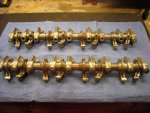
Your assembly is the one in the bottom of this pic. The one on top is a "test" unit I keep with all my tools for investigating non-oilers. I simply swap the assemblies if I find an engine that I suspect is not oiling the rocker assembly due to clogging of the rocker shaft itself.

Each of your nine rocker stands was inspected for cracks (none found) and then individually re-sized for your new rocker shaft.

All your parts got soaked in a serious parts cleaning chemical and then hand cleaned individually and inspected. I went ahead and replaced a few other of your rocker arms with ones I had that were in better condition. This assembly has not been "pre-lubed" as I do when preparing 'em to go on a fresh engine build. There is a reason for not doing the pre-lube in this case.

I'd prefer that you run the engine with no valve cover and watch to verify that each and every rocker arm oils, which means that oil will drool down the top of each rocker in that "slot" where the two halves meet. That is the way that both the pushrod pocket and the valve tip are lubricated. If you have oil flow on all eight rockers, then the rocker assembly is oiling correctly. This can take up to ten minutes or so to establish once the engine fires and goes into a stable idle as the entire rockler shaft must fill internally with oil through the feed port in the rocker stand.

I've also included four replacement pushrods for use if that situation pops up. Keep 'em on hand, those are becoming very difficult to obtain also.
 

Attachments

  • Nelson Rocker Assembly.jpg
    Nelson Rocker Assembly.jpg
    92.6 KB · Views: 346
Michael - you are the man! Thank you so much for your support on this...it's much appreciated. So I get to use my shiny new rocker shaft afterall, eh? You just had to bore out the stands a bit more to get them to fit over it?

Thanks also for all the cleanup and inspection/instruction. I'll be sure to put it back in the correct way and verify that all rockers are oiling before bolting the valve cover back on. I bought some permatex thread sealant...do I just need to do a small dab on the bottom threads of each bolt? I'm wary about it globbing out when screwing down and plugging the oil hole...

Thanks also for the replacement pushrods. I will definitely keep them handy in the event that I need them now or down the road.

Can't thank you enough!! I'll let you know when they come in and if I have any other questions. Ihon (and specifically mm) is the best!
 
Back
Top