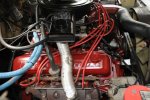
modulated air cleaner vacuum lines

michaelp

New member
I have a 71 800B with 304 and 2300 carb, bw11 tranny, and also happen to have the "modulated" air cleaner. I am trying to get the vacuum/other lines hooked up correctly. I am sort of piecing this together since my service manual only has a "full" vacuum diagram for '72 sii and above. I don't fully get how the pieces of the modulated air cleaner work together to let in warm/cool air as necessary.

1. Does the modulated air cleaner (pic attached) snorkel get attached to a manifold vacuum source? I assume this can just be off the t on the back of the intake manifold?
man1.jpg

2. I have a large line attached from the air cleaner to my flame arrestor. There is a second smaller attachment point at the back of the air cleaner, next to what I am taking to be the temperature sensor(?) does this get attached to the stove from the exhaust manifold, to supply warm air? I guess I'm not getting the interaction of this temperature sensor/line and the attachment on the snorkel.
man3.jpg

3. I have two manifold vacuum sources at the back of my intake manifold. On is a brass t attachment with 3 hose barbs. This is currently feeding my vacuum booster and tranny. There is also a hose barb in front of this t, which is currently routed to my pcv. Are the t and the attachment in front of it in the manifold equivalent, in that they're both just providing vacuum, or are the different in some way?
man2.jpg


Thanks very much.
 
I was just replying to your email michael! But I'll do it here since it will help others!

If your intake manifold has all the right low-temp and high-temp vacuum switches as spec'd in a typical vacuum diagram for the Scout II you referenced, and they are operational (I can see at least one is disconnected in your pic), you still don't have egr on that intake.

And all the vacuum for that stuff is taken from a "ported" source which on your carb is that nipple on the passenger side of the metering block where you distributor vacuum is currently connected.

You would also need a sheetmetal "cover" over the passenger-side exhaust manifold that connects with the flexible foil tube to the air cleaner snorkel fitting. The temp sensor in the air cleaner can and the vacuum motor for the intake snorkel motor can be very problematic. That snorkel also served the purpose of a "silencer" for the intake roar and the result is that air cleaner is highly restrictive in air flow capability.

I personally think that connecting all the vacuum-related emissions thingees is a bad idea on this motor after all the work you have put into it to be a performer.

I know your climate up there can be severe in winter, but the "heated air intake" stuff was for emissions, not to correct or improve a cold weather start issue! If....you have totally restored and want to maintain all systems as oem for your project, that is one thing and I understand that. But for best performance overall simply eliminating that stuff is the way to go.

Keep in mind that the 800a/b was the beginning vehicle for the 2nd tier emissions guapo pushed off by the feds at that point in time. And it dam sure wasn't "optimized" for best drivability! And the carb ya have now is set up for performance with an electric choke. Electric chokes were not part of the emissions scenario.

You do have your pcv finally connected properly, one of many ways to do this used by ihc over the evolution of these systems! Good work!

Nice install on all the msd stuff!
 
Thanks michael! I don't have to pass emissions in ny so I guess I can strip all that stuff out, though minimizing fumes in the engine compartment/cab is a good thing as far as I'm concerned.

So, I guess I'll just block off that stove from the exhaust manifold so it isn't emptying exhaust into my engine compartment. Good idea?

You say this air cleaner is very restrictive - would you recommend I install a different one? I guess if I got a modern one I'd have to figure out where to route my flame arrestor.

Also, on the back of my manifold - is that "vacuum tree" and the single port I have my pcv attached to all the same vacuum-wise? Or are there differences like high-temp, low-temp, ported/not, etc?

If I can get the above sorted out I think(?) I'll be pretty close as far as my vacuum connections are concerned. Any other gotchas?
 
A few comments on the vacuum lines on what stock (or close to stock) would be -- not recommendations.

In the first picture, the vacuum line from the "pot" on the air horn actually runs to one of the "nipples" on the base of the air cleaner (shown in picture 2). I would have to pull my air cleaner to figure out which one. I cannot tell if you have it connected to anything.

Basically, the whole "mechanism" closes a "flapper" in the entrance of the air horn so that air was drawn off the exhaust manifold -- the sheet metal / aluminum "hot air" hose that michael described -- on a cold start (emissions "stuff").

The other two nipples on the air cleaner base are connected to ported vacuum source - by various "routes" which changed over the years. One line possibly being from the egr valve (with a tee) but it appears you do not have a egr valve.

The temp switch (in picture 2) would probably run to ported vacuum and to the egr valve. Not sure what (how many - 2 or 3) temp switches your Scout would have had, but other possibilities are on the rear driver's side intake manifold and in the thermostat "neck". Do you still have these on your engine?

Yes, if you still have the line / hole from the pass exhaust manifold that provided hot air to the stock choke, you should plug it. I believe mm prefers brass plugs.
 
Thanks Robert.

The only vacuum/other fittings coming out of my intake are the vacuum tree at the rear, the single port directly in front (which I currently have my pcv attached to) and the little "tree" that has 3 small brass nipples coming out, on the passenger side of manifold. This is what I have the arrow with the ? Pointing to.

I guess if there are no implications here related to starting in cold weather, or related to terrible exhaust smell, I'll probably just bypass this modulated air cleaner functionality, but I'm interested in hearing opinions.
 
the little "tree" that has 3 small brass nipples coming out, on the passenger side of manifold. This is what I have the arrow with the ? Pointing to.

The tree with the ? Is the temp switch I referred to -- michael referred to it by the correct name(s) - high-temp and low-temp vacuum switch. There was "usually" more than one -- but yours is the "early version" of "emissions stuff", so I have no idea how many yours has / had.

I would put plastic or rubber plugs on the "nipples" (all 4) on the air cleaner.

The "complete mechanism" was designed to draw warm air from the exhaust manifold into the air cleaner air horn on a cold start - for "emissions stuff".

I see what I think is a vacuum line running "to the front" from the vacuum line that runs over to the power brake booster. Where does it go?

Actually, if you provide some more pictures of the engine with the air cleaner off ("all" sides), michael mayben can make some recommendations.
 
The heated intake is is for more than just emissions. It also prevents the phenomenon of carb icing. It does take a particular set of weather conditions for it to occur namely high humidity and lower temps. So if it isn't uncommon to have foggy days where the temps are in the mid to upper 30's then retaining the function is a good idea. It's no fun setting on the side of the road waiting for your carb to thaw.

To make it active again a hose from the tree at the back of the manifold to the temp sensor in the air cleaner and then one from the temp sensor to the vacuum motor. There is an "in" and "out" on the temp sensor. If you hook it up backwards you'll hear a vacuum leak inside the air cleaner.
 
Thanks Robert - that vacuum line you ask about is actually running to the tranny - the other line you see running to the front is the gas line. I'll plug up those holes, and try to get a better picture of the entire top of my engine.
 
Eric - cool, that makes sense. Where does the hot air come from? From the thing on the exhaust manifold, into that smaller hole in the back of the air cleaner that I have marked "to exhaust stove"? Thanks.
 
The air comes from a shield over the exhaust manifold and goes into the aircleaner via the nipple located directly below the vacuum motor.
 
eric - cool, that makes sense. Where does the hot air come from? From the thing on the exhaust manifold, into that smaller hole in the back of the air cleaner that I have marked "to exhaust stove"? Thanks.

"carb icing" was never an issue on these vehicles (either light line or medium duty) before the emissions air cleaner/snorkel implementation around 1967 on some applications. Heated air intake/snorkel air cleaners were never used in medium duty stuff (but "silenced" air cleaners were later implemented) and certainly were not part of the oil bath air cleaners that were still being used up to the advent of second tier emissions. They were implemented along with divorced chokes as an emissions component. And carb icing is not an issue now with your existing setup.

For a performance engine setup for best drivability, any aftermarket air cleaner that will mount to the carb (5-1/8" opening) and clear the hood when closed is fine. Dry paper element, k&n or a clone, etc. A 10" unit is just fine for your setup, I'm doing a setup on a 2300/10" air cleaner right now in the shop on a Scout II that has very limited underhood space.

Those air cleaner bases will have either a fitting made on for the pcv fresh air hose or will have a punch-out located for using an add-on fitting to go to the flame arrestor. The air cleaner needs to be a "flat" base version, not a "drop-base" as those won't clear the thermostat housing and water neck.

Because you have none of the "vacuum-related" emissions switches connected to an active vacuum source, there is no need to cap anything! The pcv in the passenger side valve cover is properly connected into the manifold plenum at a slightly different point from where the vacuum "tree" enters, that is just fine as the vacuum signal there is evenly distributed through the plenum.

All vacuum connections on the carb and engine itself are the same vacuum level...except...the fitting on the side of the metering block that is a "ported" source only used going forward for operating the distributor vacuum advance. Trust me, you do not want to open the basket of snakes that will result if trying to make the entire vacuum-operated emissions shit functional, and with that particular carb ya will never be happy with that anyway!

For others participating in this thread, you need to understand that michael and I have been working on bringing this rig to life for more than two years...and it has a completely custom carburetor installed that came from me some time ago. Originally, it had a total po virus and could not have been scruud over any worse.

There is no way to connect your carb fuel bowl vent to a charcoal canister under the hood. That bowl is internally vented. That carb was not an "emissions" version of a 2300. I'm certain that any odor of raw gasoline you have is due to the venting of the fuel tanks and we need to home in on that as a separate issue, that will not involve any form of "evaporative emissions" setup since that carburetor won't support that and ya don't have all the unobtanium parts anyway.

One thing you can do now is verify the fuel level in the fuel bowl by removing the sight plug in the side, if the fuel level is too high in the bowl, then you will smell raw fuel after shutdown due to unavoidable percolation which a normally condition on any engine/carb setup. The base gasket you have mounted helps reduce percolation but does not eliminate the phenomena.

Later, when you have time before snow flies, I need for ya to take some good clear shots of the fuel tank plumbing including the filler necks of both tanks. Once I see whatcha got and if that has been jury-rigged also, we can work out the venting scheme for ya that will eliminate the raw gasoline odor. If ya don't have proper fuel tank venting, then once you are driving onna regular basis, you May encounter "fuel starvation" that can only be eliminated by removing the filler cap(s) to allow tank venting.
 
Last edited:
eric - cool, that makes sense. Where does the hot air come from? From the thing on the exhaust manifold, into that smaller hole in the back of the air cleaner that I have marked "to exhaust stove"? Thanks.

No... Here is a picture of the 392 in my 73 t/a

I (we are?) am talking about the flexible aluminum hose (2") running to the bottom of the air horn.

The nipple you have marked "to exhaust stove" actually "takes a ported vacuum line".

A vacuum line runs from the "pot" on top of the air horn under the air cleaner to another of the (3) nipples" on your air cleaner base (middle one? - you can see the line in my pic.).

I would have to pull my air cleaner to make sure which goes where as I cannot remember -- even though I had my air cleaner completely off a couple weeks ago.

See the pipe plug on my exhaust manifold -- left of 2" aluminum hose?

I think this is the hot air supply to the hot air choke of your era vehicle.

I assume this is the source of exhaust into your engine compartment that you mentioned above. It should be plugged - I think that michael recommends the use of a brass pipe plug.

Again this is a pic from a mostly stock 73 392 in a t/a...

Another caveat -- this picture is an example (not 100%) of what your Scout May have looked like stock -- it is not a recommendation of what you should do to your Scout...

Hth
 

Attachments

  • HotAir.JPG
    HotAir.JPG
    252.8 KB · Views: 2,295
Last edited:
The "heat" source for any hot air choke will never penetrate any exhaust manifold! The various fittings used on the exhaust manifold by all oem over the years never penetrated the manifold to allow actual hot exhaust gas to reach the hot air choke assembly.

That tube which was originally covered with a fiberglas insulator wrap conducts only "heat".

In some cases...the aftermarket replacement fitting repair kits used a self-tapping connector to "repair" the exhaust manifold if it was rotted. Some diy folks thought they would drill out the hole completely which of course becomes a massive exhaust leak.

We have various repair kits in stock to repair crapped heat tubes for hot air chokes, the fittings for all carbs on the actual choke component mounted on the carb (either Holley, rochester, carter, etc. Are all the same thread for the choke tube swivel nut connection.

The 2300 carburetor on michael's engine has been converted from an oem hot air choke to an electric choke cap. There is no need to plug anything on the exhaust manifold unless someone in the past drilled completely into the exhaust manifold wall and penetrated. The hot air fitting on the choke body is left unplugged/uncapped for a reason, it is not a "leak" of either air, vacuum, pressure, nothing.
 
the "heat" source for any hot air choke will never penetrate any exhaust manifold! The various fittings used on the exhaust manifold by all oem over the years never penetrated the manifold to allow actual hot exhaust gas to reach the hot air choke assembly.

That tube which was originally covered with a fiberglas insulator wrap conducts only "heat".

In some cases...the aftermarket replacement fitting repair kits used a self-tapping connector to "repair" the exhaust manifold if it was rotted. Some diy folks thought they would drill out the hole completely which of course becomes a massive exhaust leak.

We have various repair kits in stock to repair crapped heat tubes for hot air chokes, the fittings for all carbs on the actual choke component mounted on the carb (either Holley, rochester, carter, etc. Are all the same thread for the choke tube swivel nut connection.

The 2300 carburetor on michael's engine has been converted from an oem hot air choke to an electric choke cap. There is no need to plug anything on the exhaust manifold unless someone in the past drilled completely into the exhaust manifold wall and penetrated. The hot air fitting on the choke body is left unplugged/uncapped for a reason, it is not a "leak" of either air, vacuum, pressure, nothing.

Ok... Yes, I know he does not have the hot air choke.

I was trying answer this question from michaelp --

"does this get attached to the stove from the exhaust manifold, to supply warm air?"

and this question

"so, I guess I'll just block off that stove from the exhaust manifold so it isn't emptying exhaust into my engine compartment. Good idea?"
 
Thanks everyone. I guess I'll feel that hole in my exhaust manifold next time I run it to see if I can tell if it's pumping out exhaust gas. The pipe fitting sure looks like its running into the manifold, but if it actually isn't and is just pumping hot air (not exhaust) that would be a relief to me, because I tried to get it off last night and it was frozen solid.
 
thanks everyone. I guess I'll feel that hole in my exhaust manifold next time I run it to see if I can tell if it's pumping out exhaust gas. The pipe fitting sure looks like its running into the manifold, but if it actually isn't and is just pumping hot air (not exhaust) that would be a relief to me, because I tried to get it off last night and it was frozen solid.

Yes, the "hot air choke tube" fitting does go into the manifold casting, but it's seated into a blind hole/counterbore. That is not to say that some yokel didn't drill into the fitting boss itself for some reason (not you!!).

I have seen some manifolds ruined because a "self-tapping" repair fitting was installed which broke through the wall of the casting. Those are specialty items that are a bit oversize and are used to repair manifolds with stripped or rotten threads, we do see those alot on this old stuff, but hot air chokes disappeared from the oem arena after 1972 on vehicles which were classed for "light duty emissions". Don't try to remove it, it's totally passive redundant at this point.
 
Back
Top