Oil out the dipstick tube

Has anyone got a clue why I am blowing oil out the dipstick tube under hard acceleration? Its a fresh motor, so this isn't a problem that just popped up when it was fine before. It has been a problem since I first drove it. I am venting the pcv valves to the carb bottom plate vacuum (3/8"), and the "spark arrester" on the valve cover is vented to the 1/2" tube on the air cleaner. I don't see a ton of crank pressure with this set up, and I'm kinda stumped.
Yes, I was running the extra quart to keep the pan full at hi revs, but I dumped that thinking it might be a problem. Not a huge improvement. My thinking is this dipstick needs some proper sealing under the steel umbrella at the top. But my '74 has never had this problem, and I rev it up pretty good sometimes.
Could it just be the inertia of the oil in the pan flying to the rear and ooozing out the tube when I stomp the pedal?
Btw, we are talking about a '79 sii, 345. Pretty much stock other than a cam (mild).
Any suggestions are welcome!
 
It's kinda "normal" to get a tiny bit of drip around the dipstick-to-dip stick tube interface on both the side-mount dipsticks and the front-mount dipsticks. As you noted, there was only a small felt wick inside the ferrule on the dipstick originally for a seal, not hardly a positive seal.

Your post also used the term "pcv valves" as in plural, I assume that is a typo and you do not have some sort of "dual" pcv valve arrangement plumbed in?

What you are experiencing is a semi/non-functional pcv system and the crankcase is being partially pressurized through normal windage and blowby when the engine is running. That has nothing to do with oil level per se, continue to use the "extra" oil in the Scout II oil pan!

Before going any further with this, can you post a pic of how your pcv valve is plumbed to the carb/intake manifold? I know what you describe...but I want to see it as I do know what's going on here and I wanna be able to describe the best fix for your setup with minimum hassle! I've experienced the same many times myself, including a few months ago on my own motor after doing some more mods that did not work out!

I need to see the carburetor and intake combo inna medium shot showing the pcv hose connection.
 
Yes michael, correct on the pcv. There is only one; the valley pan position. The spark arrestor is in the valve cover. This is a '79 m/y. The '74 has arrestors in both valve covers. And that has been in the family since early '75. I am sure its original.
The wrench in this vacuum line project is the fact that I'm using a q-jet. Nothing you're going to compare the pic to will correspond to any normal IH apps. But I will happily comply. I'll post it tonight.
 
yes michael, correct on the pcv. There is only one; the valley pan position. The spark arrestor is in the valve cover. This is a '79 m/y. The '74 has arrestors in both valve covers. And that has been in the family since early '75. I am sure its original.
The wrench in this vacuum line project is the fact that I'm using a q-jet. Nothing you're going to compare the pic to will correspond to any normal IH apps. But I will happily comply. I'll post it tonight.

A q-jet is exactly what I "thought" you were using from a previous post! That is why I need to see the plumbing, I know we can solve this problem but I don't wanna just toss shit out here!
 
Correct carb for this app is the thermoquad as you know. It was not present when I bought the truck. There was a lot of po horsing around here, and until the head gasket let go, it would in all likely hood have stayed that way. The smog guys apparently couldn't tell a q-jet from a t-quad because it always passed the inspection/sniff check. Now that its all back together, I stayed with the q-jet. Nothing against the t-quad, I just didn't have one (they are all mopar apps in the classifieds around here anyway).
I appreciate the help you guys provide. Its really a fun place to hang out. Stand by for the pics. I'll get to it.
 
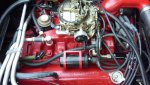
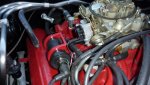
Okay, here's pics. I wish I could drop fonts right on the pics so everything could be labeled. I'll learn that trick someday.

The big 3/8" vacuum port at the carb base is connected to a muli-t. It was stock even when the t-quad was there. Two of the small ports are capped. Of the two remaining, one goes to the diverter valve on the smog pump, the other to the charcoal canister "purge". The 3/8" portion continues on to the pcv valve in the valley pan.

The "spark arrester" gets a 1/2" hose straight to the air cleaner tube.

The distributor gets its vacuum from the lower port on the passenger side front corner. This is the only port which does not have 18 hg vacuum at idle. Which brings me to my next question:
what port does the egr want? Obviously, this being the wrong carb for a stock application makes the manual no help, but it seems to me, the egr wants to operate just like the distributor. I.e. It applies more vacuum as the engine speed goes up. Otherwise, it fully applies at idle and kills the motor.

Getting back to the oil out the dipstick deal, I re-felted the underside of the umbrella (on the dipstick), and so far, this is containing the mess. Not sure if this is really the fix as I have not driven it out on the highway yet. But I welcome any advice.
 

Attachments

  • P1000960.jpg
    P1000960.jpg
    69.7 KB · Views: 1,378
  • P1000961.jpg
    P1000961.jpg
    63.9 KB · Views: 973
Now we can get into a solution! Nice pics, just what we need!

I'm not certain this is the issue, but you do need to verify the vacuum path for the pcv plumbing through the throttle body/carb base gasket/intake manifold plenum and make sure it's unimpeded and the pcv "flow" can access the primary throttle bores at all times.

There were variations in the carb-base/mounting on the spread bore manifolds on the ihc stuff, at least two that I have seen though I have no samples of those here now for verification/pics. And likewise, there are several variations of both the 2v manifold and 4v manifolds used for the "squarebore" flanges (2v flange is 1/2 of a squarebore 4v flange).

Some manifolds had a pressed-in 3/8" nipple fitting for the pcv hose at the rear base of the carb mount that entered directly into the manifold plenum for the crankcase gases to be mixed with the incoming fuel/air charge and be "re-burned". Others did not and plumbed the pcv through the vacuum tree, or some other vacuum port installed in a manifold runner.

If you don't have exactly the correct base gasket between the quadra and the intake manifold, then you are blocking the route of the pcv gases into the manifold plenum. That results in crankcase pressurization and manifests itself in oil leaks through any gasket/seal interface at certain rpm/manifold vacuum levels, along with liquid oil blowout at the dipstick (pressurization of the crankcase).

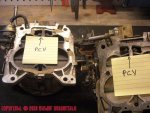
Look at this pic of two oem quadras I have on the bench for build now, see the tiny bleed passage from the pcv inlet plenum to the primary throttle bores??? Those carbs must be mounted with a heat dam gasket (the thick one!) that allows plenty of flow through that area to be able to evacuate the crankcase in sufficient volume above 1500rpm/cruise vacuum.

For the quadrajet carb alone, my reference/catalog shows twenty-four distinctly different heat dam base gaskets, these are quadra-specific for quadra-specific oem intake manifolds! Same items for the thermoquad...only four distinctly different gaskets with no interchangeability with the quadra gaskets.

This same situation can arise with the squarebore intake/carb combos since the edelbrock clones of the carter afb/avs are bastards in the throttle body deign/bore spacing/pcv plumbing area. And some Holley 4v aftermarket carbs will have this issue when mounted to some ihc oem manifolds. This is why the aftermarket carbs are not considered direct replacements for oem stuff. Yes, they will mount, but it takes much knowledge of flow patterns, vacuum paths, etc. To tune the things in and allow the pcv to operate properly.

I have delt with this same issue with my personal Holley 80457 carb mounted on the rpt aluminum intake. I've plumbed the pcv several different ways. Because that manifold pattern is based upon the last gen oem egr casting for the sv motors, and Mike designed it for the performance aspect but still allow it to be an oem replacement, he did not make provisions for the pcv nipple in the rear of the plenum, thus it must be plumbed either into the carb throttle body selected, into a spacer which incorporates a pcv nipple, or a workaround port added for pcv.

I originally plumbed the pcv into the carb throttle body on my setup and that does not allow sufficient vacuum/flow to operate the pcv except at idle since it dumps only into the secondaries which are closed most of the time in cruise mode!! That was not the only issue I had with pcv in general due to the air cleaner setup and some other plumbing I did originally, but over time I've worked all that out though it's not as neat as what I had in the beginning!

The quickfix for your rig right now for verification, install a tee fitting into the manifold runner that feeds your vacuum brake booster and run the pcv hose right there! I've been running that way now for about 5k miles and that did it!

And like I remind folks all the time around here..."they are not all the same"...especially when dealing with the huge variety of carburetion we find either po-induced on this stuff or the incorrect apps obtained off the I-net and egay!

 

Attachments

  • Quadra Throttle Body 001.jpg
    Quadra Throttle Body 001.jpg
    75.4 KB · Views: 1,218
Just a point I want to make. The problem exists under hard acceleration when manifold pressure is high and the pcv flow is very low if not non-existant. During high manifold pressure regimes the flow is mainly out of the two spark arestors and back into the air cleaner housing. I suggest that along with michaels suggestions you also verify that your arrestors are free and clean flowing. The arrestors do get blocked..

How many miles does the engine have on it? What were the piston ring end gaps set to?
 
Thanks, michael. I realize the numerous choices with the q-jet base gaskets. Learned that a few years ago the hard way. Had no idea there were 24!
So what we are trying to do is introduce fresh air into the crank case via the spark arrestor. Then, under certain vacuum conditions, the pcv valve opens and draws the air and fumes back into the intake tract via the 3/8" port in the carb base. Right so far? And what my problem might be is that pressure is building in the crank case and not being properly vented, so pushing its way through the dipstick tube the path of least resistance. And pushes oil out with it.
What is confusing is that both the spark arrestor and the pcv valve are operating in vacuum conditions. It seems that either one should provide the necessary ventilation...
I did put the vacuum gauge on the 3/8" port last night, and it also has over 18hg of vacuum at idle. But I could easily t the pcv into the brake booster. I'll give that a try. There is also a port on the back of the carb that is plugged. It looks like the same 3/8" size as on the front, only threaded.
I am going to take it out on the highway again today and check the results.
 
Robert, the arrestor is not new, but got thoroughly dosed with carb cleaner and as far as I could tell was okay. Still had some springyness to remain open except during a backfire. Pretty sure its okay.
Engine is really new. Less than 100 miles. End gaps were .016 top, .020 2nd. It did seem to have more blow by than what I expected... When the spark arrestor was open to the atmosphere, it blew a fair amount of smoke when I was adjusting the idle. But then, these motors always take forever to seat rings, so I wasn't too panicked. What's your thought?
 
thanks, michael. I realize the numerous choices with the q-jet base gaskets. Learned that a few years ago the hard way. Had no idea there were 24!
So what we are trying to do is introduce fresh air into the crank case via the spark arrestor. Then, under certain vacuum conditions, the pcv valve opens and draws the air and fumes back into the intake tract via the 3/8" port in the carb base. Right so far? And what my problem might be is that pressure is building in the crank case and not being properly vented, so pushing its way through the dipstick tube the path of least resistance. And pushes oil out with it.
What is confusing is that both the spark arrestor and the pcv valve are operating in vacuum conditions. It seems that either one should provide the necessary ventilation...
I did put the vacuum gauge on the 3/8" port last night, and it also has over 18hg of vacuum at idle. But I could easily t the pcv into the brake booster. I'll give that a try. There is also a port on the back of the carb that is plugged. It looks like the same 3/8" size as on the front, only threaded.
I am going to take it out on the highway again today and check the results.

Your analysis of the operation of the pcv system is essentially correct! But...manifold vacuum varies tremendously on a continuous basis due to your brain/foot constantly varying the throttle plate angle with no noticable action on yore part until chp busts yore ass!

Therefore, the "metering" action of the pcv changes constantly also. And ya must have a large volume flow path for the evacuated crankcase vapors to be drawn through into the intake manifold plenum. Otherwise, ya simply end up with either stagnation of flow, reversion of flow, or crankcase pressurization on an intermittent basis.

If you use that alternative vacuum port that is currently plugged, I think you will make the situation much worse as then you will be plumbed into the secondaries only and that is not a good thing!

The main thing to do here is simply remove the carb and analyze the vacuum path for the pcv plumbing vs. The intake manifold mating surface and the gasket ya currently have installed. Once ya stand back and apply common sense, then the corrective action will jump right out and you will then beat yore ass up severely for not seeing it before! I did and I'm supposed to know about this stuff!
 
Copy that. I'll get to it tonight. I was pretty sure on the gaskest, having chased my tail on that problem previously. But double checking is no real deal. Also noticed a fresh puddle of coolant. Looks like the pass side coolant tube. They were both pretty rotten in the head/water pump ends. Yeesh. Almost easier driving it when it was a pile of crap!
Thanks for help. I'll keep you guys posted.
 
Robert, the arrestor is not new, but got thoroughly dosed with carb cleaner and as far as I could tell was okay. Still had some springyness to remain open except during a backfire. Pretty sure its okay.
Engine is really new. Less than 100 miles. End gaps were .016 top, .020 2nd. It did seem to have more blow by than what I expected... When the spark arrestor was open to the atmosphere, it blew a fair amount of smoke when I was adjusting the idle. But then, these motors always take forever to seat rings, so I wasn't too panicked. What's your thought?

If the engine was cold or the oil not fully hot to vaporize condensation, the smoke is most likely steam and not an issue. Now if you could feel a strong blast of blowby from the arrestor that is a different thing.
Both arrestors right? Just clarifying that you said there was one in each cover..
I would not expect to see much idle blow by on a new properly broken in engine(say 2000 miles) after reaching full operating temp. So that is of some concern to me. The idle blow by should settle down a bunch in the next 600 miles.

End gaps are fine. So no worries there.
 
The truck in question ('79) has only one arrestor in the pass. Side cover. My '74 has one in each cover. Is that odd? The manual doesn't show two for '79 apps.

As far as end gaps, that's good news. You had me second guessing myself. But I'll be watching oil consumption the next few thousand miles. The blow-by was definitely not steam.

The ideas mayben has thrown around are intriguing. My '74 has an interesting twist. The spark arrestors are vented to the 3/8" carb port and the pcv vents to the air cleaner. It's never puked oil out the dipstick like this, though its exactly 180 deg wrong way around.

Once I get it smogged, I'll plumb it however it wants...

Keep the ideas coming. I appreciate everyone's help!
 
The spark arrestors are vented to the 3/8" carb port and the pcv vents to the air cleaner. It's never puked oil out the dipstick like this, though its exactly 180 deg wrong way around.

It probably won't puke oil due to the fact that you are sukkin a bunch of air outa the crankcase and most likely pulling a vacuum on the motor. The arrestor is an open hole basically. Are your idle mixture screws out more that 5 turns to get it to run ok?
 
It runs great. A perfect subject. Mixture screws are out 2.5 turns or so. No where near 5. Plugs are nice and tan colored. Don't actually remember doing it this way. Its a truck that gets parked for months at a time, and since it hasn't needed to be smoged since 1995, I really don't fuss over it. Change the oil and wash it once in a while...

I agree with everything you say. But the idle vacuum level entering the air cleaner port is so low it barely moves the needle. Maybe like mayben says it pulls wicked vacuum as you drive. It doesn't seem to be overly powerful at idle...just enough to draw the smoke out I suppose.
 
A 392 I just built was mistakenly hooked up that way and it ran like crap. I could turn the mixture screws out till they fell out and it still idled like sheet. After it was flipped back it ran fine. For a minute I thought the thing had a duff valve till I tried to adjust it out. I unplugged the arrestor and stuck my finger in the hose and it smoothed right out. Wheew.:yikes:

glad your's is running ok.
 
Shit man I just saw you are in monrovia kalifornia, you in the our local IH club!!?? I work in duarte and eat all over monrovia infact a buddy of mine opened a gastro pub called london in old town monrovia.
 
Been there twice! Good brews, but waiting for the menu to expand!

Not a member of any IH club yet. But nothing's stopping me. Drop me the info! Love to commiserate with fellow IH masochists.

I had a similar moment hooking the vacuum advance to constant source the first time I started it. Not so good. A buddy came over and caught it. Blood pressure went down after that.
 
Awesome, Robert. Thanks! The job keeps me out of town thurs-sun most weeks, including next week. But next month might work if its on Thursday.
Thanks again for the invite.
 
Back
Top