Torqueflight 1-2 and 2-3 shift points

hi michael,

thank you for including all the additional information, but I would like the "shift command" feature installed (see post #20).

I'll talk to Jeff about getting a different torque converter.

Ok!

"shift command" enabling is a go!

So the tf-2 install on the valve body is a full monte deal.

I'll get on it.
 
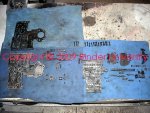
Ok Jesse...here's your fresh valve body in it's disassembled state. The major components are in the soak tank now.

Jeff and I have discussed the big picture here and we have a plan!

This is a "full throttle kickdown" valve body, came from a '76 sii 727 that is in "normal" condition internally, the tranny had no issues at all and is here for a simple rebuild...it belongs to me and is not a customer unit.
 

Attachments

  • Jesse Valve Body Teardown.jpg
    Jesse Valve Body Teardown.jpg
    141.1 KB · Views: 665
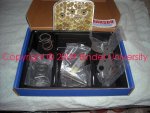
Here's the contents of the transgo tf-2 shift reprogramming kit. There are lots of little parts in those bags!

The filter is a high volume, cleanable brass mesh item.

This kit is the latest version available, packaging is all new. It has a completely revised instruction set, along with some additional mods to perform over what has been done in the past. Remember, this torqueflite app kit was originally developed around 1973!!!

There are many of these kits on the shelf at various wholesale distributor warehouses of the earlier designs...there is nothing at all wrong with using those! They work superbly! But this one was a drop-ship direct to my supplier from transgo last Wednesday and is hot off the press.
 

Attachments

  • Jesse Transgo TF-2.jpg
    Jesse Transgo TF-2.jpg
    110.6 KB · Views: 654
That looks great, thank you michael. When do you think you'll have it back together? I would like to have the truck drivable this week, so if you could finish and send down the valve body, even by overnight delivery, I would appreciate it. I'll pay the difference. After spending all my time and money on getting that engine together, only to have the tranny blow up at nine miles is killing me. All I can do is look at my truck parked in the garage.
 
I had planned to send the valve body down today, but we took down more trees last week, finished the last one yesterday after dealing with the latest storm damage and today all the burnpiles must be lit and tended, it's the last day of the season. So the valve body will ship to ihon late tomorrow, I won't complete it until tonite.

Then Jeff and Darren will have to install it along with some additional parts that go in the transmission itself. As I understand it, the trans is ready for the fresh valve body once it arrives.
 
I'm back. I have almost 900 miles on the new engine/tranny combo and am trying to get the 1-2 and 2-3 upshifts dialed in. While I was breaking everything in I left the throttle pressure on the high side to keep the engine revving and vary engine rpm, but now that everything is getting broken in, I want to set the upshift a little closer to what I want.

Because I went with a quadrajet, I abandoned the factory throttle/kickdown rod in favor of a lokar cable setup. It took a couple of tries, but I eventually fabricated a throttle bracket for the carburetor that would accomodate both the thottle and kickdown cables.

After fabricating and installing the bracket, and then installing the throttle and kickdown cables, the 1-2 upshift was way too high, right around 42 mph on hard (but not opening the four barrels hard) acceleration. I remembered that for the stock linkage you want to shorten the throttle/kickdown rod for sooner upshifts, but with the lokar setup I figured you needed to do the opposite. (page 42 of munroe "when governor pressure overcomes throttle pressure, the transmission will upshift.") so if I lengthen the lokar cable, this means that throttle pressure will be reduced at a given throttle position and governor pressure will more easily overcome throttle pressure...leading to sooner shifts.

So this has worked out. The more I lengthen the cable (by moving the lokar collar further up the cable), the sooner my upshift. However, the problem is that I am having to move the collar so far up the cable that it would appear the transmission is operating without throttle pressure during most of my around the town driving.

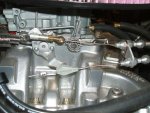
I have attached a picture showing what I mean. The throttle cable is on the top, the kickdown cable on the bottom.

Notice that there is about one inch of travel before the plastic slip sleeve with "lokar" written on it hits the cable collar with the set screw in it. As I give the truck more and more gas, the plastic slip sleeve moves closer and closer to the collar. Once the sleeve hits the collar, and I give the truck more gas, the cable is pulled and the throttle lever is pulled toward the rear of the truck, thereby increasing throttle pressure. (note: when this picture was taken, I manually pulled the cable forward until I encountered spring resistance from the throttle lever. The throttle lever on the tranny appears to have about 1 to 1 1/2 inches of, for lack of a better term, "slop" within which you can move the throttle lever back and forth by pulling on the cable with no spring resistance. I can pull hard on the cable and move the throttle lever further back toward the rear of the truck, but as I let the cable go, the spring in the throttle lever pulls the lever back to the resting position where I took the picture.)

after all of that background, my question is this: is it acceptable to run the tranny with so much gap in the throttle linkage (I.e. Little to no throttle pressure at lower rpms)? I've also read the running a tranny without the throttle rod hooked up can destroy a tranny. Should I move the hole up in the throttle bracket to reduce the arc that the throttle linkage has to travel, which will allow throttle pressure to come on more slowly. Right now, because the hole is so low in the throttle bracket, my throttle pressure comes on very quick.

I hope this makes sense.

 

Attachments

  • throttle linkage 002.jpg
    throttle linkage 002.jpg
    82.1 KB · Views: 1,663
Jesse and company this might be of no help, but the stock setup that uses the bar to connect to the carb has a slot in it. Could this be similar to the slack you see in your cable?

Edit.. Just read through the 727 guapo thread and mm setup has about a 1/4" of gap
 
Last edited:
Jesse and company this might be of no help, but the stock setup that uses the bar to connect to the carb has a slot in it. Could this be similar to the slack you see in your cable?

Edit.. Just read through the 727 guapo thread and mm setup has about a 1/4" of gap

Hi Craig,

the slot in the factory setup is generally toward the back, so it is not quite the same thing. I did read mm's post, and I saw the 1/4 inch, but my question is whether or not 1 full inch is too much. Since posting the question above, I have since moved the kickdown link further up the throttle bracket, so now there is about 1/4 inch of slop before the kickdown engages, but I am still curious to see what mm says. I think he is at the Binder Bee and will be back in a day or two. Thanks,
 
We're trying to get back in the groove here Jesse...this is a busman's holiday vacation for all of us still after Binder Bee, so it'll take a few more days to catch up!

Really nice job on the lokar cable setup! That system is outstanding in conception and very flexible in it's mounting and tunability.

The simple thing to remember about the "kickdown" deal is...in it's original design (whether mopar, IH or amc application), the throttle pressure control is coordinated with throttle plate angle. That is a simple workout when developed back in the 50's that that did not involve the use of any computer, transducers, sensory inputs, etc., just a simple mechanical linkage...no electricity or vacuum!

Throttle plate angle in this case is a mechanical device that provides input for a crude indication of vehicle "load" that the engine sees as vehicle dynamics constantly change.

The leverage of the throttle pressure control (or kickdown lever as we commonly refer to it) is directly tied to the throttle plate angle. That is why with the stock system, the sliding link is anchored at the same pivot point as the throttle cable in relation to the throttle arm (which controls throttle plate angle when in motion). Make sense??

Any difference between the two components as concerning where the pivot point is, changes the relationship away from oem design specs. So...the lokar cable attachment point needs to be at exactly the same point as the throttle cable in order to keep the systems "coordinated" when tuning/adjusting. And the two cables need to be kept as close to parallel as possible throughout their range of motion from curb idle through wot so that the linear relationship is maintained through the range of motion fore and aft.

With the throttle pressure control linkage completely disconnected from control lever on the trans, the arm can move approximately 1/4>1/2" before the throttle pressure valve moves at all in it's bore in the valve body. Thus the "slop" that is present in the oem design. Then...at wot, the pressure control is not held hard against it's internal stop...that prevents abnormal pressure from being applied against the unsupported shaft seal creating fluid leakage.

For the best "relationship" between throttle pressure control movement being initiated, we create a slight amount of slop that allows for misalignment and any engine movement last the engine torques or moves around in it's support system. And the lokar cable provides a much more precise interaction since it eliminates all that inherent slop in the oem system.

As for final adjustment, simply make certain that the throttle cable setup allows full range of motion from curb idle to wot without placing undue strain on the throttle arm, throttle cable, or throttle pedal system. Only then can you make the lokar setup connection. And final adjustment of the lokar cable should allow say 1/8" minimum movement of the throttle arm before transferring movement to the throttle pressure lever on the trans...but also provides the lever to be in "max pressure" position at wot without being held hard against it's internal stop.

Setting up this linkage does not require a inordinate amount of fabrication, but it does require some planning and ingenuity! Keep in mind, this cable system was designed only for the mopar setup originally, which in many cases uses a few bellcranks and a whole lotta wasted monkey-motion. And...the mopar setup is somewhat different from the IH version...including access to the various mounting points for the anchors, etc. In a Scout II app.

And all this stuff is also encountered when performing carb swaps away from oem setups, though setting up nice throttle cable connections for popular carb swaps is a bit easier. And this includes a FI throttle body which uses a throttle lever/butterfly setup same as a carb...no different other than you are adding a tps into the mix. And I say that from the standpoint of someone who does this quite often and has on hand all kinds of bits and pieces to make this stuff work without being a dangerous juryrig! And I'm fortunate to have local supplies of hardware items that many of ya don't have in a convenient form. My stash of "stuff" has been gathered over many years and is not something I can replicate with a quick trip to the hardware store...and I've bought tons of stuff that I thought would work but didn't!

By the way...that transgo-modded valve body is expecting to see a close-to-oem throttle pressure actuation scenario in order to function as designed! So the "adjustment" procedure for the linkage is no different than a stocker. And...all those "specs" we discussed before that are lifted from the IH service references are predicated on "stock" tire rolling diameter and final drive ratios. You will not be able to exactly replicate those specs, but what you will be able to do is "change" the upshift points slightly in order to meet your own criteria, but there is no way the throttle pressure control is infinitely adjustable like say some sort of "regulator" would be.

Screwing around with variable valves in the governor is simply not practical onna trans where the governor is so inaccessible! If...it was set up onna tranny dyno and countless hours were spent in modding various governor assemblies, ya might be able to come up with the perfect transmission tune for your rig...that's simply not practical!
 
Jesse,
I just replaced the tq on my '79 w/345 727 with a quadrajet, and my throttle cable broke and I am considering the lokar throttle cable and kickdown cable set ups. I found this searching, and I am wondering if you left your set up as it was or have you modified it? If it was left as was, how has it worked out? If you modified your set-up, could you update with pics? I would appreciate any help/advice you could give.
Thanks, Nevada
 
Hi Nevada,

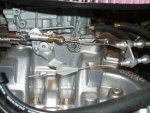
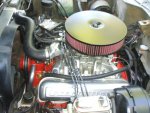
I've attached a couple pics. Two show the setup with the quadrajet, one shows the current set up. Sorry for the quality of the photo in the last pic, I shot it this morning and it came out way over exposed. Anyway, to make the lokar cable work you May have to make a bracket that swings below the throttle plate rod. The idea is that when your throttle cable pulls the throttle back, it pulls the kickdown cable forward. I had to make the one for my quadrajet. It is a little tricky to get the ratio correct. I have since gone to fuel injection. Hope this helps.
 

Attachments

  • throttle linkage 002.jpg
    throttle linkage 002.jpg
    71.3 KB · Views: 2,385
  • engine 4.jpg
    engine 4.jpg
    75.5 KB · Views: 615
  • linkage2.jpg
    linkage2.jpg
    69.9 KB · Views: 511
Back
Top